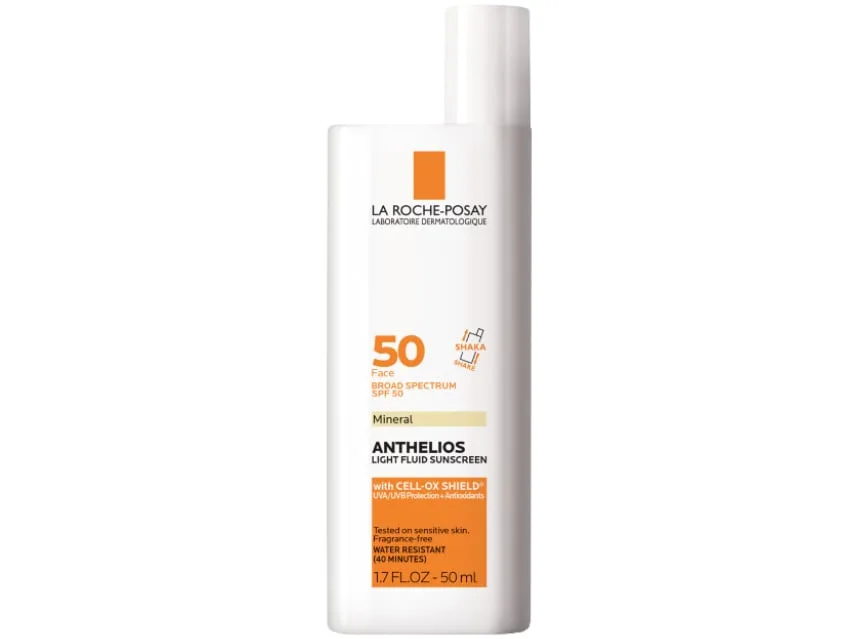
Mineral-only sunscreens at this price point traditionally delivered either cosmetic elegance or broad-spectrum protection, rarely both. This fluid leans on La Roche-Posay's micronized titanium dioxide and zinc oxide in a silicone-and-alkane base that behaves cosmetically much like a chemical fluid while delivering full mineral tolerance — making it one of the few fragrance-free mineral SPF options that's viable for daily makeup layering.
One of the most wearable mineral-only daily sunscreens in the US market, and a go-to dermatology office recommendation for post-procedure and reactive skin. Micronized titanium and zinc in a silicone-alkane base that spreads like a chemical fluid and sets to a makeup-friendly matte. Priced at the premium end for 1.7 oz, but earns it on tolerance and texture.
Good choicefor SensitivityIn your profileYou chose · No fragrance, drying alcohol, declarable allergens or sensitising preservatives in this serum — the profile sensitive skin looks for.Not yet assessedGentleNo reviews collected yet
The case for it
Titanium Dioxide + Zinc Oxide has no evidence row yet for this concern — it is in the research queue.
The formula carries none of the triggers this concern is sensitive to.
What would change this: A researched evidence row for the lead active would replace this with a verdict.
Same rule for everyone. “Good choice” is the verdict on 1,938 of 45,024 concern verdicts across the catalog; rule F2 decided 1,938 of them.
Unchanged since September 5, 2026, engine 5.1.1.
Supporting rolefor RosaceaIn your profileYou chose · Nothing here targets rosacea directly; photoprotection against a known trigger is the recognised companion to treating it, and this serum does that without known triggers.Not yet assessedGentleNo reviews collected yet
The case for it
Titanium Dioxide + Zinc Oxide has no evidence row yet for this concern — it is in the research queue.
The formula carries none of the triggers this concern is sensitive to.
What would change this: A researched evidence row for the lead active would replace this with a verdict.
Same rule for everyone. “Supporting role” is the verdict on 8,197 of 45,024 concern verdicts across the catalog; rule R8 decided 4,250 of them.
Unchanged since September 5, 2026, engine 5.1.1.
R8 — The category's job (barrier care, humectant hydration, gentle cleansing, photoprotection) is the documented supportive role for this concern. This is the honest verdict for a moisturizer on an acne page. · the full register
Full protectionfor Post-ProcedureIn your profileYou chose · Broad-spectrum SPF 40 with titanium dioxide, zinc oxide: the protection post procedure calls for.Not yet assessedGentleNo reviews collected yet
The case for it
Titanium Dioxide + Zinc Oxide has no evidence row yet for this concern — it is in the research queue.
The formula carries none of the triggers this concern is sensitive to.
What would change this: A researched evidence row for the lead active would replace this with a verdict.
Same rule for everyone. “Full protection” is the verdict on 2,288 of 45,024 concern verdicts across the catalog; rule P1 decided 2,232 of them.
Unchanged since September 5, 2026, engine 5.1.1.
P1 — Photoprotection standing is regulatory (M020 / Annex VI filters; 21 CFR 201.327 attaches the early-skin-aging claim to tested broad-spectrum SPF 15+). SPF 30 is the AAD daily-use bar. · the full register
Full protectionfor Sun DamageIn your profileYou chose · Broad-spectrum SPF 40 with titanium dioxide, zinc oxide: the protection sun damage calls for.Moderate evidenceGentleNo reviews collected yet
The case for it
Titanium Dioxide + Zinc Oxide is a first-line active — approved, monograph-listed or named in current guidelines — for this concern.
It is present at an effective concentration, declared or high in the ingredient list.
The formula carries none of the triggers this concern is sensitive to.
Same rule for everyone. “Full protection” is the verdict on 2,288 of 45,024 concern verdicts across the catalog; rule P1 decided 2,232 of them.
Unchanged since September 5, 2026, engine 5.1.1.
P1 — Photoprotection standing is regulatory (M020 / Annex VI filters; 21 CFR 201.327 attaches the early-skin-aging claim to tested broad-spectrum SPF 15+). SPF 30 is the AAD daily-use bar. · the full register
Also listed for Compromised Skin Barrier — the actives here (Zinc Oxide, Antioxidants, Vitamin E, Cassia Alata (Senna Alata) are in our research queue for that concern; there is no verdict until their evidence rows are written. That is a gap in our table, not a mark against the product.
Does the jobDoes what a sunscreen is for: UVA coverage, kind to the skin wearing it. Not measured from the label: pleasant enough to actually use.
A verdict is DermApproved’s assessment of how well a product’s ingredients fit a concern — never a claim about what the product treats. Evidence dots and collected reviews sit beside it and are never blended in.
Rules 0.5.1 · evidence table ev-2026.09-r228 · how we decide
Assessment
Pros & Cons
Pros
✓ Pure mineral filter system suitable for post-procedure and severely reactive skin
✓ Silicone-alkane base spreads more like a chemical fluid than traditional mineral
✓ Minimal white cast on fair to medium skin tones
✓ Fragrance-free, alcohol-free, and very well tolerated by rosacea-prone skin
✓ Sets to a satin-matte finish that layers cleanly under makeup
✓ Pregnancy-safe and widely recommended for post-procedure recovery
✗ Visible white cast on deep skin tones despite micronization
✗ SPF 40 rating is lower than competitive options at SPF 50
✗ Price is steep at $35 for 1.7 oz
✗ Can pill if layered too quickly over heavy moisturizer or under makeup
✗ Not water-resistant enough for beach, pool, or heavy sweat activities
Review
Full Review
There's a specific patient who walks into a dermatology office in search of a sunscreen recommendation, and this Anthelios Ultra-Light Fluid SPF 40 is the answer for most of them. They might be recovering from a laser treatment or a chemical peel and under strict instructions to avoid chemical filters. They might have rosacea that flares from octocrylene or homosalate. They might be pregnant and taking no chances with systemic absorption of anything. They might simply have reactive skin that has burned out three other sunscreens in the past year. For all of these cases, the answer has traditionally been 'use a mineral sunscreen' — followed by the grim tour of mineral SPF options, most of which either ghosted the face white or felt like applying spackle. This fluid is one of the few products in the category that solves the cosmetic elegance problem without compromising the tolerance profile.
The filter system is the traditional mineral duo of titanium dioxide and zinc oxide, both micronized for better spread and reduced cast. Titanium handles UVB and short UVA through reflection and scattering; zinc extends protection into the longer UVA wavelengths including UVA1 — which is what you want for melasma, photoaging, and hormonal pigmentation.
Why those filters matter for this particular patient is worth spelling out, because it is not a matter of 'natural is gentler.' Mineral filters sit on the skin surface and work by reflection and scattering rather than by absorbing UV into their molecular structure. They work the instant they are applied, they do not photodegrade meaningfully, and — critically — they do not penetrate into the stratum corneum the way smaller organic filter molecules do. When a laser or a peel has disrupted that barrier, chemical filters can travel further than they would on intact skin and irritate the epidermis underneath. That is the entire clinical argument, and it is a real one.
The formulation pairs the minerals with a silicone-and-alkane base — dimethicone, isododecane, undecane, C12-15 alkyl benzoate, isohexadecane — engineered to disperse the mineral particles evenly across the skin. The unglamorous supporting cast is where the elegance actually comes from: polyhydroxystearic acid and disteardimonium hectorite keep the pigments from clumping, alumina and triethoxycaprylylsilane coat the particles so they behave, and nylon-12, silica and talc deliver the soft-focus matte dry-down. The result, on application, is something far closer to a chemical fluid than to a traditional mineral lotion. It spreads thin, sinks in fast, and sets to a satin-matte finish within about a minute.
White cast is minimal on fair through medium skin tones. On deeper tones there is still a faint cast — not catastrophic, but noticeable, and honesty requires saying so plainly. This is a physics limitation, not a formulation failure: zinc and titanium are white powders, and no amount of base engineering fully solves that on the deepest skin. For those tones, the chemical-filter options in the same Anthelios line are the better cosmetic match.
What this fluid does phenomenally well is tolerate abused skin. Post-laser, post-peel, post-microneedling, the silicone base soothes rather than stings, and the fragrance-free, alcohol-free formula removes the usual triggers. Rosacea tends to stay calmer under mineral SPF than chemical, and this fluid is light enough that it does not create the occlusive heat-trap that can worsen a flush in the first place. The Cell-Ox Shield complex — tocopherol, cassia alata, and Oxynex ST — adds free-radical defense against the oxidative damage that slips past any filter, which matters more for photoaging and pigmentation than most people appreciate. No sunscreen stops every photon; the radicals generated by what gets through are a real part of the aging cascade, and mopping them up is the second half of proper photoprotection.
The SPF 40 rating rather than 50 will bother buyers who instinctively equate bigger numbers with better protection. The real-world difference is small: SPF 40 blocks roughly 97.5% of UVB, SPF 50 about 98%. What matters vastly more is dose. Most people apply about half the recommended amount, which collapses real-world protection far below the label in either case. At a proper two-finger-length application, this is plenty of UVB protection for a daily driver — and the SPF 40 rating is essentially the cost of the texture, because pushing mineral filters higher means pushing either cast or heaviness past what anyone will actually wear.
The technique deserves a note too. Shake the tube — mineral fluids separate slightly in storage. Press it in with flat palms rather than rubbing, because aggressive rubbing makes mineral fluids ball up. Then wait a full sixty to ninety seconds before makeup. Pilling, the single most common complaint about this product, is almost always a pacing error rather than a formula defect.
The genuine complaints are worth naming. Thirty-five dollars for 1.7 ounces is steep — roughly twenty dollars an ounce, and a tube lasts six to eight weeks at a proper dose. The cast on deep skin is real. And this is not water-resistant enough to be your beach or sport sunscreen; for swimming or heavy sweat, buy something purpose-built. It is also not fungal-acne-safe.
Where this sunscreen earns its recommendation is precisely where it was designed to: as the default daily mineral driver for the people who genuinely need one. Reactive rosacea, post-procedure recovery, severe sensitivity, pregnancy, or a considered personal preference for physical filters. Within that scope it is one of the best-balanced options on the US market, and the research apparatus behind the Anthelios franchise gives it more credibility than most competing mineral fluids can claim.
One last correction, because it drives a lot of unnecessary spending: mineral is not automatically better for 'sensitive skin.' It is better for compromised skin — post-procedure, actively flaring — where barrier penetration is the concern. For ordinary everyday sensitivity, a well-formulated chemical sunscreen is frequently just as well tolerated and considerably more elegant on deeper skin. Choose the filter for the situation, not for the marketing.
Formula
Key Ingredients
The hero actives that drive this product's performance.
This is La Roche-Posay's micronized mineral filter duo — titanium dioxide handles the UVB and short-UVA range while zinc oxide extends UVA coverage across the longer wavelengths, including UVA1. Together they deliver broad-spectrum SPF 40 protection through pure reflection and scattering rather than absorption, which is what makes the formula suitable for very reactive, rosacea-prone, or post-procedure skin that can't tolerate chemical filters.
Regulator-approvedfor Sun Damage · limited certainty
Oxynex ST is a photostability booster and antioxidant from L'Oréal's research labs. In a mineral formula like this one, it functions primarily as an antioxidant defender against UV-induced free radicals rather than as a filter stabilizer, reinforcing the Cell-Ox Shield complex's environmental-damage defense.
Tocopherol is a well-studied antioxidant that neutralizes UV-induced free radicals that penetrate past the mineral filters. It's a core part of the Cell-Ox Shield complex and adds oxidative defense against environmental stressors beyond just UV.
Cassia alata is La Roche-Posay's proprietary antioxidant in the Cell-Ox Shield complex, aimed at supplementary free-radical defense particularly against infrared and visible light. The evidence base is thinner than for vitamin E, but it rounds out the antioxidant support.
Not yet assessed
Ingredient standings describe the active at treatment-level doses and
vehicles; this product's own condition grades weigh its actual formula.
Save this for the last step of morning skincare. Dispense a generous pump to ensure a full two-finger-length dose for face and neck. Shake well before use — mineral fluids separate slightly in the bottle. Let settle for 60-90 seconds before applying makeup.
Results Timeline
UV protection is immediate upon application at the labeled SPF 40 level. This is a protective product, not a treatment — benefits like preventing further photodamage and reducing UV-triggered pigmentation are cumulative over months of consistent daily use.
La Roche-Posay Anthelios Ultra-Light Fluid Face Sunscreen SPF 40
Sample PM Routine
Gentle cleanser
Retinol or treatment
Moisturizer
Evidence
Science & Expert Perspective
The Science
The clinical case for mineral sunscreens in general — and this formulation specifically — rests on the distinct mechanism of physical filters compared to chemical filters. Titanium dioxide and zinc oxide block UV through reflection, scattering, and absorption at the particle surface, rather than by absorbing UV into their molecular structure and converting it to heat the way avobenzone, octocrylene, and other organic filters do. The practical consequences: mineral filters work the instant they're applied (no 15-20 minute activation window), they don't photodegrade meaningfully under sunlight, and they don't penetrate into the stratum corneum to the same extent as smaller organic filter molecules. That last point is the reason dermatologists consistently recommend mineral filters for post-procedure and compromised-barrier skin — when the barrier is disrupted by a laser, peel, or microneedling session, chemical filters can penetrate further than they would on intact skin and irritate the underlying epidermis. Zinc oxide specifically is one of the broadest-spectrum single filters available anywhere in the world, covering UVB through long-wavelength UVA1, which makes it particularly valuable for melasma and photoaging since UVA1 is the wavelength range most strongly implicated in pigmentation and dermal damage. Titanium dioxide complements this coverage on the shorter-wavelength side. The micronization process used in this formula reduces particle size to improve optical properties (less visible white cast) and skin feel, while the silicone and alkane base further improves dispersion so that the mineral particles form a more uniform film across the skin surface rather than clumping. The Cell-Ox Shield antioxidant complex (tocopherol, cassia alata leaf extract, diethylhexyl syringylidenemalonate) adds supplementary defense against reactive oxygen species generated by UV that penetrates past the filters, which is consistent with the dermatology literature on photoaging: UV generates ROS, ROS damage collagen and cellular DNA, and antioxidant support meaningfully reduces that downstream damage. The combination of physical UV blockade plus antioxidant free-radical scavenging is the current best-practice approach to comprehensive photoprotection.
Dermatologist Perspective
Dermatologists routinely recommend 100% mineral sunscreens for post-procedure recovery, and the Anthelios Mineral Fluid line has been a default recommendation in dermatology practices for the better part of a decade. In clinical practice, after lasers, chemical peels, or microneedling, the compromised stratum corneum can't reliably prevent chemical filter penetration, and mineral filters are the only safe option until the barrier has fully recovered. This fluid is also commonly recommended for active rosacea flares, post-inflammatory sensitive-skin phases after acne treatment, and pregnancy routines where patients want to minimize systemic absorption of any ingredients. The formulation's silicone-and-alkane base makes it cosmetically viable as a daily driver rather than a post-procedure-only product, which improves long-term compliance for patients with chronic reactive conditions. Dermatologists generally prefer the mineral option for patients with a history of contact dermatitis or known reactions to chemical filters, even when the patient isn't currently in a post-procedure window.
Guidance
Usage & Recommendations
How to Use
Shake the tube gently before use — mineral fluids can separate slightly during storage. Apply a full two-finger-length dose as the final step of your morning skincare routine after serums and moisturizer. Press into skin with flat palms rather than rubbing; aggressive rubbing can cause mineral fluids to ball up. Wait a full 60-90 seconds for the fluid to settle before applying makeup or any additional product. Reapply every two hours during direct sun exposure and immediately after sweating or towel-drying. For post-procedure use, follow your dermatologist's specific guidance on when to begin reapplication after treatment.
Value Assessment
At around $35 for 1.7 oz, this sits at about $20 per ounce — expensive for a mineral sunscreen, but not unreasonable for a dermatology-brand daily driver with the tolerance profile and texture quality this delivers. The premium becomes more defensible when the alternative is a cheaper mineral sunscreen that white-casts, feels heavy, or triggers the exact rosacea flares you're trying to protect against. For users who specifically need a mineral-only formula — post-procedure, reactive, pregnancy — the math is easy to justify. For users who tolerate chemical filters and don't specifically need mineral, cheaper options will save money, and La Roche-Posay's own UV Tone and UV Clear chemical SKUs in the same line are arguably better values on a per-benefit basis.
Who Should Buy
Anyone with post-procedure recovering skin, active rosacea, severe reactive sensitivity, or a specific preference for 100% mineral sun protection. A strong daily driver for pregnant users and nursing parents who want to minimize systemic absorption. Particularly valuable for patients on long-term dermatologist-supervised treatment who need a non-irritating SPF that plays nicely with prescription routines.
Who Should Skip
Skip if your skin tone is deep enough that a faint mineral cast is unacceptable — the chemical Anthelios UV Tone or UV Clear will serve you better cosmetically. Skip if you need water-resistant SPF for beach, pool, or heavy sweat activities. Skip if you tolerate chemical sunscreens well and can get comparable tolerance at a lower price from drugstore options.
Ready to try La Roche-Posay Anthelios Ultra-Light Fluid Face Sunscreen SPF 40?
Fluid, milky-light texture that spreads like a thin lotion and sets quickly.
Scent
Fragrance-free.
Packaging
Squeeze tube with narrow applicator tip for dose control.
Finish
mattenon-greasylightweight
What to Expect on First Use
First application is surprisingly light for a mineral formula — the micronized titanium and zinc combined with the silicone-and-alkane base spread far more like a chemical fluid than traditional mineral lotions. Minimal white cast during application on fair to medium skin tones; a faint cast may be visible on deeper tones. Sets to a satin-matte finish within 60-90 seconds.
How Long It Lasts
About 6-8 weeks of daily face use at a proper two-finger dose.
The Anthelios Mineral Fluid has been a dermatology-office staple for post-procedure recovery since the mid-2010s, but the formulation was refreshed as part of the 2024 Anthelios UV line relaunch to align cosmetically with the chemical-filter SKUs. This iteration is specifically designed for patients who can't tolerate chemical filters — rosacea, reactive skin, post-laser, post-peel — but still want a wearable daily option that doesn't white-cast severely or fight with makeup.
About La Roche-Posay Legacy Brand (20+ years)
La Roche-Posay was founded in 1975 and the Anthelios sunscreen franchise is one of the most clinically-studied photoprotection lines in dermatology, with decades of research behind its mineral and chemical filter systems.
Brand founded: 1975 · Product launched: 2024
Myth vs. Reality
Common Myths
Myth
Mineral sunscreens are always better for sensitive skin than chemical ones.
Reality
Mineral filters are generally better tolerated by very reactive or compromised skin because they don't absorb into the skin, but 'sensitive skin' is a spectrum. A well-formulated chemical sunscreen like Anthelios UV Clear is often equally well-tolerated and more cosmetically elegant. Mineral is the right call for post-procedure and active rosacea; chemical is often fine for everyday sensitive skin.
Myth
SPF 40 is significantly worse than SPF 50.
Reality
SPF 40 blocks about 97.5% of UVB; SPF 50 blocks about 98%. The difference is small and mostly matters at the margins of real-world under-application. What matters far more than the rating difference is whether you apply enough product and reapply on schedule — a well-applied SPF 40 outperforms a skimpily-applied SPF 50 every time.
FAQ
Frequently Asked Questions
Is this sunscreen mineral or chemical?
This is a 100% mineral sunscreen. The active ingredients are titanium dioxide and zinc oxide, which block UV through reflection and scattering rather than chemical absorption. That makes it suitable for very reactive skin, post-procedure recovery, and users who specifically avoid chemical filters like avobenzone or octocrylene.
Does this mineral sunscreen leave a white cast?
Minimal on fair to medium skin tones thanks to the micronized titanium and zinc plus the silicone-and-alkane base. On deeper skin tones, a faint cast may be visible — not as severe as traditional zinc-heavy mineral sunscreens, but not completely invisible. For deep skin tones, consider Anthelios UV Tone or UV Clear instead, which are chemical-only and have zero cast.
Why is this SPF 40 instead of SPF 50?
SPF 40 still blocks about 97.5% of UVB rays, only marginally less than SPF 50's 98%. The more meaningful protection difference at this tier is how much product you apply and how often you reapply, not the rating number. For daily driver use in non-beach contexts, SPF 40 is fully adequate protection.
Can I use this after a chemical peel or laser treatment?
Yes — this is one of the sunscreens most commonly recommended by dermatologists for post-procedure recovery. The mineral filter system doesn't absorb into compromised skin, the formula is fragrance-free and contains no irritating alcohols, and the silicone base is soothing on recently-treated skin. Wait until initial healing is complete before applying, and follow your dermatologist's specific timing guidance.
Is this sunscreen safe during pregnancy?
Yes. Mineral filters (titanium dioxide and zinc oxide) are widely considered the safest SPF option during pregnancy and nursing because they don't absorb systemically. This is a strong pick for pregnancy-era routines, especially for patients managing melasma or pregnancy-induced rosacea where daily SPF compliance is critical.
Can I wear makeup over this?
Yes, though with a small caveat. Let the sunscreen settle for a full 60-90 seconds before applying makeup, and press foundation in rather than rubbing — mineral fluids can ball up or pill if layered too quickly over a heavy moisturizer or rushed under foundation. Once settled, it sets to a matte finish that holds makeup cleanly through the day.
How does this compare to Anthelios UV Tone and UV Clear?
UV Tone and UV Clear are chemical formulas (avobenzone-based) with niacinamide or azelaic acid added for tone-evening and breakout support. This mineral fluid is the option for users who can't use chemical filters — post-procedure, severe reactive skin, or personal preference. The chemical SKUs are cosmetically more elegant on deep skin tones; this mineral is the better tolerance pick for compromised or recovering skin.
Reviews
What Reviewers Tend to Say
Recurring themes our editors read across retailer reviews of this product — summaries in our words, not quotations, and not a substitute for your own patch test.
Common Praise
Minimal to no white cast despite being mineral
Lightweight non-greasy finish
Doesn't sting sensitive or post-procedure skin
Sets to a matte finish that's makeup-friendly
Fragrance-free and gentle
Common Complaints
Visible cast on the deepest skin tones despite micronization
Price high for 1.7 oz
SPF 40 feels lower than competitive options at SPF 50
Can pill if layered too quickly over heavy moisturizer
Notable Endorsements
Widely recommended by dermatologists for post-procedure recovery after lasers, peels, and microneedling where chemical filters are off-limits
Nobody abandons a skincare routine because they didn't understand it. They abandon it because it had too many steps — and there's a randomised trial that puts a number on exactly how much that costs.
The famous 15/1/0.5 trio isn't marketing folklore — it traces to a specific Duke experiment. But 'the studied combination' and 'any serum with all three names on the label' are not the same thing.
IPL is a filtered flashlamp, a true vascular laser is one wavelength aimed at haemoglobin, and the choice between them turns on a distinction almost no consult makes: whether your redness is vessels or a state.
The smallest AHA gets deepest and shows results soonest — which is precisely why routines built around it overshoot, and why the people who do best with it use it least.
Jul 30, 2026· 7 min
Questions people ask about sensitive skin
Verified answers from our questions library — the nuance a product page cannot carry.
Products, answers, therapy guides, tools and articles in one search. Brand names,
slang and abbreviations all work — accutane finds isotretinoin, bacne finds truncal acne.