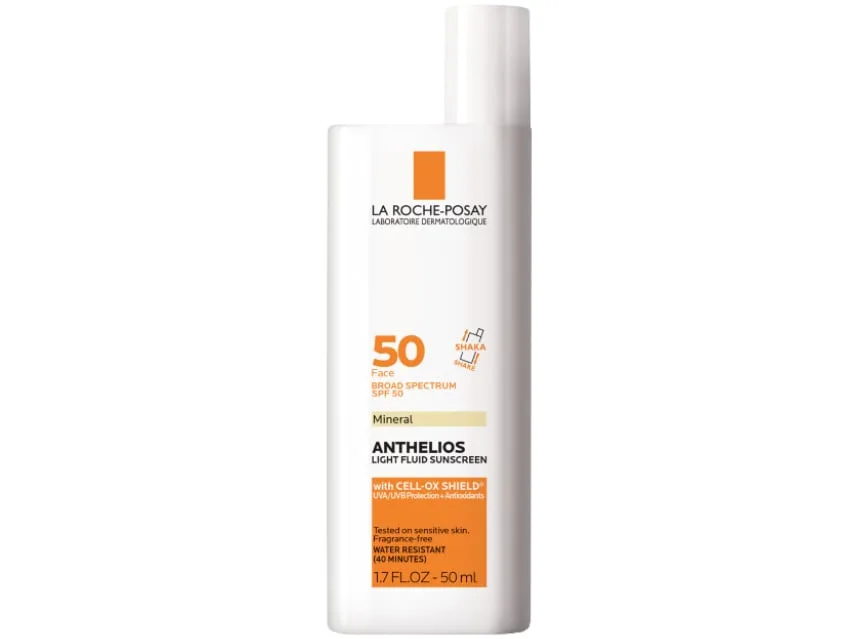
This is what happens when a brand with 50 years of sunscreen expertise applies cutting-edge dispersion technology to mineral filters. Traditional zinc oxide and titanium dioxide sunscreens are notorious for chalky texture and white cast — La Roche-Posay's fluid technology disperses the mineral particles so finely that the formula applies like a lightweight serum rather than a thick paste. The result is a 100% mineral sunscreen that actually behaves like an elegant daily product.
La Roche-Posay's answer to the mineral sunscreen texture problem — a 100% mineral SPF 50 that applies like a lightweight fluid rather than a thick paste. Ideal for sensitive and post-procedure skin that needs reliable UV protection without chemical filter irritation. White cast remains a concern for darker skin tones, and the price is premium, but the formulation elegance is genuinely impressive for mineral protection.
Good choicefor SensitivityIn your profileYou chose · No fragrance, drying alcohol, declarable allergens or sensitising preservatives in this lotion — the profile sensitive skin looks for.Not yet assessedGentle250 reviews collected
The case for it
Titanium Dioxide has no evidence row yet for this concern — it is in the research queue.
The formula carries none of the triggers this concern is sensitive to.
What would change this: A researched evidence row for the lead active would replace this with a verdict.
Same rule for everyone. “Good choice” is the verdict on 1,938 of 45,024 concern verdicts across the catalog; rule F2 decided 1,938 of them.
Unchanged since September 5, 2026, engine 5.1.1.
Supporting rolefor RosaceaIn your profileYou chose · Nothing here targets rosacea directly; photoprotection against a known trigger is the recognised companion to treating it, and this lotion does that without known triggers.Not yet assessedGentle250 reviews collected
The case for it
Titanium Dioxide has no evidence row yet for this concern — it is in the research queue.
The formula carries none of the triggers this concern is sensitive to.
What would change this: A researched evidence row for the lead active would replace this with a verdict.
Same rule for everyone. “Supporting role” is the verdict on 8,197 of 45,024 concern verdicts across the catalog; rule R8 decided 4,250 of them.
Unchanged since September 5, 2026, engine 5.1.1.
R8 — The category's job (barrier care, humectant hydration, gentle cleansing, photoprotection) is the documented supportive role for this concern. This is the honest verdict for a moisturizer on an acne page. · the full register
Full protectionfor Sun DamageIn your profileYou chose · Broad-spectrum SPF 50 with titanium dioxide, zinc oxide: the protection sun damage calls for.Moderate evidenceGentle250 reviews collected
The case for it
Titanium Dioxide is a first-line active — approved, monograph-listed or named in current guidelines — for this concern.
It is present at an effective concentration, declared or high in the ingredient list.
The formula carries none of the triggers this concern is sensitive to.
Same rule for everyone. “Full protection” is the verdict on 2,288 of 45,024 concern verdicts across the catalog; rule P1 decided 2,232 of them.
Unchanged since September 5, 2026, engine 5.1.1.
P1 — Photoprotection standing is regulatory (M020 / Annex VI filters; 21 CFR 201.327 attaches the early-skin-aging claim to tested broad-spectrum SPF 15+). SPF 30 is the AAD daily-use bar. · the full register
Carrying active
Titanium Dioxide
Standing
first line — a regulator recognises it for this use; trials support it · per § 352.10 Sunscreen active ingredients. (U.S. Food and Drug Administration — 21 CFR Part 352 (Sunscreen Drug Products for Over-the-Counter Human Use), Code of Federal Regulations via GovInfo), opened July 27, 2026
Form
adequate (declared 6%) — studied range up to 25%, from the OTC monograph or label; needs leave-on contact
Tolerability
gentle
Row checked
against its sources on July 27, 2026 (evidence table ev-2026.09-r228)
21 CFR 352.10 — Sunscreen active ingredients — US Food and Drug Administration / Electronic Code of Federal Regulations (retrieved 2026-07-16; note stayed effective date), opened July 16, 2026
Full protectionfor Post-ProcedureIn your profileYou chose · Broad-spectrum SPF 50 with titanium dioxide, zinc oxide: the protection post procedure calls for.Not yet assessedGentle250 reviews collected
The case for it
Titanium Dioxide has no evidence row yet for this concern — it is in the research queue.
The formula carries none of the triggers this concern is sensitive to.
What would change this: A researched evidence row for the lead active would replace this with a verdict.
Same rule for everyone. “Full protection” is the verdict on 2,288 of 45,024 concern verdicts across the catalog; rule P1 decided 2,232 of them.
Unchanged since September 5, 2026, engine 5.1.1.
P1 — Photoprotection standing is regulatory (M020 / Annex VI filters; 21 CFR 201.327 attaches the early-skin-aging claim to tested broad-spectrum SPF 15+). SPF 30 is the AAD daily-use bar. · the full register
Does the jobDoes what a sunscreen is for: UVA coverage, kind to the skin wearing it. Not measured from the label: pleasant enough to actually use.
A verdict is DermApproved’s assessment of how well a product’s ingredients fit a concern — never a claim about what the product treats. Evidence dots and collected reviews sit beside it and are never blended in.
Rules 0.5.1 · evidence table ev-2026.09-r228 · how we decide
Assessment
Pros & Cons
Pros
✓ 100% mineral UV protection suitable for sensitive, post-procedure, and pregnant skin
✓ Ultra-lightweight fluid texture unlike any traditional mineral sunscreen
✓ Immediate UV protection on application — no 15-minute wait needed
✓ Fragrance-free and chemical-filter-free for maximum sensitive skin tolerance
✓ Works well as a makeup primer with a soft matte finish
✓ Mineral filters don't degrade in sunlight for sustained protection
Cons
✗ White cast visible on medium to dark skin tones despite improved dispersion
✗ Premium price at $43 for 1.7 oz
✗ Only 40-minute water resistance versus 80 minutes for some chemical sunscreens
✗ Can pill over silicone-based skincare products
✗ Requires thorough shaking before each use — mineral particles settle quickly
✗ Contains dimethicone and silicones which some users prefer to avoid
Review
Full Review
There's a reason mineral sunscreen has a reputation problem. For decades, zinc oxide and titanium dioxide — the only two UV filters universally recognized as safe and gentle — came with a built-in punishment: wearing them felt like spreading toothpaste on your face. You'd get your SPF protection, sure, but you'd also get a chalky white mask, a texture that wouldn't blend under makeup, and the general sensation of having spackling compound on your skin. It was sun protection through suffering.
La Roche-Posay's Anthelios Mineral Ultra-Light Fluid is the brand's argument that this trade-off is no longer necessary. They've taken the same titanium dioxide and zinc oxide that make every mineral sunscreen work and dispersed them using a fluid technology that makes the formula behave nothing like traditional mineral sunscreen. You shake the bottle, squeeze out a thin, milky fluid, and it spreads across your face with the ease of a lightweight serum. It doesn't fight you. It doesn't ball up. It doesn't leave you looking like you've auditioned for a ghost role in community theater.
The UV protection system is purely mineral — titanium dioxide at 6% for UVB protection and zinc oxide at 5% for UVA coverage. No chemical filters, no avobenzone, no homosalate, no octocrylene. For sensitive skin, post-procedure skin, pregnant women, or anyone who simply prefers to keep synthetic UV filters off their face, this is immediately appealing. Mineral filters work through physical scattering and reflection of UV radiation, they provide instant protection without a 15-minute activation period, and they don't degrade in sunlight the way chemical filters can. There's a systemic-absorption argument here too: research published in JAMA in 2019 found several chemical UV filters entering the bloodstream above FDA screening thresholds after a single day of use, a finding that simply doesn't apply to minerals sitting on the skin surface. For compromised post-procedure barriers — where absorption runs higher — that's why mineral is the standard of care.
La Roche-Posay adds their Cell-Ox Shield technology — Cassia alata leaf extract and tocopherol — to address the oxidative damage that slips past even effective UV filters. This is relevant because no sunscreen blocks 100% of UV radiation. The antioxidant layer mops up the free radicals generated by the UV that gets through, providing a second line of defense, and a further photostabilizing antioxidant (diethylhexyl syringylidenemalonate) sits deeper in the ingredient list doing unglamorous protective work. It's the kind of thoughtful formulation detail that comes from five decades of sun protection research.
The texture deserves specific attention because it's the primary achievement of this product. After shaking (essential — the mineral particles settle, held in suspension by a hectorite clay that lets go between uses), the fluid pours out with a consistency closer to a face milk than a sunscreen. It spreads without dragging, absorbs within a minute, and sets to a soft matte finish that works well under makeup. That mattness isn't an accident either: silica, talc, and nylon-12 are in the base specifically to absorb surface oil and diffuse light, which is why so many users report that it functions as an effective primer, creating a smooth canvas for foundation. For a 100% mineral sunscreen, this level of cosmetic elegance is genuinely unusual — though the same mattifying powders explain why a minority of combination-skin users find it slightly drying through the cheeks.
The white cast conversation is unavoidable. Titanium dioxide and zinc oxide are white minerals, and no amount of formulation technology completely eliminates their visibility on skin. On fair to light-medium skin tones, this fluid does an impressive job — the white cast is minimal and fades as the product sets. On medium to dark skin tones, it's more apparent, particularly if you apply the generous amount needed for full SPF protection. La Roche-Posay offers a tinted version for those affected, though the tinted shade range is limited.
The 40-minute water resistance is noticeably shorter than the 80 minutes offered by many chemical sunscreens, including the Anthelios Clear Skin. For beach days or intense exercise, this matters. For daily commute-and-office use, it's sufficient — you're reapplying every two hours regardless. One end-of-day note that mineral wearers learn quickly: these filters cling well, so reach for an oil-based cleanser or micellar water as your first evening step to remove them fully.
At $42.99 for 1.7 ounces, this is premium for a drugstore-brand sunscreen, though comparable to other cosmetically elegant mineral formulations at the prestige tier. The mineral-only formulation, La Roche-Posay's clinical heritage, and the genuinely impressive texture justify the premium over basic zinc oxide sunscreens. HSA/FSA eligibility partially offsets the cost for those with health spending accounts, and a bottle covers two to three months of daily facial use. The nearly eight hundred reviews across major retailers settle at a strong average, with the praise concentrated exactly where the formulation effort went — the texture, the primer behavior, the absence of chemical-filter sting — and the complaints concentrated where mineral chemistry still can't fully bend: cast on deeper tones, occasional pilling, the shake-first ritual.
The pilling issue that some users report deserves mention. Mineral sunscreen particles can interact with certain skincare ingredients underneath — particularly silicone-based products — and ball up during application. If you experience pilling, try simplifying your morning routine before this sunscreen or switching to a water-based moisturizer underneath.
La Roche-Posay didn't invent mineral sunscreen, but they may have solved its most persistent obstacle to daily use. The Anthelios Mineral Ultra-Light Fluid proves that 100% mineral protection at SPF 50 can feel like wearing nothing at all — and for the millions of people whose sensitive skin makes chemical sunscreens a non-starter, that's not a minor achievement. It's the difference between theoretical protection and the sunscreen they'll actually use every morning.
Formula
Key Ingredients
The hero actives that drive this product's performance.
A mineral UV filter that primarily blocks UVB radiation through physical scattering and reflection. In this formula, titanium dioxide works alongside zinc oxide to create a full-spectrum mineral UV protection system without the chemical filters that can irritate sensitive skin — making this suitable for post-procedure use and reactive skin types.
Regulator-approvedfor Sun Damage · limited certainty
A mineral UV filter providing critical UVA protection that complements titanium dioxide's UVB strength. Zinc oxide's broad-spectrum coverage is essential for preventing the deep-tissue photoaging that UVA radiation causes, and its mild anti-inflammatory properties make it particularly well-suited for sensitive and rosacea-prone skin.
Regulator-approvedfor Sun Damage · limited certainty
La Roche-Posay's signature antioxidant from a tropical plant that provides free radical defense beyond the mineral UV filters' blocking capacity. In this formula, it addresses the oxidative damage pathway that even effective mineral sunscreens can't completely prevent, adding a biological defense layer to the physical UV barrier.
A lipid-soluble antioxidant that works synergistically with the Cassia alata extract to neutralize UV-generated free radicals. In this mineral formula, vitamin E also stabilizes the lipid matrix of the formulation and provides additional photoprotection in the skin's cell membranes.
Limitedfor Sun Damage
Ingredient standings describe the active at treatment-level doses and
vehicles; this product's own condition grades weigh its actual formula.
Shake well before use. Apply as the final step of your AM routine after moisturizer. Wait 1-2 minutes for the matte finish to set before applying makeup. The mineral filters provide immediate protection — no 15-minute wait required.
Results Timeline
Immediate UV protection from first application — mineral filters work on contact. Matte finish develops within 1-2 minutes. Long-term sun damage prevention with consistent daily use.
Pairs Well With
Hyaluronic acid serumsNiacinamide serumsLightweight moisturizersAny La Roche-Posay Toleriane products
The Anthelios Mineral Ultra-Light Fluid leverages 100% mineral UV filtration through two inorganic filters — titanium dioxide and zinc oxide — whose photoprotective mechanisms are well-established in dermatological literature.
Titanium dioxide at 6% provides primary UVB protection through a combination of UV absorption and scattering. A paper published in Photodermatology, Photoimmunology & Photomedicine has demonstrated that titanium dioxide particles absorb UV photons and convert the energy to heat through lattice vibrations, while also scattering UV radiation away from the skin surface. The particle size in modern formulations like this one is typically in the 20-50nm range — small enough to reduce visible whiteness while maintaining UV-blocking efficacy.
Zinc oxide at 5% contributes critical UVA protection that extends further into the UVA-I range (340-400nm) than titanium dioxide alone. A study reported in the Journal of the American Academy of Dermatology (Pinnell et al., 2000) demonstrated that microfine zinc oxide provides superior broad-spectrum protection when combined with titanium dioxide, as the two minerals' absorption spectra overlap complementarily to cover the full UV spectrum more effectively than either mineral alone.
The mineral-only approach offers significant advantages for sensitive skin populations. Unlike organic (chemical) UV filters, mineral filters sit on the skin surface rather than being absorbed systemically. A paper published in JAMA (Matta et al., 2019) found that certain chemical UV filters were absorbed into the bloodstream at levels exceeding FDA thresholds after a single day of application — a finding that does not apply to mineral filters. For post-procedure skin, where the barrier is compromised and systemic absorption is increased, mineral sunscreens represent the standard of care.
The antioxidant component — Cassia alata leaf extract — contains flavonoid compounds that scavenge reactive oxygen species. Published research supports the principle that combining UV filters with topical antioxidants provides photoprotection superior to UV filters alone, as antioxidants address the approximately 10-20% of UV-mediated oxidative damage that even well-formulated sunscreens cannot prevent through UV blocking alone.
Dermatologist Perspective
Dermatologists widely recommend the Anthelios Mineral Ultra-Light Fluid as a first-line daily sunscreen for patients with sensitive skin, rosacea, or those recovering from dermatological procedures. A widely shared clinical view is that mineral sunscreens are the standard of care for post-laser, post-chemical peel, and post-microneedling skin because they sit on the surface without being absorbed through the compromised barrier. The fluid texture addresses the primary compliance barrier with mineral sunscreens — most patients stop using them because they find the texture intolerable. La Roche-Posay's formulation makes mineral protection genuinely wearable for daily use. Dermatologists also recommend this for pregnant and breastfeeding patients who prefer to avoid chemical UV filter exposure.
Guidance
Usage & Recommendations
How to Use
Shake the bottle vigorously for 5-10 seconds before each use — this is essential as the mineral particles settle between uses. Apply a nickel-sized amount evenly to the face 15 minutes before sun exposure, though mineral filters begin working immediately on contact. Reapply every 2 hours during sun exposure, and immediately after swimming, sweating, or toweling off. Can be applied over moisturizer and serums — wait for them to absorb fully first to minimize pilling. In the evening, use an oil-based cleanser or micellar water as the first step to thoroughly remove the mineral filters.
Value Assessment
At $42.99 for 1.7 ounces, this is premium for a drugstore-brand sunscreen but competitive within the elegant mineral sunscreen category. Products with comparable fluid mineral technology from prestige brands range from $38-55. The 100% mineral formulation, La Roche-Posay's five-decade UV protection heritage, and Cell-Ox Shield antioxidant technology add genuine value beyond basic zinc oxide sunscreens available for under $15. HSA/FSA eligibility effectively reduces the out-of-pocket cost for many consumers. A bottle lasts 2-3 months with daily use, working out to approximately $14-21 per month for daily facial sun protection.
Who Should Buy
Anyone with sensitive, reactive, or post-procedure skin who needs gentle, effective daily UV protection. Excellent for pregnant or breastfeeding individuals who prefer mineral-only sunscreen. Ideal for those who've given up on mineral sunscreens due to texture issues — this formula may change your mind.
Who Should Skip
Those with darker skin tones who are sensitive to white cast should try the tinted version instead. If you need maximum water resistance for athletic activities, a water-resistant chemical sunscreen may perform better. Budget-conscious consumers may find the price difficult to justify for daily use.
Ready to try La Roche-Posay Anthelios Light Fluid Face Sunscreen SPF 50?
Ultra-lightweight mineral fluid that shakes into a thin, milky consistency. Applies much thinner than traditional mineral sunscreens — closer to a serum texture than a cream. Sets to a soft matte finish.
Scent
Fragrance-free. Very faint mineral/silicone base scent that dissipates immediately.
Packaging
Squeeze bottle (1.7 oz) with a small opening for controlled dispensing. Must be shaken well before each use due to the mineral filter suspension.
Finish
mattelightweightfast-absorbing
What to Expect on First Use
Applies noticeably thinner than expected for a mineral sunscreen. The fluid spreads easily and sets quickly to a matte finish. Some initial white cast is possible, particularly on darker skin tones, though it fades as the product settles. Mineral filters provide instant protection — no waiting period needed.
How Long It Lasts
Daily use makes one last about 2-3 months to the face
La Roche-Posay has been developing sun protection near the thermal springs of La Roche-Posay, France, since the brand's founding in 1975. The Anthelios line represents decades of UV filter research and is the flagship of the brand's sun care expertise. This mineral version was developed for the growing population of consumers seeking chemical-free UV protection without sacrificing the cosmetic elegance that La Roche-Posay's chemical sunscreens are known for.
About La Roche-Posay Legacy Brand (20+ years)
La Roche-Posay was founded in 1975 near the thermal springs of La Roche-Posay, France, and has been recommended by dermatologists for over four decades. Owned by L'Oréal, the brand is the #1 dermatologist-recommended skincare brand in Europe and has extensive clinical research backing its formulations.
Brand founded: 1975 · Product launched: 2015
Myth vs. Reality
Common Myths
Myth
Mineral sunscreens always leave a thick, white layer on the skin.
Reality
This fluid technology disperses titanium dioxide and zinc oxide particles so finely that the formula applies nearly transparent on most skin tones. While some white cast is possible with generous application, it's dramatically less than traditional mineral sunscreens.
Myth
Chemical sunscreens are more effective than mineral sunscreens.
Reality
The titanium dioxide and zinc oxide in this formula provide effective broad-spectrum SPF 50 protection through physical UV blocking. Mineral filters work immediately on application (no 15-minute wait), don't degrade in sunlight, and are better tolerated by sensitive and post-procedure skin.
FAQ
Frequently Asked Questions
Does La Roche-Posay Anthelios Mineral SPF 50 leave a white cast?
On fair to light-medium skin tones, the white cast is minimal and fades as the product sets. On medium to dark skin tones, some white cast is visible, particularly with generous application. La Roche-Posay offers a tinted version that addresses this for those affected.
Is this sunscreen safe during pregnancy?
Yes — the 100% mineral formula (titanium dioxide and zinc oxide) sits on the skin surface rather than being absorbed systemically. It contains no chemical UV filters, retinoids, or other ingredients typically flagged during pregnancy. It's one of the most commonly recommended sunscreens by dermatologists for pregnant patients.
Can I use this sunscreen after a chemical peel or laser treatment?
Yes — mineral sunscreens are the standard of care for post-procedure skin because they provide UV protection without being absorbed through the compromised barrier. Follow your dermatologist's guidance on when to resume sunscreen application after your specific procedure.
Why does this sunscreen need to be shaken before use?
The mineral UV filters (titanium dioxide and zinc oxide) are suspended particles that settle to the bottom between uses. Shaking redistributes them evenly throughout the fluid, ensuring consistent UV protection with each application. Skipping this step means uneven filter distribution and potentially inadequate protection.
Why does this sunscreen pill on my face?
Mineral sunscreen particles can interact with silicone-based products underneath and ball up during application. Try simplifying your morning routine, switching to a water-based moisturizer, or allowing your skincare to fully absorb before applying this sunscreen. Patting rather than rubbing also helps.
Reviews
What Reviewers Tend to Say
Recurring themes our editors read across retailer reviews of this product — summaries in our words, not quotations, and not a substitute for your own patch test.
Common Praise
Lightweight fluid texture unlike most mineral sunscreens
Works well under makeup as a primer
Suitable for very sensitive and reactive skin
Matte finish without excessive drying
No harsh chemical filter stinging
Common Complaints
White cast visible on medium to dark skin tones
Can pill over certain moisturizers or serums
Some users find it drying for combination skin
Premium price for a drugstore brand
Water resistance only 40 minutes
Notable Endorsements
Widely recommended by dermatologists for sensitive skinHSA/FSA eligibleEWG rated
It looks worst at week eight, which is exactly when everyone judges it and books a revision consult. Almost nobody is told that the ugly phase is the scar working, not the scar failing.
The smallest AHA gets deepest and shows results soonest — which is precisely why routines built around it overshoot, and why the people who do best with it use it least.
Every beginner guide quietly wants to sell you nine. The physiology wants three — and the most valuable thing a skincare site can give a newcomer is the confidence not to buy things.
Products, answers, therapy guides, tools and articles in one search. Brand names,
slang and abbreviations all work — accutane finds isotretinoin, bacne finds truncal acne.