Sensitive SPF 40 strips the Cotz philosophy to its most essential form — no tint, no added actives, no decorative ingredients, just 13.5% mineral filters in a minimal silicone base. It's specifically formulated for users whose contact dermatitis reacts to things most sensitive-skin formulas still include, and the 3 oz size makes it a practical face-and-body choice rather than a face-only product.
Cotz Sensitive SPF 40 is the Cotz philosophy taken to its logical endpoint — 13.5% mineral filters, minimal silicone base, nothing added that contact-dermatitis-prone skin might react to, and a larger 3 oz tube that makes it a practical face-and-body choice. It's thick, it leaves a slight cast, and it's not elegant. It is also one of the few sunscreens reactive users can wear every day without planning a backup.
Good choicefor SensitivityIn your profileYou chose · No fragrance, drying alcohol, declarable allergens or sensitising preservatives in this lotion — the profile sensitive skin looks for.Not yet assessedGentleNo reviews collected yet
The case for it
Zinc Oxide has no evidence row yet for this concern — it is in the research queue.
The formula carries none of the triggers this concern is sensitive to.
What would change this: A researched evidence row for the lead active would replace this with a verdict.
Same rule for everyone. “Good choice” is the verdict on 1,938 of 45,024 concern verdicts across the catalog; rule F2 decided 1,938 of them.
Unchanged since September 5, 2026, engine 5.1.1.
Supporting rolefor RosaceaIn your profileYou chose · Nothing here targets rosacea directly; photoprotection against a known trigger is the recognised companion to treating it, and this lotion does that without known triggers.Not yet assessedGentleNo reviews collected yet
The case for it
Zinc Oxide has no evidence row yet for this concern — it is in the research queue.
The formula carries none of the triggers this concern is sensitive to.
What would change this: A researched evidence row for the lead active would replace this with a verdict.
Same rule for everyone. “Supporting role” is the verdict on 8,197 of 45,024 concern verdicts across the catalog; rule R8 decided 4,250 of them.
Unchanged since September 5, 2026, engine 5.1.1.
R8 — The category's job (barrier care, humectant hydration, gentle cleansing, photoprotection) is the documented supportive role for this concern. This is the honest verdict for a moisturizer on an acne page. · the full register
Promisingfor EczemaIn your profileYou chose · Dimethicone has trial-level evidence for eczema but no guideline or regulatory standing yet — promising, short of a recommendation; the other actives here are not yet assessed for it.Moderate evidenceGentleNo reviews collected yet
The case for it
Dimethicone has trial-level evidence for this concern but no guideline or regulatory standing yet.
It is plausibly present at a working level, though the concentration is not declared.
The formula carries none of the triggers this concern is sensitive to.
What would change this: A declared concentration would move this to a firmer reading of the dose.
Same rule for everyone. “Promising” is the verdict on 7,858 of 45,024 concern verdicts across the catalog; rule R9p decided 7,858 of them.
Unchanged since September 5, 2026, engine 5.1.1.
R9p — 0.5.0: 'Unproven' beside three filled dots read as one question answered twice with opposite words (7,018 rows). The chip measures standing, the dots measure trial volume; where the row carries at least one RCT or a tier-2 source (moderate dots) and the active is present at a working level, the honest word is Promising. Unproven is reserved for plausible-standing rows with limited or weak evidence, or an under-dosed form. Same rank as Unproven — a bet either way; the dots order them. · the full register
Carrying active
Dimethicone
Standing
plausible — trials support it
Form
plausible — studied range 1–5%, from the OTC monograph or label; needs leave-on contact
Tolerability
gentle
Row checked
against its sources on July 17, 2026 (evidence table ev-2026.09-r228)
Full protectionfor Post-ProcedureIn your profileYou chose · Broad-spectrum SPF 40 with zinc oxide, titanium dioxide: the protection post procedure calls for.Not yet assessedGentleNo reviews collected yet
The case for it
Zinc Oxide has no evidence row yet for this concern — it is in the research queue.
The formula carries none of the triggers this concern is sensitive to.
What would change this: A researched evidence row for the lead active would replace this with a verdict.
Same rule for everyone. “Full protection” is the verdict on 2,288 of 45,024 concern verdicts across the catalog; rule P1 decided 2,232 of them.
Unchanged since September 5, 2026, engine 5.1.1.
P1 — Photoprotection standing is regulatory (M020 / Annex VI filters; 21 CFR 201.327 attaches the early-skin-aging claim to tested broad-spectrum SPF 15+). SPF 30 is the AAD daily-use bar. · the full register
Full protectionfor Sun DamageIn your profileYou chose · Broad-spectrum SPF 40 with zinc oxide, titanium dioxide: the protection sun damage calls for.Moderate evidenceGentleNo reviews collected yet
The case for it
Zinc Oxide is a first-line active — approved, monograph-listed or named in current guidelines — for this concern.
It is present at an effective concentration, declared or high in the ingredient list.
The formula carries none of the triggers this concern is sensitive to.
Same rule for everyone. “Full protection” is the verdict on 2,288 of 45,024 concern verdicts across the catalog; rule P1 decided 2,232 of them.
Unchanged since September 5, 2026, engine 5.1.1.
P1 — Photoprotection standing is regulatory (M020 / Annex VI filters; 21 CFR 201.327 attaches the early-skin-aging claim to tested broad-spectrum SPF 15+). SPF 30 is the AAD daily-use bar. · the full register
Good choicefor Compromised Skin BarrierIn your profileYou chose · Dimethicone is a reference standard by mechanism for compromised skin barrier; this lotion carries it.Moderate evidenceGentleNo reviews collected yet
The case for it
Dimethicone has trial-supported standing for this concern.
It is plausibly present at a working level, though the concentration is not declared.
The formula carries none of the triggers this concern is sensitive to.
What would change this: A declared concentration would move this to a firmer reading of the dose.
Same rule for everyone. “Good choice” is the verdict on 9,564 of 45,024 concern verdicts across the catalog; rule R5 decided 9,072 of them.
Unchanged since September 5, 2026, engine 5.1.1.
Does the jobDoes what a sunscreen is for: UVA coverage, kind to the skin wearing it. Not measured from the label: pleasant enough to actually use.
A verdict is DermApproved’s assessment of how well a product’s ingredients fit a concern — never a claim about what the product treats. Evidence dots and collected reviews sit beside it and are never blended in.
Rules 0.5.1 · evidence table ev-2026.09-r228 · how we decide
Assessment
Pros & Cons
Pros
✓ 13.5% mineral filter load for broad-spectrum SPF 40 without chemical filters
✓ Genuinely stripped-back inactive deck optimized for contact-dermatitis-prone skin
✓ Larger 3 oz size suitable for face-and-body daily use
✓ No fragrance, essential oils, plant extracts, or denatured alcohol
✓ Pregnancy and breastfeeding safe
✓ Well-tolerated on rosacea, eczema, and post-procedure skin
✓ Reasonable price for a dermatologist-recommended mineral sunscreen
Cons
✗ Noticeable white cast, particularly on deeper skin tones
✗ Thick texture requires patient blending
✗ Not water-resistant for swimming or athletic use
✗ No tint means no visible-light protection for melasma users
Review
Full Review
The word 'sensitive' on a sunscreen label has been devalued so thoroughly over the last decade that it barely means anything. Formulas marketed for sensitive skin routinely contain fragrance, essential oils, plant extracts, botanical actives, and chemical UV filters — ingredients that are fine for most people, including most people with 'sensitive skin,' but that reliably trigger reactions in users with actual contact dermatitis, fragrance allergy, or chemical filter intolerance. The people who most need a genuinely non-reactive sunscreen have the hardest time finding one, because the products labeled for them are often optimized for the middle of the sensitivity bell curve rather than for the users at the reactive end. Cotz Sensitive SPF 40 is one of the relatively few sunscreens that takes the word 'sensitive' seriously as a formulation constraint rather than as a marketing category, and that seriousness is what earns it a place in dermatology and allergist offices around the country.
The formula is stripped down to the minimum viable product. Ten percent zinc oxide and 3.5% titanium dioxide handle all UV protection, delivering a broad-spectrum SPF 40 without any chemical UV filters whatsoever. The inactive side is equally restrained — dimethicone and related silicones form the base, C12-15 alkyl benzoate and butyloctyl salicylate serve as cosmetic emollients to improve spread, tocopheryl acetate adds antioxidant support, phenoxyethanol preserves the formula, and disodium EDTA handles chelation. The remaining names are pure engineering: disteardimonium hectorite keeps the mineral particles evenly suspended rather than clumping, triethoxycaprylylsilane coats them so they disperse instead of grinding, and a styrene/acrylates copolymer holds the film together on skin. That's it. There's no fragrance. There are no essential oils. There's no denatured alcohol. There are no plant extracts, no botanical actives, no niacinamide, no peptides, no centella, no anything that could plausibly trigger a reaction in someone with genuine contact dermatitis. The formulation philosophy is 'add nothing that isn't structurally necessary,' and the result is one of the cleanest ingredient decks you'll find in a sunscreen meeting FDA SPF 40 standards. It is also, almost incidentally, fungal-acne safe — there is nothing here for Malassezia to eat.
Nor does that restraint cost anything in protection. The assumption that a sensitive-skin sunscreen must be a weaker sunscreen gets the logic backwards: this carries a full 13.5% mineral filter load, the same as plenty of mainstream mineral formulas. Tolerability was bought by removing triggers, not by removing filters.
The tradeoff for that minimalism is cosmetic. This is not an invisible sunscreen. It's not a tinted sunscreen. It's a thick white mineral lotion that leaves a noticeable cast on first application and takes 30 to 60 seconds of patient blending to settle into a more natural finish. On light and medium skin tones, the cast fades substantially within a few minutes of wear. On deeper skin tones, a faint ashy quality remains visible, which will be a dealbreaker for some users. If cast is your primary concern, this isn't your product — one of the tinted Cotz formulas with iron oxides will serve you better both cosmetically and for visible-light protection, which matters specifically for anyone managing melasma, since visible light drives pigment in a way an untinted mineral filter simply does not address. But if what you need is a sunscreen that reliably doesn't cause problems, the cosmetic compromise is usually worth it.
The practical advantage Sensitive SPF 40 has over Cotz's face-only formulas is the size. At 3 ounces, it's twice the size of the smaller face tubes, which makes it much more realistic to use as a combined face-and-body sunscreen. For users with reactive skin, having a single product that works on face, neck, chest, arms, and any other exposed areas simplifies a lot of daily decisions. Most users don't want to maintain one sunscreen for the face and a different one for the body, particularly when both need to meet the same tolerability standards. The 3 oz size lasts about four to six weeks of face-and-body use, which puts the per-month cost in a reasonable range for a dermatologist-tier mineral option.
Application and technique matter more with this formula than with thinner sunscreens. The correct dose for the face is a quarter-teaspoon, and for face plus neck and chest, closer to a half teaspoon. For body use, the standard is approximately one ounce — a shot glass worth — for full coverage. This is a substantial amount of product, and most users underapply body sunscreen by half or more. If you're buying Sensitive SPF 40 specifically to protect reactive skin from contact dermatitis flare-ups, committing to the full dose is essential. Underapplication reduces SPF proportionally and makes the whole exercise of choosing a well-tolerated formula pointless — which is also why the fretting over SPF 40 versus SPF 50 is misplaced. The gap between them is 97.5% and 98% of UVB blocked. The gap between a properly dosed sunscreen and a thinly smeared one is enormous. One of those numbers is worth arguing about; the other is worth changing your behaviour over.
The honest omission is water resistance: this formula does not claim it and does not have it. Swimmers and serious athletes need something built for the job.
For the contact dermatitis patient, the allergist's referral, the user whose skin has reacted to fragrance or essential oil-containing sunscreens in the past, the eczema-prone user looking for a face-and-body option that won't trigger flares, the post-procedure patient whose dermatologist has instructed them to use only the cleanest possible formula, Cotz Sensitive SPF 40 is a reliable, boring, dermatologist-approved choice — and its thousand-odd reviewers, averaging 4.4 stars, praise it in exactly those unglamorous terms: it does not sting, it does not flare anything, it goes on every morning. It is not going to win any beauty industry awards for texture or finish. It is going to quietly do its job of providing broad-spectrum UV protection without adding to the user's burden of managing their reactivity — which is exactly what it's supposed to do.
Formula
Key Ingredients
The hero actives that drive this product's performance.
The primary broad-spectrum UV filter, delivering UVA1 through UVB coverage. At 10%, it provides the bulk of the SPF 40 protection with minimal sensitization risk — zinc oxide is one of the most hypoallergenic UV filters available.
Regulator-approvedfor Sun Damage · limited certainty
Paired with zinc to strengthen UVB coverage and round out the broad-spectrum curve. The two-filter combination provides complete UV protection without any chemical filters that could trigger reactions in sensitive skin.
Regulator-approvedfor Sun Damage · limited certainty
The silicone backbone that makes a high-concentration mineral sunscreen spreadable and wearable. Without silicones like this, 13.5% mineral filter load would feel like paste. Dimethicone is also one of the lowest-reactivity cosmetic ingredients available, which matters in a formula built for contact-dermatitis-prone skin.
Established mechanismfor Compromised Skin Barrier · established mechanism
Provides antioxidant support against UV-induced free radical damage and stabilizes the formula during storage. One of the few active ingredients in the inactive deck — intentionally minimal because everything that's added is another potential trigger for reactive users.
Limitedfor Sun Damage
Ingredient standings describe the active at treatment-level doses and
vehicles; this product's own condition grades weigh its actual formula.
Use as the final morning step for face, and apply generously to body areas with sun exposure. The larger 3 oz size makes it more practical as a face-and-body option than the smaller face-only tubes in the Cotz lineup.
Results Timeline
Immediate broad-spectrum UV protection. Long-term consistent use supports photoaging prevention and reduces cumulative UV damage over months to years.
Mineral sunscreens based on zinc oxide and titanium dioxide are the best-tolerated UV filter systems for sensitive and reactive skin populations. The published literature consistently identifies chemical UV filters — particularly oxybenzone, avobenzone, and octocrylene — as more common causes of photocontact dermatitis and allergic contact dermatitis than physical filters. For patients with diagnosed contact sensitivity, mineral-only formulations are the clinically preferred choice. The 13.5% total mineral filter load in Cotz Sensitive SPF 40 delivers a labeled SPF 40, which blocks approximately 97.5% of UVB radiation when applied at the correct dose of two milligrams per square centimeter of skin. The difference between SPF 40 and SPF 50 is modest in practical terms — SPF 50 blocks about 98% of UVB, a 0.5 percentage point advantage that matters most for very high-exposure users and high-risk populations but is not meaningful for typical daily office and commute exposure. For sensitive-skin users, the more important factor is the formulation's minimization of potential triggers. Fragrance, essential oils, botanical extracts, preservatives other than phenoxyethanol, and chemical UV filters are the most common sunscreen sensitizers documented in the literature, and Sensitive SPF 40's inactive deck avoids all of them except for phenoxyethanol, which has a relatively low sensitization rate. Zinc oxide itself is among the most hypoallergenic UV filters available, and titanium dioxide has a similar profile. The dimethicone base is also low-reactivity, though a small subset of users with silicone sensitivity may need to consider alternative formulations.
Dermatologist Perspective
Dermatologists and allergists routinely recommend 100% mineral sunscreens for patients with diagnosed contact dermatitis, photo-allergic reactions, fragrance allergy, and chronic sensitivity. The clinical guidance typically emphasizes avoiding fragrance, essential oils, and chemical UV filters while maintaining adequate broad-spectrum coverage. Most dermatologists have long observed that the ingredient most commonly implicated in sunscreen reactions is fragrance, and that eliminating it dramatically reduces the rate of adverse reactions in reactive populations. Cotz Sensitive SPF 40 is frequently recommended in dermatology and allergist offices for this exact use case, and the larger tube size makes it practical as a unified face-and-body option for patients who need tolerability across their whole routine. Compliance — actually wearing sunscreen consistently — matters more than any single SPF comparison, and a formula that a sensitive patient can wear reliably outperforms one with better numbers that causes reactions.
Guidance
Usage & Recommendations
How to Use
Apply as the final step of your morning routine after moisturizer. Use a quarter-teaspoon for the face, or a half teaspoon for face and neck combined. For body application, use approximately one ounce for full body coverage. Blend patiently for 30–60 seconds to work the product into a uniform film. Reapply every two hours during meaningful sun exposure, after swimming (though this is not a true water-resistant formula), or after heavy sweating. Use year-round, not just in summer months.
Value Assessment
Twenty-two dollars for 3 ounces is one of the better per-ounce values in the dermatologist-recommended mineral sunscreen category. Comparable hypoallergenic mineral sunscreens from Vanicream, Blue Lizard Sensitive, and Neutrogena Sheer Zinc exist at similar or slightly lower price points, though each has slightly different inactive ingredient philosophies. What Cotz offers is a longer track record in dermatology office retail and a formulation specifically optimized for contact-dermatitis-prone users. The 3 oz size gives it a practical advantage for face-and-body use that the smaller Cotz face formulas don't match.
Who Should Buy
People with diagnosed contact dermatitis, fragrance allergy, or chemical UV filter intolerance. Eczema-prone users needing a face-and-body sunscreen that won't trigger flares. Post-procedure patients under dermatologist guidance to use stripped-back formulations. Pregnant and breastfeeding users seeking a straightforward mineral option.
Who Should Skip
People with deep skin tones who can't tolerate cast — look at tinted alternatives. Users working on melasma who specifically need visible-light protection — the tinted Cotz formulas or a dedicated iron-oxide sunscreen are better choices. Swimmers and athletes needing genuine water resistance.
Thick white mineral lotion that spreads into a satin finish
Scent
Fragrance-free with a faint neutral silicone base
Packaging
Squeeze tube, 3 oz — larger than Cotz's face-only formulas for practical face-and-body use
Finish
satinnatural
What to Expect on First Use
First application requires 30–60 seconds of patient blending to work the product into a uniform film. Some white cast is visible initially on all skin tones but settles into a more natural finish on lighter skin within minutes.
How Long It Lasts
Approximately 4–6 weeks with daily face-and-body application at proper dose
Sensitive SPF 40 has lived in the Cotz lineup for well over a decade as the brand's stripped-back option for the most reactive users. It's frequently recommended by allergists and dermatologists for patients with contact dermatitis, fragrance allergy, or chemical UV filter intolerance, and the larger tube size reflects its intended role as a face-and-body sunscreen for daily use.
About Cotz Established Brand (5–20 years)
Cotz has built a 20-year track record as a US mineral sunscreen specialist for reactive-skin patients. Sensitive SPF 40 is the brand's face-and-body formulation specifically designed for the most reactive users, frequently stocked in dermatology and allergist offices for patients with contact dermatitis and fragrance intolerance.
Brand founded: 2005
Myth vs. Reality
Common Myths
Myth
Sensitive-skin sunscreens are always weaker than regular sunscreens.
Reality
Sensitive SPF 40 uses a full 13.5% mineral filter load, the same as many mainstream mineral formulas. Tolerability for sensitive skin comes from removing potential triggers, not from lowering UV protection.
Myth
SPF 40 is meaningfully weaker than SPF 50.
Reality
SPF 40 blocks about 97.5% of UVB, SPF 50 blocks 98%. The practical difference is very small. Applying the correct dose of any SPF 30+ sunscreen matters far more than the number on the label.
FAQ
Frequently Asked Questions
Is Cotz Sensitive SPF 40 good for contact dermatitis?
Yes — this is one of its primary use cases. The formula strips out fragrance, essential oils, plant extracts, and chemical UV filters that most commonly trigger contact dermatitis. Many dermatologists and allergists recommend it for patients with diagnosed contact sensitivities.
Can I use Cotz Sensitive SPF 40 on my body too?
Yes — that's specifically why the tube is 3 oz rather than the 1.5 oz size of the face-only formulas. The texture and tolerability are appropriate for both face and body application, which makes it a practical single-product choice for sensitive-skin routines.
Is Cotz Sensitive pregnancy safe?
Yes. Zinc oxide and titanium dioxide are considered safe physical UV filters during pregnancy and breastfeeding, and the formula contains no chemical filters, retinoids, or other ingredients of pregnancy concern.
What's the difference between Cotz Sensitive SPF 40 and Cotz Face Moisture SPF 35?
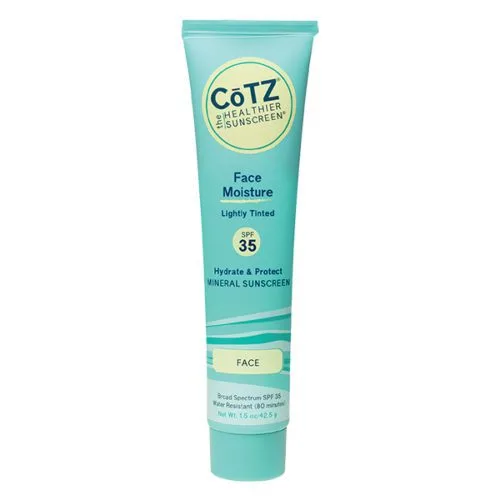
Sensitive SPF 40 uses a higher mineral filter load (13.5% vs 12%) for higher SPF, comes in a larger 3 oz size for face-and-body use, and has a slightly stripped-back inactive deck optimized for contact-dermatitis-prone skin. Face Moisture SPF 35 is face-specific and has a slightly more cosmetic feel.
Does Cotz Sensitive leave a white cast?
Yes, a noticeable one on first application that fades to mostly natural on light to medium skin tones. Deep skin tones will see more persistent cast. If cast is a concern and you're working on pigmentation, the tinted Cotz formulas with iron oxides are a better choice.
Is this sunscreen water resistant?
Not to a level appropriate for swimming or heavy sweat activity. For beach, pool, or athletic use, Cotz makes a specifically water-resistant formula that's a better fit.
Reviews
What Reviewers Tend to Say
Recurring themes our editors read across retailer reviews of this product — summaries in our words, not quotations, and not a substitute for your own patch test.
Common Praise
Genuinely non-reactive on allergy-prone skin
Larger size for face and body use
No stinging or burning
Common Complaints
White cast on deeper skin tones
Thick texture needs patient blending
Not water-resistant for serious swim time
Notable Endorsements
Recommended for contact dermatitis and fragrance-sensitive patientsNational Eczema Association friendly reputation
IPL is a filtered flashlamp, a true vascular laser is one wavelength aimed at haemoglobin, and the choice between them turns on a distinction almost no consult makes: whether your redness is vessels or a state.
The fourth most frequent positive patch test in North America is an oxidation product of a molecule that occurs naturally in lavender. Nobody synthesised it into your face cream.
Western sensitive skincare works by subtraction — remove the fragrance, remove the alcohol, shorten the list. Japan's answer adds a designed molecule back in, and one of the two bets has a trial literature.
Products, answers, therapy guides, tools and articles in one search. Brand names,
slang and abbreviations all work — accutane finds isotretinoin, bacne finds truncal acne.