Japan's Sensitive-Skin Aisle Solves a Problem the West Keeps Reformulating Around
Western sensitive skincare works by subtraction — remove the fragrance, remove the alcohol, shorten the list. Japan's answer adds a designed molecule back in, and one of the two bets has a trial literature.
Read the preview
From the DermApproved blog, in J-Beauty: Japan's sensitive-skin aisle. The West solves reactive skin by subtraction — take out the fragrance, take out the alcohol, shorten the list. Japan made a different bet: put something back in. A molecule designed to sit where the missing lipid should. Only one of those bets has trials. For the full breakdown, visit dermapproved.com/blog.
Two different bets about what reactive skin needs
Walk the sensitive-skin section of a Western pharmacy and read the fronts of the boxes. Fragrance-free. Alcohol-free. Paraben-free. Dye-free. Essential-oil-free. Non-comedogenic. Hypoallergenic. The entire category is defined by absence, and product development in it largely consists of identifying one more thing to remove.
That approach is not wrong. It is, in fact, extremely well founded — fragrance is the leading cause of cosmetic allergic contact dermatitis, ethanol at high concentration is drying, and shortening an ingredient list genuinely reduces the number of things that can go wrong. Subtraction works, and a formulation like La Roche-Posay Toleriane Hydrating Gentle Cleanser is subtraction executed properly.
But subtraction has a ceiling. Once you have removed everything removable, you have a product that will not make things worse, which is not the same as a product that makes things better. Reactive skin is usually reactive because its barrier is leaking, and an inert emollient slows the leak without repairing the structure.
The Japanese sensitive tier — Curél from Kao, Minon from Daiichi Sankyo, d program from Shiseido, Freeplus from Kanebo — made a different bet. All four are fragrance-free and short-listed in the Western sense. But their identity is built around what they add: a designed barrier lipid, or a defined amino acid complex, or a quasi-drug anti-inflammatory active. The marketing noun is a molecule rather than an absence.
One of those bets has a trial literature behind it. The other has physiology and not much else. Both deserve to be graded, and grading them is more useful than declaring the whole aisle superior.
Pseudo-ceramide: a designed molecule, not a cheaper ceramide
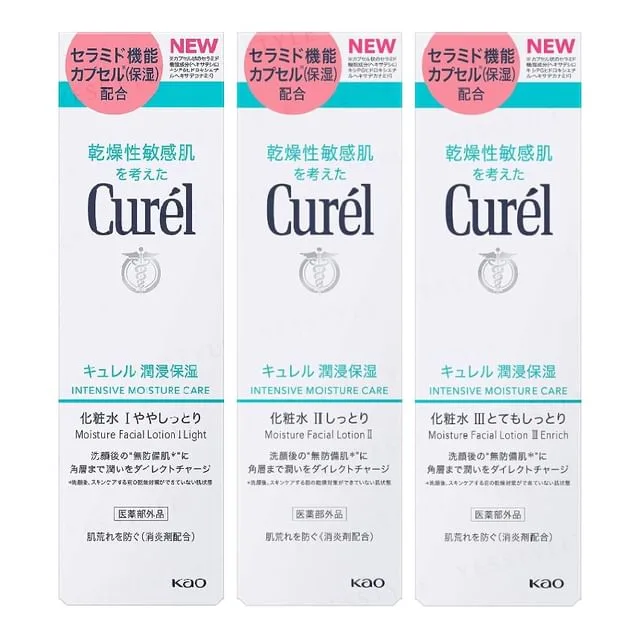
Curél's active is cetyl-PG hydroxyethyl palmitamide, referred to in the research literature as SLE66 and marketed as pseudo-ceramide. The name causes confusion, so it is worth being exact: this is not an extracted plant ceramide, not a biofermented one, and not identical to any human ceramide species. It is a synthetic molecule designed from scratch to reproduce the amphiphilic geometry that lets a ceramide sit correctly in the lamellar lipid sheets between corneocytes.
The question that matters for a designed analogue is whether it actually integrates, and that has been tested with endpoints more objective than a symptom score.
A randomised controlled trial published in the Journal of Cosmetic Dermatology measured absorption into the stratum corneum directly and found the penetrated level correlated significantly with stratum corneum water content, alongside improvement in transepidermal water loss over four weeks. Work in the Journal of Investigative Dermatology went further, reporting that treatment with the synthetic pseudoceramide improved atopic skin while switching the ceramide profile toward a healthy skin phenotype — which is a structural claim, not a comfort claim, and considerably harder to produce by accident.
The formulation also pairs the pseudo-ceramide with eucalyptus leaf extract, and that combination is not decorative. A 2024 review in the Journal of Clinical Medicine sets out the two-part mechanism: the pseudo-ceramide replenishes the deficient lipid directly, while a eucalyptus constituent, macrocarpal A, increases mRNA expression of serine palmitoyltransferase — the rate-limiting enzyme in the skin's own ceramide synthesis. One component supplies, the other stimulates supply.
The caveat is the same one we applied to any proprietary active: this literature is substantially generated by the developer. That is a real limitation. It is mitigated here more than usual by the objectivity of the endpoints — lipid profiles and instrumental water loss are harder to flatter than a patient questionnaire — but it should be stated rather than glossed.
Curél Intensive Moisture Facial Cream is the flagship of this approach, with Curél Intensive Moisture Lotion as the preceding hydrating step and Curél Foaming Facial Wash as the low-surfactant cleanse.
Why design an analogue instead of using the real thing?
The obvious objection is that real ceramides exist and are used in Western formulations, so why bother synthesising a stand-in?
The answer is engineering rather than economics, though economics is part of it. Ceramides are difficult ingredients. They are poorly soluble, they crystallise readily, and keeping them in the correct lamellar phase inside a consumer emulsion that must survive a warm bathroom for a year is a genuine formulation problem. They are also not sufficient alone — the stratum corneum's lipid matrix needs ceramides, cholesterol and free fatty acids in roughly balanced proportion, and supplying one without the others can, in some conditions, do less than nothing.
A molecule designed from first principles can be optimised on all the axes a natural ceramide is bad at: solubility, phase stability, manufacturing cost, and how readily it penetrates rather than sitting on the surface. What you give up is the certainty of being the native molecule.
So the two routes are genuinely different bets, and it is reasonable to want either. The Western ceramide route, executed well in something like CeraVe Moisturizing Cream, supplies the actual lipid classes in barrier-relevant proportions and has a large independent literature behind the general approach. Our ceramides page covers the ratio question in detail. The Japanese route supplies a proxy that has been shown to absorb, correlate with hydration, and shift the ceramide profile.
Neither is obviously superior. What is worth noticing is that they are not the same product with different packaging, and a reader who has tried the Western version without success has a genuinely different mechanism available rather than a fifth variation on the one that did not work.
The amino-acid bet, graded by the same rules
Minon's identity is built on amino acids — nine moisturising ones plus two described as clarifying — and it deserves the same treatment as Curél's pseudo-ceramide rather than a free pass for being from a pharmaceutical company.
The physiological basis is real and not in dispute. Natural moisturizing factor, the hygroscopic mixture inside corneocytes that holds water in the outer stratum corneum, is largely the proteolytic breakdown product of filaggrin, and it is dominated by free amino acids and pyrrolidone carboxylic acid derived from glutamine. NMF is measurably reduced in atopic skin and in people carrying filaggrin loss-of-function variants. Dry, reactive skin genuinely is short of these molecules.
So topically supplying amino acids is a coherent idea, not an arbitrary one, and Minon's formulations are pleasant, well-tolerated and clearly built by people who understand the problem.
What we cannot point you to is controlled evidence that a topical amino acid complex raises corneocyte NMF content or improves clinical outcomes in reactive skin. The mechanism is plausible; the trial literature specific to this approach is not something we can cite, and the absence of it is a real difference from the pseudo-ceramide case rather than a technicality. That is the same judgement we would issue on an indie brand's proprietary complex, and a Daiichi Sankyo product gets it too.
Which is not a reason to avoid it. Amino acids as humectants are low-risk, the products are gentle, and 'plausible mechanism, no controlled evidence, good tolerability' describes a large fraction of everything anyone applies to their face. It is a reason to buy it as a well-made gentle moisturiser rather than as a treatment, and to notice that the two brands most often recommended together are not equally supported.
Read the labels, not the tier
'For sensitive skin' is an unregulated marketing phrase in Japan exactly as it is everywhere else, and the tier's genuine conventions are worth separating from its reputation.
What is broadly true across these brands: fragrance-free is standard rather than optional, ethanol is usually absent, and many products carry a quasi-drug anti-inflammatory active — dipotassium glycyrrhizinate from licorice root, or allantoin — approved on a defined endpoint rather than included as a botanical gesture. That last point is a real structural advantage of the Japanese framework, and it is the same regulatory tier that governs approved depigmenting actives.
What is not true, and matters: fragrance-free does not mean allergen-free. Botanical extracts routinely contain limonene, linalool and geraniol as constituents without those appearing under a fragrance declaration, and someone whose contact allergy is to a specific terpene can react to a product that is technically and honestly fragrance-free. Our answer on what fragrance-free actually excludes is the detail on that, and it applies to every brand in every market.
The second practical problem with importing is that you may not be able to read what you are buying. Japanese domestic packaging carries a Japanese ingredient list under Japanese naming conventions, and the English INCI list on a reseller's page is often partial, machine-translated or copied from a different formulation of the same product line. If you have a known contact allergy, that uncertainty is not a small thing.
Which makes patch testing non-negotiable here in a way it is not for a product you can return to a shop. Use the patch test tool for a proper 48-hour protocol, buy the smallest available size first, and introduce one new import at a time so a reaction is attributable.
Where this aisle genuinely wins, and where it does not
Two honest recommendations and one honest discouragement.
It genuinely wins on pseudo-ceramide, because there is no close domestic equivalent. If you have reactive, barrier-compromised skin and you have already worked through fragrance-free ceramide creams without the result you wanted, a mechanistically different lipid analogue with instrumental evidence behind it is a rational next thing to try rather than a novelty. That is the single strongest reason to import from this tier.
It also wins on sunscreen for sensitive skin, for reasons that have nothing to do with formulation philosophy and everything to do with regulation. Japan permits ultraviolet filters that are not available in the United States, which means a Japanese sensitive-skin sunscreen can achieve high, well-balanced protection in a light texture without relying on the filters most associated with stinging. Curél UV Protection Milk SPF 50+ is a straightforward example, and this is a structural advantage no American brand can formulate its way around.
Where it does not win: a plain, gentle, fragrance-free moisturiser is a solved problem domestically, and importing one is paying shipping for parity. If what you need is a bland ceramide cream, a low-surfactant cleanser or an unfragranced ointment, the domestic aisle has it, usually cheaper and always returnable. Our sensitive skin moisturiser ranking and the fragrance-free cleanser list cover that ground.
And if the skin in question is not merely sensitive but actively eczematous — recurrently inflamed, itching at night, cracking — no moisturiser from any market is the answer on its own. The eczema pathway covers what a clinician adds, and the honest framing of every product in this article is that they are the maintenance layer around a treatment, not a substitute for one. Setting your profile in my-skin will keep recommendations pointed at the reactive-skin filters rather than the general ones.
Products mentioned
Independently reviewed and scored — the real products behind this piece.



- Therapy guide Eczema What a clinician adds when the skin is inflamed rather than merely reactive
- Routine Gentle Skincare Routine for Sensitive Skin A full build for reactive skin that these products slot into
- Ranked list Best Moisturizers for Sensitive Skin The domestic options worth exhausting before importing
- Ranked list Best Fragrance-Free Cleansers Where subtraction is already solved locally
- Ingredient Ceramides The ratio question and what real ceramides need alongside them
- Ingredient Allantoin One of the quasi-drug soothing actives common across the Japanese tier
- Question Does fragrance-free mean no fragrance allergens? Why a fragrance-free label can still carry terpene allergens
References
- Efficacy of Pseudo-Ceramide Absorption Into the Stratum Corneum and Effects on Transepidermal Water Loss and the Ceramide Profile: A Randomized Controlled Trial — Journal of Cosmetic Dermatology, 2025
- Treatment with Synthetic Pseudoceramide Improves Atopic Skin, Switching the Ceramide Profile to a Healthy Skin Phenotype — Journal of Investigative Dermatology, 2020
- Efficacy of Topical Application of a Skin Moisturizer Containing Pseudo-Ceramide and a Eucalyptus Leaf Extract on Atopic Dermatitis: A Review — Journal of Clinical Medicine, 2024
Every cited link is verified to resolve to the paper named. Where a source could not be independently confirmed, it is listed without a link rather than pointing you somewhere wrong.
Frequently asked
What is a pseudo-ceramide, and is it worse than a real ceramide?
It is a synthetic molecule — cetyl-PG hydroxyethyl palmitamide — designed to reproduce the geometry that lets a ceramide sit correctly in the skin's lamellar lipid sheets. It is not inferior by definition. A randomised controlled trial found absorption into the stratum corneum correlated with water content, and separate work found it shifted the atopic ceramide profile toward a healthy phenotype.
Is Japanese sensitive skincare actually gentler than Western equivalents?
Differently constructed rather than uniformly gentler. Both tiers are fragrance-free and short-listed; the Japanese one additionally adds a designed barrier lipid or an approved quasi-drug soothing active. 'For sensitive skin' is unregulated in Japan too, so the tier is not a guarantee — read the individual label.
Does Minon's amino acid approach work?
The physiology behind it is sound — natural moisturizing factor is largely free amino acids and pyrrolidone carboxylic acid from filaggrin breakdown, and it is depleted in atopic skin. What we cannot point to is controlled evidence that a topical amino acid complex raises that content or improves outcomes. Buy it as a well-made gentle moisturiser rather than as a treatment.
Should I import Japanese sensitive-skin products or stick to what I can buy locally?
Import for pseudo-ceramide, which has no close domestic equivalent, and for sensitive-skin sunscreen, where Japan's filter availability produces genuinely better formulations. Do not import a plain fragrance-free ceramide cream or a gentle cleanser — those are solved locally, cheaper and returnable.
How do I test an imported product safely?
Patch test properly over 48 hours before facial use, buy the smallest size available, and introduce one import at a time so any reaction is attributable. This matters more than usual because imported packaging often carries a Japanese ingredient list, and the English version on a reseller page may be partial or copied from a different formulation in the same line.