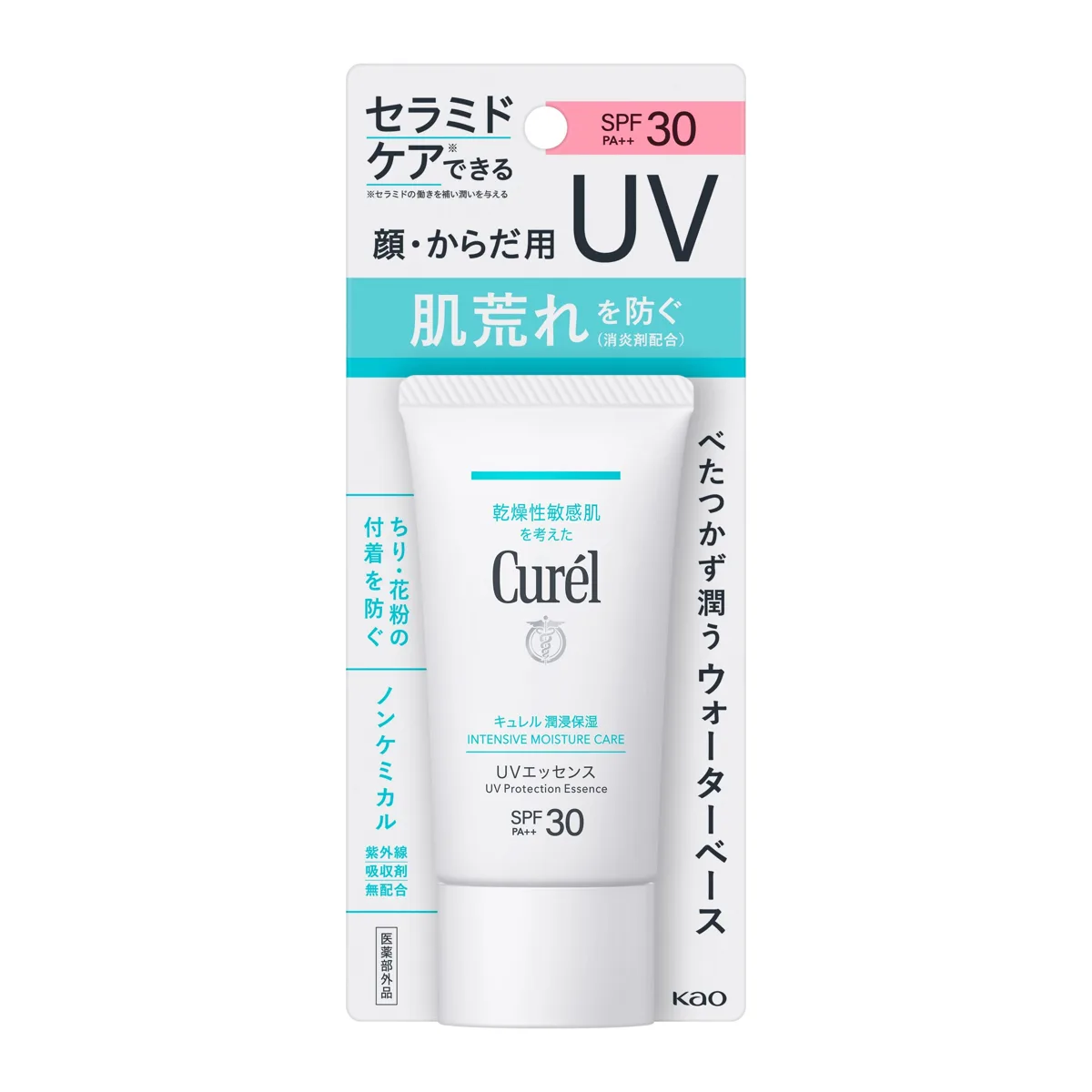
Most mineral sunscreens protect from UV but dry out sensitive skin in the process. Curél solved this paradox by engineering their pseudo-ceramide and eucalyptus extract barrier-repair system directly into a mineral SPF 50+ formula, plus an anti-inflammatory active (Stearyl Glycyrrhetinate) that soothes reactive skin during UV exposure. The 2023 reformulation added improved particle encapsulation technology for a more uniform UV-blocking film with reduced white cast.
A mineral sunscreen that finally treats sensitive skin like it deserves to be protected and nourished simultaneously. The combination of SPF 50+ mineral protection with Kao's pseudo-ceramide barrier technology makes this one of the few sunscreens that actually improves skin condition while shielding it — though the small bottle and premium pricing demand commitment.
Avoidfor SensitivityIn your profileYou chose · This formula carries fragrance — the kind of thing reactive skin flags first.Not yet assessedCarries a triggerNo reviews collected yet
The case for it
Stearyl Glycyrrhetinate has no evidence row yet for this concern — it is in the research queue.
The formula carries a known trigger for this concern, which decides the verdict before any efficacy question.
Cautions: known irritants.
What would change this: Removing the trigger named above would let the actives be judged on their own.
Same rule for everyone. “Avoid” is the verdict on 1,909 of 45,024 concern verdicts across the catalog; rule F1 decided 605 of them.
Unchanged since September 5, 2026, engine 5.1.1.
Full protectionfor Sun DamageIn your profileYou chose · Broad-spectrum SPF 50 with zinc oxide, titanium dioxide: the protection sun damage calls for.Moderate evidenceStandard tolerabilityNo reviews collected yet
The case for it
Zinc Oxide is a first-line active — approved, monograph-listed or named in current guidelines — for this concern.
It is present at an effective concentration, declared or high in the ingredient list.
The formula carries no trigger this concern is sensitive to, with the cautions noted.
Same rule for everyone. “Full protection” is the verdict on 2,288 of 45,024 concern verdicts across the catalog; rule P1 decided 2,232 of them.
Unchanged since September 5, 2026, engine 5.1.1.
P1 — Photoprotection standing is regulatory (M020 / Annex VI filters; 21 CFR 201.327 attaches the early-skin-aging claim to tested broad-spectrum SPF 15+). SPF 30 is the AAD daily-use bar. · the full register
Good choicefor DrynessIn your profileYou chose · Ceramides is a reference standard by mechanism for dryness; this lotion carries it.Moderate evidenceStandard tolerabilityNo reviews collected yet
The case for it
Cetyl-PG Hydroxyethyl Palmitamide has trial-supported standing for this concern.
It is plausibly present at a working level, though the concentration is not declared.
The formula carries no trigger this concern is sensitive to, with the cautions noted.
Cautions: fragrance.
What would change this: A declared concentration would move this to a firmer reading of the dose.
Same rule for everyone. “Good choice” is the verdict on 9,564 of 45,024 concern verdicts across the catalog; rule R5 decided 9,072 of them.
Unchanged since September 5, 2026, engine 5.1.1.
R5 — Trial-supported or guideline-supported active, adequately or plausibly dosed. · the full register
Carrying active
Cetyl-PG Hydroxyethyl Palmitamide
Standing
supported — its mechanism is established
Form
plausible
Tolerability
standard — fragrance load
Row checked
against its sources on July 17, 2026 (evidence table ev-2026.09-r228)
The studies behind the evidence row
Elias PM, Feingold KR (eds), Skin Barrier — stratum corneum ceramides are the principal intercellular lamellar lipid; their depletion is the biochemical signature of dry/xerotic skin — reference work
Avoidfor Compromised Skin BarrierIn your profileYou chose · This formula carries fragrance — a known trigger for compromised skin barrier — so it is not a fit however good its actives are.Moderate evidenceCarries a triggerNo reviews collected yet
The case for it
Cetyl-PG Hydroxyethyl Palmitamide has trial-supported standing for this concern.
It is plausibly present at a working level, though the concentration is not declared.
The formula carries a known trigger for this concern, which decides the verdict before any efficacy question.
Cautions: known irritants.
What would change this: Removing the trigger named above would let the actives be judged on their own.
Same rule for everyone. “Avoid” is the verdict on 1,909 of 45,024 concern verdicts across the catalog; rule R1 decided 1,304 of them.
Unchanged since September 5, 2026, engine 5.1.1.
R1 — Safety outranks praise (MASTER-PLAN §1.7). A condition-weighted trigger (multiplier ≥ 2 in condition-fit-matrix) decides the verdict before any efficacy question. · the full register
Carrying active
Cetyl-PG Hydroxyethyl Palmitamide
Standing
supported — its mechanism is established
Form
plausible — studied range 0.5–1%, from the trials on the row; needs leave-on contact; judge it after ~4 weeks
Tolerability
harsh — fragrance load
Row checked
against its sources on July 17, 2026 (evidence table ev-2026.09-r228)
The studies behind the evidence row
Elias PM, Skin Barrier / Coderch et al., ceramides and skin barrier function — ceramides ~50% of SC intercellular lipid mass, essential to the permeability barrier — reference work
Does the jobDoes what a sunscreen is for: UVA coverage, holds up in sunlight. Not measured from the label: pleasant enough to actually use.
A verdict is DermApproved’s assessment of how well a product’s ingredients fit a concern — never a claim about what the product treats. Evidence dots and collected reviews sit beside it and are never blended in.
Rules 0.5.1 · evidence table ev-2026.09-r228 · how we decide
Assessment
Pros & Cons
Pros
✓ Mineral-only SPF 50+ PA+++ provides broad-spectrum protection with the gentlest UV filter technology
✓ Pseudo-ceramide and eucalyptus extract actively repair skin barrier while protecting from UV
✓ Minimal white cast for a mineral sunscreen thanks to 2023 reformulated encapsulation technology
✓ Anti-inflammatory Stearyl Glycyrrhetinate soothes sensitive skin during sun exposure
✓ Silky primer-like texture works beautifully as a makeup base without pilling
✓ Completely fragrance-free, alcohol-free, and paraben-free formulation
✓ Pregnancy-safe mineral-only UV filters suitable for expectant mothers
Cons
✗ Small 60mL bottle lasts only 4-6 weeks with proper daily application amounts
✗ Premium pricing per milliliter compared to larger-format sunscreens
✗ Satin finish may be too dewy for very oily skin types seeking matte protection
✗ Not water-resistant — unsuitable for swimming, heavy exercise, or beach use
✗ Silicone-heavy base may not suit those who avoid silicone-based products
Review
Full Review
Dermatologists will tell you the best sunscreen is the one you actually use. It sounds like a platitude until you've lived in sensitive skin that stings, burns, or breaks out every time you try to follow that advice. For years, the sensitive-skin sunscreen market offered two unsatisfying choices: gentle formulas with inadequate protection, or high-SPF products that felt like punishment. Curél's UV Protection Milk quietly rejected both options.
This is a mineral sunscreen — zinc oxide and titanium dioxide do the heavy lifting — that achieves SPF 50+ PA+++ without the chalky, drying, white-cast catastrophe that high-protection mineral sunscreens are famous for. How it manages this is partly chemistry and partly engineering. Kao's 2023 reformulation introduced improved particle encapsulation technology that disperses the mineral filters more uniformly across the skin's surface. The result is a UV-blocking film that's more consistent and less visible than the previous generation.
The vehicle is silicone-based, which is what gives it that smooth, almost primer-like slip when you blend it across your face. If you've used Japanese sunscreens before, the texture will feel familiar — lighter and more cosmetically elegant than most Western mineral SPFs. It spreads easily, sets to a satin finish, and leaves your skin feeling soft rather than coated. Under makeup, it performs exceptionally well as a base, creating a smooth canvas without pilling or separation.
But the texture is only half the story. What sets this sunscreen apart in a crowded field is what Curél does below the UV-blocking surface. Their signature pseudo-ceramide — Cetyl-PG Hydroxyethyl Palmitamide — is woven into the formula alongside eucalyptus extract, creating the same barrier-repair system that powers their moisturizers. While the zinc oxide and titanium dioxide shield your skin from UV radiation above, the pseudo-ceramide is working to maintain the lipid barrier integrity below. It's the skincare equivalent of building a roof and reinforcing the walls at the same time.
Stearyl Glycyrrhetinate, a licorice-derived anti-inflammatory, serves as the designated active ingredient in this Japanese quasi-drug formulation. For sensitive skin that reddens or stings with sun exposure — or that reacts to sunscreen ingredients themselves — this provides a built-in soothing mechanism. It's a thoughtful inclusion that addresses one of the main reasons sensitive-skin people skip sunscreen in the first place.
The daily experience is pleasantly unremarkable. You squeeze out a generous amount — and you do need to be generous with any sunscreen for adequate protection — blend it across your face, and within about thirty seconds you've got a smooth, non-greasy base that doesn't sting, doesn't smell, and doesn't announce itself with a white mask. Throughout the day, it maintains a comfortable satin finish without migrating into eyes or breaking down into an oily film.
The limitations are practical rather than formulation-based. At 60 milliliters, this is a small bottle for a product you're supposed to use liberally every single day. If you're applying the dermatologist-recommended amount for face and neck, this bottle lasts roughly four to six weeks. That puts the monthly cost significantly higher than larger-format sunscreens. For a daily essential, the ongoing expense adds up.
The finish, while elegant, may not be matte enough for genuinely oily skin. The silicone base creates a satin sheen that dry and normal skin types will appreciate, but if you're already fighting midday oil, you may find it contributes to rather than controls shine. This sunscreen was designed for Curél's core demographic — dry, sensitive skin — and it doesn't pretend otherwise.
It's also worth noting that this is not a water-resistant formula. For beach days, pool sessions, or heavy sweating, you'd want a more robust sport sunscreen. This is designed for daily urban protection — commuting, office work, errands — where the priority is cosmetic elegance and skin comfort over sweat-proof endurance.
The 2023 reformulation deserves specific credit for solving the white cast problem that plagued earlier versions. Previous iterations were well-formulated but left a noticeable white tint, particularly on medium to deep skin tones. The improved encapsulation technology has made a real difference here, producing a finish that's close to transparent on most skin tones — though people with deeper complexions should still test before committing, as mineral filters inherently carry more white-cast risk than chemical alternatives.
At approximately twenty-four dollars for 60 milliliters, this sits in the upper-middle range of the Japanese sunscreen market. You're paying for Kao's ceramide technology, mineral UV filters processed for cosmetic elegance, and a formula sophisticated enough to protect and repair simultaneously. For sensitive skin that has burned through dozens of sunscreens searching for one that doesn't cause problems, the stability this product provides has value that transcends the per-milliliter cost. But for budget-conscious daily use, the small format is a genuine drawback.
The Curél UV Protection Milk won't win awards for its packaging or its price point. But it might win something more important: the daily compliance of people who've given up on sunscreen because everything else hurt. A sunscreen that sensitive skin wants to wear is worth more than one that sits unused in a bathroom drawer, and this unpretentious Japanese milk has figured out how to be both protective and pleasant in a way that remarkably few products manage.
Formula
Key Ingredients
The hero actives that drive this product's performance.
The primary UV filter in this mineral sunscreen, providing broad-spectrum protection against both UVA and UVB rays. Zinc oxide is one of the gentlest UV filters available, making it ideal for the sensitive skin Curél targets — it sits on the skin surface rather than absorbing into it, and rarely causes irritation or allergic reactions.
Regulator-approvedfor Sun Damage · limited certainty
Works alongside zinc oxide to strengthen UVB protection specifically. In this formula, Kao's encapsulation technology coats the titanium dioxide particles to create a more uniform UV-blocking film on the skin, improving protection consistency while reducing the white cast that mineral filters are notorious for.
Regulator-approvedfor Sun Damage · limited certainty
Kao's signature pseudo-ceramide included in a sunscreen — a strategic choice that addresses the barrier-drying effect UV protection products often cause. While the sunscreen shields from external UV, the pseudo-ceramide simultaneously repairs and maintains the lipid barrier from within, preventing the dehydration paradox of sunscreens that protect but dry.
Established mechanismfor Dryness · established mechanism
A licorice-derived anti-inflammatory designated as the active ingredient in this quasi-drug formulation. Provides soothing action for sensitive skin that may react to UV exposure or the physical filters themselves, helping prevent the redness and irritation that some mineral sunscreens can provoke.
Paired with the pseudo-ceramide as part of Curél's dual barrier-support strategy — Kao's research shows this extract enhances the skin's own ceramide synthesis, providing ongoing barrier repair even during daytime UV protection.
Not yet assessed
Ingredient standings describe the active at treatment-level doses and
vehicles; this product's own condition grades weigh its actual formula.
Use as the last step of your morning skincare routine, after moisturizer. Use generously — at least a nickel-sized amount for the face. Can be used as a makeup base due to its smooth, non-greasy finish. Reapply every two hours during direct sun exposure.
Results Timeline
Immediate UV protection upon application. Skin feels hydrated rather than dried out within the first week of daily use. Over 4-6 weeks, the pseudo-ceramide contributes to improved barrier function alongside UV protection.
Pairs Well With
ceramide moisturizerhydrating tonervitamin C serum (applied underneath)
This sunscreen relies on two mineral UV filters — zinc oxide and titanium dioxide — which provide protection through physical reflection and scattering of UV radiation rather than chemical absorption. Zinc oxide offers broad-spectrum coverage across both UVA and UVB wavelengths, while titanium dioxide primarily strengthens UVB protection. A key advantage of mineral filters for sensitive skin is their mechanism of action: they sit on the skin surface rather than penetrating the stratum corneum, dramatically reducing the potential for irritation and allergic contact dermatitis.
Kao's 2023 reformulation introduced improved particle encapsulation technology that addresses the primary cosmetic limitation of mineral sunscreens — white cast. By coating and dispersing the UV filter particles more uniformly, the formula creates a thinner, more even UV-blocking film. Research on nanoparticle zinc oxide and titanium dioxide has demonstrated that smaller, better-dispersed particles reduce visible whitening while maintaining photoprotective efficacy, provided the particles remain above the regulatory size threshold that prevents transdermal penetration.
The inclusion of Cetyl-PG Hydroxyethyl Palmitamide (pseudo-ceramide) in a sunscreen formulation is scientifically rational given that UV exposure has been shown to deplete skin barrier lipids. A 2020 study in the Journal of Dermatological Science demonstrated that UV radiation triggers ceramide degradation in the stratum corneum via upregulation of ceramidase enzymes. By supplying a ceramide functional ingredient during UV exposure, this formula theoretically mitigates one of the downstream effects of the very radiation it's blocking. Combined with the eucalyptus extract that Kao's research shows enhances endogenous ceramide synthesis, the approach provides both immediate lipid replacement and stimulation of the skin's own repair pathways.
Dermatologist Perspective
Skin-care clinicians frequently recommend mineral sunscreens for patients with sensitive, reactive, or rosacea-prone skin, as zinc oxide and titanium dioxide are the least likely UV filters to cause contact irritation or allergic reactions. Dermatologists note that the addition of ceramide-functional ingredients to a daily sunscreen is clinically sensible — it addresses the well-documented phenomenon of UV-induced barrier disruption while simultaneously providing photoprotection. For patients recovering from procedures, managing retinoid-induced sensitivity, or dealing with conditions like eczema or rosacea, a mineral SPF with built-in barrier support represents a practical all-in-one daytime step that improves compliance. The anti-inflammatory active provides additional reassurance for skin that historically reacts to sunscreen application.
Guidance
Usage & Recommendations
How to Use
Shake gently before use. Apply generously to the face and neck as the final step of your morning skincare routine, after moisturizer. Use at least a nickel-sized amount (approximately 1/4 teaspoon) for the face alone — most people under-apply sunscreen, which dramatically reduces effective SPF. Allow one to two minutes to set before applying makeup. Reapply every two hours during direct or prolonged sun exposure. Remove thoroughly in the evening with an oil-based cleanser followed by a gentle foaming wash.
Value Assessment
At approximately $24 for 60 mL, this is one of the pricier Japanese sunscreens per milliliter, though it remains well below luxury Western mineral SPF products that charge significantly more for comparable protection levels. The real cost concern is duration — with proper application amounts, this lasts only four to six weeks, making the annual sunscreen cost around $200-300. However, for sensitive skin that has spent far more than that on sunscreens that irritated, broke out, or were abandoned, the reliability premium is justified. The barrier-repair ingredients also mean you may be able to simplify the rest of your morning routine, potentially offsetting some of the sunscreen cost.
Who Should Buy
Anyone with dry or sensitive skin who needs high SPF protection without irritation — particularly those who've struggled to find a mineral sunscreen that doesn't feel heavy, chalky, or drying. Excellent for rosacea-prone skin, post-procedure recovery, retinoid users who need gentle daily UV protection, and pregnant individuals seeking mineral-only sun protection with barrier-support benefits.
Who Should Skip
If you have very oily skin and need a matte-finish sunscreen, this satin-finish formula may not control shine adequately. Skip if you need water-resistant protection for outdoor sports or swimming. Also not ideal if you're looking for maximum value per milliliter — the 60mL format is expensive for a daily essential product.
Lightweight, silky milk that blends smoothly with minimal white cast. The silicone base gives it a velvety, almost primer-like slip that leaves skin feeling soft rather than greasy or chalky.
Scent
Completely fragrance-free. No detectable scent.
Packaging
Small white squeeze tube with blue branding. Travel-friendly but the 60mL size feels small for a daily-use sunscreen. The tube design allows controlled dispensing.
Finish
satinnon-greasylightweight
What to Expect on First Use
Blends surprisingly well for a mineral sunscreen — no heavy white cast or chalky residue. The silicone-based vehicle gives it a smooth, primer-like feel that layers well under makeup. Skin feels protected without the tight, dry sensation common with mineral SPFs.
How Long It Lasts
1-2 months with daily facial application at recommended SPF amount
Sunscreen compliance is notoriously poor among people with sensitive skin — many skip it because conventional formulas sting, dry, or trigger breakouts. Curél developed this UV milk specifically to solve that compliance problem, reasoning that a sunscreen enriched with their barrier-repair technology would be one sensitive skin actually wants to wear daily. The 2023 reformulation with Day Barrier Technology refined the UV filter dispersion for better protection and cosmetic elegance.
About Curél Established Brand (5–20 years)
Curél was launched by Kao Corporation in 1999 as Japan's first skincare line for dry, sensitive skin. Kao's ceramide research dates to 1987, and the UV Protection Milk was reformulated in 2023 with improved Day Barrier Technology. Curél has been Japan's #1 dry/sensitive skin brand since 2008.
Brand founded: 1999 · Product launched: 2019
Myth vs. Reality
Common Myths
Myth
Mineral sunscreens always leave a heavy white cast, especially at SPF 50+.
Reality
Kao's particle encapsulation technology in this formula creates finely dispersed zinc oxide and titanium dioxide particles that spread more evenly across skin, significantly reducing the white cast associated with mineral sunscreens while maintaining full SPF 50+ PA+++ protection.
Myth
Sunscreen and barrier repair are separate concerns that need separate products.
Reality
UV exposure itself depletes skin barrier lipids. By incorporating pseudo-ceramide directly into the sunscreen formula, Curél addresses both protection and repair simultaneously — the ceramide functional ingredient works to maintain barrier integrity throughout the day while the mineral filters block UV damage.
FAQ
Frequently Asked Questions
Does Curél UV Protection Milk leave a white cast?
The 2023 reformulation significantly reduced white cast through improved particle encapsulation technology. On fair to medium skin tones, the white cast is minimal to undetectable. On deeper skin tones, there may be a slight initial tint that fades as the product sets — mineral sunscreens inherently carry more white-cast risk than chemical alternatives, but this is one of the better-performing mineral options.
Is Curél UV Protection Milk safe during pregnancy?
Yes — this uses only mineral UV filters (zinc oxide and titanium dioxide) which sit on the skin surface rather than absorbing into the bloodstream. These are widely considered the safest sunscreen options during pregnancy. The formula is also free of retinoids, chemical UV filters, and other ingredients commonly flagged during pregnancy.
Can I use Curél UV Protection Milk with retinol?
Absolutely — this is an excellent daytime companion for retinol users. The mineral SPF 50+ provides the high-level UV protection that retinol-sensitized skin requires, while the built-in pseudo-ceramide helps maintain the barrier that retinol can temporarily compromise. Apply retinol at night and this sunscreen in the morning for a complementary routine.
How long does a 60mL bottle of Curél UV Protection Milk last?
With proper application amounts (approximately 1/4 teaspoon for face alone, applied daily), a 60mL bottle lasts roughly four to six weeks. If you're applying to face and neck, it may last closer to three to four weeks. This is one of the product's main drawbacks — the small format runs out quickly for a daily essential.
Is Curél UV Protection Milk water-resistant?
No — this is formulated for daily urban wear, not outdoor sports or water activities. For swimming, heavy sweating, or prolonged direct sun exposure, choose a water-resistant sunscreen and save this one for daily commuting and office wear where its cosmetic elegance and barrier-support benefits shine.
Reviews
What Reviewers Tend to Say
Recurring themes our editors read across retailer reviews of this product — summaries in our words, not quotations, and not a substitute for your own patch test.
Common Praise
No white cast despite being a mineral sunscreen
Doesn't sting or irritate sensitive skin
Silky lightweight texture that works well under makeup
Skin feels moisturized rather than dried out
Fragrance-free and alcohol-free
Common Complaints
Small 60mL bottle runs out quickly with daily use
Pricey per milliliter compared to larger sunscreens
Can feel slightly silicone-heavy on some skin
Not water-resistant for heavy outdoor activity
May not be matte enough for very oily skin
Notable Endorsements
Part of Japan's #1 sensitive skincare brandFeatured in multiple J-beauty sunscreen roundupsAvailable at Target in the US
Western sensitive skincare works by subtraction — remove the fragrance, remove the alcohol, shorten the list. Japan's answer adds a designed molecule back in, and one of the two bets has a trial literature.
A wrecked barrier is the most common self-inflicted skin condition and the one with the clearest fix — the difficulty is that the routine which caused it feels productive and the one that repairs it feels like giving up.
'Barrier damage' has become the internet's all-purpose diagnosis. It's also a real, specific condition with a specific and slightly boring cure: mostly, stop doing things.
Piling on richer cream treats the symptom. The reason the dryness keeps coming back is a leaky barrier and a broken lipid ratio — and you fix those differently.
Jan 9, 2026· 6 min
Questions people ask about sensitive skin
Verified answers from our questions library — the nuance a product page cannot carry.
Products, answers, therapy guides, tools and articles in one search. Brand names,
slang and abbreviations all work — accutane finds isotretinoin, bacne finds truncal acne.