The Japanese 'Lotion' Isn't a Lotion — and That Mistranslation Hides a Whole Philosophy
In J-beauty a 'lotion' is a watery hydrating toner, layered by hand in thin passes. It's the quiet, engineered counterpoint to K-beauty's ten steps.
Read the preview
From the DermApproved blog, in J-Beauty: the Japanese 'lotion' — and the mistranslation hiding a whole philosophy. Picture it. You buy something labeled 'lotion,' expecting a rich, pourable cream, and instead it comes out like water — thin, slippery, nothing like the tube on your shelf. Cue the quiet panic. Did you buy the wrong thing? A dud? You didn't. You just walked straight into one of skincare's great translation traps — and behind it sits an entire approach to hydration that quietly argues against everything a ten-step routine stands for. There's a technique here, done by hand, in thin patient layers, that builds moisture in coats like paint rather than one heavy smear. There's a reason 'less' in J-beauty isn't lazy — it's engineered. And there's one small step almost everyone forgets that quietly undoes the whole ritual. What the bottle really is, and exactly how to use it, at dermapproved.com/blog.
The bottle that pours like water and confuses everyone
The first time a Western shopper buys a Japanese 'lotion,' there's usually a moment of quiet panic. The word promises a rich, pourable cream — the thing you'd slather on dry shins. Instead the bottle dispenses something closer to water, maybe faintly slippery, and the instinct is that you've bought the wrong product or a defective one.
You haven't. You've run into one of skincare's most persistent translation traps. In Japanese skincare vocabulary, 'lotion' — sometimes labeled 'toner' or, transliterated, 'keshosui' — means a watery hydrating liquid you apply right after cleansing, not an emulsion or cream. It's the first leave-on step, and its entire job is to flood the skin with water and water-binding ingredients before anything heavier goes on top.
That single mislabeling hides something bigger than a vocabulary quirk. The Japanese lotion sits at the center of a whole approach to hydration — one built on layering thin watery textures with intention rather than piling on a thick product and hoping. It's a philosophy that quietly rebuts the idea that more steps or more product equals better skin, and it's worth understanding on its own terms.
What's actually in the bottle
Strip a classic Japanese lotion down and it's essentially a delivery system for humectants — the molecules that grab water and hold it in the upper skin. The workhorses are glycerin, hyaluronic acid, and often urea, plus other components that mirror the skin's own natural moisturizing factor (NMF): the free amino acids, PCA, lactic acid, and urea that corneocytes use to stay plump.
Each of those earns its place. Urea is a genuine part of the skin's NMF and a documented humectant that reduces water loss and boosts stratum-corneum hydration and barrier function — which is why it appears in serious Japanese hydrators, not just as filler. Hyaluronic acid is often included at multiple molecular weights: larger HA sits on the surface holding water like a sponge, while lower-molecular-weight HA penetrates a bit deeper, and formulation studies confirm both improve measured skin hydration. The iconic Hada Labo Gokujyun Premium Lotion leans on layered hyaluronic acid and urea for exactly this multi-depth hydration, in a texture that feels like almost nothing.
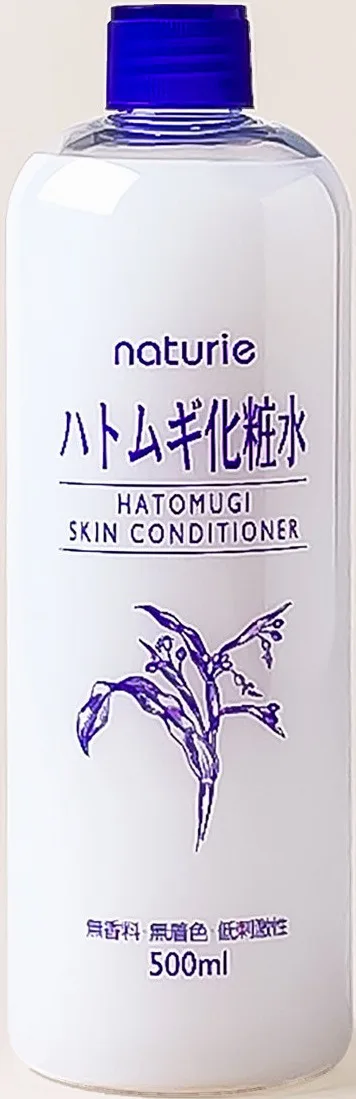
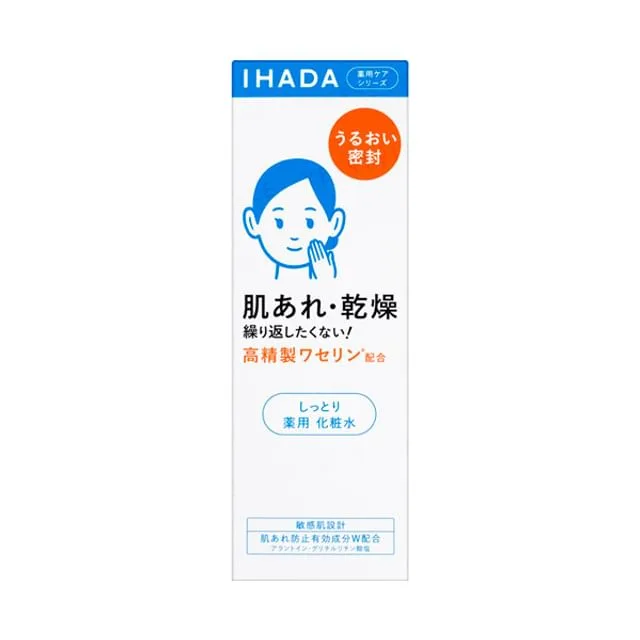
The textures themselves are the tell. Some lotions are thin as water and splash on; a big-bottle staple like Hatomugi Skin Conditioner is designed to be used generously by the palmful. Others are slightly viscous 'premium' or 'medicated' versions — IHADA Medicated Lotion Moist adds allantoin and sodium PCA for sensitive, barrier-stressed skin. The category spans watery to lightly milky, but the through-line never changes: hydration first, weight last.
Layering: depth from repetition, not thickness
Here's where the Japanese lotion becomes a technique rather than just a product. You don't apply it once and move on. You layer it — several thin passes, each pressed into the skin with the palms rather than rubbed, building hydration gradually.
The method has a logic. Humectants work best when there's water for them to bind, so the ritual is to apply each layer onto skin that's still slightly damp from cleansing or the previous pass, warm it briefly in the hands, and press it in — the warmth and gentle pressure aid absorption and the layering lets you build genuine depth of hydration without a single heavy, pore-clogging product. Two or three light layers of a watery lotion sink in and plump the skin in a way one thick application can't replicate.
There's also the 'lotion mask' (rotion pakku): saturate a cotton pad or thin cotton sheet with lotion, lay it over the face for a few minutes, and let a concentrated dose soak in — a low-cost, low-waste alternative to a sheet mask for a hydration boost before a big day. None of this is complicated, but it is deliberate, and it rewards a light hand. If you're unsure where the lotion step slots in relative to your serums and creams, our routine-order tool sequences water-based-to-oil-based so your layers actually absorb instead of pilling. The principle to hold onto: in J-beauty, you build hydration in coats, like thin layers of paint, not one thick smear.
Less, but engineered — the quiet answer to ten steps
It's tempting to file Japanese skincare under 'minimalism' and leave it there, but that undersells what's happening. J-beauty minimalism isn't the absence of effort — it's effort concentrated into fewer, better-considered steps. This is the philosophical fork with K-beauty, its more famous neighbor.
K-beauty's cultural export was maximalism: the ten-step routine, the cushion of essences and ampoules and serums, the joy of a long, layered ritual. It's genuinely effective for many people and it made skincare fun. J-beauty tends to move the opposite way — toward restraint, precision, and the sense that each product should be quietly excellent and pull real weight. Cleanse, lotion (layered), maybe one serum or emulsion, moisturizer, sunscreen. The lotion step often replaces three separate hydrating products because it's doing the hydration job thoroughly on its own.
Neither is 'right' — this isn't a rivalry with a winner, and plenty of people happily borrow from both. But the Japanese approach is a useful corrective to the assumption, baked into a lot of skincare marketing, that a longer routine is a better one. Fewer steps executed with technique can outperform a stack of half-absorbed products. Less isn't lazy here. Less is engineered.
How to actually use one — and the step people forget
Adopting the Japanese lotion is simple, with one caveat people routinely miss. After cleansing, dispense a generous amount into your palms, press the first layer onto still-damp skin, and repeat for a second or third thin layer, warming and pressing each time rather than dragging it across your face. Adjust the number of layers to the season and your skin — more in dry winter air, fewer in humid summer. On a tired day, do the cotton-pad lotion mask for a few minutes.
The caveat: a watery lotion is a hydrator, not a sealer. Humectants pull water into the skin, but without something on top to slow evaporation, that water can escape — and in dry air a humectant left uncovered can even draw moisture out of deeper layers and let it evaporate off the surface. So the lotion is a beginning, not the whole routine. Follow it with an emulsion, cream, or occlusive to lock the hydration in. Skip that seal and you can end up doing all the layering and still feeling tight an hour later.
Done right, the payoff is the specific J-beauty result: skin that feels cushioned and supple without anything heavy sitting on it. That's the whole promise hiding behind a mistranslated word — not a cream that pours funny, but a smarter, lighter way to hydrate, one deliberate layer at a time.
Products mentioned
Independently reviewed and scored — the real products behind this piece.

References
- Urea in Dermatology: A Review of its Emollient, Moisturizing, Keratolytic, Skin Barrier Enhancing and Antimicrobial Properties — Dermatology and Therapy, 2021
- Efficacy of cream-based novel formulations of hyaluronic acid of different molecular weights in anti-wrinkle treatment — Journal of Drugs in Dermatology, 2011
Every cited link is verified to resolve to the paper named. Where a source could not be independently confirmed, it is listed without a link rather than pointing you somewhere wrong.
Frequently asked
Is a Japanese 'lotion' the same as a moisturizer or a cream?
No — that's the common mix-up. In Japanese skincare, a 'lotion' (sometimes labeled toner or skin) is a watery hydrating liquid applied right after cleansing, not a rich cream. It floods the skin with humectants like glycerin, hyaluronic acid, and urea, and it's meant to be followed by a separate emulsion or cream to seal that hydration in.
How do you layer a Japanese hydrating lotion?
Apply it in several thin passes rather than one heavy dose. Press each layer into still-damp skin with your palms, warm it briefly, and repeat two or three times, adjusting for the season. You can also saturate a cotton pad and lay it on as a quick 'lotion mask' for a few minutes. Depth of hydration comes from repetition, not thickness.
What's the difference between J-beauty and K-beauty routines?
Broadly, K-beauty leans maximalist — the famous ten-step routine with layered essences and serums — while J-beauty leans minimalist, concentrating effort into fewer, deliberately excellent steps. A Japanese lotion often replaces several hydrating products by doing the job thoroughly on its own. Neither is objectively better; many people borrow from both.
Do I still need a moisturizer if I use a hydrating lotion?
Yes. A watery lotion is a humectant that pulls water into the skin, but it doesn't seal it in — without an occlusive or cream on top, that water can evaporate, and in dry air a bare humectant can even draw moisture from deeper layers. Always follow the lotion with an emulsion, cream, or occlusive to lock in the hydration.
Which ingredients make a Japanese lotion actually hydrating?
Look for humectants and natural-moisturizing-factor components: glycerin, hyaluronic acid (often at multiple molecular weights), urea, sodium PCA, and amino acids. Urea and hyaluronic acid in particular have data supporting increased stratum-corneum hydration. These pull and bind water into the upper skin, which the subsequent moisturizer then keeps there.