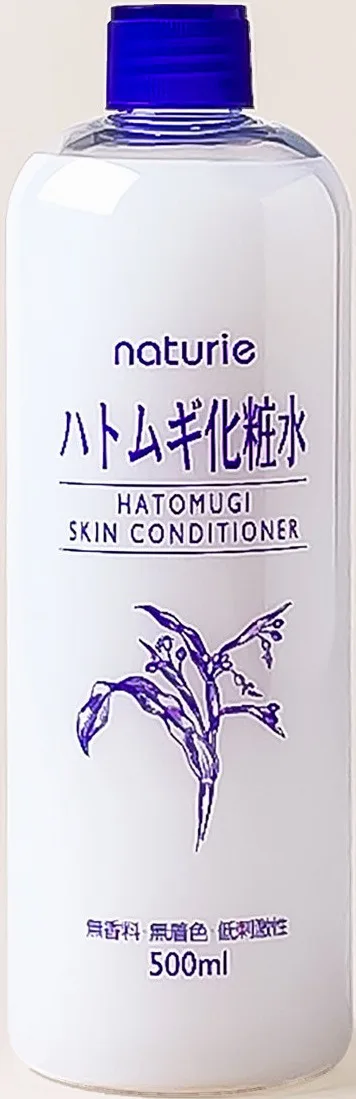
Hatomugi Skin Conditioner is one of Japan's most iconic J-beauty cult products — a deliberately simple 10-ingredient hydrating toner with Coix lacryma-jobi (Job's Tears) extract as signature active. The 500ml large-format size at drugstore pricing makes the per-ounce value exceptional. Fragrance-free, alcohol-free, oil-free, and well-tolerated by virtually all skin types.
Ten ingredients, 500ml, fourteen dollars. This J-beauty cult toner has been a Japanese staple since 2003 by doing one thing well: delivering simple, fragrance-free hydration via a triple humectant base and Job's Tears extract. It is not exciting, and that is the point — it is gentle enough for anyone and cheap enough to splash on liberally. The methylparaben is the only asterisk.
Good choicefor DehydrationIn your profileYou chose · Glycerin is a reference standard by mechanism for dehydration; this liquid carries it.Moderate evidenceGentleNo reviews collected yet
The case for it
Dipropylene Glycol + Butylene Glycol + Glycerin has trial-supported standing for this concern.
It is plausibly present at a working level, though the concentration is not declared.
The formula carries none of the triggers this concern is sensitive to.
What would change this: A declared concentration would move this to a firmer reading of the dose.
Same rule for everyone. “Good choice” is the verdict on 9,564 of 45,024 concern verdicts across the catalog; rule R5 decided 9,072 of them.
Unchanged since September 5, 2026, engine 5.1.1.
R5 — Trial-supported or guideline-supported active, adequately or plausibly dosed. · the full register
Carrying active
Dipropylene Glycol + Butylene Glycol + Glycerin
Standing
supported — its mechanism is established
Form
plausible — studied range 20%, from the trials on the row; needs leave-on contact; judge it after ~1 weeks
Tolerability
gentle
Row checked
against its sources on July 17, 2026 (evidence table ev-2026.09-r228)
The studies behind the evidence row
USP glycerin monograph / Fluhr et al., glycerol and the skin (review) — glycerin is the reference humectant, drawing and holding water in the stratum corneum — reference work
Good choicefor SensitivityIn your profileYou chose · No fragrance, drying alcohol, declarable allergens or sensitising preservatives in this liquid — the profile sensitive skin looks for.Not yet assessedGentleNo reviews collected yet
The case for it
Coix Lacryma-Jobi Ma-Yuen has no evidence row yet for this concern — it is in the research queue.
The formula carries none of the triggers this concern is sensitive to.
What would change this: A researched evidence row for the lead active would replace this with a verdict.
Same rule for everyone. “Good choice” is the verdict on 1,938 of 45,024 concern verdicts across the catalog; rule F2 decided 1,938 of them.
Unchanged since September 5, 2026, engine 5.1.1.
Promisingfor DullnessIn your profileYou chose · Glycerin has trial-level evidence for dullness but no guideline or regulatory standing yet — promising, short of a recommendation; the other actives here are not yet assessed for it.Moderate evidenceGentleNo reviews collected yet
The case for it
Dipropylene Glycol + Butylene Glycol + Glycerin has trial-level evidence for this concern but no guideline or regulatory standing yet.
It is plausibly present at a working level, though the concentration is not declared.
The formula carries none of the triggers this concern is sensitive to.
What would change this: A declared concentration would move this to a firmer reading of the dose.
Same rule for everyone. “Promising” is the verdict on 7,858 of 45,024 concern verdicts across the catalog; rule R9p decided 7,858 of them.
Unchanged since September 5, 2026, engine 5.1.1.
R9p — 0.5.0: 'Unproven' beside three filled dots read as one question answered twice with opposite words (7,018 rows). The chip measures standing, the dots measure trial volume; where the row carries at least one RCT or a tier-2 source (moderate dots) and the active is present at a working level, the honest word is Promising. Unproven is reserved for plausible-standing rows with limited or weak evidence, or an under-dosed form. Same rank as Unproven — a bet either way; the dots order them. · the full register
Carrying active
Dipropylene Glycol + Butylene Glycol + Glycerin
Standing
plausible — trials support it
Form
plausible — studied range 2–20%, from the trials on the row; needs leave-on contact; judge it after ~1 weeks
Tolerability
gentle
Row checked
against its sources on July 17, 2026 (evidence table ev-2026.09-r228)
The studies behind the evidence row
Harry's Cosmeticology / Baran & Maibach Textbook of Cosmetic Dermatology — humectant, emollient and occlusive classification — standard reference text
Does the jobDoes what a toner is for: not alcohol-driven, adds something real. Not measured from the label: restores skin pH, plays well with what follows.
A verdict is DermApproved’s assessment of how well a product’s ingredients fit a concern — never a claim about what the product treats. Evidence dots and collected reviews sit beside it and are never blended in.
Rules 0.5.1 · evidence table ev-2026.09-r228 · how we decide
Assessment
Pros & Cons
Pros
✓ Deliberately minimal ten-ingredient formula is hard to react to
✓ Triple humectant base delivers genuine, reliable hydration
✓ Fragrance-free, alcohol-free, and oil-free
✓ Licorice-derived active adds real soothing benefit
✓ Job's Tears extract contributes gentle brightening support
✓ Exceptional value — 500ml for around fourteen dollars
✓ Works for virtually every skin type and the 7-skin method
Cons
✗ Contains methylparaben, which paraben-avoidant shoppers will skip
✗ Effects are mild and limited to hydration and soothing
✗ Minimal formula offers no treatment-level actives
✗ Plain plastic bottle with no premium feel
✗ Will not address acne, dark spots, or aging
Review
Full Review
There is a particular kind of skepticism that kicks in when you read a very short ingredient list. We have been trained, by years of marketing, to associate long, dense INCI lists with sophistication — more actives, more peptides, more botanical extracts, more value. So a toner with just ten ingredients can look almost suspiciously bare, as if the brand forgot to finish the formula. Hatomugi Skin Conditioner has exactly ten ingredients, and it has been one of Japan's most beloved cult skincare products since 2003. The shortness of that list is not a gap. It is the entire design philosophy, and once you understand that, the product makes complete sense.
Here is the full cast: water, three humectants — dipropylene glycol, butylene glycol, and glycerin — Job's Tears seed extract, a licorice-derived soothing active, a texture-modifying copolymer, citric acid and sodium citrate for pH balance, and methylparaben as preservative. That is it. And every single one of those ingredients is doing a clear, deliberate job. The three humectants are the engine of the product: stacked together near the top of the formula, they pull and hold water in the skin far more effectively than a single humectant would, and they are the reason this watery liquid genuinely hydrates rather than just evaporating off your face. Glycerin in particular is among the most thoroughly researched and reliable humectants in all of dermatology. Job's Tears extract — 'hatomugi' is the Japanese name for the Coix lacryma-jobi grain — is the brand's signature ingredient, carrying compounds like coixenolide that traditional and modern use both associate with mild brightening and soothing. Dipotassium glycyrrhizinate, the licorice derivative, is a genuinely well-established anti-inflammatory active that adds a real soothing benefit for sensitive skin. There is nothing here that does not need to be here, and nothing extra to react to.
That is the quiet brilliance of the formula. Every ingredient you add to a product is another thing a sensitive face can potentially react to. By keeping the list to ten purposeful ingredients — no fragrance, no alcohol, no oils, no essential oils, no botanical-extract grab-bag — Hatomugi makes a product that is tolerable across essentially every skin type. Oily, dry, combination, normal, sensitive: this toner does not care. It is, by design, hard to react to. Calling it 'basic' misses the point entirely; it is deliberately, intelligently minimal.
In use, it is a clear, watery liquid. You pour it onto a cotton round or pat it directly into the skin with your hands, it absorbs instantly, and your skin feels hydrated and refreshed with no residue and no scent. It is excellent for the Korean 7-skin method — the practice of patting on multiple thin layers of hydrating toner for cumulative moisture — and the enormous 500ml bottle makes that affordable to do without a second thought. That last point is not trivial: the 7-skin method only becomes a sustainable habit when the toner is cheap and plentiful enough that you do not flinch at using it generously, and a small luxury bottle quietly discourages the exact technique that suits dry skin best. Plenty of users also use it as a body hydrator, a sheet-mask soaking liquid, a hydrating mist decanted into a spray bottle, or a general all-purpose splash.
It is also worth noting how well this toner functions as a base layer in a larger routine. Because it adds nothing but hydration and a touch of soothing — no actives, no acids, no fragrance — it conflicts with nothing. You can layer any serum, treatment, or moisturizer on top without worrying about interactions, which makes it a genuinely low-stakes first step regardless of how complicated the rest of your routine gets.
The trade-offs are the same two that apply to any product of this type. First, methylparaben: it is in the formula as the preservative, and while parabens carry a fraught public reputation, methylparaben at cosmetic concentrations has a well-documented safety profile backed by decades of research. If you choose to avoid parabens, that is a personal preference rather than a response to a real flaw. Second, the effects are mild and hydration-focused — this is a toner that hydrates and soothes, not one that treats acne, fades dark spots, or reverses aging. Judge it as a hydration step and it succeeds completely; judge it as a treatment and you are asking the wrong product the wrong question. The packaging is a plain plastic bottle, which is exactly what fourteen dollars should look like.
Naturie introduced this toner in 2003, which makes it one of Japan's longest-running cult skincare products and Hatomugi a genuinely established brand with over two decades of proven track record. With a 4.7-star average across roughly 25,000 reviews, the validation is about as deep as real-world feedback gets. On value, it is borderline absurd: 500ml for around fourteen dollars is a per-ounce cost that almost nothing in skincare can match, and the low price is real economies of mass-market Japanese drugstore scale plus a deliberately inexpensive formula, not a quality compromise. A bottle lasts three to six months for face use, less with body or layering use. The recommendation is simple and confident: if you want a gentle, fragrance-free hydrating toner you can use generously without thinking about cost, and you are not committed to avoiding parabens, this is one of the best-value products in skincare. The ten-ingredient list is not a warning sign. It is the whole reason it works.
Formula
Key Ingredients
The hero actives that drive this product's performance.
Fifth-position ingredient — Job's Tears extract (hatomugi) is the brand's signature active. Traditional Japanese skincare ingredient providing mild brightening and soothing through coixenolide and other compounds. Modern J-beauty interpretation of centuries-old traditional Japanese skincare use.
Triple humectant system providing strong hydration as the formula's primary mechanism. The deliberately simple base (just water, three humectants, and active ingredient) defines the toner's appeal — minimal ingredients, maximum hydration efficacy.
Established mechanismfor Dehydration · established mechanism
Licorice-derived anti-inflammatory active — provides soothing activity for sensitive skin. Used at therapeutic concentration in many Japanese skincare formulations.
Not yet assessed
Ingredient standings describe the active at treatment-level doses and
vehicles; this product's own condition grades weigh its actual formula.
Apply liberally after cleansing. Excellent for J-beauty layering method — apply multiple thin layers for cumulative hydration. Can be used as toner, essence, body lotion, or face mask base. Follow with serums and moisturizer.
Results Timeline
Immediate hydration and softer skin feel. Sustained barrier comfort over weeks of consistent use.
This toner's hydration mechanism is well-established and rests on a triple humectant system. Dipropylene glycol, butylene glycol, and glycerin — three humectants stacked near the top of a deliberately short ten-ingredient formula — together draw and hold water in the stratum corneum more effectively than any single humectant. Glycerin in particular has one of the deepest evidence bases in dermatology for improving skin hydration and supporting barrier function. The signature ingredient, Coix lacryma-jobi (Ma-Yuen) seed extract — hatomugi, or Job's Tears — contributes bioactive compounds including coixenolide and polysaccharides. Coix-derived extracts have been studied for anti-inflammatory and antioxidant activity; a 2019 study published in Pharmaceutical Biology examined Coix lachryma-jobi extract's capacity to reduce inflammation and oxidative stress in an experimental model, consistent with the ingredient's traditional soothing reputation. For skin, the evidence is best characterized as traditional-use: Job's Tears is associated with mild brightening and soothing rather than dramatic, clinically-proven effects. The most rigorously supported of the actives is dipotassium glycyrrhizinate, a licorice-root-derived compound with a well-established anti-inflammatory profile, widely used in Japanese formulations at concentrations sufficient to provide genuine soothing benefit for sensitive and reactive skin. Citric acid and sodium citrate function as a pH-adjusting buffer system. The formulation's deliberate minimalism is itself worth noting from a safety standpoint: each additional ingredient is a potential sensitizer, and by omitting fragrance, alcohol, oils, and a broad botanical mix, the formula reduces the surface area for irritation — which is well-supported as a meaningful factor in tolerability across skin types.
Dermatologists generally favor simple, fragrance-free formulations for patients with sensitive or reactive skin, and a deliberately minimal hydrating toner like this fits that recommendation well. Practitioners often observe that a humectant-based toner free of fragrance, alcohol, and essential oils carries a low risk of irritation and is appropriate across skin types, including oily, dry, and sensitive. The licorice-derived dipotassium glycyrrhizinate is an ingredient dermatologists recognize for genuine anti-inflammatory and soothing activity. On the methylparaben in the formula, dermatologists routinely reassure patients that parabens at cosmetic concentrations have a long-established safety record and that effective preservation prevents microbial contamination. Dermatologists also point out that a hydrating toner is an optional, supportive step rather than a treatment, and that hydration layering does not replace a moisturizer or, where needed, an active treatment. For patients wanting a gentle, low-cost way to add hydration, dermatologists would consider this a reasonable and low-risk choice.
Guidance
Usage & Recommendations
How to Use
Apply this toner immediately after cleansing. Pour it onto a cotton round and sweep it over the face, or pour a little into your palms and pat it directly into the skin. It absorbs instantly. For extra hydration — useful on dry days or in winter — use the Korean 7-skin method: apply three to seven thin layers, letting each absorb before the next. Follow with serums and moisturizer, and sunscreen in the morning. The large 500ml size makes generous use practical, and many people also use it as a body hydrator or to soak DIY sheet masks. The fragrance-free formula is suitable for twice-daily use even on sensitive skin.
Value Assessment
This is among the best per-ounce values in all of skincare. At around fourteen dollars for a full 500ml, the cost per ounce is lower than almost anything else on the market, and the low price reflects genuine mass-market Japanese drugstore economies of scale paired with a deliberately inexpensive ten-ingredient formula — not a quality shortcut. No alternative sizes are needed; the large bottle is the entire proposition, and it lasts three to six months for face use, less with body or 7-skin layering use. Naturie/I-Mju is an established brand with over two decades behind this product and roughly 25,000 reviews averaging 4.7 stars, so the value is backed by exceptional long-term validation. The plain packaging is the only concession to the price, and an entirely fair one. For affordable, generously-usable hydration, it is hard to do better.
Who Should Buy
This suits virtually everyone wanting a gentle, fragrance-free hydrating toner they can use liberally without worrying about cost. It is an ideal pick for sensitive and reactive skin, budget-conscious shoppers, fans of the 7-skin method, and anyone who prefers a simple, no-frills hydration step.
Who Should Skip
Skip it only if you specifically avoid parabens as a personal preference, since methylparaben is the preservative. Also look elsewhere if you want a toner with treatment-level actives for acne, hyperpigmentation, or aging — this is purely a gentle hydrating and soothing step, by design.
Naturie introduced the Hatomugi Skin Conditioner in 2003, building on traditional Japanese skincare use of Job's Tears (hatomugi). The product became a cult Japanese drugstore favorite and has spread internationally through K-beauty and J-beauty enthusiast communities. The deliberately simple formulation and exceptional value made it a viral favorite.
About Hatomugi (Naturie/I-Mju) Established Brand (5–20 years)
Naturie/I-Mju Hatomugi Skin Conditioner is one of Japan's longest-running cult J-beauty products — a deliberately simple hydrating toner with Job's Tears extract. The 500ml large-format size at drugstore J-beauty pricing makes it among the best-value clinical-grade toners available.
Brand founded: 2002 · Product launched: 2003
Myth vs. Reality
Common Myths
Myth
Simple ingredient lists mean ineffective products.
Reality
Hatomugi Skin Conditioner's 10-ingredient formula provides genuine hydration through triple humectant system plus Job's Tears extract. Simplicity is a deliberate design choice for tolerability across skin types, not a quality compromise.
FAQ
Frequently Asked Questions
What's the difference between Skin Conditioner and Moisturizing Gel?
Both contain Job's Tears extract. The Skin Conditioner is a watery hydrating toner format for the toner step; the Moisturizing Gel is a thicker gel format for the moisturizer step. Both share signature hatomugi positioning. Many users use both together.
Is it really a toner?
It's positioned as a 'skin conditioner' which is the Japanese term for hydrating essence-toner. Functions like Korean toner-essences — providing hydration support rather than astringency.
How does the 7-skin method work with this?
Apply 3-7 layers of the toner after cleansing — let each layer absorb before applying the next. The watery format and large size make it ideal for this Korean technique. Excellent for very dry skin or J-beauty hydration layering.
Why is it so cheap?
The deliberately simple formula has minimal expensive ingredients. The mass-market Japanese drugstore distribution allows economies of scale that boutique brands don't achieve. The exceptional value is real, not a quality compromise.
Can Hatomugi Skin Conditioner be used while pregnant or breastfeeding?
Yes — formula contains no retinoids or restricted ingredients. Generally regarded as pregnancy-safe.
Can I use it as a body lotion?
Yes — many users apply it as a whole-body hydrating spritz or pat-on lotion. The 500ml size makes whole-body application affordable.
How does it compare to Hada Labo Gokujyun?
Both are Japanese drugstore hydrating toners. Hada Labo focuses on hyaluronic acid; Hatomugi focuses on Job's Tears. Hada Labo has more recognizable HA content; Hatomugi has the traditional Japanese ingredient focus. Both are J-beauty staples at similar pricing.
Reviews
What Reviewers Tend to Say
Recurring themes our editors read across retailer reviews of this product — summaries in our words, not quotations, and not a substitute for your own patch test.
Common Praise
Exceptional value — 500ml at drugstore price
Genuinely fragrance-free and gentle
Versatile for face, body, and J-beauty layering
Works for virtually all skin types
Cult favorite since 2003
Common Complaints
Contains methylparaben
Effects mild rather than treatment-strength
Simple ingredient list may seem 'basic' to some users
Not luxurious packaging
Notable Endorsements
Japanese cult favoriteAmazon best-seller20+ year J-beauty staple
Japan's daily-mask economy runs on thirty-count boxes at drugstore prices — and the trick underneath it costs less again, controls what goes on your face, and is one of the few cases where the homemade version genuinely wins.
Hada Labo, Senka, Melano CC, Curel and Minon occupy a price-to-formulation tier the West does not have. Reading them correctly requires knowing one rule that inverts everything you assume about ingredient lists.
Licorice root is skincare's rare two-in-one: a pigment inhibitor and an anti-inflammatory in the same molecule — which is exactly why reactive skin should know it.
Oct 30, 2025· 5 min
Questions people ask about sensitive skin
Verified answers from our questions library — the nuance a product page cannot carry.
Products, answers, therapy guides, tools and articles in one search. Brand names,
slang and abbreviations all work — accutane finds isotretinoin, bacne finds truncal acne.