Japan's Drugstore Aisle Is the Best-Value Skincare Shelf in the World — and Its Labels Lie to You by Omission
Hada Labo, Senka, Melano CC, Curel and Minon occupy a price-to-formulation tier the West does not have. Reading them correctly requires knowing one rule that inverts everything you assume about ingredient lists.
Read the preview
From the DermApproved blog, in J-Beauty: Japan's drugstore aisle sells formulas that would embarrass products at four times the price. But the labels do not work the way you think. On one popular whitening lotion, two ingredients are listed before water — which is chemically impossible. There is a reason. For the full breakdown, visit dermapproved.com/blog.
The tier that has no Western equivalent
There is a rung on the Japanese pharmacy shelf that simply does not exist in American or British retail. It is not the prestige counter and it is not the bargain bin. It is a mass-market price point occupied by houses that put government-validated actives into restrained, well-built formulas and then sell them in volumes that make the economics work.
The closest Western analogue is a drugstore barrier moisturiser — genuinely good, unglamorous, cheap. But the Western version of that tier is almost entirely emollients. It has no equivalent of a mass-market whitening lotion built on an approved active with placebo-controlled data behind it, sold for less than a sandwich, because the regulatory category that would validate such a product does not exist.
So the tier is worth understanding as a tier, not as a list of cult products. And it is worth understanding the labelling convention first, because it works backwards from what most readers assume — the ingredient lists on these products carry less information than a Western one, not more.
The houses, and what each is actually for
Six names cover most of the shelf, and they are not interchangeable.
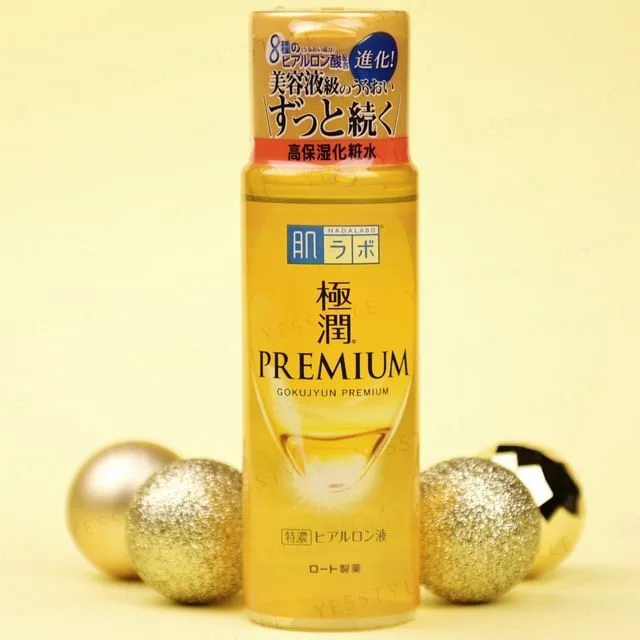
Hada Labo is the hydration house, split into two lines that people routinely conflate. Gokujyun is the hyaluronic acid range — Hada Labo Gokujyun Premium Hyaluronic Acid Lotion stacks something like eight different hyaluronic acid forms at different molecular weights, plus a ferment filtrate and a crosspolymer, in a formula whose entire personality is water-binding. Shirojyun is the whitening line, built on a different active entirely. Hada Labo Gokujyun Cleansing Oil extends the same idea to the cleansing step.
Senka is the cleansing house, and Senka Perfect Whip Facial Cleanser is the reason. It is a potassium-soap foam — potassium stearate, potassium myristate, potassium laurate — which is an old-fashioned true soap base rather than a synthetic detergent, engineered to produce a dense lather. It is genuinely excellent at what it does and it is alkaline, which matters if your barrier is fragile.
Melano CC is the vitamin C house, and it is the most interesting label on the shelf. Melano CC Intensive Spot Prevention Premium Beauty Essence carries free ascorbic acid alongside ethyl ascorbic acid, ascorbyl glucoside and ascorbyl tetraisopalmitate, plus allantoin and a mild topical antibacterial.
Curel is the sensitive-skin house, built around a synthetic pseudo-ceramide rather than the ceramide identical to human skin's, plus allantoin as an anti-irritant. Curel Hydrating Water Essence is the entry point and the ingredient list is notably short.
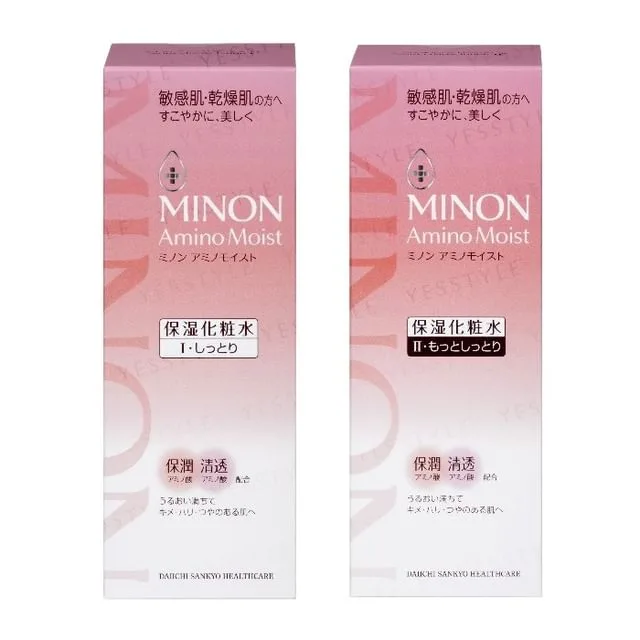
Minon takes the same brief and answers it with amino acids instead — Minon Amino Moist Charge Lotion II Moist runs serine, alanine, lysine, glycine, threonine, valine, histidine, proline and leucine alongside dipotassium glycyrrhizate. It is the most distinctive formulation philosophy on the shelf.
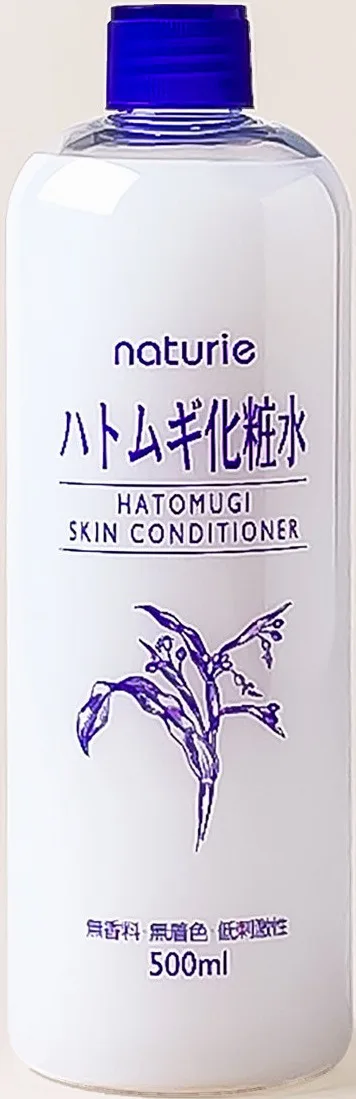
Hatomugi is the bulk-hydration house, built on Job's tears seed extract and sold in bottles large enough to use on your body. Hatomugi Skin Conditioner is minimalism at a price that makes generosity possible.
The label rule that inverts everything
Now the part that matters more than any product recommendation.
Japanese quasi-drugs do not label like cosmetics. They separate active ingredients — 有効成分 — from other ingredients, その他の成分, and the descending-concentration convention that governs ordinary cosmetic lists does not apply to them in the same way. Quasi-drug actives live in their own regulatory namespace, the Japanese Standards of Quasi-drug Ingredients, rather than in the cosmetics ingredient list.
Our own catalogue shows what that looks like in practice. The ingredient list for Hada Labo Shirojyun Premium Whitening Lotion opens with tranexamic acid and dipotassium glycyrrhizate — ahead of water. In a Western cosmetic that would mean the product is more than half tranexamic acid, which is chemically absurd. It is not a list of concentrations at all. Those two are the declared actives, printed first because they are actives, and the ordering carries no information about how much of anything is present.
The second rule is more consequential and much less known: a full ingredient listing is not required for Japanese quasi-drugs. The health ministry designates a set of ingredients that must be indicated — 138 of them — and the remainder may be omitted. So a quasi-drug label can be complete, compliant and still not tell you everything in the bottle.
The irony is sharp. Western readers often treat Japanese labels as a mark of rigour, when for the quasi-drug half of the shelf they convey strictly less information than a US or EU cosmetic list, which must be complete and ordered. The rigour lives in the premarket approval, not in the label. There is a third, milder trap too: Japanese lists use JCIA naming conventions and abbreviations that do not match INCI — Hatomugi Skin Conditioner literally prints "DPG" and "BG" for dipropylene glycol and butylene glycol. Pasting an export list into the Ingredient Decoder resolves those, and it is the fastest way to find out whether a product's short list is short by design or short by omission.
The actives that recur, and what each is approved to do
Once you know the tier, the same handful of molecules appear everywhere, and each has a specific approved purpose rather than a marketing one.
Tranexamic acid is the signature. Approved as a whitening quasi-drug active in Japan in 2002, it appears across the entire drugstore whitening shelf and is the reason that shelf is credible at the price. It works upstream of melanin production through the plasmin pathway rather than by inhibiting tyrosinase directly, which is also why it behaves differently from arbutin or kojic acid on the same skin.
Dipotassium glycyrrhizate, a licorice derivative, is the tier's default anti-inflammatory and turns up in almost everything aimed at sensitive skin. Allantoin does similar work as a soothing agent. O-cymen-5-ol — isopropyl methylphenol — is an antibacterial that appears in the acne-adjacent and vitamin C products.
Vitamin C is where the tier is most oversold, and it is worth being precise. The Melano CC essence carries free L-ascorbic acid, which is the form with the strongest absorption evidence, but it also carries three derivatives. Percutaneous absorption work found that magnesium ascorbyl phosphate, ascorbyl-6-palmitate and dehydroascorbic acid did not increase skin levels of L-ascorbic acid — so a stack of four vitamin C forms is, in absorption terms, mostly one vitamin C form and three label ingredients. The product is not bad; the multi-form framing is doing more work in the marketing than in the tissue.
One genuine tradition worth naming: rice bran oil and rice bran ferment run through Japanese formulation history the way olive oil runs through Mediterranean cosmetics, and it predates every regulatory category discussed here.
Import realities, and where this tier is not the answer
Buying this shelf from outside Japan introduces problems the shelf itself does not have.
Export formulas frequently differ from domestic ones. A product sold in a Japanese pharmacy and the same product sold through an international distributor can carry different preservative systems, different fragrance, and — most importantly — different actives, because a whitening active approved as a quasi-drug in Japan may not be permitted in the same role elsewhere. The name on the box being identical is not evidence that the formula is.
Grey-market sellers are the norm rather than the exception for this category, and the consequences are mundane rather than dramatic: stock that has sat in a warehouse, no recourse if a batch is wrong, and packaging in Japanese with no English ingredient list. Check batch codes where you can, buy from sellers with visible turnover, and treat vitamin C products with particular suspicion, since free ascorbic acid oxidises and a bottle that has aged in transit is delivering degradation products. If a Melano CC essence arrives amber, that is not a formulation quirk.
Also worth stating plainly: nothing here is reviewed by the FDA or the MHRA. Quasi-drug approval is a Japanese regulatory status and it confers no standing abroad, which means the whitening claims that are legally substantiated in Japan are simply unregulated marketing copy by the time the product reaches you.
And the tier has real gaps. It is weak on retinoids, weak on exfoliating acids, and — a recurring complaint — many of the most popular products are fragranced, which sits awkwardly with the sensitive-skin positioning of half the shelf. It is superb at hydration, cleansing, soothing and pigment; it is not a complete routine.
The honest framing is that this is the best-value shelf in the world for a specific set of jobs, not a universally superior one. If you want to test whether a Japanese drugstore product genuinely replaces something you are already paying more for, Dupe Finder makes that comparison explicit. Our drugstore toner list and drugstore cleanser list cover the Western equivalents worth weighing against it, and the Japanese sunscreen ranking covers the one category where the gap is not close. If the underlying question is whether paying more buys a better formula at all, whether 'medical grade' differs from drugstore answers it more generally than this shelf can.
Products mentioned
Independently reviewed and scored — the real products behind this piece.


- Ranked list Best Drugstore Toners The Western equivalents worth weighing against Hada Labo.
- Ranked list Best Drugstore Cleansers Where Senka's competition sits.
- Ranked list Best Japanese Sunscreens The one category where the gap is not close.
- Ingredient Hyaluronic Acid The molecule the Gokujyun line is entirely built around.
- Ingredient Vitamin C (L-Ascorbic Acid) Where absorption evidence undercuts the multi-derivative label.
- Ingredient Ceramides What Curel's pseudo-ceramide is imitating.
- Ingredient Rice Bran Oil A Japanese formulation tradition older than any of these regulatory categories.
- Question Is a 'medical-grade' product different from a drugstore one? The general version of the question this shelf raises.
References
- Topical L-ascorbic acid: percutaneous absorption studies — Dermatologic Surgery, 2001
- Timeline of the Development of Skin-Lightening Active Ingredients in Japan — Molecules, 2022
- Decoding the Ingredient Requirements for Japanese Quasi-drugs: JSQI and Other Ingredient Lists — ChemLinked (regulatory reference), 2022
- Japan Quasi-drug Regulation — ChemLinked Cosmepedia (regulatory reference), 2023
Every cited link is verified to resolve to the paper named. Where a source could not be independently confirmed, it is listed without a link rather than pointing you somewhere wrong.
Frequently asked
Why does a Japanese ingredient list sometimes start with an active instead of water?
Because quasi-drugs separate declared actives from other ingredients and print the actives first, outside the concentration ordering that governs ordinary cosmetics. Seeing tranexamic acid ahead of water does not mean the product is mostly tranexamic acid. It means that molecule is the approved active. The rest of the list carries much less positional information than a Western one.
Do Japanese labels tell you more than Western ones?
For ordinary cosmetics, roughly the same. For quasi-drugs, less — a full ingredient listing is not required, only a designated set of ingredients must be indicated, and the remainder can be left off. The rigour in the Japanese system sits in premarket approval of the active, not in label transparency, which is the opposite of what most enthusiasts assume.
Is tranexamic acid actually effective for pigmentation?
It has been an approved whitening quasi-drug active in Japan since 2002, which required demonstrating melanin suppression in controlled trials against placebo — a higher evidentiary bar than most brightening ingredients clear anywhere. It acts through the plasmin pathway rather than by inhibiting tyrosinase directly, so it behaves differently from arbutin or kojic acid and is often better tolerated.
Is a serum with four forms of vitamin C better than one with a single form?
Not necessarily, and possibly not at all. Absorption research found that several common ascorbate derivatives did not raise skin levels of L-ascorbic acid. A stack of four forms therefore tends to mean one form doing the work and three contributing to the label. Free ascorbic acid at a low pH remains the best-evidenced route, with the trade-off that it oxidises.
Are imported Japanese products the same as the domestic versions?
Often not. Export formulas can differ in preservatives, fragrance and even actives, since a quasi-drug active approved in Japan may not be permitted in the same role in the destination market. Add grey-market storage conditions and no local regulatory oversight, and the practical advice is to buy from high-turnover sellers, check batch codes, and be especially wary of vitamin C products that have travelled.