Cutting the Leaf Yourself Gets You a Latex Problem the Bottle Already Solved
Aloe has the best clinical case of any kitchen remedy — and the fresh-leaf version puts a manual processing step between you and the part that works.
Read the preview
From the DermApproved blog, in DIY and At-Home: aloe. It's the kitchen remedy with the best clinical evidence behind it. So cutting the leaf yourself feels obvious. But there's a layer between the rind and the clear gel — one the bottle already removed, and you have to remove it by hand. Every single time. For the full breakdown, visit dermapproved.com/blog.
Start from the unusual position: this one has real evidence
Most of what we write about home remedies involves explaining why an appealing story is not supported. Aloe is the exception, and it is worth saying so before complicating it.
A 2022 meta-analysis and systematic review of second-degree burns pooled four studies covering 133 patients and 163 wounds, and found a statistically significant mean difference in healing time of 4.44 days in favour of topical aloe. A separate review comparing aloe against silver sulfadiazine across eight studies published between 1988 and 2018 also found mean time to wound healing favouring aloe. Earlier pooling reported a larger gap still. The individual trials are small, the comparators vary, and blinding a green gel is hard — but the direction is consistent across decades and research groups, and for a plant extract that is a stronger record than almost anything else in the kitchen-remedy category.
We are not going to re-argue the efficacy case here; the aloe vera ingredient page covers the mechanisms, the polysaccharide fraction, and where the evidence thins out beyond burns.
This piece is about a narrower and more practical question that the efficacy literature does not answer. Given that aloe works, does it follow that a leaf off your own plant is better than something a factory processed? The answer is more interesting than yes or no, and it lives in the anatomy of the leaf.
Three layers, and the middle one is the problem
Cut an aloe leaf across and you get a cross-section with distinct zones.
Outermost is the tough green rind. Immediately beneath it, running along the vascular bundles, is a thin layer of bitter yellow exudate — the latex. Inside that sits the clear, slippery parenchymal gel that everyone is actually after.
The latex is a different substance chemically from the gel. It is where anthraquinones concentrate, principally aloin, and those compounds are pharmacologically active in their own right — they are the reason aloe latex has a long history as a stimulant laxative. On skin, anthraquinones carry irritant potential and are the component usually named when aloe appears on a sensitiser list.
'Filleting' the leaf, the term the industry uses, means removing the rind and draining and rinsing that latex layer away. It is not the same as scooping. When people cut a leaf and immediately press the cut face against a sunburn — which is the image in every video — they are dragging the highest-latex surface of the leaf directly across compromised skin, which is precisely backwards.
The correct home procedure, if you are going to do this: cut the leaf, stand it cut-end down in a glass for ten to fifteen minutes and let the yellow drip run out, then trim the rind away, then rinse the fillet under running water until it is no longer bitter or discoloured. That drip is the tell. If the liquid coming out is yellow, it is not gel.
The toxicology everyone half-remembers, corrected in both directions
There is a persistent internet claim that aloe vera causes cancer, and a matching counter-claim that this was debunked. Both are wrong in an instructive way.
The source is a two-year rodent bioassay in which orally administered non-decolorized whole leaf extract — containing roughly 6,400 ppm aloin A — produced carcinogenic findings in F344 rats. That study is real, well conducted, and should not be waved away, which is the failure mode of most industry responses to it. Aloe-emodin and aloin, both hydroxyanthraquinone derivatives, are the components implicated.
The correction matters just as much. A subsequent commentary in Toxicological Sciences argued that 'nondecolorized' is an essential qualifier that gets dropped every time the finding is cited — and it is right that this changes the meaning entirely. Decolorized products, produced by carbon filtration specifically to strip the anthraquinone fraction, are the industry standard at under 10 ppm aloin. That is roughly three orders of magnitude below the material tested. The route was oral, the species was rat, and the exposure was chronic.
So the honest reading is neither 'aloe is carcinogenic' nor 'that study was nonsense'. It is that the latex fraction is the fraction with a toxicology problem, that processing exists to remove it, and that a properly decolorized product has already had the thing the study was about taken out of it.
Which puts the DIY question in sharper relief. Commercial decolorization is a validated, measured step with a specification. Standing a leaf in a glass and rinsing it is the same idea performed by hand, at unknown efficiency, with no way to check the result.
What actually goes wrong with a fresh leaf
Beyond latex, three practical problems attend the windowsill version.
The first is spoilage. Fresh aloe gel is roughly 99% water with dissolved polysaccharides and no preservative system whatsoever. It is, from a microbiological standpoint, a nutrient broth. Once the leaf is cut the clock starts: the gel browns through enzymatic oxidation, the polysaccharides degrade, and anything introduced during handling has an ideal medium to grow in. Refrigerated in a sealed container, treat it as a few days. Not a fortnight, and certainly not the jar of blended aloe that has been in the door of the fridge since the holiday.
The second is provenance. A houseplant is not a sterile input. It has been watered, handled, dusted, possibly treated with a leaf-shine product or a systemic insecticide, and it sits in the ambient microbial environment of a room. None of that is alarming for intact skin, and all of it matters more if you are about to apply the result to a burn, an eczema flare or broken skin — which is exactly when people reach for aloe.
The third is what aloe is not. It is a humectant and a soothing agent with essentially no occlusive capacity. Applied neat, it draws water, feels cool, and then evaporates, sometimes leaving skin marginally drier than before — the reason a pure gel can feel wonderful for ten minutes and tight at twenty. That is a formulation gap, and it is one of the things a bottle fixes.
What the bottle is buying you, and where it cheats
A well-made aloe product is not a diluted version of the leaf. It is the leaf plus four things you cannot do at home.
Decolorization and filtration to a specified aloin ceiling, so the latex question is answered by a number rather than by whether you rinsed thoroughly. A preservative system, which is the reason a gel can sit in a warm bathroom for months without becoming a culture. Stabilisation of the polysaccharide fraction, which begins degrading in fresh gel almost immediately. And a stated percentage, so you know what you are applying — Holika Holika Aloe 99% Soothing Gel and Isntree Aloe Soothing Gel Fresh both put the number on the front for exactly this reason.
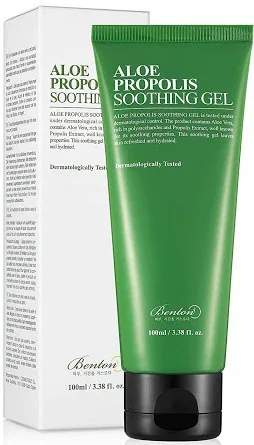
The fourth addition is the one that most improves on the leaf: companions that cover aloe's occlusive gap. Panthenol and allantoin pair with it constantly because they do the soothing and humectant job on a longer timescale, and a formulation like Cetaphil Soothing Gel-Cream with Aloe or Benton Aloe Propolis Soothing Gel holds the water in rather than letting it flash off. For after-sun specifically, a dedicated product such as Sun Bum Cool Down Aloe Vera Gel is built around staying on skin.
Now the fair criticism, because this is not a defence of the category. A great many products marketed on aloe are water, carbomer, a preservative and a token amount of aloe well down the list, sold at a price that implies otherwise. That is a real complaint and the reason to buy sceptically. The ingredient decoder will tell you where aloe actually sits in a given INCI list, which is the only way to distinguish a 99% gel from a gel with 0.1% aloe and a green tint.
The allergy question, and where this lands
Aloe appears on plenty of 'natural sensitisers' lists, which overstates a real but uncommon risk. The evidence deserves both halves.
On one side: a patch-test study of 702 consecutive patients, tested with an oily extract from aloe leaves, aloe powder from the entire plant, and concentrated aloe vera gel, produced no reactions at all. For an ingredient this widely used, that is a reassuring denominator, and it means routine allergic contact dermatitis to aloe is not something most people need to worry about.
On the other: case reports do exist, and the pattern in them is telling. Reported reactions cluster around raw plant material applied to already-compromised skin — the described cases include dermatitis after raw aloe juice was applied over legs with venous insufficiency, with secondary eyelid involvement. That is not the same exposure as a preserved, decolorized gel on intact skin.
The pattern maps exactly onto this article's argument. The fraction most likely to sensitise is the fraction processing removes, and the situations where it matters most are the ones where people are most tempted to use the raw leaf.
So: patch test before committing, especially with fresh leaf — our patch test tool covers a proper 48-hour protocol rather than a dab on the wrist. If something reacts, the contact dermatitis pathway covers working out what and treating it, and the eczema pathway is the right route if the underlying skin was already inflamed.
The verdict is narrower than either camp likes. For a sunburn on intact skin, with a leaf you drained and rinsed properly and used the same day: genuinely fine, pleasant, and backed by the best evidence in this whole category. For daily facial use, for eczema, for broken skin, or for anything you want to keep for longer than a weekend, the bottle wins on three specific counts — a verified aloin ceiling, a preservative system, and a formulation that does not evaporate off five minutes after you apply it. That is not the factory beating the plant. It is the factory doing three steps you would have to do by hand, and being able to prove it.
Products mentioned
Independently reviewed and scored — the real products behind this piece.



- Therapy guide Contact dermatitis If a patch test or real-world use reacts, especially to raw leaf
- Therapy guide Eczema The right route when the skin underneath was already inflamed
- Ingredient Aloe Vera The efficacy case, the polysaccharide fraction, and where evidence thins beyond burns
- Ingredient Panthenol (Pro-Vitamin B5) The companion that does aloe's soothing job on a longer timescale
- Ingredient Allantoin Pairs with aloe to cover the gap a pure gel leaves
References
- Second-Degree Burns and Aloe Vera: A Meta-analysis and Systematic Review — Advances in Skin & Wound Care, 2022
- "Nondecolorized" essential qualifier for NTP aloe vera study material — Toxicological Sciences, 2013
- Absence of contact sensitization to Aloe vera (L.) Burm. f. — Contact Dermatitis, 2005
- A Systematic Review and Meta-Analysis Comparing Burn Healing Outcomes Between Silver Sulfadiazine and Aloe vera — Cureus, 2022
Every cited link is verified to resolve to the paper named. Where a source could not be independently confirmed, it is listed without a link rather than pointing you somewhere wrong.
Frequently asked
How do I get the latex out of a leaf I cut myself?
Stand the cut leaf upright, cut end down, in a glass for ten to fifteen minutes so the yellow exudate drains out. Then trim the rind away and rinse the clear fillet under running water until it is neither bitter nor discoloured. Pressing the freshly cut face straight onto skin does the opposite — it applies the highest-latex surface directly.
Is it true that aloe vera causes cancer?
That claim comes from a rodent bioassay of orally administered non-decolorized whole leaf extract containing around 6,400 ppm aloin. Decolorized products, which is the industry standard, sit under 10 ppm. The finding is real and it is about the latex fraction, oral dosing and chronic exposure — not about a decolorized topical gel.
How long does fresh aloe gel keep in the fridge?
Days, not weeks. It is roughly 99% water with dissolved polysaccharides and no preservative, so it browns through oxidation and supports microbial growth readily once cut. If you are going to use fresh leaf, cut what you need for that day rather than blending a batch to keep.
Am I likely to be allergic to aloe?
Probably not. A patch-test series of 702 consecutive patients using leaf extract, aloe powder and concentrated gel produced no reactions. Case reports do exist, and they cluster around raw plant material applied to already-damaged skin — which is a good argument for patch testing before you put fresh leaf on a burn or an eczema flare.
Why does pure aloe gel leave my skin feeling tight?
Because it is a humectant with essentially no occlusive capacity. It draws water to the surface, feels cool while it is wet, then evaporates and can take some of that water with it. Pairing it with panthenol, allantoin, glycerin or a light lipid layer is what turns the cooling sensation into actual retained hydration.