You Can Mix L-Ascorbic Acid at Home. Keeping It Alive Is the Hard Part.
The one home formulation with a genuinely coherent case, taken apart on its own terms: the pH window, the oxidation clock, and what a browning serum has actually become.
Read the preview
From the DermApproved blog, in DIY and At-Home: mixing your own vitamin C. The powder costs nothing and it's the same molecule the branded bottle uses — so the case looks airtight. It isn't. There's a pH window you can't confirm without equipment, and a clock that starts the moment water touches it. Browning isn't just weaker. For the full breakdown, visit dermapproved.com/blog.
Why this one deserves a serious answer
Most home skincare recipes collapse the moment you ask what the active is supposed to be doing. Lemon juice on dark spots, baking soda as an exfoliant, coconut oil as a moisturiser for acne-prone skin — these fail at the level of the premise, and dismantling them takes a paragraph.
Mixing your own vitamin C is not in that category, and pretending otherwise costs credibility. L-ascorbic acid is sold as a food-grade powder for a few cents a gram. It is chemically identical to the ascorbic acid in a laboratory-formulated serum — there is no proprietary variant. The concentration that the evidence supports is easy to weigh out on a jeweller's scale. Someone looking at a small tub of powder and a costly bottle of serum containing the same molecule at a known percentage is not being irrational. They are doing arithmetic, and the arithmetic is correct as far as it goes.
What follows is where it stops going. Not because home chemistry is beneath anyone, but because ascorbic acid in water is one of the least cooperative molecules in cosmetic formulation, and every constraint below is a measurement problem rather than an effort problem. Effort you can supply. Measurement you cannot, without instruments.
The pH window does two jobs, and you cannot see either of them
The foundational work here is a percutaneous absorption study that applied ascorbic acid and several derivatives to skin and measured what actually got in. Three findings from it govern everything else.
First: L-ascorbic acid must be formulated below pH 3.5 to enter the skin. Above that threshold the molecule is increasingly ionised, and the ionised form does not cross the stratum corneum. This is not a gradient you can partially satisfy — it is a gate.
Second: maximal absorption occurred at 20%. Beyond that, more powder does not deliver more vitamin C. The 30% homemade serum is not stronger; it is the same delivery with more irritation and more suspended solids.
Third, and least discussed: tissue levels saturated after three daily applications, and the half-life of disappearance from tissue was around four days. Skin behaves like a reservoir that fills and then holds. This is genuinely good news for the home formulator, because it means a serum does not need to be at full potency every single morning to keep the reservoir topped up — but it also means that a batch quietly degrading over three weeks does not announce itself as a sudden loss of effect.
Here is the practical trap. Ascorbic acid at 15–20% dissolved in plain water lands somewhere around pH 2.2–2.5 — comfortably inside the absorption window, and low enough to sting significantly and to irritate compromised skin. Bringing it up toward 3.0–3.4 means adding a base in small increments. And pH strips resolve to roughly half a unit, which is the entire width of the usable range. Without a calibrated meter you genuinely do not know whether you have made a functional serum, an unnecessarily aggressive one, or something above 3.5 that will not penetrate at all. Our ingredient decoder can tell you what is in a commercial formula; nothing can tell you the pH of yours by eye.
The oxidation clock starts when the water goes in
Ascorbic acid is an antioxidant, which is another way of saying it is extremely easy to oxidise. That is the mechanism, not a manufacturing defect.
A modelling review of ascorbate oxidation kinetics identified the dominant loss pathways in solution as reactive oxygen species and transition metals — specifically iron and copper. That detail matters more at a kitchen counter than in a lab, because tap water carries dissolved iron and copper from plumbing, and distilled water does not. A homemade serum mixed with tap water starts with catalyst already in the bottle.
The other three variables are temperature, light and headspace air, and their effects are ordinary chemistry. Formulation stability work consistently finds storage temperature to be the single largest determinant of degradation rate, with refrigerated samples holding potency substantially better than room-temperature ones. Even under controlled dark storage at room temperature, measurable double-digit potency loss over a couple of months is a normal result — and a kitchen with a window, a warm bathroom shelf, and a bottle opened daily is nothing like controlled storage.
So the honest home protocol looks like this: distilled water only, small batches sized to two weeks, an opaque bottle with minimal air space, refrigerated between uses, and a hard disposal date rather than a visual judgement. That is a real regimen and some people will happily run it. It is also the reason commercial formulations invest so heavily in airless pumps, opaque glass and anhydrous bases — they are solving the same problem with better tools. Our shelf life tool is the place to work out what your actual disposal date should be for any product, homemade or not.
What browning means, and the part people get wrong in both directions
Everyone knows a vitamin C serum that has turned yellow-brown is past its best. Fewer people know what the colour is, and there are two opposite errors in circulation.
The first error is treating colour as a binary. Ascorbic acid oxidises through a sequence — ascorbate to the ascorbyl radical to dehydroascorbic acid, which then hydrolyses irreversibly to 2,3-diketogulonic acid and onward to the coloured breakdown products. Visible yellowing means the sequence is well advanced; it does not switch on at a threshold. A faintly straw-coloured serum has already lost meaningful potency, and a clear one is not proof of freshness.
The second error runs the other way, and it is the one worth taking seriously. Ascorbate is not merely inert once oxidised — in the presence of free transition metal it can act as a pro-oxidant, reducing Fe(III) to Fe(II) and thereby accelerating the redox cycling that drives Fenton chemistry and increases hydroxyl radical yield. Crucially, that pro-oxidant behaviour is most pronounced when available ascorbate is low relative to the metal present, which is precisely the composition of an old, browning, tap-water-mixed serum.
It is worth being careful about how far that goes. This chemistry is well characterised in solution and in physiological systems; a controlled demonstration that a degraded topical serum causes oxidative damage to human skin in normal use is not something we can point you to. The correct posture is neither 'it's fine, just weaker' nor 'you are actively damaging your face'. It is that you are applying an unknown mixture of breakdown products with a plausible mechanism for harm and no remaining benefit, which is more than enough reason to throw it out. If it has gone amber, bin it — and note that the same rule applies to a commercial bottle that has sat open for eight months.
Ferulic and vitamin E: the upgrade that is not a stirring problem
The best-supported vitamin C formulation in the literature is not ascorbic acid alone. In a study of a topical solution combining 15% L-ascorbic acid with 1% alpha-tocopherol and ferulic acid, the addition of ferulic improved the chemical stability of the vitamins and doubled photoprotection against solar-simulated irradiation — from roughly fourfold to about eightfold, measured on both erythema and sunburn cell formation, with reduced thymine dimer formation alongside it.
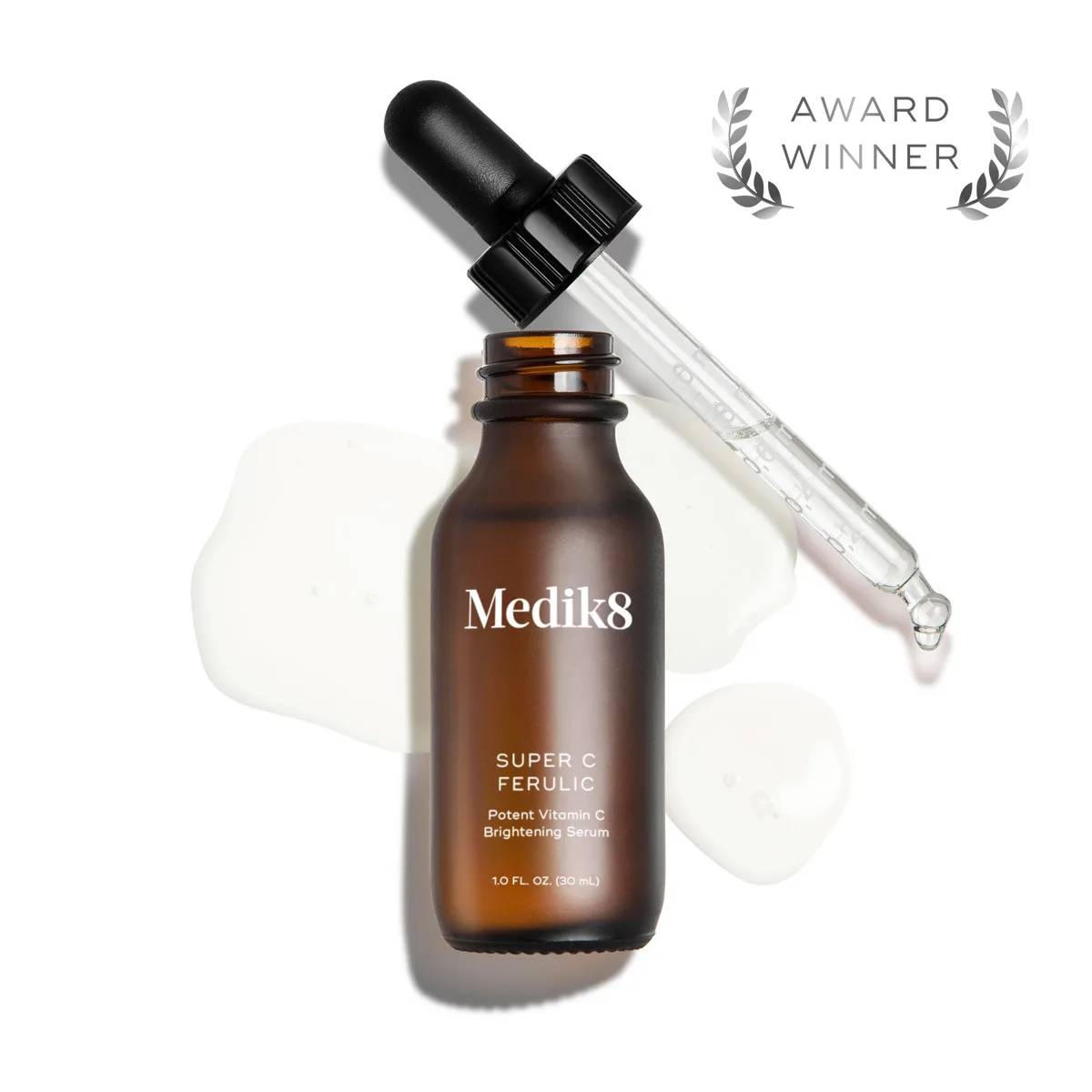
Doubling photoprotection is a serious result, and it explains why that particular trio became the reference architecture for a whole product category. SkinCeuticals C E Ferulic is the formulation that work describes; Medik8 Super C Ferulic is one of several that followed the same architecture.
Reproducing it at home is where the project changes character. Ascorbic acid is water-soluble. Alpha-tocopherol is oil-soluble and will not simply disperse into an aqueous solution. Ferulic acid is poorly soluble in water and needs a co-solvent system — typically propylene glycol or ethanol — to go in at all, and its own stability is pH-dependent. Combining all three into a single clear, stable phase is a genuine formulation exercise involving solvents, solubilisers and pH control that interact with each other. Stirring powder into water is not a smaller version of this. It is a different task.
That is the honest boundary of the DIY case: plain ascorbic acid in water, achievable with discipline. The evidence-backed combination, not realistically.
The alternatives, and exactly where each one gives something up
If the conclusion is that you would rather not run a two-week refrigerated batch cycle, there are three commercial routes around the instability, and each pays for it differently.
Derivatives are the most common. Magnesium and sodium ascorbyl phosphate, ascorbyl glucoside and tetrahexyldecyl ascorbate are all far more stable than free ascorbic acid, and they are the reason a serum can sit on a shelf for a year without browning. What they give up is proven delivery. In the same absorption study that established the pH threshold, magnesium ascorbyl phosphate, ascorbyl-6-palmitate and dehydroascorbic acid all failed to raise skin levels of L-ascorbic acid — the conversion step that derivatives depend on cannot be assumed. Something like The Ordinary Ascorbyl Glucoside Solution 12% is an entirely reasonable low-irritation option, provided you understand you are buying tolerability and stability rather than the delivery figures that the ascorbic acid literature reports.
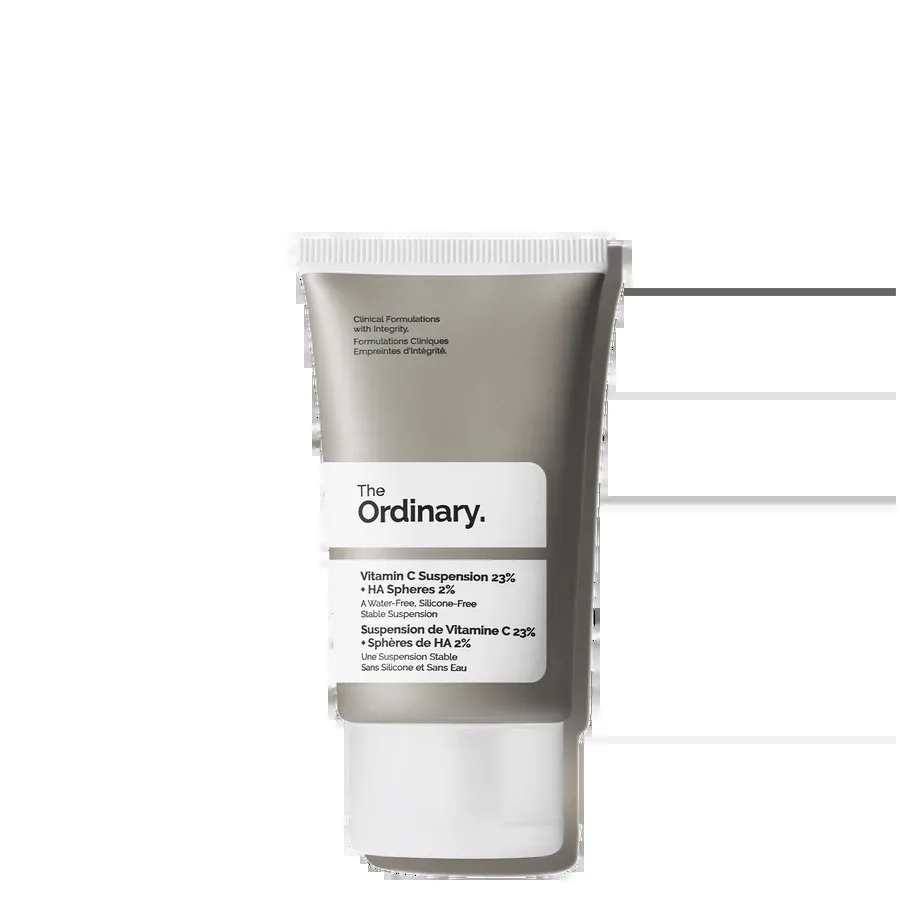
Anhydrous suspensions take the opposite approach: keep the real molecule, remove the water. The Ordinary Vitamin C Suspension 23% + HA Spheres 2% is powdered ascorbic acid held in a non-aqueous base, which is why it does not brown and also why it feels gritty. The trade is that dissolution and any pH effect happen on your skin, using your own moisture, which is less controlled than a solution but far more stable in the bottle.
The third route is simply solving the packaging: real L-ascorbic acid in water, protected by opaque, low-air-ingress containers and sold in modest volumes. L'Oréal Paris Revitalift Derm Intensives 10% Pure Vitamin C Serum and COSRX The Vitamin C 13 Serum both sit in this lane, and it is the closest commercial analogue to what a careful home formulator is trying to build.
The verdict is narrower than either camp wants. Home-mixed ascorbic acid is real chemistry that can work, on a short clock, with distilled water, a scale, a pH meter and a refrigerator. Without all five it is a serum of unknown pH and unknown remaining potency, which is the one thing worse than a commercial product you found mildly overpriced. Our vitamin C ingredient page covers concentration and form in more depth, the vitamin C routine shows where the step sits, and if you want the shortlist rather than the chemistry, our vitamin C ranking, the drugstore version and the dark-spot list are sorted on formulation rather than marketing. One practical note if you are also treating breakouts: using vitamin C alongside acne treatment covers the layering order, because the low pH interacts with more than your skin.
Products mentioned
Independently reviewed and scored — the real products behind this piece.




- Routine Building a Vitamin C Skincare Routine That Actually Works Where the step sits in a full morning sequence
- Ranked list Best Vitamin C Serums Sorted on formulation and form rather than marketing claims
- Ranked list Best Drugstore Vitamin C Serums The accessible end, where the DIY cost argument is weakest
- Ranked list Best Vitamin C for Dark Spots For readers whose target is pigment specifically
- Ingredient Vitamin C (L-Ascorbic Acid) Concentration, form and the differences between derivatives in depth
- Question Can I use vitamin C alongside my acne treatment? Layering order when a low-pH serum meets an acne active
References
- Topical L-ascorbic acid: percutaneous absorption studies — Dermatologic Surgery, 2001
- Ferulic acid stabilizes a solution of vitamins C and E and doubles its photoprotection of skin — Journal of Investigative Dermatology, 2005
- Ascorbate oxidation by iron, copper and reactive oxygen species: review, model development, and derivation of key rate constants — Scientific Reports, 2021
Every cited link is verified to resolve to the paper named. Where a source could not be independently confirmed, it is listed without a link rather than pointing you somewhere wrong.
Frequently asked
How long does a homemade ascorbic acid serum actually last?
Plan on about two weeks, refrigerated, in an opaque bottle with little air space, mixed with distilled rather than tap water. Storage temperature is the largest single determinant of degradation rate, and tap water contributes the iron and copper that catalyse the loss. Set a disposal date rather than judging by colour, because meaningful potency is gone before yellowing is obvious.
Is a 30% homemade serum stronger than a 20% one?
No. Absorption peaked at 20% in the percutaneous work that established the delivery figures, so additional powder above that buys irritation and undissolved solids rather than delivery. If you are mixing your own, 15–20% is the ceiling worth aiming at.
Can I test the pH with strips instead of a meter?
Not usefully. The functional range runs from roughly 3.0 to just under 3.5, and paper strips resolve to about half a pH unit — the width of the entire window. A strip cannot distinguish a serum that penetrates from one that does not, which makes it the wrong instrument for the only measurement that matters here.
My serum has turned faintly yellow. Is it still worth using?
No, and not only because it is weaker. Ascorbate can behave as a pro-oxidant when it is depleted relative to the free transition metal present, which describes an old aqueous serum precisely. There is no demonstrated benefit remaining and a plausible mechanism for harm, so the cost of discarding it is the only real cost.
Can I just add vitamin E and ferulic acid powder to my mix?
Not by stirring. Alpha-tocopherol is oil-soluble and will not disperse into water, and ferulic acid needs a co-solvent such as propylene glycol or ethanol to dissolve at all. Getting all three into one stable phase is a formulation exercise with interacting solubility and pH constraints, which is why the combination is where home mixing genuinely stops.