Castor Oil Grows Nothing. What It Actually Does Is Stranger and More Useful.
No trial has ever shown it produces a single new lash — and the one adverse event with its own case literature is weirder than anything on the bottle.
Read the preview
From the DermApproved blog, in DIY and At-Home: castor oil. No trial shows it grows a single lash — and yet people genuinely do look different after a month, for reasons that have nothing to do with growth. Meanwhile the one adverse event with its own case literature is far stranger than anything on the label. For the full breakdown, visit dermapproved.com/blog.
The claim, and the standard it would have to meet
There is a clean way to settle whether a topical grows eyelashes, and the industry already ran it — for a different molecule.
Bimatoprost was tested in multicentre, randomised, double-masked, vehicle-controlled trials with a validated global eyelash assessment scale. At week 16, 78.1% of treated subjects had gained at least one grade against 18.4% on vehicle, with statistically significant increases in measured length, thickness and darkness. The mechanism is understood: it increases the proportion of lash follicles in anagen and extends the time they spend there. Discontinue it and lashes return toward baseline over several months, which is itself evidence the drug was doing the work.
That is what a growth claim looks like when it is true. It has a mechanism, a controlled comparison, an effect size and a demonstrated reversal.
Castor oil has none of these. Not a weak trial, not a small trial, not an underpowered trial with a promising trend — no controlled trial of castor oil for eyelash or eyebrow growth exists to point at. This matters more than the usual 'more research is needed' shrug, because the research is not merely absent; the bar has been publicly cleared by something else in the same indication, using methods that were available the whole time. A cheap, popular, decades-old remedy with a genuine growth effect would be among the easiest studies in cosmetic dermatology to run.
And yet people are not imagining the change they see. That deserves an explanation rather than a dismissal.
Why conditioned lashes read as fuller without being more numerous
Four things happen when you coat a lash line in a heavy oil nightly, and all four are visible.
A viscous film increases the apparent diameter of each fibre and raises its specular gloss, so lashes catch light and photograph darker. The same film reduces the static separation between adjacent hairs, letting them sit in slight clusters that read as density rather than as clumping. Mechanical breakage falls, because a lubricated fibre survives rubbing, mascara removal and pillow friction better than a dry one — so more of the lashes you already grew reach the end of their cycle instead of snapping halfway. And the surrounding lid skin, being occluded, looks smoother, which changes the frame.
None of that is growth. All of it is a real, visible improvement, and dismissing it as placebo is both wrong and condescending.
There is a fifth factor worth naming honestly, because it inflates every before-and-after in this category: people start lash oils at the bottom of a loss. Extensions come off, an illness passes, the postpartum shed ends, a stressful year finishes. Lash follicles cycle over months and recover on their own schedule, and whatever was applied during the recovery gets the credit. This is regression to the mean, and it is the single most powerful engine behind every home remedy that appears to work on hair.
Ricinoleic acid, and the mechanism people quote incorrectly
Castor oil is chemically unusual, which is why it behaves unlike other plant oils. Roughly 90% of it is ricinoleic acid: an 18-carbon unsaturated fatty acid bearing a hydroxyl group at carbon 12. Most dietary and cosmetic fatty acids have no such group. That single hydroxyl is responsible for the oil's extraordinary viscosity, its solubility behaviour, and — as we will get to — probably its allergenicity too.
The headline pharmacology is well established. Work published in PNAS demonstrated that ricinoleic acid, released from the oil by intestinal lipases, activates EP3 prostanoid receptors on smooth muscle; in mice lacking EP3 receptors, both the laxative effect and the uterine contraction disappeared. That is a clean, mechanistically satisfying result and it explains two thousand years of castor oil's actual medical use.
It is also the finding most often misapplied. EP3 activation on intestinal and uterine smooth muscle is not evidence of a topical anti-inflammatory effect on skin, and the leap from one to the other is made constantly in wellness copy. Skin has no equivalent smooth-muscle target in the relevant sense, the delivery situation is entirely different, and no controlled topical work supports the extrapolation.
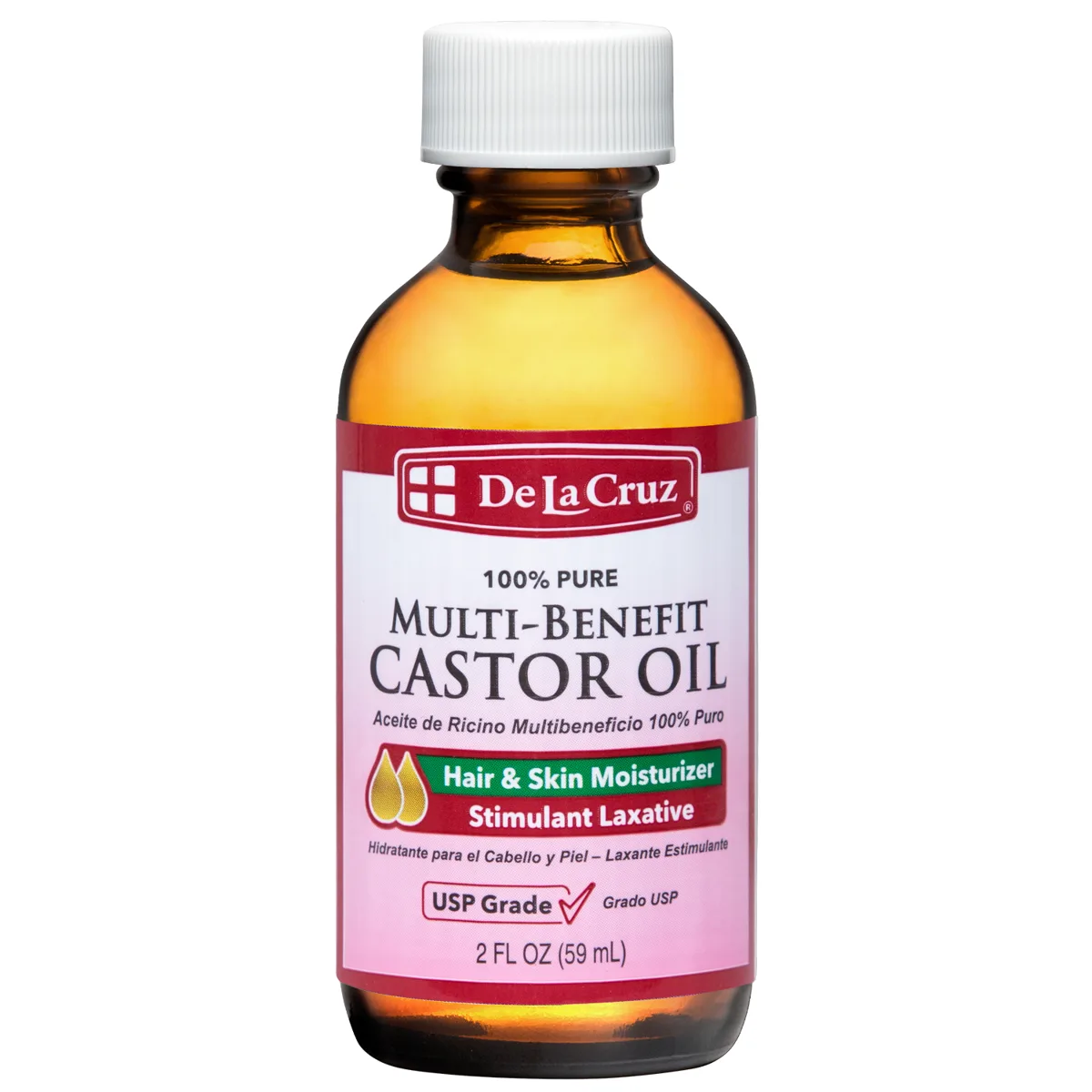
What castor oil demonstrably does on skin is simpler and unfashionable: it forms a durable occlusive film, it reduces transepidermal water loss, and it stays where you put it far better than a light oil does. For chapped lips, split cuticles, cracked heels and the dry patch that keeps coming back, that is genuinely useful behaviour and De La Cruz 100% Pure Expeller-Pressed Castor Oil does it about as well as anything. Our castor oil page sets out where it belongs in a formula.
Acute hair felting: the complication with a case literature
Every popular oil has a folk warning attached. This one has a published case report and a name.
Acute hair felting is a rare disorder in which scalp hair suddenly twists and mats into a hard, tangled mass — the descriptive term used in the literature is a bird's nest. A report in the International Journal of Trichology describes a twenty-year-old woman who applied coconut and castor oil before a hair wash and presented the next day with sudden matting. While drying, the lower length twisted and curled, and every attempt to detangle drew it tighter until the visible length had halved. The authors identify the high viscosity of castor oil combined with long hair as the contributing factors, and note the patient had used castor oil for the first time, for hair growth.
The clinically important sentence is the last one: the disorder is irreversible and the hair has to be cut off.
Proportion matters here. This is rare — one report is one report, and millions of people oil their hair without incident. It is not a reason for panic, and the practice of oiling hair has a long, sound tradition behind it. But it is the one adverse event specific to castor oil rather than to oils in general, it is mechanically explicable rather than mysterious, and it has a permanent outcome. The mitigations follow directly from the mechanism: dilute it in a lighter carrier rather than applying it neat, keep long hair sectioned and braided rather than loose, do not sleep in it on long hair, and detangle before washing rather than after.
The navel, taken seriously enough to answer properly
The practice of applying castor oil to the navel for hormonal balance, period pain or detoxification deserves a real answer rather than a laugh, because the people trying it are usually people whose actual symptoms have been dismissed elsewhere.
The anatomical claim is that the umbilicus is a special portal. It is not. It is a scar. In utero the umbilical vein and two arteries pass through it; after birth those vessels obliterate — the vein becomes the round ligament of the liver and the arteries become the medial umbilical ligaments, fibrous cords with no lumen. There is no patent channel from the skin of the navel to the peritoneum, the liver or the reproductive organs in a healthy adult. The skin covering it is ordinary skin with an ordinary stratum corneum, and if anything scar tissue is not more usefully permeable.
So whatever crosses there crosses by the same route it would on a forearm: passive diffusion through the stratum corneum, which is a very poor route for a large, viscous triglyceride. The navel is not doing anything special.
That said, the honest version does not stop at debunking. People who use warm castor oil packs across the lower abdomen frequently report genuine relief from cramping, and there is a plausible reason: sustained local heat, gentle pressure, and lying still for forty minutes are each independently effective for visceral pain, and doing all three at once is a reasonable self-care ritual. The relief is real. The explanation offered for it is not. If it helps, keep doing it — just don't skip a gynaecology appointment because a jar of oil is managing the symptom.
The allergy problem, the eye, and what to use instead
The risk that actually shows up in dermatology clinics is not felting. It is allergic contact dermatitis, and castor oil's profile here has been rising rather than falling.
Ricinoleic acid is repeatedly named in case series as a leading cause of allergic contact cheilitis from lip cosmetics, which makes sense given how much castor oil the category contains. Pigmented contact cheilitis specifically attributable to ricinoleic acid in lipsticks is documented in Contact Dermatitis. Allergic contact dermatitis from hydrogenated castor oil and 12-hydroxystearic acid has its own report. And there is a satisfying chemical coda: patch-test reactivity is absent to stearic and oleic acid, the non-hydroxylated analogues, which points to the 12-hydroxyl group itself as the structural requirement for allergenicity — the same feature that gives the oil its useful viscosity.
This is why the eye area is the worst place to experiment with it. Oil applied at the lash line migrates into the tear film within minutes; that causes transient blur, and repeated lid-margin occlusion is not something to undertake casually if you are prone to styes or lid irritation. If you are going to try it anywhere, patch test first — our patch test tool walks through a proper 48-hour protocol rather than the dab-and-hope version — and if something does react, the contact dermatitis pathway covers identification and treatment. The ingredient decoder is the fastest way to find out how much castor oil is hiding in the lip products you already own.
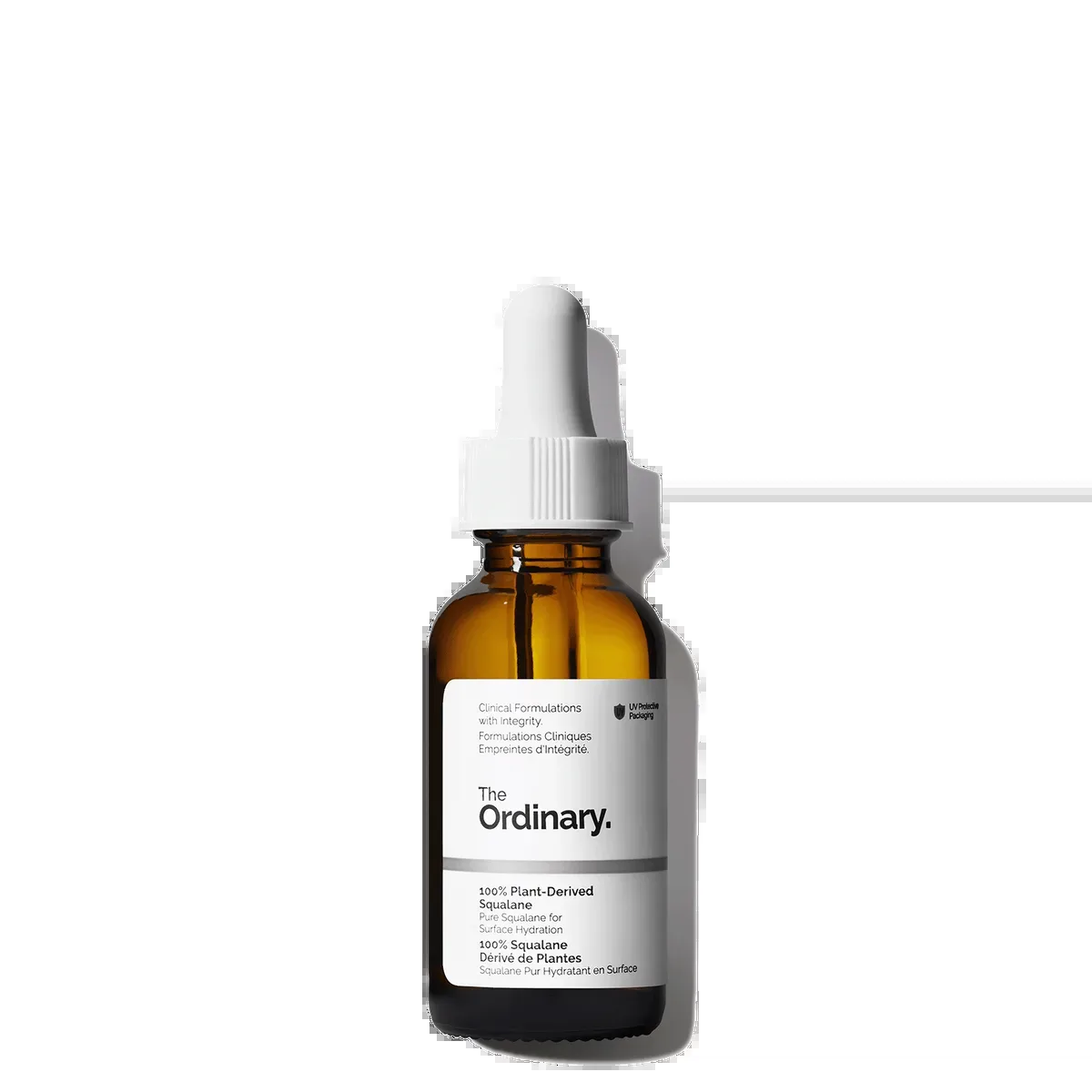
What to use instead, by goal. For genuine lash and brow growth, the honest answer is that the only thing with a controlled trial behind it is a prescription prostaglandin analogue, with its own real side effects including iris pigmentation change and periorbital fat loss — a conversation for a clinician, not a comment section. For lash condition without the viscosity risk, a formulated conditioner such as DHC 3-in-1 Eyelash Serum does the film-forming job in a base designed for the eye, and peptides and caffeine are the two ingredient families in this category with mechanisms worth reading about rather than ignoring. For facial use where you want conditioning without an occlusive that heavy, The Ordinary 100% Plant-Derived Squalane and Byoma Recovery Oil deliver the barrier benefit at a fraction of the viscosity and with a far cleaner allergen profile.
Castor oil earns a place on a shelf. It has just been sold on the one property it does not have.
Products mentioned
Independently reviewed and scored — the real products behind this piece.



- Therapy guide Contact dermatitis Identification and treatment if the patch test or real-world use reacts
- Ingredient Castor Oil (Ricinus Communis Seed Oil) Where the oil genuinely belongs in a formulation
- Ingredient Peptides One of two ingredient families in lash conditioners with a readable mechanism
- Ingredient Caffeine The other, and what its evidence base actually covers
- Question How do I treat my beard, brows and ears with a shampoo? For readers applying oils to brows where seborrhoeic dermatitis is the real problem
References
- Eyelash growth in subjects treated with bimatoprost: a multicenter, randomized, double-masked, vehicle-controlled, parallel-group study — Journal of the American Academy of Dermatology, 2012
- Castor oil induces laxation and uterus contraction via ricinoleic acid activating prostaglandin EP3 receptors — Proceedings of the National Academy of Sciences, 2012
- "Castor Oil" - The Culprit of Acute Hair Felting — International Journal of Trichology, 2017
- Pigmented contact cheilitis from ricinoleic acid in lipsticks — Contact Dermatitis, 2003
- Allergic contact dermatitis from 12-hydroxystearic Acid and hydrogenated castor oil — Dermatitis, 2009
Every cited link is verified to resolve to the paper named. Where a source could not be independently confirmed, it is listed without a link rather than pointing you somewhere wrong.
Frequently asked
Will castor oil make my eyelashes grow longer?
There is no controlled trial showing it produces new lash growth, and this is not a case of missing research in an obscure area — the same endpoint has been measured properly for a prescription prostaglandin analogue using a validated scale. What castor oil does do is coat, gloss and protect the lashes you already have, which reduces breakage and reads as fullness.
Why do my lashes look noticeably better after a month of using it, then?
A viscous film increases each fibre's apparent diameter and gloss, reduces static separation so lashes read as denser, and lubricates against the friction that snaps them. Add regression to the mean — most people start after a shed, and the follicles were recovering anyway — and you get a visible change with no growth involved.
Is it safe to put castor oil on my eyelids overnight?
It is the site we would be most cautious about. Oil at the lash line migrates into the tear film and causes transient blur, and repeated lid-margin occlusion is worth avoiding if you are prone to styes. Castor oil is also a rising contact allergen, so patch test on the inner forearm over 48 hours before it goes anywhere near an eye.
Can castor oil really mat my hair permanently?
It is rare and it is documented. A published case describes sudden irreversible felting after a first application, with the hair tightening at every detangling attempt until it had to be cut. High viscosity plus long loose hair is the mechanism, so dilute it in a lighter carrier, braid or section long hair, and detangle before washing rather than after.
Does putting castor oil in my navel do anything hormonal?
No. The umbilicus is a scar — the fetal vessels obliterate after birth into fibrous ligaments with no lumen — so there is no channel from that skin to any organ. Absorption there is ordinary transdermal diffusion, which is poor for a large viscous triglyceride. Warm abdominal packs may genuinely ease cramping through heat, pressure and rest, which is a real effect with a different explanation.