That 70% Acid You Bought Online Has No pH on the Label. That Is the Whole Problem.
Burn depth is governed by acidity and contact time, not by the percentage on the front — which makes the one number these kits print the one number that predicts nothing.
Read the preview
From the DermApproved blog, in DIY and At-Home: a bottle labelled seventy percent acid tells you little about what it will do to you. Researchers measured solutions at that same strength and found their acidity varied hundreds of times over. The label is not the dose — and the FDA has a file on what happens next. For the full breakdown, visit dermapproved.com/blog.
The percentage is the least informative number on the bottle
Buy a peel solution from a marketplace listing and you will get one figure in large type on the front: 30%, 50%, 70%. It reads like a dose. It is not a dose.
What determines how deep an acid goes into skin is how much of it exists in the free, un-neutralised acid form — which is a function of pH — multiplied by how long it stays there. Concentration contributes, but it is the weakest of the three variables, and it is the only one these products print.
The cleanest demonstration is nearly thirty years old. Researchers took seven commercially available glycolic acid solutions, applied them to facial skin, left them for thirty minutes, neutralised, and biopsied at 48 hours. The solutions sold as 70% glycolic acid spanned a pH range from 0.08 to 2.75. That is not a rounding difference. Because pH is logarithmic, the most acidic bottle in that range carries several hundred times the free hydrogen ion concentration of the least acidic one — while both print the same number on the label.
The histology followed the pH, not the percentage. Solutions below pH 2 demonstrated the potential to induce crusting and necrosis. The partially neutralised solutions above pH 2, at the same concentration, did not. The authors also noted the part that undermines the entire appeal of a stronger bottle: there is no evidence that creating necrosis produces a better peel result.
So the consumer buying "stronger" is not buying more effect. They are buying more unpredictability, priced by a number that does not describe what they are holding.
What the safety framework actually says, and who is documenting the failures
There is a published consensus on where these acids belong, and it is not vague.
The cosmetic industry's own safety review concluded that glycolic and lactic acid are safe in consumer products at concentrations of 10% or less, at a finished pH of 3.5 or above, with sun protection directions. For salon use the ceiling rises to 30% at pH 3.0 or above — but only in products designed for brief, discontinuous contact followed by thorough rinsing, applied by trained professionals, again with sun protection instructions. Every clause in that second sentence is load-bearing, and an unsupervised bottle from a marketplace satisfies none of them.
Regulators subsequently surveyed what was actually on shelves and found products below both thresholds — some consumer products under the recommended minimum pH, some salon products significantly under theirs. The framework existed; conformity did not.
What gives this real weight is who published the injury data. In 2025, authors from the FDA compiled 18 documented skin injuries following layperson application of chemical peel products, drawn from the agency's adverse event reporting system, from consumer reviews on a major marketplace, and from published literature. The agents involved were glycolic acid at 30 to 70% and trichloroacetic acid at concentrations up to 100%, several of them labelled as professional-grade. Injuries ran from superficial through partial to full-thickness. Half of the cases required emergency department, dermatologic or surgical care. Reported consequences included disfiguring scarring and reduced mobility. The patients spanned skin types II through VI and the face predominated, but injuries also occurred on eyelids, neck, chest, feet and buttocks.
Eighteen reported cases is a floor, not a ceiling — adverse event reporting for cosmetics is voluntary and catches a small fraction of what happens. That is the point worth holding onto: the number is small because the reporting is weak, not because the problem is rare.
TCA and phenol are not stronger versions of the same thing
It is tempting to picture peel agents on a single dial from mild to strong. They are not on one dial, and the medium- and deep-depth agents fail in categorically different ways.
A case published in 2022 describes a patient who applied 70% trichloroacetic acid, purchased online, to her entire face. There was immediate stinging and frosting. Hours later came diffuse erythema and oedema with hyperpigmented linear areas of demarcation, and skin shedding around the mouth and eyes — despite the solution having been washed off immediately. She also developed anaphylaxis requiring intramuscular adrenaline, hydrocortisone and intravenous chlorphenamine. Non-medical commercially available TCA is generally capped around 20%; what she bought was more than three times that.
Two things in that account are worth isolating. The first is that washing it off immediately did not prevent the injury, because TCA coagulates protein on contact and the reaction proceeds in the tissue rather than on it. The second is frosting. In a clinic, the white frost is the endpoint — the operator is reading the shade and evenness of it in real time to decide when to stop, and reading it correctly is a skill acquired over hundreds of treatments. Alone in a bathroom, frost is simply the moment you realise something is happening, which is already too late to change the outcome.
Phenol belongs in a different conversation entirely. Deep phenol peels are cardiotoxic through systemic absorption, are performed with cardiac monitoring and intravenous fluids, and are staged across facial regions specifically to limit absorption rate. Nothing about that is replicable at home, and its presence in consumer listings is the clearest signal that the marketplace is not filtering for safety.
The pigment risk, stated accurately rather than dramatically
The usual warning is that people with deeper skin tones should avoid peels. That is both unfair and wrong, and the accurate version is more useful.
A retrospective analysis of 473 superficial chemical peel treatments in patients with Fitzpatrick skin types III through VI found complications in 18 treatments — 3.8%. The commonest were crusting, post-inflammatory hyperpigmentation and erythema, each under two and a half percent. Every side effect resolved within eight months, and all were on the face. Skin type VI did carry higher odds of an adverse event, with an odds ratio of 5.14, and complications were less frequent in winter, which is a straightforward statement about ultraviolet exposure during healing.
Read that properly and it is reassuring about the procedure and damning about the setting. Superficial peels, performed by someone choosing depth deliberately and managing aftercare, are low-risk across the full range of skin tones. What converts them into a pigment problem is uncontrolled depth, no neutralisation, no sun protection during healing, and nobody to intervene when something goes wrong at week two.
That matters because post-inflammatory hyperpigmentation is far more consequential in richly pigmented skin — it is more intense, occupies a larger area, and lasts months to years rather than weeks. It is also the injury most likely to be mistaken for the thing the peel was supposed to fix, which sends people back for a second attempt on already inflamed skin. If you are unsure whether what you are looking at is pigment or a textural scar, that distinction has a specific answer on deeper skin, and the hyperpigmentation pathway sets out what actually clears it. If skin has already blistered or crusted after a treatment, the first 48 hours have their own protocol and it is not "apply something soothing and hope".
What you are actually paying a clinic for
The value proposition of a professional peel is frequently misread as the acid itself, which is why substituting a cheaper bottle feels like arbitrage. The acid is the least of it.
Preparation comes first. Skin is often primed for weeks beforehand — a retinoid, a tyrosinase inhibitor where pigment is a concern — which measurably changes how it responds and how it heals. Then agent selection: the choice between a hydroxy acid, TCA and a combination is made against your skin type, your pigment history, the specific problem, and the season.
During the procedure, the operator is doing two things a kit cannot. They are reading the endpoint continuously and stopping at it, and they are holding a neutraliser. Most home solutions ship with no neutraliser at all, which means the reaction ends when you decide it does, using judgment you have never had a chance to develop.
Afterwards there is aftercare that is actually enforced, and — the part nobody prices in until they need it — complication management. Someone to call at day three when a patch looks wrong, who can distinguish normal peeling from an early infection, prescribe when it is one, and start pigment suppression before post-inflammatory hyperpigmentation sets in rather than after. Whether a peel course is the right call for your specific problem in the first place is worth settling before any of this: whether peels are worth it for acne has a more qualified answer than the marketing suggests, and for textural damage the acne scarring pathway ranks peels honestly against the interventions that outperform them.
Where at-home acids are entirely reasonable
None of this is an argument against using acids yourself. It is an argument about depth, and the consumer range that respects the framework above is genuinely effective.
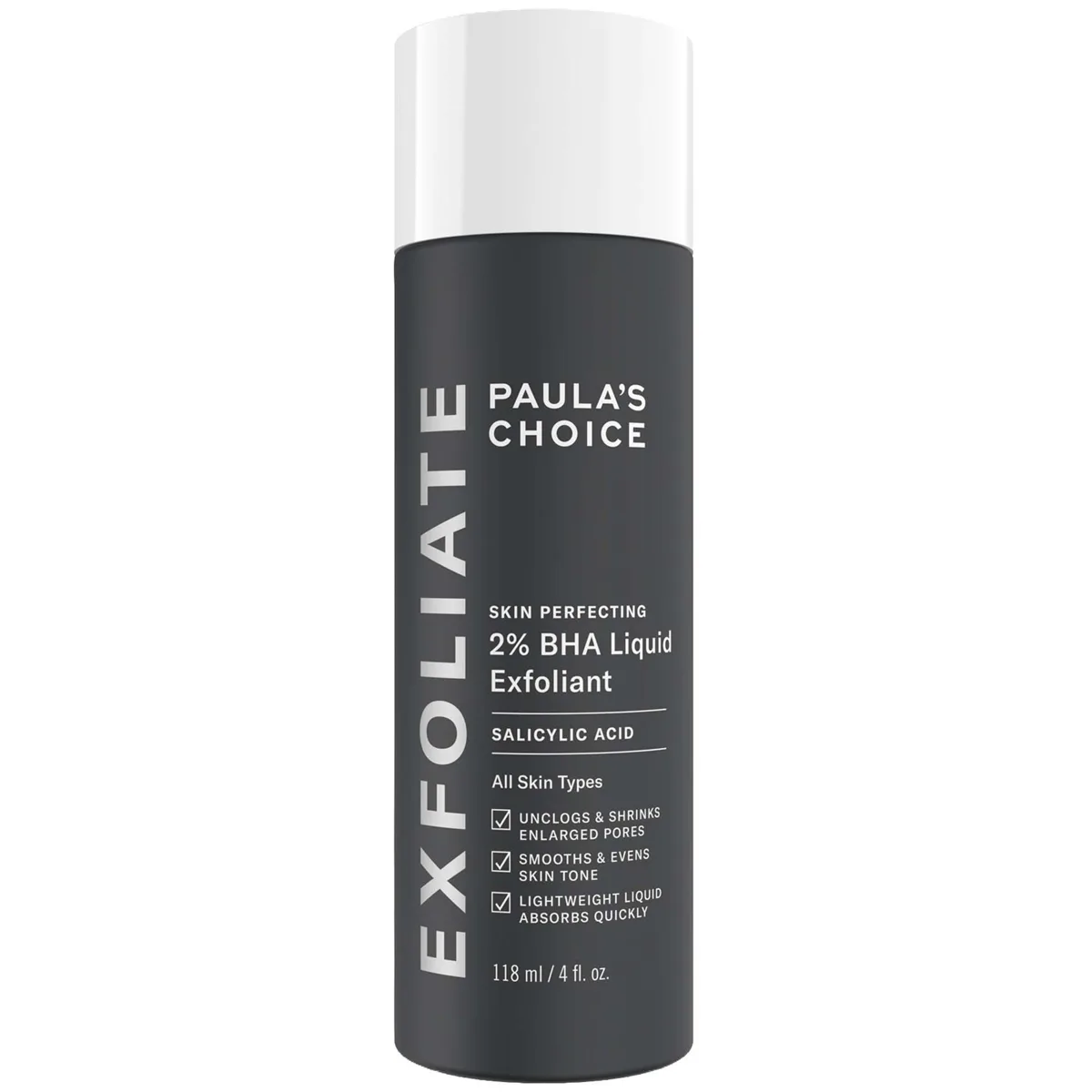
For congestion and blackheads, salicylic acid at consumer strength is the right tool because it is lipophilic and concentrates in the follicle. The Ordinary Salicylic Acid 2% Anhydrous Solution and Naturium BHA Liquid Exfoliant 2% are both straightforward leave-ons, and Paula's Choice 2% BHA Liquid Exfoliant is the long-standing reference formulation in the category.
For surface texture and dullness, low-concentration glycolic acid at a formulated pH does the work without any of the drama above; Krave Beauty Kale-Lalu-yAHA sits deliberately at the gentle end of that range. If your skin reacts to everything, a polyhydroxy acid is the sensible entry point — the larger molecule penetrates more slowly — and Geek & Gorgeous Calm Down PHA + BHA Liquid Exfoliant is built around exactly that trade. Our sensitive-skin exfoliant list is the shortcut if reactivity is the constraint.
Where pigment rather than texture is the target, azelaic acid is the more appropriate active — it addresses pigment without the barrier disruption that risks creating more of it, and The Ordinary Azelaic Acid Suspension 10% is the accessible version.
The consumer ceiling is a rinse-off with an explicit contact time. The Ordinary AHA 30% + BHA 2% Peeling Solution sits right at it, and the comparison with a marketplace bottle at the same headline percentage is instructive: this one has a formulated pH, a stated maximum contact time, an instruction to rinse, and explicit warnings about who should not use it. Those four things are the difference between a cosmetic product and an uncontrolled chemical exposure. It is still not a beginner product, and it should not be layered onto a routine already carrying a retinoid.
Two habits make all of this safer for almost no effort. Patch test anything new on a small area for several days before it goes near your whole face, and keep a record — the Patch Test Log exists so that a delayed reaction on day four is attributable to something rather than a mystery. And when a new acid produces spots in week two, use the Purging or Breaking Out? tool before you escalate, because treating irritation as if it were congestion is how a manageable reaction turns into the pigment problem this article opened with.
Products mentioned
Independently reviewed and scored — the real products behind this piece.




- Therapy guide Hyperpigmentation What actually clears post-inflammatory pigment once it has appeared.
- Therapy guide Acne scarring Where peels rank honestly against interventions that outperform them for texture.
- Ranked list Best Exfoliants for Sensitive Skin For readers whose limiting factor is reactivity.
- Ingredient Glycolic Acid (AHA) The agent whose pH-versus-concentration behaviour this article turns on.
- Ingredient Salicylic Acid (BHA) Lipophilic, so it concentrates where congestion is.
- Ingredient Azelaic Acid Pigment target without the barrier disruption that creates more pigment.
- Question Are chemical peels worth it for acne? A more qualified answer than the marketing gives.
- Question My skin blistered after a treatment — is that an emergency? The first 48 hours have a protocol.
- Question On deep skin, how do I tell pigment from a real scar? Pigment and texture need different treatment, and are easily confused.
References
- A histological comparison of 50% and 70% glycolic acid peels using solutions with various pHs — Dermatologic Surgery, 1996
- Skin Injuries Following Layperson Application of Chemical Peel Products — The Journal of Clinical and Aesthetic Dermatology, 2025
- High strength chemical peels—not to be tried at home — Health Science Reports, 2022
- Assessing the safety of superficial chemical peels in darker skin: A retrospective study — Journal of the American Academy of Dermatology, 2018
- A survey of consumer cosmetic products and salon preparations for alpha hydroxy acids — Journal of Cosmetic Science, 2002
- Glycolic acid peel therapy - a current review — Clinical, Cosmetic and Investigational Dermatology, 2013
Every cited link is verified to resolve to the paper named. Where a source could not be independently confirmed, it is listed without a link rather than pointing you somewhere wrong.
Frequently asked
If two bottles both say 70% glycolic acid, why would one burn me and the other not?
Because the percentage describes how much acid is in the bottle, not how much of it is chemically active. That depends on pH. Commercially sold 70% glycolic solutions have been measured anywhere from pH 0.08 to 2.75, and because pH is logarithmic that is a difference of hundreds of times in free acid available to the skin. In the study that measured it, the solutions below pH 2 caused crusting and necrosis and the partially neutralised ones did not.
What is a neutraliser, and does it matter that my kit did not come with one?
It matters a great deal. A neutraliser is an alkaline solution that stops a hydroxy acid reaction on demand, which is how a clinician controls depth rather than merely hoping the timer was right. Without one, the reaction ends when you have finished rinsing and the acid has been diluted enough to stop, which is slower and far less precise. A kit shipped without a neutraliser is a kit that has handed you the depth decision with no way to act on it.
Is it true that people with darker skin should not have chemical peels?
No, and the blanket version of that advice keeps effective treatment away from the people who most often need it. In a study of 473 superficial peels in Fitzpatrick types III to VI, complications occurred in 3.8% of treatments and all resolved within eight months. Type VI did have higher odds of a reaction, and winter treatment was safer. The risk lives in uncontrolled depth and poor aftercare, not in pigment itself.
I already applied something too strong and my skin is red and peeling. What now?
Stop every active immediately — no acids, no retinoid, no vitamin C — and reduce to a bland cleanser, a plain emollient and rigorous sun protection, because ultraviolet exposure during healing is what converts inflammation into lasting pigment. Blistering, weeping, spreading pain, or any sign of infection warrants same-day medical attention rather than a wait-and-see approach. Photograph it daily; the trajectory over the first three days is what a clinician needs to see.
Are the over-the-counter acids in ordinary skincare doing anything, or do I need the strong version?
They work, and they work on the same mechanism. Consumer-strength hydroxy acids at a formulated pH improve texture, congestion and surface pigment reliably over weeks, which is how the timescale actually runs. The strong version does not produce a faster version of that result; the study on glycolic depth found no evidence that causing necrosis improves the outcome. What escalation buys is risk, not speed.