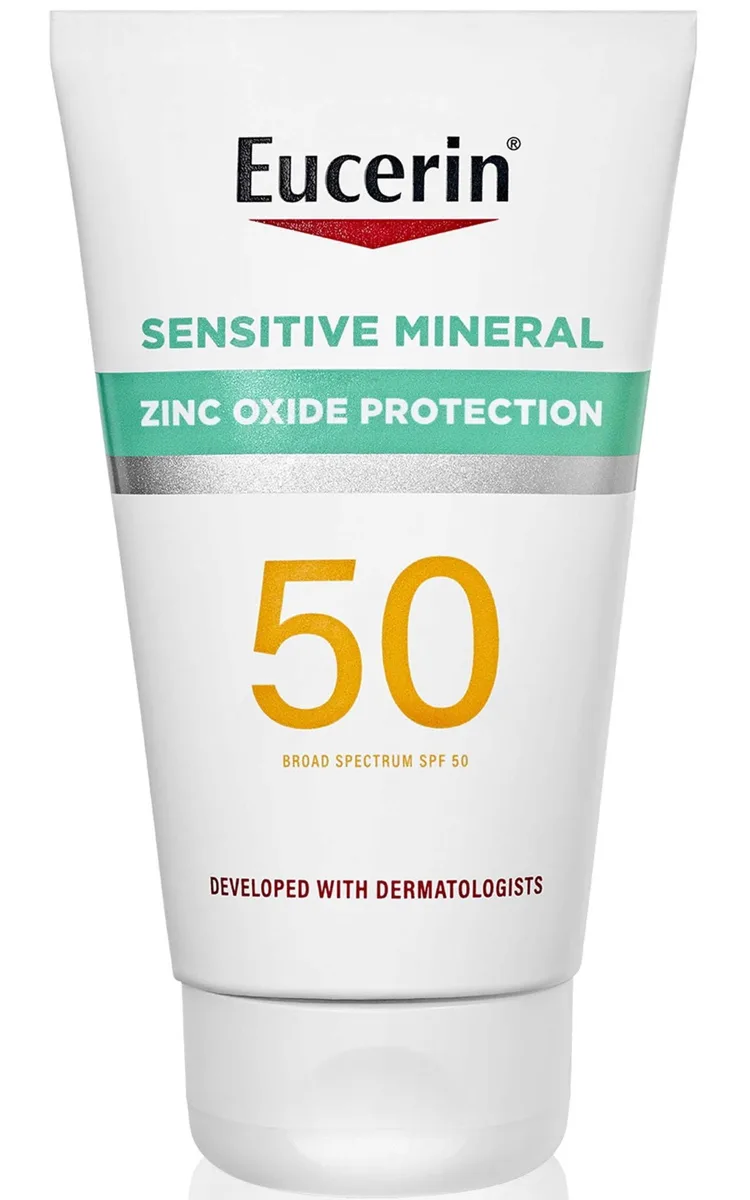
It relies on a single 24% zinc oxide active with no chemical filters at all, which is about as stripped-down and reactivity-friendly as broad-spectrum protection gets. The silicone dispersion system is engineered to make that heavy mineral load spread thin and minimize the chalkiness that usually plagues high-zinc lotions.
A no-chemical-filter, 24% zinc oxide sunscreen built squarely for skin that reacts to everything else. It's fragrance-free, genuinely gentle, water resistant, and spreads better than most high-zinc lotions thanks to its silicone base. The trade-offs are a thick texture, a faint cast on deeper tones, and a 4 oz tube that disappears fast on the body.
Good choicefor SensitivityIn your profileYou chose · No fragrance, drying alcohol, declarable allergens or sensitising preservatives in this lotion — the profile sensitive skin looks for.Not yet assessedGentleNo reviews collected yet
The case for it
Zinc Oxide has no evidence row yet for this concern — it is in the research queue.
The formula carries none of the triggers this concern is sensitive to.
What would change this: A researched evidence row for the lead active would replace this with a verdict.
Same rule for everyone. “Good choice” is the verdict on 1,938 of 45,024 concern verdicts across the catalog; rule F2 decided 1,938 of them.
Unchanged since September 5, 2026, engine 5.1.1.
Supporting rolefor RosaceaIn your profileYou chose · Nothing here targets rosacea directly; photoprotection against a known trigger is the recognised companion to treating it, and this lotion does that without known triggers.Not yet assessedGentleNo reviews collected yet
The case for it
Zinc Oxide has no evidence row yet for this concern — it is in the research queue.
The formula carries none of the triggers this concern is sensitive to.
What would change this: A researched evidence row for the lead active would replace this with a verdict.
Same rule for everyone. “Supporting role” is the verdict on 8,197 of 45,024 concern verdicts across the catalog; rule R8 decided 4,250 of them.
Unchanged since September 5, 2026, engine 5.1.1.
R8 — The category's job (barrier care, humectant hydration, gentle cleansing, photoprotection) is the documented supportive role for this concern. This is the honest verdict for a moisturizer on an acne page. · the full register
Full protectionfor Sun DamageIn your profileYou chose · Broad-spectrum SPF 50 with zinc oxide: the protection sun damage calls for.Moderate evidenceGentleNo reviews collected yet
The case for it
Zinc Oxide is a first-line active — approved, monograph-listed or named in current guidelines — for this concern.
It is present at an effective concentration, declared or high in the ingredient list.
The formula carries none of the triggers this concern is sensitive to.
Same rule for everyone. “Full protection” is the verdict on 2,288 of 45,024 concern verdicts across the catalog; rule P1 decided 2,232 of them.
Unchanged since September 5, 2026, engine 5.1.1.
P1 — Photoprotection standing is regulatory (M020 / Annex VI filters; 21 CFR 201.327 attaches the early-skin-aging claim to tested broad-spectrum SPF 15+). SPF 30 is the AAD daily-use bar. · the full register
Good choicefor Compromised Skin BarrierIn your profileYou chose · Dimethicone is a reference standard by mechanism for compromised skin barrier; this lotion carries it high in the ingredient list.Moderate evidenceGentleNo reviews collected yet
The case for it
Dimethicone & Cyclopentasiloxane Blend has trial-supported standing for this concern.
It is present at an effective concentration, declared or high in the ingredient list.
The formula carries none of the triggers this concern is sensitive to.
Same rule for everyone. “Good choice” is the verdict on 9,564 of 45,024 concern verdicts across the catalog; rule R5 decided 9,072 of them.
Unchanged since September 5, 2026, engine 5.1.1.
Promisingfor EczemaIn your profileYou chose · Dimethicone has trial-level evidence for eczema but no guideline or regulatory standing yet — promising, short of a recommendation; the other actives here are not yet assessed for it.Moderate evidenceGentleNo reviews collected yet
The case for it
Dimethicone & Cyclopentasiloxane Blend has trial-level evidence for this concern but no guideline or regulatory standing yet.
It is plausibly present at a working level, though the concentration is not declared.
The formula carries none of the triggers this concern is sensitive to.
What would change this: A declared concentration would move this to a firmer reading of the dose.
Same rule for everyone. “Promising” is the verdict on 7,858 of 45,024 concern verdicts across the catalog; rule R9p decided 7,858 of them.
Unchanged since September 5, 2026, engine 5.1.1.
R9p — 0.5.0: 'Unproven' beside three filled dots read as one question answered twice with opposite words (7,018 rows). The chip measures standing, the dots measure trial volume; where the row carries at least one RCT or a tier-2 source (moderate dots) and the active is present at a working level, the honest word is Promising. Unproven is reserved for plausible-standing rows with limited or weak evidence, or an under-dosed form. Same rank as Unproven — a bet either way; the dots order them. · the full register
Carrying active
Dimethicone & Cyclopentasiloxane Blend
Standing
plausible — trials support it
Form
plausible — studied range 1–5%, from the OTC monograph or label; needs leave-on contact
Tolerability
gentle
Row checked
against its sources on July 17, 2026 (evidence table ev-2026.09-r228)
Does the jobDoes what a sunscreen is for: UVA coverage, kind to the skin wearing it. Not measured from the label: pleasant enough to actually use.
A verdict is DermApproved’s assessment of how well a product’s ingredients fit a concern — never a claim about what the product treats. Evidence dots and collected reviews sit beside it and are never blended in.
Rules 0.5.1 · evidence table ev-2026.09-r228 · how we decide
Assessment
Pros & Cons
Pros
✓ Single 24% zinc oxide active, no chemical filters
✓ Fragrance-free and genuinely gentle on reactive skin
✓ Broad-spectrum SPF 50 that works on application
✓ Water resistant and doesn't sting the eyes
✓ Spreads and casts better than most high-zinc lotions
✓ Suitable for pregnancy and eczema-prone skin
✓ Fungal-acne safe formulation
Cons
✗ Thick texture requires deliberate effort to rub in
✗ Leaves a faint cast on deeper skin tones
✗ Small 4 oz tube empties fast on the body
✗ Richer base can feel heavy on oily facial skin
Review
Full Review
Some skincare products are interesting because of what they put in. This one is interesting because of everything it leaves out. Eucerin's Sensitive Mineral Sunscreen Lotion has exactly one UV active, zinc oxide at twenty-four percent, and that single-mindedness is the entire pitch. There are no chemical filters, no fragrance, no oxybenzone, no octinoxate, nothing that the substantial population of filter-reactive and allergy-prone people have learned to dread on an ingredient label. If you've spent summers cautiously sniff-testing sunscreens and bracing for the inevitable sting around your eyes or flush across your cheeks, the appeal here is immediate and obvious. This is a formula that aims to be unremarkable in the best possible way.
Zinc oxide is the workhorse, and at twenty-four percent it's carrying a serious load. Mineral filters protect by sitting on the skin and both scattering and absorbing UV across the UVA and UVB range, and zinc in particular is prized for its breadth of coverage and its gentleness. It begins working the moment it's on, with no wait for the film to bind, and it doesn't degrade in sunlight the way some chemical filters can. For sensitive, rosacea-prone, eczema-prone, or simply easily-irritated skin, an all-zinc formula is widely considered the safest broad-spectrum choice available, and this one delivers a legitimate SPF 50 to back that reputation up.
The formulation challenge with any high-zinc sunscreen is cosmetic, not protective, and this is where the supporting cast matters. Cramming twenty-four percent of a white mineral powder into a lotion that doesn't drag, chalk, or paint you ghostly is a real engineering problem, and Eucerin's answer is a silicone dispersion system. Dimethicone, cyclopentasiloxane, and a couple of specialized silicone surfactants disperse the zinc evenly and let it spread into a thin film rather than clumping. The result glides far better than a high-zinc lotion has any right to, and the white cast is minimized to the point where most fair-to-medium skin won't notice much after rubbing it in. A touch of tocopherol rounds things out as an antioxidant, adding a small secondary defense against the free radicals that any sunscreen lets slip through.
In use, this behaves like the thick, honest mineral body lotion it is. It's noticeably denser than a chemical sunscreen, and it asks for a bit of deliberate effort: you work it in section by section, rubbing until the brief whitish phase blends down, rather than slapping it on all at once. That's not a flaw so much as the nature of mineral protection, and the payoff is a finish that's natural and non-greasy rather than slick or shiny. It's water resistant, which makes it practical for actual outdoor use, and it stays put without the eye-stinging migration that plagues so many chemical formulas. There's no fragrance to speak of beyond the faint waxy-mineral note that comes with a beeswax-and-zinc base. Once it has set, it has a reassuring permanence to it that lighter chemical lotions lack, the kind of staying power that makes it genuinely suited to a long day outdoors rather than a quick errand.
The honest limitations track with what mineral sunscreens have always asked of us. The texture is thick and takes effort, which some people find tedious for full-body coverage. Deeper skin tones may still catch a faint cast despite the silicone dispersion, because no high-zinc lotion is truly invisible on rich complexions. And while the formula is genuinely gentle, it's a richer, more emollient base, so very oily skin may find it heavier than they'd like for facial use, even though it's technically fungal-acne safe and free of the usual problem ingredients. None of these are dealbreakers for the intended audience; they're the familiar price of admission for the gentlest protection on the shelf.
Value is the one place where I'd temper enthusiasm. The four-ounce tube is fine for the face or for exposed areas, but if you're using this as a true body sunscreen and applying the generous amount that SPF 50 protection actually requires, it empties in a matter of weeks, and there's no larger size to improve the per-ounce math. The price isn't unreasonable for a well-formulated mineral sunscreen from a legacy dermatology-aligned brand, but it's not a bargain either, and heavy body users will feel the repurchase cadence. You're paying for gentleness and simplicity rather than volume.
Who is this for? It's a near-default recommendation for anyone with sensitive, reactive, rosacea-prone, or eczema-prone skin who can't tolerate chemical filters or fragrance, and a sound everyday choice for pregnant users wanting a mineral-only option. It also suits people who simply prefer the reassurance of an ingredient list they can read top to bottom without a chemistry degree. Those chasing a weightless, invisible finish or covering large areas on a budget have more efficient options, but for the person whose skin treats most sunscreens as a provocation, this gentle, dependable zinc lotion is exactly the kind of boring that's worth buying.
Formula
Key Ingredients
The hero actives that drive this product's performance.
The sole active and the entire protective story here: a high 24% load of zinc oxide that physically reflects and absorbs across UVA and UVB, chosen because zinc-only mineral formulas are the gentlest broad-spectrum option for reactive, allergy-prone skin.
Regulator-approvedfor Sun Damage · limited certainty
A lipid-soluble antioxidant that backstops the zinc by neutralizing the free radicals from any UV that gets through, while also lending the silicone-rich emollient base a little extra stability against oxidation.
The silicone system is what makes a 24% zinc lotion spread without dragging or chalking; it disperses the mineral evenly into a thin film, cutting the white cast and giving the formula its slip on sensitive skin.
Established mechanismfor Compromised Skin Barrier · established mechanism
Ingredient standings describe the active at treatment-level doses and
vehicles; this product's own condition grades weigh its actual formula.
Best used as a body or face-and-body sunscreen over moisturizer; because it's a thicker mineral lotion, work it in section by section rather than all at once so the film stays even. Allow it to set before dressing to avoid transfer.
Results Timeline
Protection begins immediately on application, with no waiting period needed for a mineral filter. As a daily-use body sunscreen, its cumulative payoff is sun-damage prevention realized over months and years of consistent use.
The protective logic is straightforward and well supported: zinc oxide is a broad-spectrum inorganic UV filter that, unlike many organic filters, covers the long-wave UVA range that drives photoaging and contributes to pigmentation, and it does so without the photostability concerns that plague filters like unsupported avobenzone. At a 24% concentration it provides genuine SPF 50 protection, and decades of safety and efficacy data make zinc one of the best-characterized actives in sunscreen, which is precisely why it dominates formulations aimed at sensitive and pediatric skin. The more nuanced science here is cosmetic. The whitening and poor spreadability historically associated with high-zinc products stem from how the mineral particles aggregate; even dispersion is what determines both the thinness of the protective film and the visibility of any cast. The silicone system in this formula, built on dimethicone and volatile cyclomethicone-type silicones plus specialized silicone surfactants, functions as a dispersing and film-forming matrix that keeps the zinc uniformly distributed, improving both efficacy uniformity and finish. Tocopherol adds a lipid-phase antioxidant layer; topical vitamin E has documented free-radical-scavenging activity that complements UV filtration by addressing the oxidative stress generated by the small fraction of radiation any sunscreen transmits. There is nothing experimental in this formula, and for its sensitive-skin purpose that conservatism is a feature: the evidence base for zinc-only mineral sun protection is among the deepest in the category.
Dermatologist Perspective
For reactive, rosacea-prone, eczema-prone, and pediatric skin, mineral sunscreens using zinc oxide are a standard clinical recommendation, since the lone-active mineral approach minimizes the contact-allergy and stinging risks associated with chemical filters and fragrance. A 24% zinc formula provides reliable broad-spectrum coverage, and the absence of fragrance and chemical UV filters is consistent with what dermatologists typically advise for skin that flares easily or for patients recovering from procedures. The practical caution raised in clinics is application: mineral lotions are easy to under-apply because the thicker texture tempts a thin layer, so adequate quantity and even coverage are emphasized to achieve the labeled SPF. Water resistance makes it appropriate for outdoor and recreational use, and the conservative, well-documented profile of zinc oxide is part of why it remains a go-to suggestion for sensitive-skin sun protection.
Guidance
Usage & Recommendations
How to Use
Shake or squeeze a generous amount and apply liberally to all exposed skin at least 15 minutes before sun exposure. Because the high zinc content makes the lotion thick, work it in section by section, rubbing each area until the brief whitish phase blends into a thin, even film rather than trying to cover everything at once. Reapply at least every two hours, and immediately after swimming, toweling off, or heavy sweating. For facial use, a smaller amount layered over moisturizer works well; let it set before dressing or applying anything on top to limit transfer.
Value Assessment
The price is fair rather than generous. A well-dispersed 24% zinc oxide lotion from a legacy dermatologist-recommended brand is reasonably priced for what it is, and the gentleness and water resistance justify a step above bargain mineral sunscreens. The catch is the 4 fluid ounce tube: applied at the generous amount SPF 50 requires for body coverage, it runs out within weeks, and there is no larger size to bring the per-ounce cost down. For face-only or exposed-area use the tube stretches much further and the value improves. Heavy full-body users should expect frequent repurchasing, while reactive skin that simply can't tolerate alternatives will find the cost easy to justify.
Who Should Buy
This is a top choice for sensitive, rosacea-prone, or eczema-prone skin that reacts to chemical filters or fragrance, and a reassuring mineral-only option during pregnancy. Anyone who wants gentle, water-resistant broad-spectrum protection with a short, readable ingredient list will find it dependable.
Who Should Skip
If you want a weightless, completely invisible finish, the thick mineral texture and effort to rub it in may frustrate you. Deeper skin tones bothered by any cast, and budget-minded shoppers covering large areas daily, may be better served by a sheerer formula or a larger-volume sunscreen.
Ready to try Eucerin Sensitive Mineral Sunscreen Lotion SPF 50?
Thick, creamy mineral lotion with a silicone-smoothed glide; needs deliberate rubbing to work the high zinc load into a thin, even layer.
Scent
Fragrance-free, with only the faint waxy-mineral note inherent to a high-zinc beeswax base.
Packaging
4 fl oz squeeze tube, practical for body application and travel.
Finish
naturalnon-greasy
What to Expect on First Use
First application takes a little more rubbing than a chemical lotion because of the dense zinc content, and you may catch a brief whitish phase before it blends down. There's no tingling, stinging, or adjustment period, which is the point of a sensitive-skin mineral formula.
How Long It Lasts
About 3-4 weeks if used daily for full body coverage; considerably longer if reserved for the face or exposed areas only.
Eucerin developed its Sensitive Mineral line to serve the sizeable group of people who react to chemical sunscreen filters or fragrance, leaning on its hypoallergenic formulation heritage. Choosing zinc oxide as the lone active reflects a deliberate bet that simplicity and gentleness matter more than a featherweight finish for this audience.
About Eucerin Legacy Brand (20+ years)
Eucerin is a Beiersdorf brand established in 1900 with a long record of dermatologist collaboration; its sensitive-skin and mineral sun lines are formulated around hypoallergenic, fragrance-free principles backed by the company's UV research.
Brand founded: 1900 · Product launched: 2021
Myth vs. Reality
Common Myths
Myth
Mineral sunscreens don't protect as well as chemical ones.
Reality
A 24% zinc oxide formula like this delivers genuine broad-spectrum SPF 50 protection; mineral filters work as soon as they're applied and cover both UVA and UVB, the gap historically being cosmetic elegance, not efficacy.
Myth
Zinc oxide always leaves an unwearable white cast.
Reality
Cast depends on particle dispersion, not just zinc content. This formula's silicone system spreads the mineral thin to minimize whitening, though deeper skin tones may still notice a slight residue with a high-zinc body lotion.
FAQ
Frequently Asked Questions
Is Eucerin Sensitive Mineral Sunscreen 100% mineral?
Yes. Its only UV active is zinc oxide at 24%, with no chemical filters. That all-mineral, fragrance-free design is what makes it suitable for reactive and allergy-prone skin.
Does Eucerin Sensitive Mineral Sunscreen leave a white cast?
The silicone dispersion system keeps the cast minimal for a high-zinc lotion, and fair to medium skin usually sees little after rubbing it in. Deeper skin tones may notice a faint residue, as with most 100% zinc formulas.
Is Eucerin Sensitive Mineral Sunscreen safe during pregnancy?
Yes. It uses only zinc oxide as a mineral filter and contains no chemical UV filters, retinoids, or fragrance, which makes it a common mineral-only choice for those who prefer to avoid chemical sunscreens while pregnant.
Is this Eucerin sunscreen good for the face or just the body?
It works on both, but the rich, thick base suits dry to normal skin better on the face. Oily skin may find it heavy facially even though it's fragrance-free and fungal-acne safe; it's especially well suited as a sensitive-skin body sunscreen.
Is Eucerin Sensitive Mineral Sunscreen water resistant?
Yes, it's formulated to be water resistant, making it practical for outdoor and recreational use. As with any sunscreen, reapply after swimming, toweling off, or heavy sweating to maintain protection.
Why is Eucerin Sensitive Mineral Sunscreen so thick?
The thickness comes from its high 24% zinc oxide load. Mineral particles make a denser lotion than chemical filters, which is why you rub it in section by section; the silicone base helps it spread more easily than most high-zinc products.
Reviews
What Reviewers Tend to Say
Recurring themes our editors read across retailer reviews of this product — summaries in our words, not quotations, and not a substitute for your own patch test.
Common Praise
Genuinely gentle on reactive skin
No sting near eyes
Water resistant
Minimal white cast for a high-zinc lotion
Common Complaints
Thick and takes effort to rub in
Leaves a slight cast on deeper skin tones
Can feel heavy on oily skin
Notable Endorsements
100% mineral (zinc oxide only)Free of fragrance, oxybenzone, and octinoxate
IPL is a filtered flashlamp, a true vascular laser is one wavelength aimed at haemoglobin, and the choice between them turns on a distinction almost no consult makes: whether your redness is vessels or a state.
The fourth most frequent positive patch test in North America is an oxidation product of a molecule that occurs naturally in lavender. Nobody synthesised it into your face cream.
Western sensitive skincare works by subtraction — remove the fragrance, remove the alcohol, shorten the list. Japan's answer adds a designed molecule back in, and one of the two bets has a trial literature.
Products, answers, therapy guides, tools and articles in one search. Brand names,
slang and abbreviations all work — accutane finds isotretinoin, bacne finds truncal acne.