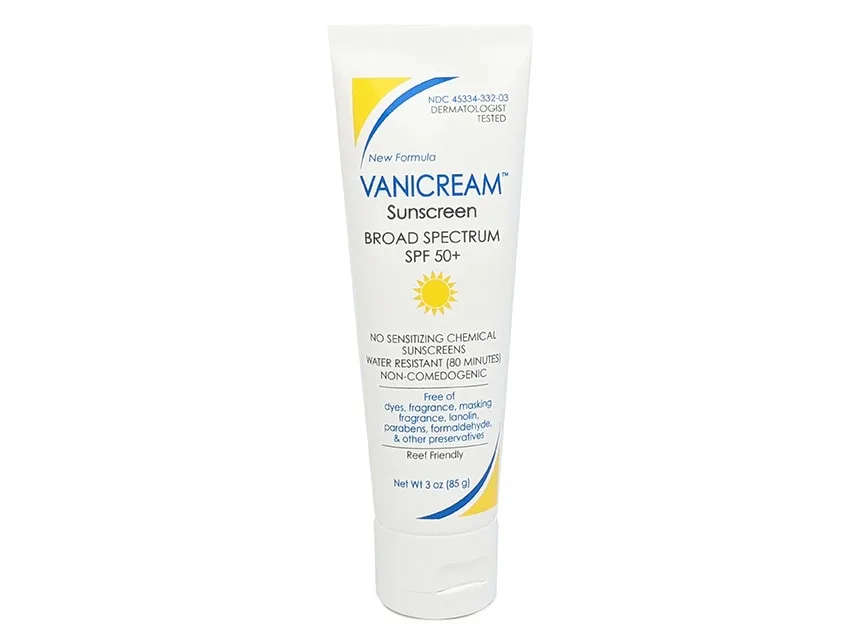
A single-filter mineral sunscreen using only zinc oxide at 12% to achieve SPF 50+ — no titanium dioxide, no chemical UV filters, and a remarkably short inactive ingredient list for a sunscreen formula. The 2021 reformulation doubled down on simplicity by removing the titanium dioxide from the previous version. For patients who need the absolute cleanest mineral protection, this is as stripped-back as SPF 50+ gets.
A no-compromise mineral sunscreen that prioritizes skin safety over cosmetic elegance. The white cast is real, the texture is thick, and the finish is far from matte — but for sensitive, rosacea-prone, and eczema-affected skin that can't tolerate chemical UV filters, this single-filter zinc oxide formula provides SPF 50+ protection with one of the cleanest ingredient lists in the sunscreen category.
Note: The current zinc-oxide-only formulation was introduced in 2021. Our assessment reflects this reformulated version with approximately 3,000 user reviews across platforms. The product has experienced intermittent availability issues. We'll update this review if reformulation or discontinuation occurs.
Verdicts
How well it fits each concern
Verdict by concern tap a concern for the case
Supporting rolefor RosaceaIn your profileYou chose · Nothing here targets rosacea directly; photoprotection against a known trigger is the recognised companion to treating it, and this cream does that without known triggers.Not yet assessedGentleNo reviews collected yet
The case for it
Allantoin has been researched for this concern and the evidence does not support it.
It is plausibly present at a working level, though the concentration is not declared.
The formula carries none of the triggers this concern is sensitive to.
What would change this: A declared concentration would move this to a firmer reading of the dose.
Same rule for everyone. “Supporting role” is the verdict on 8,197 of 45,024 concern verdicts across the catalog; rule R8 decided 4,250 of them.
Unchanged since September 5, 2026, engine 5.1.1.
R8 — The category's job (barrier care, humectant hydration, gentle cleansing, photoprotection) is the documented supportive role for this concern. This is the honest verdict for a moisturizer on an acne page. · the full register
Carrying active
Allantoin
Standing
none
Form
plausible — studied range 0.5–2%, from the OTC monograph or label; needs leave-on contact
Not for thisfor EczemaIn your profileYou chose · The actives here have been researched for eczema and the evidence does not support the claim.Not yet assessedGentleNo reviews collected yet
The case for it
Squalane has been researched for this concern and the evidence does not support it.
It is plausibly present at a working level, though the concentration is not declared.
The formula carries none of the triggers this concern is sensitive to.
What would change this: A declared concentration would move this to a firmer reading of the dose.
Same rule for everyone. “Not for this” is the verdict on 488 of 45,024 concern verdicts across the catalog; rule R10 decided 488 of them.
Unchanged since September 5, 2026, engine 5.1.1.
Good choicefor SensitivityIn your profileYou chose · No fragrance, drying alcohol, declarable allergens or sensitising preservatives in this cream — the profile sensitive skin looks for.Not yet assessedGentleNo reviews collected yet
The case for it
Zinc Oxide 12% has no evidence row yet for this concern — it is in the research queue.
The formula carries none of the triggers this concern is sensitive to.
What would change this: A researched evidence row for the lead active would replace this with a verdict.
Same rule for everyone. “Good choice” is the verdict on 1,938 of 45,024 concern verdicts across the catalog; rule F2 decided 1,938 of them.
Unchanged since September 5, 2026, engine 5.1.1.
Full protectionfor Post-ProcedureIn your profileYou chose · Broad-spectrum SPF 50 with zinc oxide: the protection post procedure calls for.Limited evidenceGentleNo reviews collected yet
The case for it
Allantoin has early or mechanistic evidence for this concern, not trial-backed standing.
It is plausibly present at a working level, though the concentration is not declared.
The formula carries none of the triggers this concern is sensitive to.
What would change this: A declared concentration would move this to a firmer reading of the dose.
Same rule for everyone. “Full protection” is the verdict on 2,288 of 45,024 concern verdicts across the catalog; rule P1 decided 2,232 of them.
Unchanged since September 5, 2026, engine 5.1.1.
P1 — Photoprotection standing is regulatory (M020 / Annex VI filters; 21 CFR 201.327 attaches the early-skin-aging claim to tested broad-spectrum SPF 15+). SPF 30 is the AAD daily-use bar. · the full register
Carrying active
Allantoin
Standing
plausible — trials support it
Form
plausible — studied range 0.5–2%, from the OTC monograph or label; needs leave-on contact
Tolerability
gentle
Row checked
against its sources on July 17, 2026 (evidence table ev-2026.09-r228)
Full protectionfor Sun DamageIn your profileYou chose · Broad-spectrum SPF 50 with zinc oxide: the protection sun damage calls for.Moderate evidenceGentleNo reviews collected yet
The case for it
Zinc Oxide 12% is a first-line active — approved, monograph-listed or named in current guidelines — for this concern.
It is present at an effective concentration, declared or high in the ingredient list.
The formula carries none of the triggers this concern is sensitive to.
Same rule for everyone. “Full protection” is the verdict on 2,288 of 45,024 concern verdicts across the catalog; rule P1 decided 2,232 of them.
Unchanged since September 5, 2026, engine 5.1.1.
P1 — Photoprotection standing is regulatory (M020 / Annex VI filters; 21 CFR 201.327 attaches the early-skin-aging claim to tested broad-spectrum SPF 15+). SPF 30 is the AAD daily-use bar. · the full register
Also listed for Compromised Skin Barrier — the actives here (Zinc Oxide, Allantoin, Squalane) are in our research queue for that concern; there is no verdict until their evidence rows are written. That is a gap in our table, not a mark against the product.
Does the jobDoes what a sunscreen is for: UVA coverage, kind to the skin wearing it. Not measured from the label: pleasant enough to actually use.
A verdict is DermApproved’s assessment of how well a product’s ingredients fit a concern — never a claim about what the product treats. Evidence dots and collected reviews sit beside it and are never blended in.
Rules 0.5.1 · evidence table ev-2026.09-r228 · how we decide
Assessment
Pros & Cons
Pros
✓ Single-filter zinc oxide formula — one of the cleanest mineral sunscreens at SPF 50+
✓ Does not irritate rosacea, eczema, or post-procedure skin
✓ Non-stinging near eyes — no chemical UV filters to cause burning during sweat
✓ Water resistant for the maximum FDA-allowed 80 minutes
✓ Pregnancy-safe mineral formula with no systemic absorption concerns
✓ Reef-friendly certified with no oxybenzone or octinoxate
✓ Allantoin and squalane provide soothing and conditioning benefits
Cons
✗ Noticeable white cast that is prominent on medium to deep skin tones
✗ Thick, pasty texture that requires effort to blend evenly
✗ Does not dry down matte — stays tacky and transfers to clothing
✗ Can pill or ball up when layered under makeup
✗ Three-ounce tube lasts only 1-2 months with proper daily application
✗ Intermittent availability and stock issues at multiple retailers
Review
Full Review
There is a tension at the heart of every mineral sunscreen: the more zinc oxide you add, the better the protection and the worse it looks on your face. Chemical UV filters dissolve invisibly. Zinc oxide sits on the surface and announces its presence with a white cast that ranges from 'subtle glow' to 'mime who forgot to finish their routine.' Vanicream's Sunscreen Broad Spectrum SPF 50+ lands firmly in the latter territory — and it doesn't apologize for it.
The 2021 reformulation made a deliberate choice: remove the titanium dioxide from the previous dual-mineral formula and rely entirely on zinc oxide at 12% as the sole active UV filter. This is an unusual approach. Most mineral sunscreens use a combination of zinc oxide and titanium dioxide to cover the full UV spectrum, with titanium dioxide handling the UVB range and zinc oxide providing broader UVA coverage. By going zinc-only, Vanicream simplified the formula and reduced one source of white cast — but at 12%, the remaining zinc oxide still makes its presence known. It's worth heading off a common objection here: that you can't reach SPF 50+ from a single mineral filter without chemical boosters. You can, and this formula proves it. The trick isn't the concentration so much as the vehicle — the salicylate esters (butyloctyl, isodecyl, and tridecyl salicylate) and the silicone crosspolymer lay down an even film that maximizes how efficiently the zinc oxide covers the skin.
The protection, however, is genuine. Zinc oxide is one of only two UV filters classified by the FDA as Category I — generally recognized as safe and effective — and it provides the broadest spectrum coverage of any single UV filter, extending into the long UVA I range where many chemical filters fall short. Research published in the Journal of the American Academy of Dermatology in 1999 demonstrated zinc oxide's superior photostability and UVA protection compared to other available filters. At SPF 50+, this formula is providing high-level protection through a single, well-studied ingredient. And while marketing loves the image of minerals bouncing UV off the skin like a mirror, the science is less cinematic: research has shown that zinc oxide and titanium dioxide protect primarily by absorbing UV (around 95%) and converting it to heat, with only a small fraction reflected — much the same mechanism as chemical filters. The 'physical barrier' framing is largely overstated.
The texture is this product's most polarizing feature. It's thick. It requires work to spread. The silicone crosspolymer helps somewhat with dispersibility, and the squalane prevents the dry, chalky feel that plagues some mineral sunscreens, but this is still not a cosmetically elegant product. It does not dry down to a matte finish. It stays somewhat tacky. It can pill under makeup. For users with oily skin, the dewiness crosses the line into greasiness, and the isopropyl isostearate means it isn't fungal-acne-safe.
But here's the thing: the people who need this sunscreen don't care about any of that. The person with perioral dermatitis who has tried six sunscreens and each one triggered a flare — they care about the ingredient list. The rosacea patient whose face turns crimson from the avobenzone in every chemical sunscreen — they care about the zinc oxide. The eczema sufferer who can't wear most sunscreens without itching and burning — they care about the absence of fragrance, botanical extracts, and chemical UV filters.
Allantoin is a thoughtful addition to the inactive ingredient list, providing genuine skin-soothing properties that complement the mineral filter and help calm residual irritation from sun exposure. Squalane serves as the primary emollient, keeping the formula from drying out the skin the way some zinc-only formulations can. A little lecithin rounds out the vehicle — and is the reason the formula isn't vegan.
The water resistance is rated at 80 minutes — the maximum the FDA allows — which makes this suitable for swimming, outdoor sports, and extended sun exposure, and it's reef-friendly certified. It doesn't sting the eyes, a common complaint with chemical sunscreens that run into the eyes when you sweat.
At around fifteen dollars for three ounces, the value is decent for a mineral SPF 50+, though the tube won't last long with proper daily application. Using the recommended quarter teaspoon for face and neck, you'll go through a tube in one to two months. This is standard for sunscreens but worth noting — sun protection isn't cheap when you use enough of it. One caveat that shapes the recommendation: the product has intermittent stock issues across retailers, and some specialty sites have marked it unavailable, which is a real concern for anyone who wants to rely on it daily. Its several thousand reviews average solidly and split exactly along its design — the non-irritating, sting-free protection is near-universally praised, the white cast and tacky, thick texture near-universally flagged.
Vanicream Sunscreen Broad Spectrum SPF 50+ is not trying to be the best-feeling sunscreen on the market. It's trying to be the most tolerable one. For skin that reacts to everything else, that distinction is more valuable than any matte finish or invisible application. You'll look a little white. You'll feel a little tacky. And your skin will be protected by a formula that has done everything possible to avoid causing harm.
Formula
Key Ingredients
The hero actives that drive this product's performance.
The sole active UV filter in this reformulated mineral sunscreen, providing true broad-spectrum protection across both UVA and UVB wavelengths. Non-nano zinc oxide sits on the skin surface without penetrating, making it inherently gentle for sensitive, eczema-prone, and rosacea-affected skin. Achieves SPF 50+ protection entirely through this single mineral filter.
Regulator-approvedfor Sun Damage · limited certainty
The primary emollient in this otherwise oil-free mineral formula, preventing the zinc oxide from creating the dry, chalky feel common in high-zinc sunscreens. Works alongside the glyceryl esters to give the cream its spreadability while providing skin-conditioning benefits that complement the sun protection.
Provides skin-soothing and anti-irritation benefits that complement the inherently gentle mineral filter. Helps calm any minor irritation from sun exposure and supports barrier recovery — particularly relevant for rosacea and eczema patients who need mineral-only sun protection without additional actives that could trigger sensitivity.
Limitedfor Post-Procedure
Ingredient standings describe the active at treatment-level doses and
vehicles; this product's own condition grades weigh its actual formula.
Apply as the final step of your morning skincare routine, after moisturizer and any treatment serums. Allow 15 minutes before sun exposure. Reapply every two hours during prolonged outdoor activity. The thick texture may pill under makeup — allow full absorption before applying cosmetics.
Results Timeline
Immediate UV protection upon application. Consistent daily use prevents cumulative UV damage and supports long-term skin health. Those with rosacea or sensitivity may notice reduced sun-triggered flushing within days of daily use.
Pairs Well With
lightweight moisturizer underneath for dry skinniacinamide serumazelaic acid treatment
The reformulated formula relies on zinc oxide as its sole UV filter — a choice supported by substantial research into zinc oxide's unique spectral coverage. A 1999 study by Mitchnick, Fairhurst, and Pinnell in the Journal of the American Academy of Dermatology demonstrated that microfine zinc oxide provides photostable broad-spectrum protection extending into the long UVA I range (above 360 nm), coverage that many chemical UV filters cannot match.
A comprehensive 2019 review by Schneider and Lim in Photodermatology, Photoimmunology & Photomedicine confirmed zinc oxide's advantages for sensitive populations: it is chemically inert on the skin, does not penetrate the stratum corneum, and does not generate free radicals under UV exposure the way some organic filters can. The review positioned mineral filters as the preferred choice for sensitive, pediatric, and pregnancy-related use.
One common misconception about mineral sunscreens was addressed by Cole, Shyr, and Ou-Yang in a 2016 study in Photodermatology, Photoimmunology & Photomedicine, which found that zinc oxide provides UV protection primarily through absorption (95-96%), not reflection. This debunks the popular notion that mineral sunscreens 'bounce' UV rays off the skin — they absorb UV radiation and convert it to heat, mechanistically similar to chemical filters but without the skin penetration concerns.
The FDA classifies zinc oxide as Category I (GRASE) — one of only two UV filters to receive this designation. Chemical UV filters including avobenzone, oxybenzone, and octinoxate have been asked to provide additional safety data due to evidence of systemic absorption, a concern that does not apply to mineral filters.
Dermatologists frequently recommend mineral-only sunscreens for patients with rosacea, eczema, contact dermatitis, and post-procedure skin — conditions where chemical UV filters can exacerbate inflammation and sensitivity. Dermatologists in everyday practice generally emphasize that zinc oxide's lack of skin penetration makes it the safest UV filter choice for compromised barriers. This sunscreen's minimal ingredient list further reduces the risk of sensitization, making it a reliable option for patients who have failed multiple chemical and combination mineral sunscreens. Dermatologists also recommend mineral-only sunscreens during pregnancy, as zinc oxide does not enter systemic circulation.
Guidance
Usage & Recommendations
How to Use
Apply generously to the face and neck as the final step of your morning skincare routine, at least 15 minutes before sun exposure. Use approximately a quarter teaspoon for the face and neck. Reapply every two hours during extended outdoor activity, and immediately after swimming, sweating, or toweling off. For best cosmetic results, apply in thin layers and build up coverage rather than applying a thick single layer. Allow full absorption before applying makeup.
Value Assessment
At approximately fifteen dollars for three ounces, this is competitively priced for a mineral SPF 50+ sunscreen — many comparable mineral formulas cost significantly more. However, the three-ounce tube lasts only one to two months with proper daily facial application, making the annual cost around ninety to one hundred eighty dollars. For a product this essential to daily skin protection, the cost is reasonable but not negligible. No larger sizes are currently available, which limits the per-ounce value for heavier users.
Who Should Buy
Patients with rosacea, eczema, or contact allergies who cannot tolerate chemical UV filters should make this their first choice. It's also ideal for post-procedure skin protection, pregnancy-safe sun care, and anyone who prioritizes ingredient safety over cosmetic elegance. Parents seeking a gentle mineral sunscreen for children will also find this suitable.
Who Should Skip
Those with oily skin will likely find the finish too greasy and the white cast too prominent for daily wear. Anyone who wears makeup daily may struggle with pilling issues. Users with medium to deep skin tones should be aware that the white cast is significant. And those seeking a cosmetically elegant, invisible-finish sunscreen will need to look elsewhere — this product prioritizes protection and tolerability over aesthetics.
Ready to try Vanicream Sunscreen Broad Spectrum SPF 50+?
Thick, dense cream consistency that requires effort to spread evenly. Heavier than most modern mineral sunscreens. A silicone crosspolymer helps with spreadability, but this is not an elegant-finish sunscreen — it prioritizes protection and tolerability over cosmetic feel.
Scent
Completely odorless — no fragrance, no masking fragrance, no discernible scent.
Packaging
White squeeze tube (3 oz) with flip-top cap. Clean, clinical Vanicream branding. Compact enough for travel but the single size limits options.
Finish
dewy
What to Expect on First Use
On first application, expect a thick, white cream that takes work to blend. A noticeable white cast will remain, particularly visible on medium to deep skin tones. The finish is dewy rather than matte, and some users find it stays tacky. There is no tingling, stinging, or warmth — even around the eyes or on compromised skin. The experience is protective rather than cosmetically elegant.
How Long It Lasts
1-2 months with daily facial application using recommended amount (1/4 teaspoon for face and neck)
Vanicream's sunscreen line extends the brand's founding mission to sun protection — a category where sensitive-skin patients often struggle to find tolerable options. The 2021 reformulation simplified the formula from a dual-mineral (zinc oxide + titanium dioxide) system to zinc oxide alone, reducing the ingredient complexity and potential for white cast from titanium dioxide while maintaining the SPF 50+ protection level.
About Vanicream Legacy Brand (20+ years)
Pharmaceutical Specialties, Inc. was founded in 1975 by pharmacists working closely with dermatologists in Rochester, Minnesota. The SPF 50+ sunscreen was reformulated in 2021 to use zinc oxide as the sole active UV filter, reflecting the brand's commitment to minimal, well-tolerated formulations for the most reactive skin types.
Brand founded: 1975
Myth vs. Reality
Common Myths
Myth
Mineral sunscreens work by reflecting UV rays off the skin like a mirror.
Reality
Research published in Photodermatology, Photoimmunology & Photomedicine (Cole et al., 2016) demonstrated that zinc oxide and titanium dioxide provide UV protection primarily through absorption (95-96%), with only 4-5% of protection coming from reflection. Mineral sunscreens absorb UV radiation and convert it to heat, much like chemical filters — the mechanism difference is overstated in marketing.
Myth
SPF 50+ from a single mineral filter isn't possible without chemical boosters.
Reality
This formula achieves SPF 50+ using only zinc oxide at 12%, with no chemical UV filters. The key is the formulation vehicle — the salicylate esters and silicone crosspolymer create an even film that maximizes the zinc oxide's coverage efficiency, achieving high protection from a relatively modest concentration.
FAQ
Frequently Asked Questions
Does Vanicream Sunscreen SPF 50+ leave a white cast?
Yes — the 12% non-nano zinc oxide produces a noticeable white cast that does not fully disappear, particularly on medium to deep skin tones. This is inherent to the mineral-only formula at protective concentrations. The trade-off is maximum tolerability for sensitive, rosacea-prone, and eczema-affected skin.
Is Vanicream Sunscreen safe during pregnancy?
Yes — zinc oxide is one of only two UV filters classified by the FDA as 'generally recognized as safe and effective,' and it does not penetrate the skin or enter the bloodstream. This mineral-only formula contains no chemical UV filters, retinoids, or other ingredients of concern during pregnancy. It is widely recommended by dermatologists and OB-GYNs for pregnant individuals.
Is Vanicream Sunscreen SPF 50+ water resistant?
Yes, it is water resistant for 80 minutes — the maximum water resistance rating allowed by the FDA. Reapply after swimming, sweating, or toweling off. Even with water resistance, reapplication every two hours during continued sun exposure is recommended.
Is Vanicream Sunscreen reef safe?
Yes — this formula is reef-friendly certified and contains no oxybenzone or octinoxate, the two UV filter ingredients most associated with coral reef damage. The sole active ingredient is zinc oxide, which is considered environmentally safer than chemical UV filters.
Can I use Vanicream Sunscreen under makeup?
You can, but the thick texture may cause pilling when layered under foundation or powder. Allow the sunscreen to fully absorb for several minutes before applying makeup. Some users find that using a silicone-based primer between the sunscreen and makeup reduces pilling. For daily makeup wearers, a more cosmetically elegant sunscreen may be more practical.
Why did Vanicream reformulate their SPF 50+ sunscreen?
The 2021 reformulation simplified the formula by removing titanium dioxide and using zinc oxide as the sole active UV filter. This reduced the overall ingredient count and potential for the additional white cast that titanium dioxide contributes. The reformulated version maintains SPF 50+ broad-spectrum protection from zinc oxide alone.
Reviews
What Reviewers Tend to Say
Recurring themes our editors read across retailer reviews of this product — summaries in our words, not quotations, and not a substitute for your own patch test.
Common Praise
Does not irritate sensitive, rosacea-prone, or eczema-prone skin
Effective sun protection — users report no sunburns with consistent use
Minimal ingredient list with no fragrance, dyes, or common irritants
Does not sting or burn eyes on contact
Water-resistant for 80 minutes
Reef-friendly mineral formula safe for pregnancy and children
Common Complaints
Leaves a noticeable white cast, especially on medium to deep skin tones
Thick, pasty texture requires significant effort to blend
Can feel greasy and shiny on the face for oily skin types
Does not dry down well — stays tacky and may transfer to clothing
Can pill or ball up when layered under makeup
Intermittent availability and stock issues at some retailers
Notable Endorsements
Dermatologist-tested and recommendedSold in dermatology officesRecommended in pregnancy-safe sunscreen listsEWG Sunscreen Guide ratedReef-friendly certified
The phrase means nothing in law and any bottle can carry it. The science underneath it is neither proven nor debunked — and the paper that changed it most came out after most people stopped paying attention.
IPL is a filtered flashlamp, a true vascular laser is one wavelength aimed at haemoglobin, and the choice between them turns on a distinction almost no consult makes: whether your redness is vessels or a state.
Cutting a beard hair takes about a twentieth of a newton. You press with two and stretch your skin by a fifth — which is why almost every shaving problem is a technique problem wearing a hardware costume.
The strongest counterexample to blanket botanical scepticism is also one of the more common contact allergens — and holding both facts at once is the only honest way to read it.
Aug 28, 2026· 8 min
Questions people ask about Rosacea
Verified answers from our questions library — the nuance a product page cannot carry.
Products, answers, therapy guides, tools and articles in one search. Brand names,
slang and abbreviations all work — accutane finds isotretinoin, bacne finds truncal acne.