Blade or Electric Is the Wrong First Question. Prep Is.
Cutting a beard hair takes about a twentieth of a newton. You press with two and stretch your skin by a fifth — which is why almost every shaving problem is a technique problem wearing a hardware costume.
Read the preview
From the DermApproved blog, in Men's Grooming: the razor is not what's wrecking your face. Cutting a beard hair takes a twentieth of a newton. You press with two, and stretch the skin by a fifth. So prep beats hardware — and the one thing every barber tells you has a randomised trial working against it. For the full breakdown, visit dermapproved.com/blog.
The forces you are actually applying
Start with the number that reframes everything else. In vivo measurement of blade shaving puts the force required to sever a single beard hair at roughly 0.05 N per blade edge — a twentieth of a newton, about the weight of a paperclip. The force a typical shaver applies perpendicular to his face is around 2 N, ranging from 0.5 N to 4 N between individuals. And the skin itself is not passive during this: strains of up to 20% have been recorded in vivo as the cartridge drags across the face.
Sit with that ratio. The cutting is trivial. Nearly all of the mechanical energy you are delivering to your face is going into pressing, dragging and stretching living tissue, and that is the part that produces the inflammatory response people describe as razor burn. The blade is not the antagonist in this story. The hand holding it is.
Which makes hydration the highest-yield intervention available, because it is the only one that attacks the cutting force directly. Water acts as a plasticiser on keratin, breaking the hydrogen bonds that hold the fibre rigid; the same biomechanics work found that beard hair cutting force falls by approximately 40% as the hair reaches full hydration. Not instantly, either — the reason 'shave after your shower, not before' is real advice rather than folklore is that keratin needs minutes, not seconds, to take up water through the cuticle.
So the sequence that actually matters: warm water on the face for two to three minutes, then the shave medium, then the blade. Splashing your face and reaching for the razor gives you a hair that is roughly a third harder to cut, which you will compensate for with pressure, which is the exact variable you were trying to keep low.
Two different ways a hair gets back into your skin
Razor bumps get discussed as one thing. They are two, with opposite prevention strategies, and conflating them is why so much shaving advice contradicts itself.
The first is extrafollicular penetration: the shaved tip exits the follicle, and because the hair is curved, it arcs back around and pierces the skin from outside. The tip is sharp because you cut it, and the geometry is set by the follicle's curvature — this is the mechanism that dominates in tightly coiled hair and it is why the condition has a prevalence estimated at 45–83% in men of African ancestry and is uncommon in men with straight hair.
The second is transfollicular penetration, and this one is entirely self-inflicted. When skin is pulled taut and shaved against the grain, the hair is cut below the level it would otherwise sit at. Release the tension and the stub retracts beneath the surface, where it then grows into the wall of its own follicle rather than out of it. The result is a foreign-body inflammatory reaction happening entirely under intact skin.
That distinction explains the advice. 'Don't stretch the skin' and 'don't shave against the grain' are aimed at transfollicular penetration only; they do very little about the curved hair coming back in from outside. For that, the lever is stub length — leaving the hair long enough that it cannot reach the surface at a piercing angle.
It is also worth knowing that this is not purely a technique disease. A 2004 investigation identified an Ala12Thr polymorphism in KRT75, the gene encoding a companion-layer keratin of the hair follicle, as a genetic risk factor for razor bumps. Some men are shaving on much narrower margins than others through no fault of their grooming, and telling those men they are simply doing it wrong is both inaccurate and unkind.
Where the received wisdom runs out of evidence
Two claims get repeated in every barbershop and most articles: use a single-blade razor, and shave less often. Both deserve more scepticism than they get.
A 2016 review of razor bumps and facial grooming concluded plainly that robust clinical evidence to support avoiding shaving, curtailing shaving, or switching to a single-blade razor is lacking, and pointed instead to preliminary evidence that a daily regimen including pre-shave hydration and post-shave moisturisation may actually help. The trial behind part of that: 90 men with razor bumps randomised for 12 weeks to shaving two to three times weekly with standard products, daily with standard products, or daily with a more advanced product set. No significant differences emerged between groups in papule or pustule counts. The less-frequent group did end with significantly fewer ingrown hairs — a real finding, and the honest caveat on the whole 'shave daily, it's fine' position — while the daily advanced group reported significantly better perceived improvement and less itching.
The cleaner reading is not that frequency is irrelevant, but that the regimen around the shave matters at least as much as the interval between shaves, and that the confident single-blade prescription rests on tradition rather than trials.
And now the disclosure that most shaving coverage omits. The overwhelming majority of published biomechanics on shaving comes from two places: Gillette's innovation centre in Reading and Braun's in Kronberg. The study demonstrating that additional closely-spaced blades distribute load and reduce skin bulging is a Gillette study, and the head-to-head showing lower post-shave blood flux and better comfort scores compared a low-tier Gillette disposable against a premium Gillette system. The measurements are real, the methods are described, and there is no serious independent body of work contradicting them. But 'our premium product irritates less than our budget product' is exactly the result you would expect the funder to publish, and it is the reason we would not tell you that a five-blade cartridge is a barrier-protective device. Treat the mechanism as plausible and the marketing conclusion as unproven.
Blade versus electric, finally answerable
Now the original question makes sense, because the two tools differ in one respect that maps directly onto the mechanisms above: where they leave the cut end of the hair.
A blade held against wet, lubricated skin cuts at or slightly below the skin plane, and it takes a layer of stratum corneum with it — that is the closeness people pay for, and it is also a mild exfoliation happening several times a week. An electric shaver, foil or rotary, works by trapping the hair in a slot and cutting it against a guard, which by construction leaves a stub standing proud of the surface. That stub is the disadvantage if you want a glass-smooth face at 7 a.m. It is the entire advantage if your hair is curved and keeps re-entering the skin, because a hair that cannot reach a piercing angle cannot penetrate.
The trade-off is friction. Electric shaving substitutes repeated mechanical rubbing across a dry surface for a single lubricated pass, and in vitro work on hair removal methods found that dry shaving measurably raised transepidermal water loss and increased permeation of applied substances — a moderate but real reduction in barrier function. Whatever you use, dry shaving with no medium is the worst option available on both counts.
A practical assignment, then. Straight or wavy hair, no history of bumps, skin that tolerates the process: a blade, well hydrated, minimal pressure, with the grain, is the better shave and there is no reason to abandon it. Tightly coiled hair, a history of papules along the jaw and neck, or skin that flares every time: an electric shaver — or clippers on a guard that leaves roughly a millimetre — trades closeness for the one variable that actually governs your problem. If you are somewhere in between, run the experiment on one side of the neck for a fortnight rather than switching everything at once. And if a new product is going into the mix, the patch test tool exists so that a reaction lands on your inner arm instead of the most visible part of your body.
What a shave medium has to do, and what it does not
The job description is short and nothing on the front of the can appears in it. A shave medium must hold water against the hair while it hydrates, reduce the coefficient of friction between the cartridge and the stratum corneum, not evaporate off the face during the four minutes you take, and leave the skin no worse than it found it. That is the whole list.
What it does not do: soften the whisker through protein chemistry, open pores — pores do not have hinges — or lift the hair. Those are advertising verbs. It also does not need to tingle. The cooling sensation that reads as efficacy is menthol activating a cold receptor, which is a sensory event, not a barrier event, and on a face that has just been abraded it is a straightforward irritant. The same applies to denatured alcohol high in an aftershave: the sting is the product telling you it is working, and what it is doing is dehydrating skin whose barrier you just thinned.
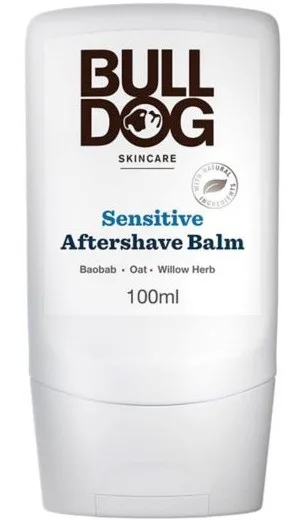
In practice a plain, fragrance-free cream that cushions and stays wet outperforms almost anything with a mechanism claim. Vanicream Shave Cream is about as stripped-down as the category gets and is the sane default for reactive skin; Bulldog Sensitive Shave Cream does the same job with plant emollients if you want more slip. A denser lathering cream such as Jack Black Supreme Cream Triple Cushion Shave Lather earns its place on coarse, dense growth where the extra cushion measurably reduces how hard you have to press. Afterwards, the useful move is a bland moisturising balm rather than a splash — Bulldog Sensitive After Shave Balm is the shape of thing to look for: humectants, an anti-irritant, no alcohol near the top of the list.
For bumps specifically, the chemistry that helps is exfoliation on the non-shaving days rather than anything applied at the moment of the shave. Glycolic acid loosens the corneocytes that trap an emerging tip; adapalene normalises follicular keratinisation over weeks and is available without a prescription in Differin Adapalene Gel 0.1%. Neither is a shave-day product. Both work on the mechanism rather than the symptom.
Shaving over skin that is already inflamed
Three situations come up constantly and each has a different answer.
Active acne. Dragging a blade across an inflamed papule opens it, spreads its contents across a lubricated field, and turns one lesion into a cluster along the pass direction. Shave with the grain, use as few passes as you can stand, and go around anything raised rather than over it — a slightly uneven shave is a much better outcome than a week of new lesions. Benzoyl peroxide will bleach a towel and a shirt collar but is not the problem here; the sequencing issue is retinoids, which thin the stratum corneum you are about to abrade, so keep them to nights and give the skin its recovery window. Whether shaving over acne genuinely worsens it has a more nuanced answer than most men assume, and the acne pathway covers what escalation looks like if the beard-area lesions are nodular rather than superficial. Where old lesions have already left texture behind, shaving over scarred skin introduces a separate problem: a raised or depressed surface does not present a flat plane to the cartridge, and the blade catches.
Rosacea. Heat and friction are both established triggers, which means the standard hot-towel ritual is working against you. Warm rather than hot water, an electric shaver if you can tolerate the closeness trade, no menthol, no alcohol, and a cool rinse afterwards. The rosacea pathway is worth reading before you conclude the razor is the cause of flushing that would have happened anyway.
Eczema and psoriasis in the beard area. Shaving over an active plaque risks the Koebner phenomenon — new lesions appearing at sites of skin trauma — so the answer is to treat the plaque first and shave around it in the meantime; the psoriasis-and-shaving question sets out the specifics.
The common thread across all three: when skin is inflamed, every one of the forces in the first section hurts more than it would otherwise. Lowering the load, shortening the stroke, and hydrating longer are not comfort preferences. They are the treatment.
Products mentioned
Independently reviewed and scored — the real products behind this piece.



- Therapy guide Acne What escalation looks like when beard-area lesions are nodular rather than superficial.
- Therapy guide Rosacea Before blaming the razor for flushing that heat and friction would have triggered anyway.
- Ingredient Menthol The cooling sensation is a sensory event, not a barrier one — and an irritant on freshly abraded skin.
- Ingredient Alcohol Denat. (Denatured Alcohol) The classic aftershave sting, applied to a barrier you just thinned.
- Ingredient Glycolic Acid (AHA) Loosens the corneocytes that trap an emerging hair tip, on non-shaving days.
- Ingredient Adapalene Normalises follicular keratinisation over weeks — mechanism, not symptom.
- Question Does shaving over acne make it worse? The nuanced version of the question every man with beard-area acne asks.
- Question Does shaving over scarred skin cause problems? Why an uneven surface changes what the cartridge does.
- Question Can I shave over plaques? Koebner risk and how to shave around an active plaque.
References
- The biomechanics of blade shaving — International Journal of Cosmetic Science, 2016
- Pseudofolliculitis barbae: understanding the condition and the role of facial grooming — International Journal of Cosmetic Science, 2016
- Shave frequency and regimen variation effects on the management of pseudofolliculitis barbae — Journal of Drugs in Dermatology, 2013
- An unusual Ala12Thr polymorphism in the 1A alpha-helical segment of the companion layer-specific keratin K6hf: evidence for a risk factor in the etiology of the common hair disorder pseudofolliculitis barbae — Journal of Investigative Dermatology, 2004
- Effect of Physical and Chemical Hair Removal Methods on Skin Barrier Function in vitro: Consequences for a Hydrophilic Model Permeant — Skin Pharmacology and Physiology, 2019
- Innovative approaches to avoid electric shaving-induced skin irritation — International Journal of Cosmetic Science, 2016
- Review of treatments for pseudofolliculitis barbae — Clinical and Experimental Dermatology, 2023
Every cited link is verified to resolve to the paper named. Where a source could not be independently confirmed, it is listed without a link rather than pointing you somewhere wrong.
Frequently asked
Does shaving with the grain really matter, or is that just barbershop lore?
It matters for one specific mechanism. Shaving against the grain while pulling the skin taut cuts the hair below the surface; when the tension releases, the stub retracts under the skin and can grow into the follicle wall. That is transfollicular penetration and it is entirely preventable. It does nothing about a curved hair re-entering from outside, which is a separate problem solved by leaving a longer stub.
Should I switch to a single-blade safety razor to stop razor bumps?
The evidence for that advice is thinner than its popularity suggests. A 2016 review concluded there is a lack of robust clinical evidence supporting single-blade razors, curtailing shaving, or avoiding it. If a safety razor helps you use less pressure and fewer passes, those are real mechanical gains — but the blade count itself has not been shown to be the deciding variable.
How long do I actually need to hydrate before shaving?
Two to three minutes of warm water on the face, which in practice means shaving at the end of a shower rather than before one. Beard hair cutting force falls by roughly 40% at full hydration because water disrupts the hydrogen bonds in keratin, and that softening takes minutes to develop through the cuticle. Splashing and shaving immediately gives you a substantially harder hair.
Is an electric shaver genuinely better for my skin than a blade?
It is better for one problem and worse for another. An electric shaver leaves a stub above the skin plane, which prevents a curved hair from re-entering — the main advantage if you get bumps. It substitutes repeated dry friction for one lubricated pass, and dry hair removal measurably raises transepidermal water loss. If bumps are not your issue, a well-prepped blade shave is usually the gentler option.
Why does my aftershave sting, and is that a good sign?
It is not. The sting is usually denatured alcohol on skin whose stratum corneum you have just partially removed, and the cooling that follows is often menthol activating a cold receptor. Neither is doing anything restorative. A bland balm with humectants and an anti-irritant, applied to still-damp skin, is doing the work that the sting is only imitating.