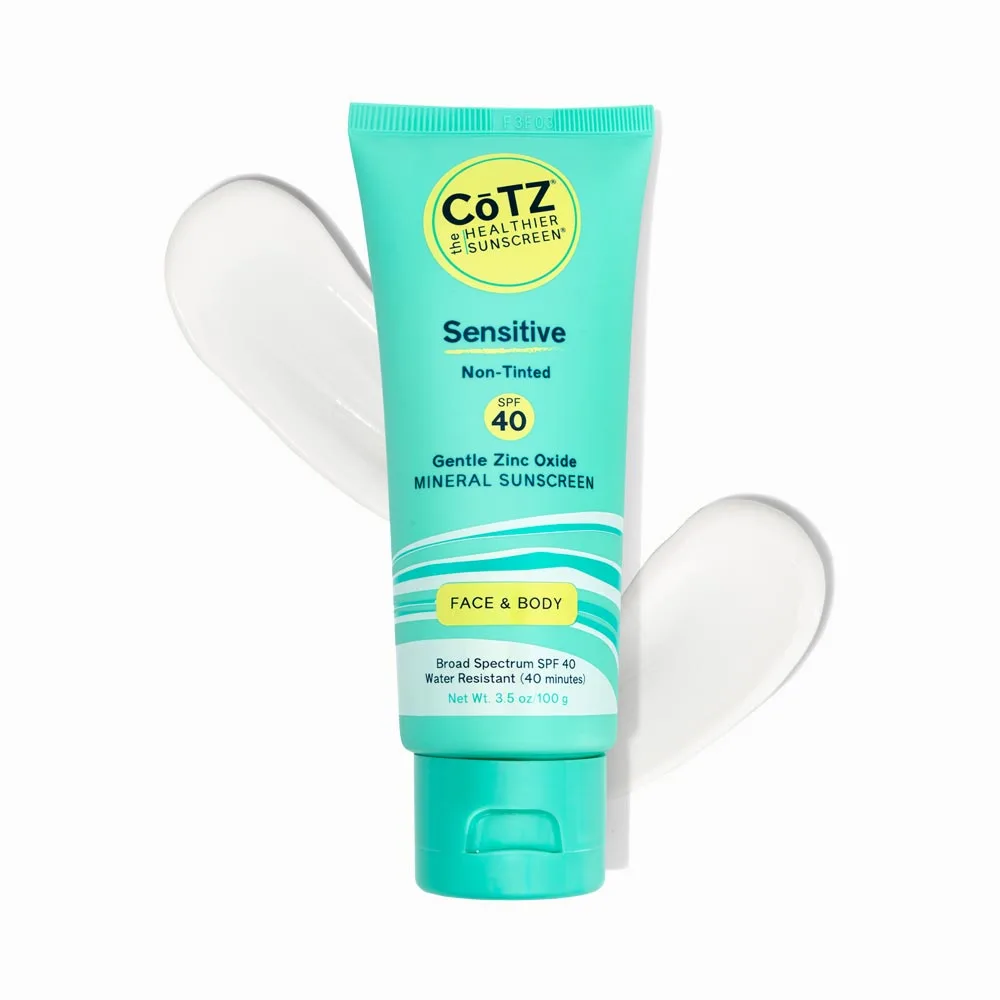
Most mineral sunscreens at this price point use a blend of lower-concentration zinc oxide and titanium dioxide to reduce white cast at the expense of broad-spectrum coverage. Cotz Sensitive uses the maximum 20% zinc oxide with no titanium dioxide and no chemical filters — it's one of the purest mineral sunscreens commercially available, which is exactly why dermatologists recommend it for rosacea, post-procedure recovery, and pediatric patients.
A dermatologist-developed 20% zinc oxide mineral sunscreen that has earned its reputation as a go-to recommendation for rosacea, post-procedure recovery, and pediatric use. The formulation is exactly what sensitive skin needs — no fragrance, no chemical filters, no titanium dioxide — and the price is reasonable for what you're getting. The only real tradeoff is white cast, which is manageable on fair to light skin but becomes a real concern on deeper tones.
Supporting rolefor RosaceaIn your profileYou chose · Nothing here targets rosacea directly; photoprotection against a known trigger is the recognised companion to treating it, and this lotion does that without known triggers.Not yet assessedGentleNo reviews collected yet
The case for it
Zinc Oxide 20% has no evidence row yet for this concern — it is in the research queue.
The formula carries none of the triggers this concern is sensitive to.
What would change this: A researched evidence row for the lead active would replace this with a verdict.
Same rule for everyone. “Supporting role” is the verdict on 8,197 of 45,024 concern verdicts across the catalog; rule R8 decided 4,250 of them.
Unchanged since September 5, 2026, engine 5.1.1.
R8 — The category's job (barrier care, humectant hydration, gentle cleansing, photoprotection) is the documented supportive role for this concern. This is the honest verdict for a moisturizer on an acne page. · the full register
Good choicefor SensitivityIn your profileYou chose · No fragrance, drying alcohol, declarable allergens or sensitising preservatives in this lotion — the profile sensitive skin looks for.Not yet assessedGentleNo reviews collected yet
The case for it
Zinc Oxide 20% has no evidence row yet for this concern — it is in the research queue.
The formula carries none of the triggers this concern is sensitive to.
What would change this: A researched evidence row for the lead active would replace this with a verdict.
Same rule for everyone. “Good choice” is the verdict on 1,938 of 45,024 concern verdicts across the catalog; rule F2 decided 1,938 of them.
Unchanged since September 5, 2026, engine 5.1.1.
Full protectionfor HyperpigmentationIn your profileYou chose · Broad-spectrum SPF 40 with zinc oxide: the protection hyperpigmentation calls for.Moderate evidenceGentleNo reviews collected yet
The case for it
Tetrahexyldecyl Ascorbate has early or mechanistic evidence for this concern, not trial-backed standing.
It is present below the studied range.
The formula carries none of the triggers this concern is sensitive to.
What would change this: A concentration inside the studied range would raise this a step.
Same rule for everyone. “Full protection” is the verdict on 2,288 of 45,024 concern verdicts across the catalog; rule P1 decided 2,232 of them.
Unchanged since September 5, 2026, engine 5.1.1.
P1 — Photoprotection standing is regulatory (M020 / Annex VI filters; 21 CFR 201.327 attaches the early-skin-aging claim to tested broad-spectrum SPF 15+). SPF 30 is the AAD daily-use bar. · the full register
Carrying active
Tetrahexyldecyl Ascorbate
Standing
plausible — trials support it
Form
sub threshold — studied range 5–6%, from the trials on the row; needs leave-on contact; judge it after ~12 weeks
Tolerability
gentle
Row checked
against its sources on July 17, 2026 (evidence table ev-2026.09-r228)
Basic protectionfor MelasmaIn your profileYou chose · Broad-spectrum SPF 40, but no iron oxides — melasma is worsened by visible light, which UV filters alone do not block.Moderate evidenceGentleNo reviews collected yet
The case for it
Tetrahexyldecyl Ascorbate has early or mechanistic evidence for this concern, not trial-backed standing.
It is present below the studied range.
The formula carries none of the triggers this concern is sensitive to.
What would change this: A concentration inside the studied range would raise this a step.
Same rule for everyone. “Basic protection” is the verdict on 175 of 45,024 concern verdicts across the catalog; rule P3 decided 68 of them.
Unchanged since September 5, 2026, engine 5.1.1.
Full protectionfor Post-ProcedureIn your profileYou chose · Broad-spectrum SPF 40 with zinc oxide: the protection post procedure calls for.Not yet assessedGentleNo reviews collected yet
The case for it
Zinc Oxide 20% has no evidence row yet for this concern — it is in the research queue.
The formula carries none of the triggers this concern is sensitive to.
What would change this: A researched evidence row for the lead active would replace this with a verdict.
Same rule for everyone. “Full protection” is the verdict on 2,288 of 45,024 concern verdicts across the catalog; rule P1 decided 2,232 of them.
Unchanged since September 5, 2026, engine 5.1.1.
P1 — Photoprotection standing is regulatory (M020 / Annex VI filters; 21 CFR 201.327 attaches the early-skin-aging claim to tested broad-spectrum SPF 15+). SPF 30 is the AAD daily-use bar. · the full register
Also listed for Eczema and Compromised Skin Barrier — the actives here (Zinc Oxide, Vitamin C, silicone emollient matrix) are in our research queue for those concerns; there is no verdict until their evidence rows are written. That is a gap in our table, not a mark against the product.
Does the jobDoes what a sunscreen is for: UVA coverage, kind to the skin wearing it. Not measured from the label: pleasant enough to actually use.
A verdict is DermApproved’s assessment of how well a product’s ingredients fit a concern — never a claim about what the product treats. Evidence dots and collected reviews sit beside it and are never blended in.
Rules 0.5.1 · evidence table ev-2026.09-r228 · how we decide
Assessment
Pros & Cons
Pros
✓ Maximum allowable 20% zinc oxide for true broad-spectrum protection
✓ No chemical filters, titanium dioxide, or fragrance to trigger sensitive skin
✓ Fragrance-free formulation appropriate for rosacea and post-procedure use
✓ Skin Cancer Foundation Seal of Recommendation
✓ Safe for children six months and older
✓ Reef-safe and compliant with Hawaii and Key West sunscreen regulations
✓ Fair price relative to dermatologist-office sensitive-skin sunscreens
Cons
✗ Significant white cast on medium and deep skin tones
✗ Thick texture requires firm rubbing to blend
✗ Not the most cosmetically elegant option for everyday use
✗ Only 40 minutes of water resistance
Review
Full Review
Most sunscreens are designed with cosmetic elegance as the primary goal and skin tolerance as the secondary consideration. The formulators start with a desired finish — weightless, invisible, glowy, whatever the current aesthetic trend demands — and then try to deliver UV protection inside those constraints. It works well for the average consumer with healthy, resilient skin. It doesn't work at all for the patients dermatologists see most often: people with rosacea whose skin reacts to fragrance and certain filters, people recovering from lasers or chemical peels whose barriers can't tolerate anything beyond pure zinc, kids whose thin skin absorbs chemical filters more readily than adults, and patients with photosensitive conditions who need maximum UV blocking at all costs.
Cotz was built for that second group. The brand name — an acronym for 'Contains Only Titanium and Zinc' — tells you everything about the original design brief, and the Sensitive SPF 40 formulation is the most disciplined product in the line. It uses 20% zinc oxide, the maximum allowable concentration under FDA regulations, with no titanium dioxide and no chemical filters. There is literally nothing else in the sunscreen actives profile. That simplicity is the entire value proposition.
Twenty percent zinc oxide is as much broad-spectrum protection as any mineral sunscreen commercially available, and the absence of any chemical filters or blended titanium means there's nothing in the active profile that can trigger a photosensitive or sensitive-skin reaction. For patients recovering from ablative lasers, chemical peels, or Mohs surgery, this is exactly the protection their dermatologists want them wearing. For rosacea patients whose skin flares with even mild irritants, it's one of the few sunscreens they can reliably tolerate. For parents of young children, it's fragrance-free, chemical-filter-free, and safe for daily use from six months of age. It's also reef-safe and fungal-acne safe, two boxes a lot of 'gentle' sunscreens quietly fail to tick.
The inactive ingredients reflect the same discipline. The formula is built on a silicone emollient matrix — dimethicone, cyclomethicone, and silicone crosspolymers — that suspends the high zinc concentration evenly and prevents the clumping and patchiness that 20% zinc often creates in aqueous emulsion bases. Polyhydroxystearic acid and a silane surface coating help disperse the zinc particles so the finish stays smooth, and a little microcrystalline wax gives the film its water resistance. There's a trace of tetrahexyldecyl ascorbate (a stable fat-soluble vitamin C) and tocopheryl acetate (vitamin E) for supplemental antioxidant support, which is more than most pure mineral sunscreens bother including. No fragrance, no essential oils, no botanical extracts that could trigger allergic reactions. The ingredient list reads like a dermatologist's safe prescription rather than a marketing deck.
Two persistent misconceptions are worth clearing up here, because they scare people away from exactly the kind of formula that would suit them. The first is that mineral sunscreens are inherently less effective than chemical ones; at 20% zinc, this delivers true broad-spectrum coverage that meets or exceeds most chemical sunscreens, and the old efficacy gap closed once high-concentration zinc formulas became common — today's differences are aesthetic, not protective. The second is that non-nano zinc underperforms the nanoparticle kind; both protect equally at the same concentration, and particle size affects only appearance and spreadability. When you see white cast, you're seeing larger non-nano particles chosen for aesthetics or reassurance, not a weaker sunscreen.
The use experience is where the tradeoffs become visible, and Cotz doesn't pretend otherwise. This is a thick, opaque white lotion. It does not blend weightlessly. You dispense a genuinely generous amount — a quarter-teaspoon for the face alone, because that's what the SPF rating requires — warm it between your fingertips, and work it into skin in sections. On fair to light skin, the white cast fades to a soft matte finish after about a minute. On medium skin tones, you get a pale ghostiness that looks fine in daylight but can photograph oddly in flash. On deep skin tones, the white cast is significant, and a tinted alternative such as Cotz Face Natural Skin Tone, or a different brand's deep-tone mineral formula, is the better call. This is the honest limitation of high-percentage zinc oxide sunscreens.
The price is reasonable. At $31 for 100g, you're paying mid-market for a formulation that rivals dermatologist-office sunscreens costing twice as much. A single tube lasts about two months with face-only daily use, roughly $15 a month for maximum-zinc broad-spectrum protection — a genuinely good deal by prescription-adjacent sunscreen standards. Its roughly 2,200 reviews averaging 4.5, alongside a Skin Cancer Foundation seal and two decades of derm-office use, back that up: the praise is all about zero irritation and true broad-spectrum coverage, the complaints all about the cast and the effort to blend.
Overall, this is one of the sunscreens that earns the 'if you need it, you really need it' designation. It's not the most cosmetically elegant option on the market, and it's not the right pick if white cast is a dealbreaker for your daily routine. But for sensitive skin, post-procedure recovery, pediatric use, or anyone prioritizing maximum broad-spectrum protection over aesthetics, it's one of the best mineral sunscreens available — and it's earned its place in dermatology offices for two decades running.
Formula
Key Ingredients
The hero actives that drive this product's performance.
The maximum allowable concentration of zinc oxide in a US sunscreen, providing true broad-spectrum UVA and UVB protection through physical reflection and absorption — in this formula it's the entire sunscreen story, with no titanium dioxide or chemical filters diluting the approach.
Not yet assessed
Silicone Emollient Matrix
The dimethicone and cyclomethicone blend is what makes 20% zinc oxide cosmetically wearable — it suspends the mineral particles evenly, prevents them from clumping on skin, and delivers a smoother finish than traditional emulsion bases allow at this high a zinc concentration.
A fat-soluble vitamin C derivative added in trace amounts to provide supplemental antioxidant defense against any UV-induced free radicals that make it past the zinc barrier — a small but useful finishing touch that most basic mineral sunscreens don't bother with.
Limitedfor Hyperpigmentation
Ingredient standings describe the active at treatment-level doses and
vehicles; this product's own condition grades weigh its actual formula.
Use as the last step of your morning routine, using a generous quarter-teaspoon amount for the face alone. Allow one to two minutes to set before applying makeup. Reapply every two hours during sun exposure or after sweating.
Results Timeline
Immediate full broad-spectrum UV protection; visible reduction in sun-induced hyperpigmentation and redness after 4-8 weeks of consistent daily use; cumulative photoprotective benefits over months and years.
The formulation's efficacy rests on one of the most robust evidence bases in dermatological skincare — zinc oxide as a broad-spectrum UV filter. Zinc oxide at concentrations of 15% and higher provides genuine broad-spectrum protection covering UVB and the full UVA range, including UVA1 which is responsible for most photoaging and is poorly covered by older chemical filters. Peer-reviewed research has extensively documented zinc oxide's photoprotective mechanism, which combines physical reflection, scattering, and absorption of UV radiation. At 20%, this formulation uses the maximum concentration allowed under FDA monograph regulations, which delivers the upper limit of protection that a US over-the-counter mineral sunscreen can legally claim. The single-active approach — zinc oxide with no titanium dioxide or chemical filters — eliminates the interactions and compatibility issues that can occur in blended filter systems, and it removes every known photosensitizer and potential allergen from the active profile. The silicone-based inactive formulation is a deliberate cosmetic chemistry choice. Dimethicone and cyclomethicone provide an even dispersion matrix for the zinc oxide particles, preventing clumping that would create patchy application and inconsistent UV coverage. The silicone matrix also contributes to water resistance, though the product's 40-minute claim is modest compared to beach-specific formulations. The addition of tetrahexyldecyl ascorbate and tocopheryl acetate provides supplemental antioxidant defense against residual UV-induced free radicals, which is a thoughtful inclusion that aligns with current dermatological recommendations for antioxidant-plus-sunscreen combinations. The absence of fragrance, essential oils, and botanical extracts minimizes allergen exposure and makes this product one of the safest options for patients with contact sensitivities or compromised barriers. Clinical evidence for zinc oxide sunscreens in rosacea and post-procedure populations consistently favors high-zinc formulations over blended or chemical alternatives.
Dermatologist Perspective
Dermatologists widely recommend high-concentration zinc oxide sunscreens as first-line options for patients with sensitive skin, rosacea, post-procedure recovery needs, and pediatric photoprotection. Clinical dermatologists commonly recognize that 20% zinc oxide represents the maximum mineral UV protection available in an over-the-counter formulation, and this specific concentration is commonly prescribed for patients recovering from laser resurfacing, chemical peels, and other procedures where barrier compromise makes chemical filter sunscreens unsuitable. Cotz has maintained dermatologist recommendation for nearly two decades specifically because its formulation approach aligns with clinical needs — fragrance-free, single-active, and appropriate for the most reactive skin populations. For pediatric use, dermatologists frequently recommend this category of mineral sunscreen over chemical filter alternatives because children's thinner skin absorbs topical ingredients more readily and their endocrine systems are more sensitive to certain chemical filters. The white cast is the limitation most commonly raised by patients, and dermatologists typically acknowledge it honestly while emphasizing that cosmetic elegance is a secondary consideration behind maximum UV protection for clinical populations.
Guidance
Usage & Recommendations
How to Use
Apply generously to clean, moisturizer-prepped skin as the final step of your morning routine, using approximately a quarter-teaspoon for face alone or a full tablespoon for face, neck, and décolletage. Warm between fingertips and work into skin in sections, blending thoroughly to minimize white cast. Allow one to two minutes to set before applying makeup. Reapply every two hours during sun exposure or after sweating, swimming, or towel drying. For children under two years old, consult a pediatrician before use. Do not apply to damaged or broken skin unless specifically directed by a dermatologist.
Value Assessment
At $31 for 100g, this sunscreen is priced in the middle of the mineral sunscreen market and represents solid value for a 20% zinc oxide formulation. Compared to dermatology-office alternatives like EltaMD UV Pure ($33 for 56ml, lower zinc percentage) or SkinCeuticals Sheer Physical ($38 for 50ml, blended filters), Cotz delivers more zinc for less money per milliliter. Drugstore alternatives from Blue Lizard or Neutrogena Sheer Zinc are cheaper but typically use lower zinc concentrations and include titanium dioxide or additional filters. Cotz does not offer a larger body-size version of this specific formulation, which limits extended outdoor use value. The verdict: a genuinely good value for users who specifically need maximum zinc concentration in a fragrance-free formulation; fairly priced relative to its direct competitors.
Who Should Buy
Sensitive, rosacea-prone, or reactive skin types who need maximum broad-spectrum protection without fragrance or chemical filters. Especially good for users recovering from laser treatments, chemical peels, or other dermatological procedures. Also a strong pick for parents looking for a pediatric-safe family sunscreen and for anyone prioritizing reef-safe, fragrance-free mineral protection over cosmetic elegance.
Who Should Skip
Users with medium to deep skin tones who find white cast unacceptable should look at tinted mineral alternatives like EltaMD UV Elements, ILIA Super Serum Skin Tint, or a Cotz tinted option. Skip if you prioritize weightless, invisible finishes for daily makeup wear. This one is also wrong for you if you spend extensive time in water — the 40-minute water resistance is less than beach-specific sunscreens provide.
Ready to try Cotz Sensitive SPF 40 Mineral Sunscreen?
Thick opaque white lotion that requires firm rubbing to blend
Scent
Unscented in practice, with a barely-there neutral note.
Packaging
White squeeze tube with flip cap
Finish
mattenon-greasy
What to Expect on First Use
Dispense a generous amount — about a quarter teaspoon for face alone — and apply in sections, warming between fingertips to help it spread. Expect a visible white cast during application that settles into a lighter finish after one to two minutes, though users with medium to deep skin tones will see residual ghostiness. The formula sets to a matte finish that holds up under makeup.
How Long It Lasts
About 2 months with daily face-only use, or 3-4 weeks with full-body application
Skin Cancer Foundation RecommendedCruelty-FreeFragrance-Free
Background
The Story Behind This Product
Cotz was founded in 2004 by a team focused specifically on mineral-only sunscreen for sensitive skin and photosensitive conditions. The brand name is an acronym — 'Contains Only Titanium and Zinc' — though this specific Sensitive formulation drops the titanium dioxide entirely in favor of a single-active 20% zinc approach for maximum gentleness.
About Cotz Established Brand (5–20 years)
Cotz (which stands for 'contains only titanium and zinc') was developed by dermatologists in 2004 as a dedicated mineral sunscreen brand. The line has long-standing recommendation from dermatologists treating photosensitive skin, post-procedure patients, and pediatric users, and is commonly stocked in dermatology offices and medical distribution channels.
Brand founded: 2005 · Product launched: 2006
Myth vs. Reality
Common Myths
Myth
Mineral sunscreens are always less effective than chemical sunscreens.
Reality
A 20% zinc oxide formulation like this provides true broad-spectrum UVA and UVB protection at a level that meets or exceeds most chemical sunscreens. The efficacy gap narrowed significantly once high-concentration zinc formulations became widely available; the real differences today are aesthetic, not protective.
Myth
Non-nano zinc oxide doesn't work as well as the nanoparticle version.
Reality
Both non-nano and nano zinc oxide provide equivalent UV protection at the same concentration — the difference is particle size, which affects appearance and spreadability, not efficacy. If you see white cast, it's typically because the formulation uses larger non-nano particles for aesthetic or safety reasons, not because it's underperforming.
FAQ
Frequently Asked Questions
How does this compare to EltaMD UV Pure?
Both are zinc-plus-titanium or zinc-only mineral sunscreens recommended for sensitive skin. Cotz Sensitive uses 20% zinc oxide alone, while EltaMD UV Pure uses a 10% zinc oxide plus 5.5% titanium dioxide blend. Cotz has a higher zinc concentration and no titanium; EltaMD tends to be slightly more cosmetically elegant with less white cast. Choose based on whether you prioritize maximum zinc or smoother aesthetics.
Is this safe for babies and children?
Yes — the fragrance-free, chemical-filter-free formulation is commonly recommended by pediatric dermatologists for children six months and older. The thick texture and white cast are less of a concern for kids than cosmetic elegance.
Will this work under makeup?
Yes, with some patience. Apply a generous amount, allow one to two minutes to set, then apply primer and foundation. The silicone matrix helps makeup layer cleanly, though darker foundations may need to be mixed with a drop of skin-tone moisturizer to balance the white cast.
How much white cast should I expect?
At 20% zinc oxide with no tinting, the white cast is noticeable on medium to dark skin tones. Fair to light skin users typically see minimal residue after full blending; medium tones see a pale ghostiness; deep skin tones see significant white cast that may not be acceptable for daily use without a tinted alternative.
Is this reef-safe?
Yes — the zinc-only, chemical-filter-free formulation meets the criteria used in most reef-safe sunscreen guidelines. It's allowed in Hawaii, Key West, and other jurisdictions that have banned oxybenzone and octinoxate.
How long will a 100g tube last?
For face-only daily use, about two months. For face and neck, closer to six weeks. If you're using it on body areas for beach days or outdoor activities, a single tube will cover two to three full-body applications.
Can I use this on the beach?
Yes, but understand the water resistance claim is only 40 minutes. Reapply every 40 minutes in water or after heavy sweating, and apply generously — mineral sunscreens underperform their SPF rating when applied sparingly.
Reviews
What Reviewers Tend to Say
Recurring themes our editors read across retailer reviews of this product — summaries in our words, not quotations, and not a substitute for your own patch test.
Common Praise
Zero irritation even on rosacea skin
Maximum zinc concentration for true broad-spectrum
No chemical filters or fragrance
Safe for post-procedure recovery
Reliable family sunscreen
Common Complaints
Noticeable white cast on medium and dark skin tones
Thick texture requires patience to blend
Not as cosmetically elegant as tinted or chemical alternatives
Notable Endorsements
Skin Cancer Foundation Seal of RecommendationDermatologist-recommended for rosacea and post-procedure useEWG verified for lower-hazard formulation
The fourth most frequent positive patch test in North America is an oxidation product of a molecule that occurs naturally in lavender. Nobody synthesised it into your face cream.
Western sensitive skincare works by subtraction — remove the fragrance, remove the alcohol, shorten the list. Japan's answer adds a designed molecule back in, and one of the two bets has a trial literature.
Antiperspirants and deodorants solve unrelated problems, a large share of people buying either are genetically incapable of producing the smell, and the aluminium question has a real answer that nobody bothers to give.
It treats acne, rosacea and pigment simultaneously, survives pregnancy, and fights with almost nothing in your routine. Its problem is texture and the absence of a marketing budget.
Jul 31, 2026· 8 min
Questions people ask about Rosacea
Verified answers from our questions library — the nuance a product page cannot carry.
Products, answers, therapy guides, tools and articles in one search. Brand names,
slang and abbreviations all work — accutane finds isotretinoin, bacne finds truncal acne.