Azelaic Acid Should Be Far More Popular Than It Is
It treats acne, rosacea and pigment simultaneously, survives pregnancy, and fights with almost nothing in your routine. Its problem is texture and the absence of a marketing budget.
Read the preview
From the DermApproved blog, in Brightening and Pigment Actives: azelaic acid. It treats acne, rosacea and pigmentation at once, stays available in pregnancy, and conflicts with almost nothing — which should make it the most popular active in skincare. It isn't, and the reason has nothing to do with the evidence. For the full breakdown, visit dermapproved.com/blog.
The active that was found by asking the right question about a rash
Pityriasis versicolor leaves pale patches behind. For decades that was filed as a curiosity — a superficial yeast overgrowth that somehow bleaches the skin it colonizes. In the 1970s, researchers in Rome asked the obvious follow-up nobody had pursued: what is the organism making, and does that compound inhibit pigment on its own? The answer turned out to be a family of dicarboxylic acids, of which the nine-carbon member — azelaic acid — was the one worth developing.
What came out of that line of work is a molecule with an unusual property: it is genuinely useful for three conditions that are usually treated with three separate products. Acne, papulopustular rosacea, and disorders of pigment each respond to it, and not because of one broad anti-inflammatory effect being credited three times. The mechanisms are distinct, which is what makes the breadth defensible rather than promotional.
And yet azelaic acid remains a second-string recommendation, the thing suggested after the tretinoin and the hydroquinone and the doxycycline. That is a story about pharmaceutical economics and cosmetic elegance, not about evidence.
Three mechanisms, not one effect wearing three hats
On pigment, azelaic acid is a competitive inhibitor of tyrosinase, the rate-limiting enzyme in melanin synthesis. What distinguishes it from other tyrosinase inhibitors is selectivity: it acts preferentially on hyperactive and abnormal melanocytes rather than on normal ones. This is the practical reason it does not tend to produce the halo of over-lightened skin around a treated patch that can follow aggressive hydroquinone use, and why it is used with more confidence in deeper skin tones.
On acne, it works on two fronts at once — antibacterial activity against Cutibacterium acnes, and normalization of follicular keratinization, which addresses the microcomedone before it becomes anything visible. The 2024 American Academy of Dermatology acne guidelines list it among the recommended topical agents, and its particular value is that it treats active lesions and the post-inflammatory pigment they leave behind in the same application. For anyone whose real complaint about acne is the brown marks that outlast it, that is not a small thing.
On rosacea the mechanism is the most specific and the most recently characterized. Papulopustular rosacea involves a dysregulated innate immune response: excess cathelicidin, processed into inflammatory fragments by the serine protease kallikrein 5. A prospective open-label study paired with laboratory work found that azelaic acid directly inhibits KLK5 in cultured keratinocytes, suppresses gene expression of KLK5, Toll-like receptor 2 and cathelicidin in mouse skin, and lowers cathelicidin and KLK5 messenger RNA in treated rosacea patients. Patients who started with high serine protease activity showed a statistically significant reduction on treatment. The authors were careful about their own limits — the study was too small to connect that biochemistry to clinical response — but it is a far more satisfying explanation than 'anti-inflammatory,' and it explains why azelaic acid behaves differently from a general soothing agent.
What the numbers actually look like
The melasma evidence is old and better than its reputation. A 24-week double-blind study randomized 329 women to 20% azelaic acid cream or 4% hydroquinone cream, both alongside broad-spectrum sunscreen. Azelaic acid produced good or excellent results in 65% of patients, and no significant difference emerged between the two treatments on overall rating, lesion size, or pigmentary intensity. The safety line matters as much as the efficacy line: no allergic sensitization and no exogenous ochronosis were seen with azelaic acid — the two problems that make long-term hydroquinone use something to manage carefully rather than simply prescribe.
The rosacea evidence is more recent and more granular. Two identically designed vehicle-controlled trials of 15% gel, enrolling 329 and 335 patients, found inflammatory lesion count reductions of 58% versus 40% and 51% versus 39%. Erythema improved in 44% and 46% of treated patients against 29% and 28% on vehicle, and investigator-rated success — clear, minimal or mild at the end — reached 61% and 62% versus 40% and 48%. The Cochrane review of rosacea interventions has consistently placed azelaic acid among the treatments with real supporting evidence rather than in the plausible-but-unproven pile.
Note what the vehicle arms did, though. Forty percent lesion reduction on gel base alone is a reminder that a substantial share of visible rosacea improvement comes from consistent gentle application of something bland, which is worth remembering before attributing everything to the active.
10% versus prescription strength: what the gap actually is
Almost every over-the-counter azelaic product sits at 10%, sometimes lower. The prescription versions are 15% gel and 20% cream, and those are the concentrations the trial data above was generated at. There is no head-to-head study establishing what the 10% formulas achieve relative to them, which means anyone claiming equivalence is guessing and anyone dismissing them is also guessing.
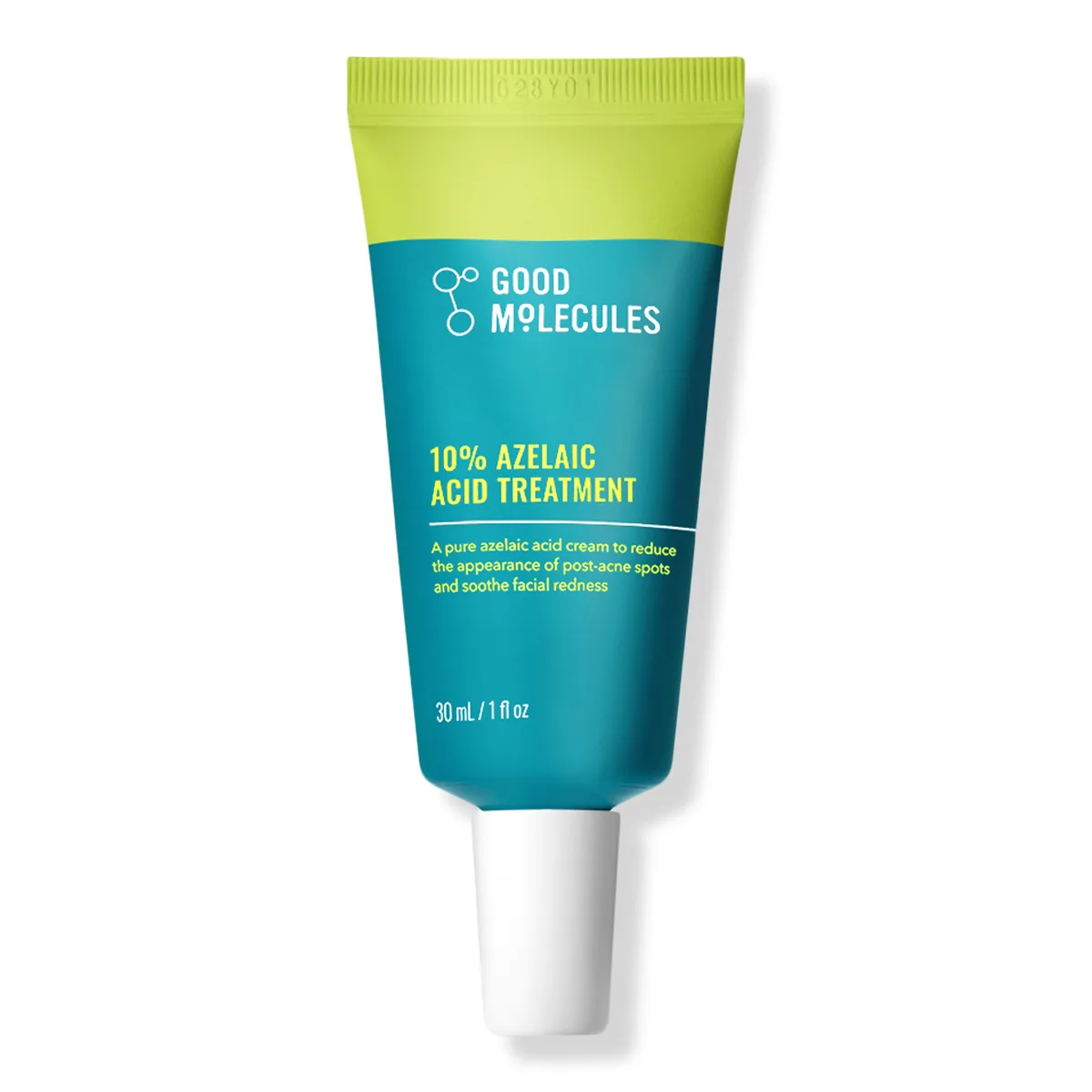
What can be said is more useful than either. Ten percent is a real dose, not a pixie-dusted trace — it is enough to have meaningful pharmacology, unlike the 0.1% appearances azelaic acid sometimes makes in a marketing ingredient list. Vehicle matters enormously for a compound with limited solubility, and the formulations differ far more than the percentage suggests: The Ordinary Azelaic Acid Suspension 10% disperses the acid through a silicone base, Good Molecules 10% Azelaic Acid Treatment takes a lighter cream approach, and SKIN1004's Azelaic Acid 10 Ampoule delivers it in a thin fluid alongside centella. Same number on the label, three different amounts of contact with skin.
The honest positioning: if you have diagnosed melasma or papulopustular rosacea, the prescription strength is what the evidence supports and is worth asking for — it is inexpensive and rarely refused. If you are treating post-inflammatory pigment, uneven tone, or mild breakouts, a well-formulated 10% used consistently for three months is a reasonable first move, and its low conflict profile means it costs you nothing else in the routine.
It fights with nothing, which is rarer than it sounds
Most actives come with a negotiation. Retinoids and exfoliating acids compete for the same tolerance budget. Benzoyl peroxide degrades certain molecules it sits next to. Vitamin C wants a low pH that other things do not. Building a routine is largely the work of keeping these apart.
Azelaic acid opts out of that entirely. It works across a wide pH range, does not photosensitize, is not oxidized by benzoyl peroxide, and layers under or over a retinoid without either losing potency. It sits alongside niacinamide and vitamin C without incident. This is what makes it the active to reach for when a routine is already full — it does not require you to remove something to make room, which is the usual and frequently fatal condition for adding anything new. Our Conflict Checker will confirm that against whatever you are currently using, and the Routine Order tool handles the sequencing question, which for azelaic acid is mostly a texture decision rather than a chemistry one.
The other unusual property is that it remains available during pregnancy, when the pigment problems it treats are at their most active and the standard options — retinoids, hydroquinone in most guidance, oral tetracyclines — are off the table. That is a narrow field, and azelaic acid is one of the few things standing in it. Our Pregnancy-Safe tool is the place to check anything else you are considering keeping. The azelaic acid routine lays out the full build.
Texture is the real reason people quit
Here is the unglamorous truth this active cannot escape. Azelaic acid is poorly soluble, so the effective formulations are suspensions and heavy creams rather than the weightless serums the category has trained everyone to expect. The prescription 15% gel and 20% cream have a distinct grip on the skin. Over-the-counter suspensions can feel faintly gritty and can pill under sunscreen if applied too generously or too quickly.
Then there is the tingle. A stinging or burning sensation on application is common in the first two to four weeks, most noticeable on inflamed rosacea skin, and it fades with continued use. That sequencing is exactly backwards from what encourages adherence: worst when motivation is lowest and the skin looks least improved. A great deal of azelaic acid failure is really azelaic acid abandonment somewhere in week two.
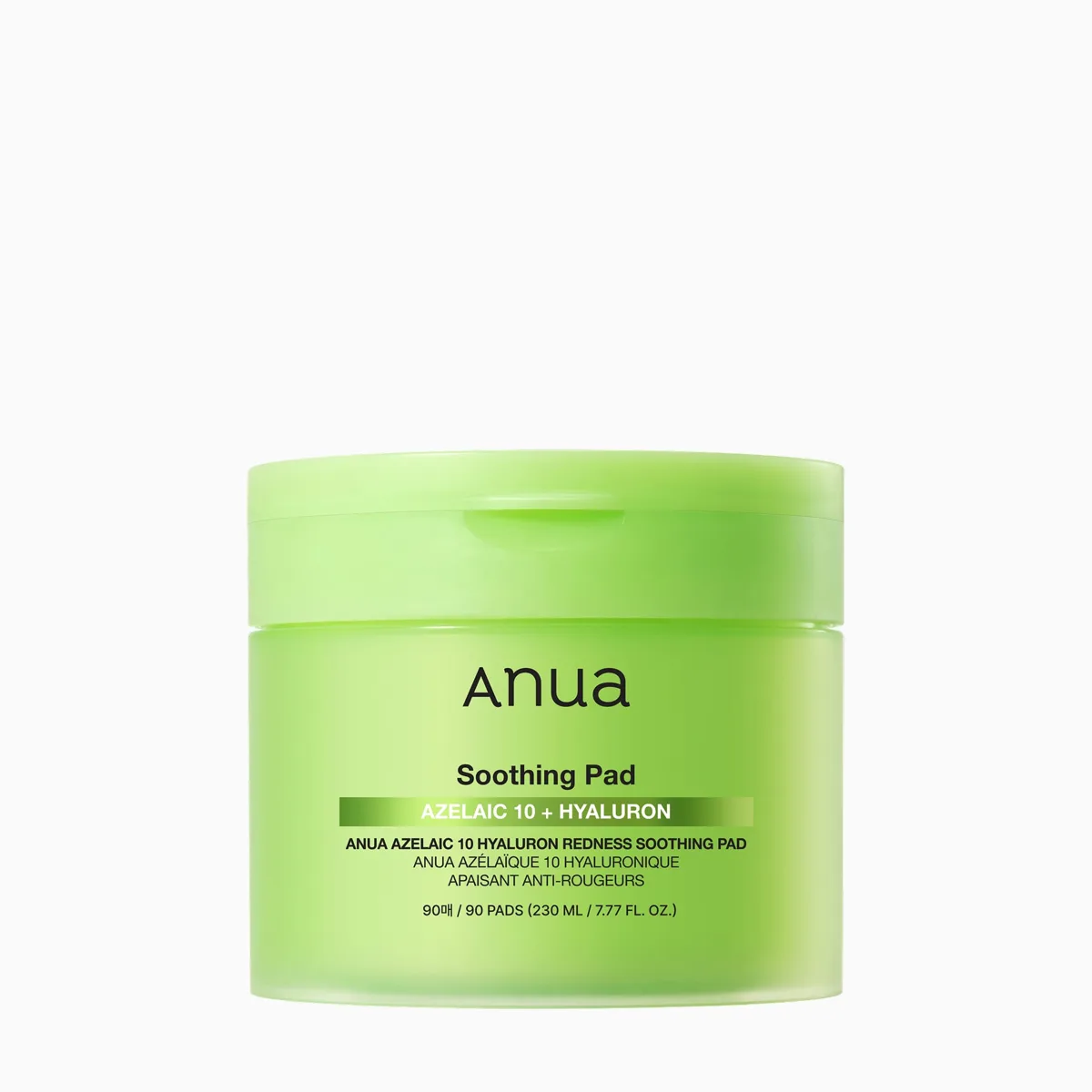
The workarounds are simple and worth knowing before you start. Apply to fully dry skin, since damp skin increases both penetration and sting. Start at night only, every other night, and build. Use less than you think — a thin film, not a mask. If the sting is the limiting factor, applying moisturizer first and the acid on top blunts it at some cost to potency, which is a trade worth making if the alternative is stopping. Gentler entry points exist too: a rinse-off format like Good Molecules Soothing Azelaic Acid Cleanser has limited contact time and correspondingly limited effect, but it acclimatizes skin, and a pad format such as Anua's Azelaic 10 Hyaluron Redness Soothing Pad buffers the acid in a humectant base. Neither substitutes for a leave-on treatment; both are useful runways.
Where it deserves to be the first choice
Papulopustular rosacea, where the mechanism is specific and the trial evidence direct. Pigment problems in deeper skin tones, where azelaic acid's selectivity for overactive melanocytes and its clean record on ochronosis and sensitization make it a lower-risk long-term option than the alternatives — see our azelaic picks for pigment and the melasma pathway for where it sits in the escalation order. Acne during pregnancy, by process of elimination. And acne that leaves marks, where treating the lesion and the pigment with one product is a structural advantage no combination of two products quite matches.
Be realistic about what it will not do. It is slow on pigment — twelve weeks before a fair judgement, longer for melasma, and it demands the same daily sunscreen discipline that governs every pigment treatment. It does relatively little for the flushing and visible vessels of erythematotelangiectatic rosacea, which is a vascular problem rather than an inflammatory one. It is not a retinoid substitute for photoaging; it does not do collagen. And the texture will never be luxurious, because the chemistry does not permit it.
What you get in exchange is an active that fits almost any routine, treats three things at once, and stays available through the one period when most of the alternatives disappear. That combination doesn't exist anywhere else on the shelf, which is a strange thing to be able to say about a molecule nobody advertises.
Products mentioned
Independently reviewed and scored — the real products behind this piece.



- Therapy guide Melasma Where azelaic acid sits in the pigment escalation order relative to hydroquinone and procedures.
- Routine Azelaic Acid Routine: The Underrated Multitasker The full build — what to pair it with and where in the sequence it goes.
- Ranked list Best Azelaic Acid for Hyperpigmentation Formulation picks for the pigment use case specifically.
- Ingredient Azelaic Acid The ingredient page with the full mechanism and evidence summary.
References
- The treatment of melasma. 20% azelaic acid versus 4% hydroquinone cream — International Journal of Dermatology, 1991
- Efficacy and safety of azelaic acid (15%) gel as a new treatment for papulopustular rosacea: results from two vehicle-controlled, randomized phase III studies — Journal of the American Academy of Dermatology, 2003
- Cathelicidin, kallikrein 5, and serine protease activity is inhibited during treatment of rosacea with azelaic acid 15% gel — Journal of the American Academy of Dermatology, 2013
- The multiple uses of azelaic acid in dermatology: mechanism of action, preparations, and potential therapeutic applications — Postepy Dermatologii i Alergologii, 2023
- Guidelines of care for the management of acne vulgaris — Journal of the American Academy of Dermatology, 2024
- Interventions for rosacea — Cochrane Database of Systematic Reviews, 2015
Every cited link is verified to resolve to the paper named. Where a source could not be independently confirmed, it is listed without a link rather than pointing you somewhere wrong.
Frequently asked
Is 10% azelaic acid strong enough to do anything?
It is a pharmacologically meaningful dose rather than a token inclusion, but the published trials were run at 15% and 20%, and no head-to-head study tells you what the gap costs. For post-inflammatory marks and mild breakouts, a well-formulated 10% used consistently for three months is a fair first attempt. For diagnosed melasma or papulopustular rosacea, ask for the prescription strength — it is cheap and the evidence is specifically about it.
Can I use azelaic acid and a retinoid in the same routine?
Yes, and this is one of the reasons azelaic acid is worth the shelf space. It is stable across a wide pH range, is not degraded by benzoyl peroxide, does not photosensitize, and does not compete with retinoids chemically. The only real constraint is cumulative irritation, so introduce them on alternate nights before combining them nightly.
Why does azelaic acid sting, and does that ever stop?
Transient stinging or burning on application affects a substantial minority of users, is worst on actively inflamed skin, and typically settles within two to four weeks. Applying it to completely dry skin reduces it noticeably, since damp skin increases penetration. If it remains limiting, applying moisturizer first and the acid on top blunts the sensation at some cost to potency — a reasonable trade against quitting.
Is azelaic acid genuinely safe to keep using while pregnant?
It is one of the few pigment and acne actives that remains on the table during pregnancy, which is precisely when melasma tends to be at its most active and when retinoids, hydroquinone and oral tetracyclines come off. Confirm your specific product and any other actives you are keeping with a clinician — the concern is usually what else is in the formula, not the azelaic acid itself.
Will azelaic acid help the redness and flushing of rosacea?
Partially. In the pivotal 15% gel trials, erythema improved in roughly 44-46% of treated patients versus 28-29% on vehicle, so the inflammatory redness that accompanies papules and pustules does respond. Persistent background flushing and visible vessels are a vascular problem rather than an inflammatory one, and azelaic acid does considerably less for those.