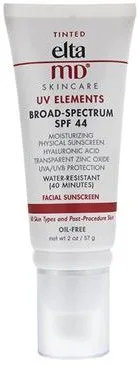
Most tinted mineral sunscreens deliver either the tint or the antioxidant load — rarely both at meaningful concentrations. This formulation pairs a high 13.5% zinc oxide load with iron oxides for documented HEV protection, plus a real antioxidant trio of carnosine, tocopherol, and ascorbyl palmitate that the standard UV Elements formula does not include. For melasma patients and users with cumulative photoaging concerns, the combination targets multiple drivers of pigmentation in a single product.
A well-engineered tinted mineral sunscreen that combines a high 13.5% zinc oxide load with iron oxide HEV protection and a meaningful antioxidant trio. For melasma patients, post-procedure users, and anyone concerned about visible-light-triggered pigmentation, this is one of the better consumer choices available. The 1.7 oz size at $46 is the main friction.
Good choicefor SensitivityIn your profileYou chose · No fragrance, drying alcohol, declarable allergens or sensitising preservatives in this lotion — the profile sensitive skin looks for.Not yet assessedGentleNo reviews collected yet
The case for it
Zinc Oxide has no evidence row yet for this concern — it is in the research queue.
The formula carries none of the triggers this concern is sensitive to.
What would change this: A researched evidence row for the lead active would replace this with a verdict.
Same rule for everyone. “Good choice” is the verdict on 1,938 of 45,024 concern verdicts across the catalog; rule F2 decided 1,938 of them.
Unchanged since September 5, 2026, engine 5.1.1.
Full protectionfor MelasmaIn your profileYou chose · Broad-spectrum SPF 50 with iron oxides for visible light — what melasma needs from a sunscreen.Not yet assessedGentleNo reviews collected yet
The case for it
Zinc Oxide has no evidence row yet for this concern — it is in the research queue.
The formula carries none of the triggers this concern is sensitive to.
What would change this: A researched evidence row for the lead active would replace this with a verdict.
Same rule for everyone. “Full protection” is the verdict on 2,288 of 45,024 concern verdicts across the catalog; rule P2 decided 56 of them.
Unchanged since September 5, 2026, engine 5.1.1.
Full protectionfor HyperpigmentationIn your profileYou chose · Broad-spectrum SPF 50 with zinc oxide, titanium dioxide: the protection hyperpigmentation calls for.Not yet assessedGentleNo reviews collected yet
The case for it
Zinc Oxide has no evidence row yet for this concern — it is in the research queue.
The formula carries none of the triggers this concern is sensitive to.
What would change this: A researched evidence row for the lead active would replace this with a verdict.
Same rule for everyone. “Full protection” is the verdict on 2,288 of 45,024 concern verdicts across the catalog; rule P1 decided 2,232 of them.
Unchanged since September 5, 2026, engine 5.1.1.
P1 — Photoprotection standing is regulatory (M020 / Annex VI filters; 21 CFR 201.327 attaches the early-skin-aging claim to tested broad-spectrum SPF 15+). SPF 30 is the AAD daily-use bar. · the full register
Supporting rolefor RosaceaIn your profileYou chose · Nothing here targets rosacea directly; photoprotection against a known trigger is the recognised companion to treating it, and this lotion does that without known triggers.Not yet assessedGentleNo reviews collected yet
The case for it
Zinc Oxide has no evidence row yet for this concern — it is in the research queue.
The formula carries none of the triggers this concern is sensitive to.
What would change this: A researched evidence row for the lead active would replace this with a verdict.
Same rule for everyone. “Supporting role” is the verdict on 8,197 of 45,024 concern verdicts across the catalog; rule R8 decided 4,250 of them.
Unchanged since September 5, 2026, engine 5.1.1.
R8 — The category's job (barrier care, humectant hydration, gentle cleansing, photoprotection) is the documented supportive role for this concern. This is the honest verdict for a moisturizer on an acne page. · the full register
Full protectionfor Post-ProcedureIn your profileYou chose · Broad-spectrum SPF 50 with zinc oxide, titanium dioxide: the protection post procedure calls for.Not yet assessedGentleNo reviews collected yet
The case for it
Zinc Oxide has no evidence row yet for this concern — it is in the research queue.
The formula carries none of the triggers this concern is sensitive to.
What would change this: A researched evidence row for the lead active would replace this with a verdict.
Same rule for everyone. “Full protection” is the verdict on 2,288 of 45,024 concern verdicts across the catalog; rule P1 decided 2,232 of them.
Unchanged since September 5, 2026, engine 5.1.1.
P1 — Photoprotection standing is regulatory (M020 / Annex VI filters; 21 CFR 201.327 attaches the early-skin-aging claim to tested broad-spectrum SPF 15+). SPF 30 is the AAD daily-use bar. · the full register
Full protectionfor AgingIn your profileYou chose · Broad-spectrum SPF 50 with zinc oxide, titanium dioxide: the protection aging calls for.Not yet assessedGentleNo reviews collected yet
The case for it
Zinc Oxide has no evidence row yet for this concern — it is in the research queue.
The formula carries none of the triggers this concern is sensitive to.
What would change this: A researched evidence row for the lead active would replace this with a verdict.
Same rule for everyone. “Full protection” is the verdict on 2,288 of 45,024 concern verdicts across the catalog; rule P1 decided 2,232 of them.
Unchanged since September 5, 2026, engine 5.1.1.
P1 — Photoprotection standing is regulatory (M020 / Annex VI filters; 21 CFR 201.327 attaches the early-skin-aging claim to tested broad-spectrum SPF 15+). SPF 30 is the AAD daily-use bar. · the full register
Full protectionfor Sun DamageIn your profileYou chose · Broad-spectrum SPF 50 with zinc oxide, titanium dioxide: the protection sun damage calls for.Moderate evidenceGentleNo reviews collected yet
The case for it
Zinc Oxide is a first-line active — approved, monograph-listed or named in current guidelines — for this concern.
It is present at an effective concentration, declared or high in the ingredient list.
The formula carries none of the triggers this concern is sensitive to.
Same rule for everyone. “Full protection” is the verdict on 2,288 of 45,024 concern verdicts across the catalog; rule P1 decided 2,232 of them.
Unchanged since September 5, 2026, engine 5.1.1.
P1 — Photoprotection standing is regulatory (M020 / Annex VI filters; 21 CFR 201.327 attaches the early-skin-aging claim to tested broad-spectrum SPF 15+). SPF 30 is the AAD daily-use bar. · the full register
Does the jobDoes what a sunscreen is for: UVA coverage, kind to the skin wearing it. Not measured from the label: pleasant enough to actually use.
A verdict is DermApproved’s assessment of how well a product’s ingredients fit a concern — never a claim about what the product treats. Evidence dots and collected reviews sit beside it and are never blended in.
Rules 0.5.1 · evidence table ev-2026.09-r228 · how we decide
✓ 100% mineral filter — appropriate for sensitive, pregnancy, and post-procedure
✓ Universal tint blends well across fair-to-medium-deep skin tones
✓ Sits smoothly under makeup without pilling
Cons
✗ 1.7 oz at $46 is premium pricing versus cheaper tinted mineral alternatives
✗ Universal tint can read too dark on very fair or too ashy on deep skin tones
✗ Pump dispenser can be inconsistent with the thicker mineral formula
✗ Brand-reported clinical figures rather than independent trials
Review
Full Review
Sunscreen recommendations have shifted meaningfully over the past five years, and the shift has not been about SPF numbers or filter chemistry. It has been about visible light. The dermatology literature over the past decade has accumulated convincing evidence that visible light — particularly the high-energy visible (HEV) blue light spectrum — is a meaningful contributor to melasma triggering and post-inflammatory hyperpigmentation in skin of color. The traditional UVA-UVB framework, which dominated sunscreen research for the previous half-century, captures only part of what skin is exposed to during the day. Visible light is the other part, and visible light is what cell phones, computer screens, fluorescent indoor lighting, and the bulk of daytime sunlight actually deliver to skin. The dermatology response to this research has been a shift toward tinted mineral sunscreens with iron oxide content, because iron oxides have documented visible-light and HEV protection that pure zinc oxide and titanium dioxide filters do not. EltaMD's UV AOX Elements is one of the most thoughtful consumer formulations that translates this research into a usable product.
The formulation has three distinct layers worth understanding. The first is the mineral filter system: 13.5% zinc oxide plus 4.4% titanium dioxide, delivering SPF 50 broad-spectrum protection through reflection and scattering rather than chemical absorption. The 13.5% zinc oxide load is at the upper end of what is cosmetically achievable in a lotion format — many mineral sunscreens with similar SPF ratings rely on a lower zinc-to-titanium ratio that produces more white cast. The high zinc content here matters because zinc oxide is the most reliably broad-spectrum mineral filter, providing both UVA1 and UVA2 coverage that titanium dioxide alone does not match. For sensitive-skin users, post-procedure patients, pregnancy, and anyone who specifically wants to avoid chemical UV filters, this is the foundational protection layer.
The second layer is the iron oxide tint. This is the formulation feature that justifies the product's positioning for melasma and pigmentation-prone users. Published dermatology research — particularly the work that has accumulated since around 2015 — has shown that iron oxide-tinted formulations reduce melasma triggering from visible light exposure significantly better than untinted mineral sunscreens. The mechanism is straightforward: iron oxides absorb visible-light wavelengths that pure mineral filters cannot block, particularly in the 400-500 nm range that overlaps with the HEV spectrum. The brand reports 56% HEV blocking from this formulation, which is 39% higher than the original UV Elements formula. For users who specifically have melasma, post-inflammatory hyperpigmentation, or any pigmentation concern that is driven by visible light, the iron oxide tint is functionally distinct from the cosmetic role tints play in non-mineral sunscreens.
The third layer is the antioxidant trio that gives the product its 'AOX' name. Carnosine, tocopherol (vitamin E), and ascorbyl palmitate work together to neutralize the free radicals that get past the mineral filter layer. No sunscreen is 100% effective at blocking UV and visible light — at SPF 50, roughly 2% of UV exposure still reaches skin, and visible light blocking is even less complete. Antioxidants address the downstream oxidative damage from that residual exposure. Carnosine specifically is a dipeptide with documented activity against advanced glycation end products, and it is an underused but credible inclusion in this antioxidant complex. This is the formulation feature that differentiates the AOX version from the standard UV Elements. Whether the antioxidant load is meaningful enough to translate into measurable photoaging benefit over years of use is a more speculative claim, but the underlying mechanism is well-supported.
In practice the sunscreen behaves predictably for a well-engineered tinted mineral formulation. The silicone polymer base — dimethicone, butyloctyl salicylate (a non-sunscreen emollient that improves the cosmetic feel), and the dimethicone crosspolymers — produces a smooth, satin finish that sits well under makeup. The universal tint blends across a moderate range of skin tones; users in the fair-to-medium-deep range will find it works well, while very fair or very deep skin tones may see some tonal mismatch. Application volume matters: most users underapply mineral sunscreens by 50-70% versus the FDA's testing protocol, which reduces the effective SPF substantially. At the proper 1/4 teaspoon dose, this sunscreen delivers what it claims on the label.
The brand's reported clinical outcomes — 14% improvement in skin tone evenness at 12 weeks, 44% improvement in skin texture — should be read with appropriate caveats. These are brand-reported in-house clinical measurements, not peer-reviewed independent trials. They are consistent with what a well-formulated mineral-plus-iron-oxide-plus-antioxidant sunscreen should deliver over months of consistent use, but they are not the same level of evidence as published dermatology trials. For most users, the more reliable benchmark is the formulation's alignment with current dermatology consensus on visible-light protection and antioxidant supplementation, which is solid.
Where the product is at its strongest is the melasma and pigmentation-prone population. Dermatologists treating melasma have steadily migrated toward tinted iron oxide-rich mineral sunscreens as the daily protective foundation of the treatment protocol, and this product is among the better consumer options in that category. Paired with a prescription depigmenting routine — tranexamic acid, hydroquinone, or others — this sunscreen prevents new pigmentation triggering while the prescription work fades existing pigment. For post-procedure use after chemical peels, microneedling, or laser treatments, the 100% mineral filter formulation with no chemical filters and the bisabolol anti-inflammatory inclusion makes it appropriate immediately after procedures when skin is most photosensitive. For sensitive-skin daily use, the fragrance-free, mineral-only formulation is reliable.
The friction points are mostly about pricing and tonal range. At $46 for 1.7 oz, the per-ounce pricing is firmly in the derm-office premium tier. Comparable tinted mineral sunscreens are available across a range of price points — Australian Gold Botanical Tinted SPF 50 retails around $13, the Black Girl Sunscreen Make It Matte runs around $19, and several K-beauty tinted mineral options are available in the $20-30 range. For users who specifically need the high zinc oxide load, the documented HEV protection, and the antioxidant trio of this formulation, the EltaMD premium is reasonable. For users who just want a basic tinted mineral sunscreen, cheaper alternatives may suffice. The tonal range is the other limit: this is a universal tint, not a shade range, and users at the extremes of skin tone may not find the match they need.
For the population this product is engineered for — melasma patients, post-procedure users, sensitive-skin populations, users concerned about visible-light-triggered pigmentation, anyone who specifically wants the antioxidant supplementation layer — this is a sensibly designed and well-executed mineral sunscreen. The combination of high zinc oxide, iron oxide HEV protection, and the carnosine-vitamin E-ascorbyl palmitate antioxidant trio covers more ground than most consumer mineral sunscreens. The price premium reflects the formulation discipline and the dermatology-office channel positioning, both of which are legitimately earned in this case rather than being purely a branding premium.
Formula
Key Ingredients
The hero actives that drive this product's performance.
A 100% mineral filter system providing broad-spectrum UVA and UVB protection through reflection and scattering rather than chemical absorption. The 13.5% zinc oxide load is at the upper end of what is achievable in a cosmetically-elegant lotion format, and combined with the 4.4% titanium dioxide delivers SPF 50 protection that is independently appropriate for sensitive skin, post-procedure use, and pregnancy.
Regulator-approvedfor Sun Damage · limited certainty
Beyond providing the universal tint, iron oxides offer documented visible-light and HEV (blue light) protection that pure mineral filters alone cannot deliver. Published research has specifically shown that iron oxides reduce melasma triggering from visible light exposure — which is why dermatologists now recommend tinted sunscreens specifically for melasma and post-inflammatory hyperpigmentation patients rather than untinted mineral sunscreens.
Carnosine is a dipeptide antioxidant with documented activity against advanced glycation end products and oxidative stress. Paired with tocopherol (vitamin E) and ascorbyl palmitate, this antioxidant trio is the 'AOX' the product is named for — designed to neutralize the free radicals that get past the mineral filter layer rather than relying on sunscreen filtering alone. This combination is what differentiates this product from the standard UV Elements formula.
Provides supplemental humectant support to balance the silicone-rich base of the formula. At its position late in the ingredient list, the hyaluronate is contributing surface hydration rather than acting as a primary moisturizing engine, but it adds a mild cushioning effect that the pure mineral filter would lack on its own.
A chamomile-derived anti-inflammatory included specifically to soothe the skin response to UV exposure and any minor irritation from the mineral filter layer. Bisabolol is one of the better-studied botanical anti-inflammatories and is a sensible addition to a sensitive-skin-positioned mineral sunscreen.
Not yet assessed
Ingredient standings describe the active at treatment-level doses and
vehicles; this product's own condition grades weigh its actual formula.
Save this for the last step of the morning routine after moisturizer. Use the recommended 1/4 teaspoon for the full face — most users underapply mineral sunscreens, which reduces the SPF rating substantially. The universal tint blends across a moderate range of skin tones; very fair or very deep skin tones may see slight grey or ashy cast. Reapply every 2 hours during prolonged sun exposure.
Results Timeline
Immediate: full UVA, UVB, and HEV protection on application, with the tint providing instant tone-evening cosmetic improvement. Short-term (4-8 weeks): consistent daily use produces measurable improvement in skin tone evenness — the brand reports 14% tone evenness improvement at 12 weeks. Full benefits (3-6 months): cumulative protection against melasma triggering and photoaging-related pigmentation. The AOX antioxidant load supports the broader anti-photoaging case over months of consistent use.
The clinical evidence base for this product's formulation choices is well-established across multiple distinct research areas. The mineral filter combination of zinc oxide and titanium dioxide is among the most rigorously studied sunscreen filter systems in dermatology, with consistent evidence for broad-spectrum UVA and UVB protection through reflection and scattering. The 13.5% zinc oxide load is at the upper cosmetically-achievable end and provides reliable UVA1 coverage that lower zinc loads do not. The iron oxide visible-light protection evidence base has accumulated rapidly since around 2015. Boukari et al. (J Am Acad Dermatol, 2015) demonstrated that iron oxide-tinted sunscreens significantly reduced melasma severity compared to untinted mineral sunscreens in a controlled trial, and subsequent work by Castanedo-Cazares and colleagues has reinforced this finding across multiple study populations with melasma and post-inflammatory hyperpigmentation. The visible-light triggering mechanism for melasma — particularly via the opsin-3 photoreceptor pathway — has been characterized in research by Regazzetti et al. (J Invest Dermatol, 2018) and extended in multiple subsequent papers. The carnosine antioxidant inclusion rests on a smaller but reasonable evidence base; published work has documented carnosine's activity against advanced glycation end products and oxidative stress markers in skin, though the clinical evidence for topical carnosine in sunscreen formulations specifically is more limited than the broader carnosine literature. Tocopherol and ascorbyl palmitate are among the better-studied topical antioxidants, with consistent evidence for free radical neutralization across the skin's lipid and aqueous compartments. Bisabolol's anti-inflammatory action is supported by a moderate evidence base in dermatology, particularly for sensitive and post-inflammatory skin states. Overall, the formulation rests on a strong evidence base for the primary protection mechanisms (mineral filtration plus iron oxide visible-light blocking) and a reasonable evidence base for the antioxidant supplementation layer.
Dermatologist Perspective
Dermatologists treating melasma, post-inflammatory hyperpigmentation, and other visible-light-driven pigmentation concerns have steadily moved toward tinted iron oxide-rich mineral sunscreens as the daily protective foundation of treatment protocols. UV AOX Elements is widely stocked in dermatology offices for this population and is one of the better-regarded consumer options in the category. Clinical dermatologists frequently recommend it specifically for melasma patients, post-Mohs surgery patients, post-laser patients, and pregnancy-related skin concerns. The 100% mineral filter formulation with no chemical absorbers is appropriate for pregnancy and breastfeeding without restriction. The bisabolol anti-inflammatory inclusion makes it particularly well-suited for post-procedure skin and rosacea-adjacent populations. The most common clinical caveat raised is the importance of proper application volume — dermatologists routinely note that the 1/4 teaspoon dose is essential for the labeled SPF rating to apply in practice, and that consistent reapplication during prolonged sun exposure is more important than the choice of sunscreen brand. The tonal range limitation — the product is a universal tint rather than a shade range — is noted as a fit issue for the extremes of the skin tone spectrum, where alternative tinted or untinted options may be needed.
Guidance
Usage & Recommendations
How to Use
Apply approximately 1/4 teaspoon to the face as the last step of the morning skincare routine, after moisturizer. Spread evenly across the face, hairline, ears, and neck. Allow about a minute for the formula to set before applying makeup. For prolonged outdoor exposure, reapply every two hours. The universal tint can be layered over with foundation for fuller coverage or worn alone for low-coverage days. Compatible with all common AM serum routines including vitamin C, niacinamide, and tranexamic acid. For melasma management, daily consistent use is more important than the specific product choice — the formulation only works if it is on the skin during light exposure.
Value Assessment
At $46 for 1.7 oz, the per-ounce pricing is firmly in the derm-office premium tier. Comparable tinted mineral sunscreens span a wide price range: Australian Gold Botanical Tinted SPF 50 around $13, Black Girl Sunscreen Make It Matte around $19, and several K-beauty tinted mineral options in the $20-30 range. Most of those alternatives have lower zinc oxide loads, more limited iron oxide content, and lack the antioxidant trio that AOX Elements includes. For users who specifically need the high zinc oxide load, the documented HEV protection, and the antioxidant supplementation, the EltaMD premium is reasonable. For users who just want a basic tinted mineral sunscreen, cheaper alternatives may suffice. The 1.7 oz bottle typically lasts 6-8 weeks at twice-daily face application, putting the monthly cost around $11-15 — meaningful but consistent with the price tier of derm-recommended sunscreens. The brand does not heavily discount this product; bundle pricing through EltaMD's regimen kits offers modest savings for committed users.
Who Should Buy
Users with melasma, post-inflammatory hyperpigmentation, or any pigmentation concern that is driven by visible light. Also valuable for sensitive skin populations, post-procedure patients, pregnancy, and anyone who specifically wants the antioxidant supplementation layer alongside the mineral protection. Users with skin tones in the fair-to-medium-deep range will find the tint match works well.
Who Should Skip
Skip if you are at the extremes of the skin tone spectrum (very fair or very deep) — the universal tint will not match cleanly. Skip if you want a basic mineral sunscreen without the premium pricing — Australian Gold Botanical Tinted SPF 50 and similar are adequate substitutes for users who do not specifically need the antioxidant load or the highest-tier zinc oxide concentration. It's also not for you if you prefer a chemical filter sunscreen for its lighter cosmetic feel.
Ready to try EltaMD UV AOX Elements Broad-Spectrum SPF 50?
Medium-weight tinted lotion that glides on smoothly with the silicone polymer base. Sets to a satin finish within a minute, with the tint blending into skin rather than sitting on top.
Scent
Fragrance-free.
Packaging
1.7 oz white plastic pump bottle with the EltaMD blue-and-white label. Pump format protects the formula from light exposure.
Finish
satinnon-greasynatural
What to Expect on First Use
First application produces an immediate cosmetic tone-evening effect from the universal tint plus iron oxides — most users notice that uneven tone, post-inflammatory pigmentation, and minor redness look measurably better within seconds of application. No purging or adjustment period. The silicone base creates a smooth surface for subsequent makeup application; many users find this functions as a daily tinted moisturizer in addition to its sunscreen role.
How Long It Lasts
Roughly 6-8 weeks applied morning and night face application (or 4-6 weeks if reapplying through the day for outdoor exposure).
EltaMD launched the original UV Elements as a sensitive-skin tinted mineral sunscreen in the mid-2010s, and the product became widely used in dermatology offices for post-procedure and sensitive patient populations. UV AOX Elements followed in 2022 as the evolution of that formula, with the brand adding the carnosine-tocopherol-ascorbyl palmitate antioxidant trio and increasing the HEV protection to 56% (versus the original's lower HEV blocking). The product was developed in response to the growing dermatology literature on visible-light-triggered melasma and the recognition that traditional mineral sunscreens were not addressing this driver of pigmentation.
About EltaMD Established Brand (5–20 years)
EltaMD built its reputation in dermatology offices starting in the late 1980s, particularly through Mohs surgery practices that stock the UV Clear sunscreen as a patient takeaway. UV AOX Elements is a 2022 evolution of the brand's mineral-sunscreen line, designed specifically with HEV (blue light) protection and antioxidant supplementation as the differentiating features versus the original UV Elements formula.
Brand founded: 1988 · Product launched: 2022
Myth vs. Reality
Common Myths
Myth
Tinted sunscreens are just sunscreens with cosmetic color added.
Reality
Iron oxides in tinted sunscreens provide documented visible-light and HEV protection that pure mineral filters alone cannot deliver. Published dermatology research has specifically shown that iron oxide-tinted formulations reduce melasma triggering from visible light exposure significantly better than untinted mineral sunscreens. The tint is functional, not just cosmetic, particularly for users with melasma or post-inflammatory hyperpigmentation.
Myth
Mineral sunscreens always leave a white cast on darker skin.
Reality
Modern mineral sunscreen formulations using micronized zinc oxide and iron oxide tinting can be largely cast-free across a wide range of skin tones. This product specifically blends on most medium-to-medium-deep skin tones without significant white cast, though very fair or very deep skin tones may see some tonal mismatch. The legacy white-cast issue applies primarily to first-generation mineral formulations from the 1990s and 2000s.
FAQ
Frequently Asked Questions
How is this different from EltaMD UV Elements?
UV AOX Elements adds a carnosine-tocopherol-ascorbyl palmitate antioxidant trio that the standard UV Elements does not include, and increases HEV (blue light) blocking to 56% — the brand reports this is 39% more HEV protection than the original formula. Both products are 100% mineral filters with iron oxide tinting; the AOX version specifically targets users concerned about visible-light-triggered pigmentation and photoaging via antioxidant supplementation.
Will the tint match my skin tone?
The universal tint is engineered to blend across a moderate range of skin tones — generally fair to medium-deep. Very fair skin may see the tint read slightly dark on application; very deep skin tones may see a slight grey or ashy cast. For users outside the central tonal range, untinted alternatives like EltaMD UV Pure or a separate tinted product may be a better fit.
Is it enough for melasma management?
It is one of the better consumer sunscreen choices for melasma management specifically, because of the combination of high zinc oxide load and documented iron oxide visible-light protection. For active melasma, daily consistent use plus a prescription depigmenting protocol (tranexamic acid, hydroquinone, or others) is usually still needed. This sunscreen is the protective foundation that prevents new pigmentation, not a treatment for existing melasma.
Can I wear it under makeup?
Yes — the silicone-rich base creates a smooth surface that primer-like under foundation. Many users find this product functions as a tinted moisturizer on its own for low-coverage days, with foundation layered over for fuller coverage. It does not pill under common foundation formulations when applied in the proper 1/4 teaspoon dose.
Is it safe for use after Mohs surgery or laser treatment?
Yes — the 100% mineral filter formulation with no chemical filters and no fragrance is specifically appropriate for post-procedure skin. Mineral sunscreens are routinely recommended for the days and weeks following in-office procedures, and this formulation's anti-inflammatory bisabolol inclusion makes it particularly well-suited for sensitive post-procedure skin.
Can UV AOX Elements Broad-Spectrum SPF 50 be used while pregnant?
Yes — the active ingredients are 100% mineral (zinc oxide and titanium dioxide), both of which are considered first-line sunscreen choices during pregnancy. The inactive ingredient deck is also pregnancy-safe with no flagged retinoids, salicylic acid, or other commonly avoided ingredients.
How much do I need to apply for the SPF 50 rating?
Approximately 1/4 teaspoon for the full face, applied evenly. Most users underapply mineral sunscreens by 50-70% versus the FDA's testing protocol, which reduces the effective SPF substantially. Using the proper dose is more important than the choice of sunscreen — an underapplied SPF 50 may deliver SPF 15-20 in practice.
Reviews
What Reviewers Tend to Say
Recurring themes our editors read across retailer reviews of this product — summaries in our words, not quotations, and not a substitute for your own patch test.
Common Praise
Universal tint blends across most medium skin tones
No white cast despite 13.5% zinc oxide load
Iron oxide HEV protection is a real differentiator for melasma users
Sits well under makeup without pilling
Fragrance-free, sensitive-skin appropriate
Substantively better tone evening than untinted mineral sunscreens
Common Complaints
1.7 oz at $46 is premium pricing
Tint can read too dark on very fair skin
Tint can read too light or ashy on deeper skin tones
Pump dispenser can be inconsistent with the thicker mineral formula
Notable Endorsements
Carried in dermatology and Mohs surgery officesFrequently recommended for melasma patientsFeatured in dermatologist YouTube reviews including Dr. Dray and Dr. Sam Bunting
Every pigment-fading active runs against a re-pigmenting stimulus, and for melasma part of that stimulus is visible light — which broad-spectrum sunscreen does essentially nothing about unless you can see it on your face.
Chamomile's active fraction inhibits the same inflammatory pathways a steroid does, at a fraction of the strength — and the version that works best is grubbed out of Brazilian cerrado, while the synthetic substitute is half inactive by construction.
Aug 28, 2026· 9 min
Questions people ask about sensitive skin
Verified answers from our questions library — the nuance a product page cannot carry.
Products, answers, therapy guides, tools and articles in one search. Brand names,
slang and abbreviations all work — accutane finds isotretinoin, bacne finds truncal acne.