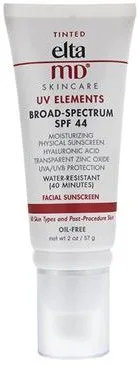
Within the EltaMD UV lineup, UV Elements is the only pure-mineral SKU with universal-tint iron oxides — making it uniquely positioned for hyperpigmentation, melasma, and post-procedure use where visible-light protection (not just UV) actually matters. Research from the last decade has shown that visible light, especially HEV blue light, drives pigmentation in Fitzpatrick III-VI skin, and iron oxides are the most validated topical block. This is the SKU dermatologists prescribe specifically for that problem.
EltaMD's pure-mineral tinted SPF that's quietly become the dermatology standard for melasma and hyperpigmentation management. The iron oxides aren't just for masking white cast — they're a clinically meaningful visible-light block, which is what makes this SKU genuinely different from a standard mineral sunscreen. Worth the price tag for the target use cases.
Full protectionfor Sun DamageIn your profileYou chose · Broad-spectrum SPF 44 with zinc oxide, titanium dioxide: the protection sun damage calls for.Moderate evidenceGentleNo reviews collected yet
The case for it
Zinc Oxide 10.0% is a first-line active — approved, monograph-listed or named in current guidelines — for this concern.
It is present at an effective concentration, declared or high in the ingredient list.
The formula carries none of the triggers this concern is sensitive to.
Same rule for everyone. “Full protection” is the verdict on 2,288 of 45,024 concern verdicts across the catalog; rule P1 decided 2,232 of them.
Unchanged since September 5, 2026, engine 5.1.1.
P1 — Photoprotection standing is regulatory (M020 / Annex VI filters; 21 CFR 201.327 attaches the early-skin-aging claim to tested broad-spectrum SPF 15+). SPF 30 is the AAD daily-use bar. · the full register
Full protectionfor AgingIn your profileYou chose · Broad-spectrum SPF 44 with zinc oxide, titanium dioxide: the protection aging calls for.Limited evidenceGentleNo reviews collected yet
The case for it
Ascorbyl Palmitate + Tocopherol has early or mechanistic evidence for this concern, not trial-backed standing.
It is plausibly present at a working level, though the concentration is not declared.
The formula carries none of the triggers this concern is sensitive to.
What would change this: A declared concentration would move this to a firmer reading of the dose.
Same rule for everyone. “Full protection” is the verdict on 2,288 of 45,024 concern verdicts across the catalog; rule P1 decided 2,232 of them.
Unchanged since September 5, 2026, engine 5.1.1.
P1 — Photoprotection standing is regulatory (M020 / Annex VI filters; 21 CFR 201.327 attaches the early-skin-aging claim to tested broad-spectrum SPF 15+). SPF 30 is the AAD daily-use bar. · the full register
Carrying active
Ascorbyl Palmitate + Tocopherol
Standing
plausible — trials support it
Form
plausible — studied range 1%, from the OTC monograph or label; needs leave-on contact
Tolerability
gentle
Row checked
against its sources on July 17, 2026 (evidence table ev-2026.09-r228)
Supporting rolefor RosaceaIn your profileYou chose · Nothing here targets rosacea directly; photoprotection against a known trigger is the recognised companion to treating it, and this cream does that without known triggers.Not yet assessedGentleNo reviews collected yet
The case for it
Zinc Oxide 10.0% has no evidence row yet for this concern — it is in the research queue.
The formula carries none of the triggers this concern is sensitive to.
What would change this: A researched evidence row for the lead active would replace this with a verdict.
Same rule for everyone. “Supporting role” is the verdict on 8,197 of 45,024 concern verdicts across the catalog; rule R8 decided 4,250 of them.
Unchanged since September 5, 2026, engine 5.1.1.
R8 — The category's job (barrier care, humectant hydration, gentle cleansing, photoprotection) is the documented supportive role for this concern. This is the honest verdict for a moisturizer on an acne page. · the full register
Full protectionfor HyperpigmentationIn your profileYou chose · Broad-spectrum SPF 44 with zinc oxide, titanium dioxide: the protection hyperpigmentation calls for.Not yet assessedGentleNo reviews collected yet
The case for it
Zinc Oxide 10.0% has no evidence row yet for this concern — it is in the research queue.
The formula carries none of the triggers this concern is sensitive to.
What would change this: A researched evidence row for the lead active would replace this with a verdict.
Same rule for everyone. “Full protection” is the verdict on 2,288 of 45,024 concern verdicts across the catalog; rule P1 decided 2,232 of them.
Unchanged since September 5, 2026, engine 5.1.1.
P1 — Photoprotection standing is regulatory (M020 / Annex VI filters; 21 CFR 201.327 attaches the early-skin-aging claim to tested broad-spectrum SPF 15+). SPF 30 is the AAD daily-use bar. · the full register
Full protectionfor MelasmaIn your profileYou chose · Broad-spectrum SPF 44 with iron oxides for visible light — what melasma needs from a sunscreen.Not yet assessedGentleNo reviews collected yet
The case for it
Zinc Oxide 10.0% has no evidence row yet for this concern — it is in the research queue.
The formula carries none of the triggers this concern is sensitive to.
What would change this: A researched evidence row for the lead active would replace this with a verdict.
Same rule for everyone. “Full protection” is the verdict on 2,288 of 45,024 concern verdicts across the catalog; rule P2 decided 56 of them.
Unchanged since September 5, 2026, engine 5.1.1.
Full protectionfor Post-ProcedureIn your profileYou chose · Broad-spectrum SPF 44 with zinc oxide, titanium dioxide: the protection post procedure calls for.Not yet assessedGentleNo reviews collected yet
The case for it
Zinc Oxide 10.0% has no evidence row yet for this concern — it is in the research queue.
The formula carries none of the triggers this concern is sensitive to.
What would change this: A researched evidence row for the lead active would replace this with a verdict.
Same rule for everyone. “Full protection” is the verdict on 2,288 of 45,024 concern verdicts across the catalog; rule P1 decided 2,232 of them.
Unchanged since September 5, 2026, engine 5.1.1.
P1 — Photoprotection standing is regulatory (M020 / Annex VI filters; 21 CFR 201.327 attaches the early-skin-aging claim to tested broad-spectrum SPF 15+). SPF 30 is the AAD daily-use bar. · the full register
Does the jobDoes what a sunscreen is for: UVA coverage, kind to the skin wearing it. Not measured from the label: pleasant enough to actually use.
A verdict is DermApproved’s assessment of how well a product’s ingredients fit a concern — never a claim about what the product treats. Evidence dots and collected reviews sit beside it and are never blended in.
Rules 0.5.1 · evidence table ev-2026.09-r228 · how we decide
Assessment
Pros & Cons
Pros
✓ Iron oxide tint provides clinically meaningful visible-light protection for melasma and hyperpigmentation
✓ 100% mineral formula — pregnancy-safe, reef-safe, and post-procedure tolerable
✓ Universal warm tint works across a range of skin tones without white cast
✓ Skin Cancer Foundation Seal of Recommendation
✓ Silicone-and-emollient base spreads easily despite high zinc concentration
✓ Fragrance-free and tolerable for sensitive and rosacea-prone skin
✓ Background antioxidants (vitamin C ester and vitamin E) plus humectant hyaluronic acid
Cons
✗ Universal tint may not match very fair or very deep skin tones perfectly
✗ Higher price point than comparable iron-oxide-tinted mineral options
✗ Not water-resistant — separate SKU needed for athletic or outdoor activity
✗ Smaller volume (2 oz) than UV Daily (1.7 oz) but similar price-per-ounce
✗ Lighter coverage than a true foundation — supplemental coverage may be needed
Review
Full Review
Until about a decade ago, sunscreen recommendations focused on one number: SPF. The implicit assumption was that blocking ultraviolet radiation was the entire job, and a higher SPF was always better. Then a series of papers — most influentially work by Mahmoud and colleagues in 2010 and subsequent research through the mid-2010s — established something dermatologists had clinically suspected but couldn't prove. Visible light, especially the high-energy visible (HEV) blue portion that passes through standard UV-blocking sunscreens, drives pigment darkening in melasma and post-inflammatory hyperpigmentation. Patients with Fitzpatrick III-VI skin were getting darker spots even with religious daily SPF application, because the SPF wasn't blocking the wavelengths responsible. The solution, it turned out, had been sitting in foundation tubes for decades: iron oxides. The same mineral pigments that color cosmetic foundation also absorb visible light in the 400-700 nm range. Sunscreens with iron oxides — tinted mineral sunscreens — provide protection that UV-only sunscreens fundamentally cannot. EltaMD UV Elements has been in the line since around 2010, but the dermatology recommendation around it has shifted significantly in the last several years. What was originally positioned as a sensitive-skin tinted SPF is now the go-to brand-specific recommendation when a dermatologist is treating melasma, hyperpigmentation, or post-inflammatory pigment in darker skin tones. The formula is 100% mineral: 10% zinc oxide and 5.5% titanium dioxide as the active ingredients, with no chemical filters anywhere in the formula. This makes it pregnancy-friendly, reef-safe, and tolerable for post-procedure skin (microneedling recovery, laser resurfacing, chemical peel aftercare) where chemical filters are best avoided. The iron oxides provide universal tint and visible-light protection. The supporting base is a silicone-and-emollient system — cyclopentasiloxane, dimethicone, octyldodecyl neopentanoate — that gives the formula slip and helps it spread across skin without dragging. Sodium hyaluronate is folded in as a humectant. Ascorbyl palmitate and tocopherol provide background antioxidant protection. There's no fragrance, no alcohol, no parabens. The texture in actual use is what justifies the entire architecture. A pure-mineral formula at 10% zinc oxide would normally feel chalky, look white, and refuse to blend into skin. UV Elements doesn't. The silicone slip makes it spread easily. The iron oxide tint neutralizes the white cast that the high zinc concentration would otherwise produce. The finish is satin and natural-looking, with a subtle warm color-correction that flatters a range of skin tones. For someone who's used to traditional mineral sunscreens, the wear quality is genuinely surprising. The tint shade is calibrated to a universal warm tone that works across Fitzpatrick III-IV skin most consistently, and adapts reasonably well to lighter and darker tones with adjusted application amounts. Very fair complexions may find the tint slightly warm; very deep complexions may find it slightly light. EltaMD doesn't sell shade variants the way a tinted moisturizer line would, which is the main cosmetic limitation. For melasma patients specifically, this SKU has become almost a clinical default. Dermatologists prescribing tranexamic acid, hydroquinone, or kojic acid treatments routinely pair the prescription with daily UV Elements use, because the topical lightening agents won't outpace ongoing visible-light-driven darkening if the patient's sunscreen doesn't block visible light. The iron oxide tint solves that exact problem. Pregnancy is the other major use case. The formula contains no oxybenzone, no octinoxate, no avobenzone — none of the chemical filters that some obstetric dermatologists prefer pregnant patients avoid out of an abundance of caution. The pure-mineral active system makes UV Elements one of the most consistently recommended pregnancy-safe sunscreens. Post-procedure skin is the third. After microneedling, laser, or peels, the skin barrier is temporarily compromised and chemical UV filters are more likely to sting, irritate, or absorb systemically. Mineral-only formulas are the standard recommendation, and UV Elements is tolerable enough for most patients to start using within 24-48 hours of the procedure. Where the formula needs honest framing is its limitations outside these specific use cases. For routine daily SPF on skin that doesn't have melasma, hyperpigmentation concerns, or sensitivity needs, the value proposition is harder to justify against drugstore alternatives. La Roche-Posay Anthelios Mineral Tinted SPF 50 is roughly $36 and uses similar iron-oxide-tinted mineral architecture for less. EltaMD's price reflects the brand's clinical pedigree and physician-distribution model more than a meaningful formulation gap. For shoppers who don't need the clinical-context recommendation, the upgrade isn't always worth it. The water-resistance issue is also worth noting: this isn't a sport sunscreen. It's a daily SPF for normal indoor-to-light-outdoor wear. For swimming, sweating, or extended outdoor activity, EltaMD UV Sport SPF 50 is the water-resistant choice in the brand's lineup. UV Elements will rub or wash off with significant moisture exposure. The value question, then, is really about whether you fit the target use cases. If you have melasma, hyperpigmentation in darker skin, are pregnant, or are managing post-procedure recovery, this is one of the most clinically validated sunscreens you can use, with nearly two decades of derm-office track record. If you're shopping for routine daily SPF without those specific concerns, there are good options at lower prices. EltaMD UV Elements isn't a hype product or a marketing-driven recommendation. It's the answer to a specific clinical problem that other sunscreens don't solve as well, and the recommendation pattern from dermatologists reflects that.
Formula
Key Ingredients
The hero actives that drive this product's performance.
The primary broad-spectrum UVA/UVB protector in this pure-mineral formula, present at a slightly higher concentration than UV Daily's 9% — paired with titanium dioxide for layered protection that doesn't rely on any chemical filters, which is the entire point of the Elements SKU for sensitive and post-procedure skin.
Regulator-approvedfor Sun Damage · limited certainty
Stacked alongside zinc oxide as the second mineral filter, primarily extending UVB coverage and bringing total SPF to 44 without needing any chemical absorbers — this is what makes Elements pregnancy-friendly and reef-safe compared to UV Daily's octinoxate-containing formula.
Regulator-approvedfor Sun Damage · limited certainty
Provides the universal warm tint that masks the white cast typical of high-concentration mineral sunscreens, but more importantly contributes visible-light and HEV blue-light protection — relevant for hyperpigmentation-prone skin and melasma where visible light, not just UV, drives pigment.
Folded into the silicone-and-emollient base to add a humectant layer that offsets the slight drying effect of high-zinc formulations — the reason this formula reads as a tinted moisturizer with SPF rather than a typical chalky mineral sunscreen.
Lipid-soluble vitamin C ester and vitamin E pairing in the inactive base, providing background antioxidant protection that complements the mechanical UV blocking — useful for an outdoor-exposed routine where free radical damage compounds UV damage.
Limitedfor Sun Damage
Ingredient standings describe the active at treatment-level doses and
vehicles; this product's own condition grades weigh its actual formula.
Final step in your AM routine. Apply a generous quarter-teaspoon to face and neck after serums and moisturizer. The tint provides light coverage that can replace a tinted moisturizer entirely or be worn under foundation. Best applied with fingertips and pressed in rather than rubbed.
Results Timeline
Immediate UV and visible-light protection on application (effective after 15 minutes). For melasma and hyperpigmentation patients, sustained reduction in pigment darkening over 4-8 weeks of consistent daily use. Long-term photoaging prevention with daily use over months and years.
The clinical case for iron-oxide-tinted mineral sunscreens has solidified meaningfully over the past decade. Visible light spans approximately 400-700 nm, with high-energy visible (HEV) blue light at 400-450 nm being particularly relevant for skin biology. Research by Mahmoud and colleagues published in the Journal of Investigative Dermatology in 2010 demonstrated that visible light induces pigmentation in Fitzpatrick III-VI skin types — the kind of pigmentation that drives melasma, post-inflammatory hyperpigmentation, and various dyschromias common in skin of color. Standard UV-blocking sunscreens with zinc oxide and titanium dioxide alone do not measurably block visible light at the concentrations typically used in cosmetic formulations. Iron oxides change this. Castanedo-Cazares and colleagues demonstrated in 2014 that sunscreens formulated with iron oxides plus mineral UV filters significantly outperformed UV-only sunscreens in preventing melasma recurrence over a 2-month treatment course. Subsequent work has refined this further: the specific iron oxide content matters, with formulations containing 2-3% iron oxides showing meaningful visible-light protection. The combination of zinc oxide and titanium dioxide as UV filters in this formulation is well-established. Zinc oxide provides broad-spectrum protection across UVA1, UVA2, and UVB ranges; titanium dioxide is primarily a UVB blocker. The 10%/5.5% ratio in UV Elements is similar to or higher than many competitive mineral sunscreens and produces the SPF 44 broad-spectrum rating. The supporting cast — hyaluronic acid as a humectant, ascorbyl palmitate as a stable lipid-soluble vitamin C ester, tocopherol as vitamin E — provides minor antioxidant and hydration benefits without claiming to be treatment-strength. The formulation reflects an understanding that mineral sunscreens at high concentration tend toward dryness and white cast; the silicone slip system, occlusive emollients, and iron oxide tint each address one of these issues directly.
Dermatology practitioners frequently recommend EltaMD UV Elements as a clinical-grade tinted sunscreen specifically for patients with melasma, post-inflammatory hyperpigmentation, or visible-light-driven pigment concerns. The iron oxide tint is the key clinical feature — dermatologists treating these conditions know that UV-only sunscreens are insufficient and that iron-oxide-tinted formulas measurably outperform them in pigment prevention. This SKU is also commonly recommended as a pregnancy-safe SPF (no chemical filters) and as a post-procedure sunscreen for patients recovering from microneedling, laser resurfacing, or chemical peels. The universal warm tint suits a wide range of skin tones reasonably well, though very fair or very deep complexions may need adjustment. Dermatologists treating melasma typically pair this sunscreen with topical lightening agents (tranexamic acid, hydroquinone, kojic acid) — the combination is meaningfully more effective than either alone, since UV Elements blocks the visible light driving ongoing pigment while the topical works to lighten existing pigment.
Guidance
Usage & Recommendations
How to Use
Apply a generous quarter-teaspoon (nickel-sized amount) to face and neck as the final step in your AM routine, after serums and moisturizer. The tint provides light coverage that can replace a tinted moisturizer entirely. For best results, dispense onto fingertips, warm briefly, and press into skin rather than rubbing — this preserves the iron oxide tint pattern. Allow 60-90 seconds to settle before applying foundation if desired. Reapply every 2 hours if outdoors. For midday touch-ups, a tinted SPF powder or stick works better than re-layering the lotion. Avoid the eye area; if it gets in your eyes, rinse thoroughly.
Value Assessment
At $41 for 2 oz, UV Elements is priced similarly to UV Daily but in a slightly larger size, putting per-ounce cost in a comparable range. The price reflects EltaMD's physician-distribution model and the universally-tinted iron-oxide formulation. For patients with melasma, hyperpigmentation, or pregnancy needs where the clinical formulation matters, the price is justified — there are few alternatives that combine 100% mineral active system, iron oxide tinting, and clinical track record at lower prices. La Roche-Posay Anthelios Mineral Tinted SPF 50 is the most direct competitor at roughly $36 and offers similar architecture. For shoppers without specific clinical needs, the comparable La Roche-Posay or CeraVe AM SPF 30 Tinted are reasonable lower-cost alternatives.
Who Should Buy
This sunscreen is specifically suited to anyone with melasma, post-inflammatory hyperpigmentation, or other pigment concerns where visible-light protection matters clinically. It's also a strong choice for pregnant patients who want pure-mineral sunscreen, for post-procedure recovery (microneedling, laser, peels), and for sensitive or rosacea-prone skin that doesn't tolerate chemical UV filters. The universal warm tint suits Fitzpatrick III-IV skin tones particularly well.
Who Should Skip
Skip this if your skin tone is very fair or very deep (the universal tint may not match well), if you need water-resistance for athletic activity, if you're shopping primarily on price and don't have specific clinical needs that justify the premium, or if you prefer untinted formulas (UV Physical or UV Pure are the untinted EltaMD mineral options).
Ready to try EltaMD UV Elements Broad-Spectrum SPF 44?
Lightly creamy tinted lotion with a slight silicone slip from the cyclopentasiloxane and dimethicone base — spreads more easily than typical high-zinc mineral sunscreens
Scent
Effectively unscented — no added fragrance, with a faint underlying mineral note from the high zinc content
Packaging
Squeeze tube with flip cap; opaque packaging protects the iron oxide pigments from light degradation.
Finish
satinnaturalnon-greasy
What to Expect on First Use
Dispenses as a warm-tinted lotion. Spreads with a slight silicone slip, blending into a satin, slightly skin-warming finish. The tint adjusts to a range of medium-light to medium skin tones reasonably well — very fair or very deep skin may need a touch more or less product. No white cast. No stinging or tingling. Skin feels protected and lightly hydrated, with subtle color correction visible immediately.
Skin Cancer Foundation Seal of RecommendationReef-SafeNon-Comedogenic
Background
The Story Behind This Product
EltaMD introduced UV Elements around 2010 as the tinted, pure-mineral entry in the UV line, designed for patients who needed sunscreen without any chemical filters — primarily pregnant patients, post-procedure patients, and patients with rosacea or sensitivity. As the dermatological understanding of visible-light-driven hyperpigmentation evolved through the 2010s, this SKU became the brand's de facto recommendation for melasma management, since the iron oxide tint provides the visible-light protection plain mineral sunscreens lack.
About EltaMD Established Brand (5–20 years)
EltaMD was founded in 1988 and has spent decades as a near-default sunscreen prescription in U.S. dermatology offices. Multiple SKUs in the UV line carry the Skin Cancer Foundation Seal of Recommendation; UV Elements specifically was developed as the tinted, pure-mineral option for sensitive and post-procedure skin.
Brand founded: 1988 · Product launched: 2010
Myth vs. Reality
Common Myths
Myth
Tinted sunscreens are just for cosmetic preference.
Reality
The iron oxides in this formula provide measurable protection against visible light (400-700nm) and high-energy visible (HEV/blue) light — wavelengths that drive pigmentation in melasma and post-inflammatory hyperpigmentation but pass through standard UV-only sunscreens. For pigmentation patients, the tint is a clinical feature, not a cosmetic one.
Myth
Mineral sunscreens always leave a white cast.
Reality
This formula uses iron oxides to neutralize the white cast that 10% zinc oxide would otherwise produce. The result is a universal warm tint that works across a wide range of skin tones and looks like skin rather than a chalky overlay.
FAQ
Frequently Asked Questions
Is EltaMD UV Elements good for melasma?
Yes — and it's one of the most commonly dermatologist-recommended sunscreens specifically for melasma. The iron oxides provide visible-light and HEV blue-light protection in addition to the UV protection from zinc oxide and titanium dioxide. Visible light is a key driver of melasma darkening, and standard UV-only sunscreens don't block it. The universal tint also works well across a wide range of skin tones.
What's the difference between UV Elements and UV Physical?
Both are pure-mineral formulas, but UV Elements is tinted with iron oxides (universal warm tone) and uses a slightly different silicone-emollient base. UV Physical is untinted (well, the original — there's now a tinted version too) and has a more occlusive feel. For melasma or hyperpigmentation patients, UV Elements is the standard recommendation. For very dry post-procedure skin, UV Physical may feel more nourishing.
Is UV Elements safe during pregnancy?
Yes — the formula contains only zinc oxide and titanium dioxide as actives, both of which are considered safe during pregnancy by virtually all obstetric dermatologists. There are no chemical UV filters in this formulation. The Skin Cancer Foundation Seal applies.
Will the tint match my skin tone?
The universal warm tint is calibrated to flatter a range of medium-light to medium skin tones. Very fair skin may find it slightly too warm; very deep skin may find it too light. For best results, apply lightly and check in natural light. The tint is sheer enough to blend into most skin tones without looking like a foundation.
Is it reef-safe?
Yes — UV Elements contains only non-nano zinc oxide and titanium dioxide as actives, both of which are allowed in marine-protected areas including Hawaii. There are no octinoxate, oxybenzone, or other reef-restricted chemical filters in the formula.
Can I wear UV Elements alone or do I need a moisturizer underneath?
For combination, normal, or oily skin, UV Elements can often be worn alone as your daytime moisturizer-plus-SPF. For dry skin, a hydrating serum and a moisturizer underneath are typically helpful since the silicone base provides slip but not deep hydration.
Does UV Elements work as a foundation replacement?
The tint provides light coverage and color correction comparable to a tinted moisturizer — enough to even out skin tone but not enough to cover dark spots or significant redness. For most users, it works as a foundation replacement for casual everyday wear but not for full-coverage looks.
Reviews
What Reviewers Tend to Say
Recurring themes our editors read across retailer reviews of this product — summaries in our words, not quotations, and not a substitute for your own patch test.
Common Praise
Universal tint flatters most skin tones
No white cast despite high zinc
Excellent for melasma management
Works for sensitive skin without stinging
Lightweight despite mineral formulation
Common Complaints
Tint may not match very fair or very deep skin tones perfectly
Price relative to drugstore tinted mineral options
Not water-resistant
Smaller volume than UV Daily
Notable Endorsements
Skin Cancer Foundation Seal of RecommendationDermstoreBluemercuryAllure
Every pigment-fading active runs against a re-pigmenting stimulus, and for melasma part of that stimulus is visible light — which broad-spectrum sunscreen does essentially nothing about unless you can see it on your face.
We have spent years praising Japanese filter chemistry while ignoring that the filter is the last line of a system built out of fabric, shade and timing — the part that needs no importing and does not depend on you remembering to reapply.
Aug 28, 2026· 10 min
Questions people ask about Rosacea
Verified answers from our questions library — the nuance a product page cannot carry.
Products, answers, therapy guides, tools and articles in one search. Brand names,
slang and abbreviations all work — accutane finds isotretinoin, bacne finds truncal acne.