The Most Common Contact Allergens in Skincare Are Overwhelmingly Plant-Derived
The fourth most frequent positive patch test in North America is an oxidation product of a molecule that occurs naturally in lavender. Nobody synthesised it into your face cream.
Read the preview
From the DermApproved blog, in Clean Beauty & Marketing: the allergens that actually show up in clinic. Fourth place in North America goes to an oxidation product of a molecule made by lavender. Not a lab. A flower. And Europe's fragrance allergen list — the one clean beauty cites as proof — reads like a field guide. For the full breakdown, visit dermapproved.com/blog.
Fourth place belongs to a lavender molecule
Every two years the North American Contact Dermatitis Group publishes what it found. Twelve centres, a standardised screening series of eighty allergens, and a straightforward tally of what people actually react to.
In the 2021–2022 cycle, 3,056 patients were tested and 72 percent had at least one positive reaction. The leaderboard runs: nickel sulfate, then methylisothiazolinone at 11.5 percent, then hydroperoxides of linalool at 10.1 percent, then cobalt, then the methylchloroisothiazolinone blend. Reactions to hydroperoxides of limonene rose significantly against the previous cycle, as did several others.
Linalool is not a laboratory invention. It is a terpene alcohol produced by lavender, bergamot, coriander, basil, rosewood and several hundred other plants — one of the most abundant naturally occurring fragrance molecules on earth. Limonene comes from citrus peel. Both sit near the top of a list that most people assume is populated by unpronounceable industrial chemicals.
The authors' own summary is worth quoting for its restraint: fragrance allergy remains very common, but the composition of the markers is changing. What is changing is that the terpenes are climbing while the synthetic preservatives that dominated the 2010s are falling. Which is, if you have been reading ingredient-avoidance content for a decade, precisely backwards from the story you were told.
Europe's allergen list reads like a field guide
Clean beauty marketing leans hard on a specific comparison: Europe regulates cosmetics properly, the US does not, and the European list is proof that the concerning ingredients are the synthetic ones. The first half of that is defensible. The second half falls apart the moment you open the list.
The EU requires certain fragrance allergens to be named individually on the label rather than hidden under 'parfum', whenever they exceed 0.001 percent in a leave-on product or 0.01 percent in a rinse-off one. The original set ran to twenty-six entries — twenty-four substances plus two lichen extracts, oak moss and tree moss. Regulation (EU) 2023/1545 expanded it to roughly eighty, adding fifty-six more, with products required to comply for new placement by 31 July 2026 and full market withdrawal of non-compliant stock by 31 July 2028.
Go through the roster. Limonene, linalool, citral, geraniol, eugenol, coumarin, citronellol, farnesol, benzyl salicylate. Then the new arrivals: menthol, vanillin, camphor, benzaldehyde, lemongrass oil, Eucalyptus globulus oil. Some entries are not even molecules — they are whole botanical extracts, listed as such.
This is a regulator with unusually good allergy surveillance data deciding, over three decades, that the things consumers most need warning about in a fragrance are overwhelmingly plant-derived. The list is the strongest available evidence against the proposition it is usually cited to support. Our fragrance page carries the full picture, including where 'fragrance-free' and 'unscented' diverge, and the answer on whether fragrance-free means no allergens handles the part that trips most people up.
The mechanism is oxidation, which means the bottle's age matters more than its provenance
Here is the part that reframes everything, and it explains why the word 'hydroperoxides' keeps appearing.
Linalool and limonene, as they exist inside a living plant, are relatively weak sensitisers. Expose them to air and light and they autoxidise, and the hydroperoxides that form are potent contact allergens. The molecule that sensitises you is not the one that was in the flower. It is what that molecule became sitting in a warm bathroom with the cap off.
Tea tree oil demonstrates the same physics with unusual clarity. A comprehensive review of contact allergy to tea tree oil — the essential oil responsible for more published allergic reactions than any other — found that fresh oil is a weak to moderate sensitiser, while oxidation increases its allergenic potency. The identified sensitisers are largely degradation products: ascaridole, terpinolene, alpha-terpinene, alpha-phellandrene, limonene. This is settled enough that clinics patch test using oxidised tea tree oil at five percent, because testing fresh oil would miss the real-world exposure.
Two consequences follow, and both are uncomfortable for the way natural products are sold. The first is that shelf life and packaging matter more than sourcing — a cold-pressed, organic, small-batch oil in a clear bottle is riskier at twelve months than an indifferent one that was stabilised and sealed. The second is sharper: the antioxidants that retard exactly this reaction, BHT chief among them, appear on several retailer clean lists as prohibited. A standard that removes the preservative-of-oxidation while promoting the botanicals that need it is not obviously making anyone safer.
If you want to know which terpenes are sitting in your own products, our ingredient decoder will flag them by INCI name, which is how they are legally required to appear. The essential oils overview goes deeper on which ones oxidise fastest.
The families that turn up in clinic
Beyond the fragrance terpenes, a handful of botanical groups appear again and again in patch test series.
The Compositae, or daisy family, is the largest: chamomile, calendula, arnica, feverfew, yarrow, echinacea. The sensitisers are sesquiterpene lactones, and the family is well enough established as a problem to have its own screening mix. That is not a reason to avoid every one of them — a botanical toner such as Kiehl's Calendula Herbal-Extract Toner is a perfectly reasonable product for skin that tolerates it — but if you have had unexplained facial dermatitis and your routine is Compositae-heavy, that is a pattern a clinician will recognise instantly. Calendula and chamomile both carry the caveat on their own pages.
Propolis is the case that requires care in both directions. It was added to the European baseline series in 2019, and an Amsterdam centre testing 3,134 consecutive patients found 9.5 percent positive to it — a very high rate. But only three percent of those reactions were judged clinically relevant, and most were probably cross-reactions in people already allergic to fragrance markers and balsam of Peru. The authors concluded that propolis in the baseline series had limited value for their population. That is a genuinely important corrective: a positive patch test is not automatically a diagnosis, and inflating allergen scare-lists from raw positivity rates is its own error. The propolis entry sets out where the real risk sits.
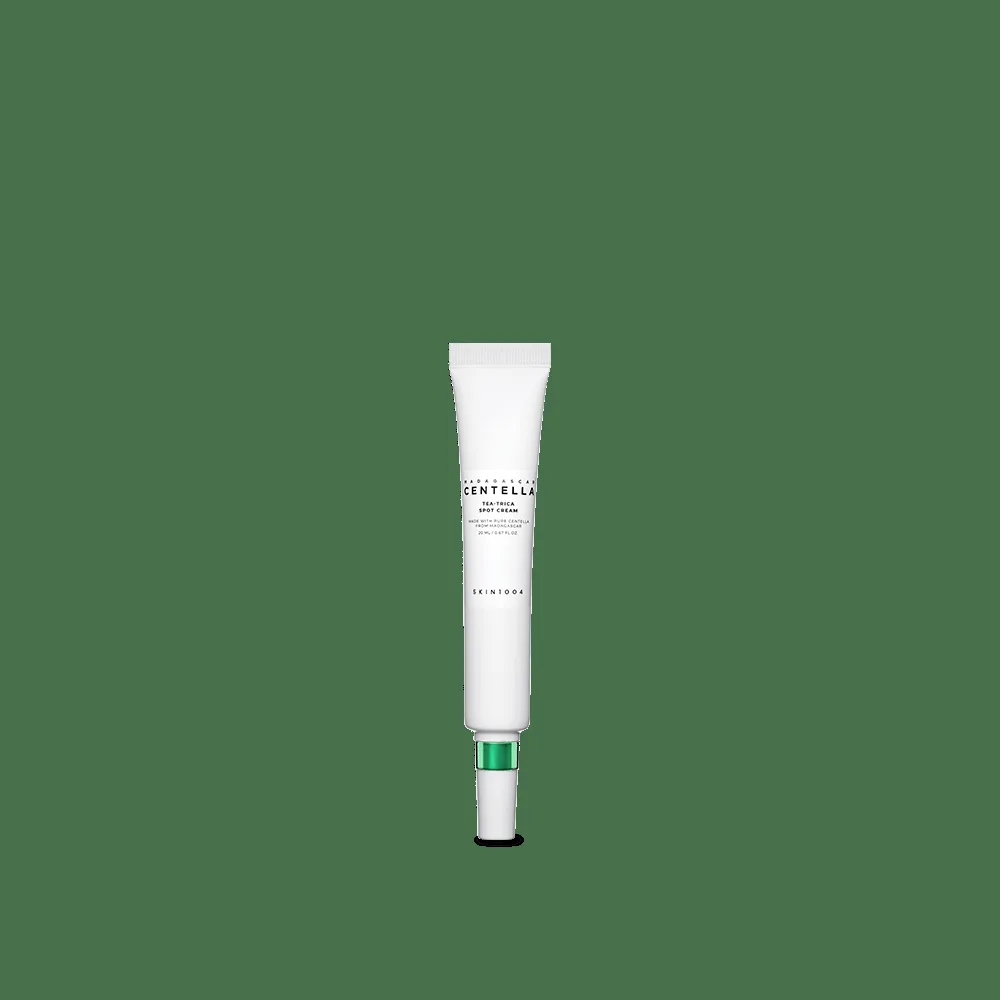
Tea tree earns a separate mention because of how it behaves statistically. In a combined North American and central European analysis of 62,354 patients, among the North American patients who reacted to at least one essential oil but to none of the three standard fragrance markers, tea tree accounted for 45 percent of the positives — half of them strong reactions, and about half of definite or probable clinical relevance. In other words, standard fragrance screening misses it, and when it is positive it usually matters. A formula like SKIN1004 Tea-Trica Spot Cream uses it at cosmetic levels rather than neat, which is a meaningfully lower exposure than the undiluted oil most reported reactions come from — but tea tree is still the essential oil worth knowing your status on, and lavender is the one most likely to be quietly everywhere.
Why 'I've used it for years' is the wrong reassurance
Almost everyone reasons about tolerability the way they reason about irritation, and the two work on opposite logic.
Irritant contact dermatitis is dose-dependent and immediate. Too much acid, too strong a surfactant, too often — it stings on contact, it improves when you stop, and anyone exposed to enough of the substance will react. It has no memory.
Allergic contact dermatitis is immunological and requires prior exposure. The first encounters sensitise silently: no rash, no warning, nothing to notice. Once a T-cell population has been established against the hapten, subsequent exposures produce dermatitis at doses that were previously invisible, and the reaction typically appears one to four days later rather than immediately. Sensitisation is also, for practical purposes, permanent.
So the arithmetic of a daily leave-on botanical product runs the wrong way. Every application is another exposure, and repeated low-level exposure is the classic route to sensitisation. The product that was fine for eighteen months is not evidence of safety; it is the period during which the immune system was being introduced. That delay of a day or more between application and rash is also why people so reliably blame the wrong product — usually the newest one, rather than the one they have been using since last spring.
This is where a structured patch test earns its keep, and it is the one piece of practical advice worth more than any ingredient list. Our patch test tool walks through the timing: several days, one product at a time, on a discreet site, reading at forty-eight and ninety-six hours rather than immediately. If the reaction is already established, the contact dermatitis pathway sets out what a formal patch test at a clinic involves and when it is worth pursuing.
What this argument is not
It is worth being explicit, because this piece is easy to misread as an argument for synthetics.
It is not. Plant extracts include some of the best-evidenced actives in skincare, and the point of a patch test series is that it identifies individuals, not villains. The overwhelming majority of people using a lavender-scented moisturiser will never react to it. What the data forecloses is a specific and very widely marketed inference: that 'derived from plants' is information about tolerability. It is not. It is information about sourcing, and the two are independent.
What actually predicts tolerability is dull and checkable. Fewer fragrance materials, whatever their origin. Preservation and antioxidant systems that keep the formula from degrading into something more sensitising than it started. Short ingredient lists on the products you leave on your face all day. And knowing your own allergens, which requires testing rather than reading.
In practice that looks like a boring shortlist. La Roche-Posay Toleriane Double Repair and CeraVe Moisturizing Cream both run fragrance-free with conservative ingredient sets; Vanicream Gentle Facial Cleanser exists more or less specifically to remove variables for people being investigated for contact allergy. None of them is exciting. That is the feature.
And the last thing to internalise: the declarable allergens sit at the bottom of the INCI list, below one percent, in the block nobody reads. Limonene and linalool are almost always the final two or three words on the panel. If you have unexplained facial dermatitis, that is where to start looking — not at the top of the list, and not at the front of the box. Our answer on whether natural and clean products are safer puts the same conclusion in one paragraph, if you want to hand someone the short version.
Products mentioned
Independently reviewed and scored — the real products behind this piece.



- Therapy guide Contact dermatitis What a formal patch test involves and when it is worth pursuing.
- Ingredient Essential Oils Which oils oxidise fastest and why that governs the risk.
- Ingredient Fragrance (Parfum) The full picture on declarable allergens and fragrance-free labelling.
- Ingredient Tea Tree Oil (Melaleuca alternifolia) The essential oil with the most published allergic reactions, and why fresh differs from oxidised.
- Ingredient Lavender (Lavandula angustifolia) The most ubiquitous source of linalool in cosmetics.
- Ingredient Propolis (Bee Propolis) High patch-test positivity against low clinical relevance — the case for reading test data carefully.
- Ingredient Calendula Extract (Pot Marigold) Compositae-family sensitiser, and the pattern a clinician looks for.
- Ingredient Chamomile Extract The other everyday Compositae botanical in soothing formulas.
- Question Are natural or 'clean' products safer for this? The one-paragraph version of this post's conclusion.
- Question Does fragrance-free mean no fragrance allergens? Where fragrance-free and allergen-free stop being the same thing.
References
- North American Contact Dermatitis Group Patch Test Results: 2021-2022 — Dermatitis, 2025
- Tea tree oil: contact allergy and chemical composition — Contact Dermatitis, 2016
- Positive Patch-Test Reactions to Essential Oils in Consecutive Patients From North America and Central Europe — Dermatitis, 2017
- Results of patch testing propolis in the European baseline series: A 4-year retrospective study — Contact Dermatitis, 2024
- Patch testing hydroperoxides of limonene and linalool in consecutive patients-Results of the IVDK 2018-2020 — Contact Dermatitis, 2023
- Patterns of simultaneous contact allergies in patients with contact sensitization to oxidised linalool and oxidised limonene — Contact Dermatitis, 2024
- The sesquiterpene lactone mix: A review of past, present and future aspects — Contact Dermatitis, 2023
Every cited link is verified to resolve to the paper named. Where a source could not be independently confirmed, it is listed without a link rather than pointing you somewhere wrong.
Frequently asked
If limonene and linalool come from plants, why are they on an allergen list?
Because origin has no bearing on immunology. Both are terpenes that autoxidise on exposure to air and light, and the hydroperoxides they form are potent contact sensitisers. In the most recent North American Contact Dermatitis Group results, hydroperoxides of linalool were the fourth most common positive allergen tested.
Does that mean I should avoid all botanical skincare?
No. The overwhelming majority of people never react to any given botanical, and plant extracts include several of the best-evidenced actives available. The claim being dismantled is narrower: that 'natural' tells you anything about how well your skin will tolerate a product. It tells you about sourcing only.
Why does an old bottle of essential oil matter more than where it came from?
Because oxidation is the mechanism. A review of tea tree oil found fresh oil is a weak-to-moderate sensitiser while oxidation increases its potency, and clinics patch test using oxidised oil precisely because that reflects real exposure. Storage, packaging and age govern the risk more than sourcing does.
I've used this product happily for a year — can it really be the cause of my rash?
Yes, and that is characteristic rather than unusual. Allergic contact dermatitis requires prior exposure to sensitise, so the comfortable months are the period during which sensitisation occurred. Reactions also appear one to four days after application, which is why people usually suspect the newest product rather than the long-standing one.
Where on a label do these allergens actually appear?
At the very end. Because they are present well below one percent, declarable fragrance allergens sit in the final block of the INCI list — limonene and linalool are frequently the last two words on the panel. It is the part of the label almost nobody reads, and the part that matters most for unexplained facial dermatitis.