The Minimalist Three-Step Routine, Defended With Evidence
Cleanser, moisturiser, sunscreen isn't the starter pack you graduate from — it's the only part of your routine with hard clinical endpoints behind it.
Read the preview
From the DermApproved blog, in Skinimalism: cleanser, moisturiser, sunscreen. Everyone calls it the beginner routine. But those three are the only steps tested in trials that ran for years and counted melanomas — everything you'd add was tested for eight weeks against a probe. The burden of proof runs backwards. There's one place the argument breaks. For the full breakdown, visit dermapproved.com/blog.
The framing is upside down
Ask what the evidence base for skincare looks like and you get a strange picture. There are thousands of trials of individual actives, run for eight or twelve weeks, on outcomes measured with instruments. And there is a much smaller set of trials that ran for years, on endpoints that matter to a person rather than to a probe: did you get a melanoma, did your skin measurably age, did you finish the treatment.
Almost all of the second kind sit inside the three steps everyone treats as remedial.
The Nambour trial in Queensland randomised 1,621 adults to daily or discretionary sunscreen on the head and arms. A decade after the intervention ended, 11 new primary melanomas had appeared in the daily group against 22 in the discretionary group — and for invasive melanoma specifically, 3 versus 11. A separate analysis of the same cohort, published in the Annals of Internal Medicine, found no detectable increase in skin ageing in the daily-sunscreen group at 4.5 years, 24% less photoageing than the discretionary group.
That is a level of evidence that essentially nothing else on a bathroom shelf can approach. Not because the other things don't work — many do — but because nobody runs a five-year randomised trial on an essence.
So when a routine is described as "just the basics," it is worth noticing that "the basics" is where the trials with real endpoints happen to live, and "the advanced routine" is largely a stack of eight-week surrogate-outcome studies arranged in a sequence nobody has tested as a system. That doesn't make additions wrong. It does mean the burden of proof runs the other way from how it is usually assigned. Our minimalist routine is the version of this argument you can actually follow in the morning.
What each of the three is actually for
Understanding what each step does mechanically is what stops you buying a more elaborate version of something already handled.
Cleansing removes what water alone won't: sebum, the day's sunscreen, particulate pollution, and the residue of anything you applied. The mechanism is surfactant, and the risk is that the same surfactant strips the intercellular lipids you need. Here pH does real work — skin surface sits mildly acidic, around 4 to 6, while a traditional soap is alkaline at 8.5 to 11, and raising stratum corneum pH alters the enzymes governing lipid processing and desquamation. A synthetic detergent system formulated near skin pH does the removal with meaningfully less disruption, which is why a non-foaming syndet like CeraVe Hydrating Facial Cleanser outperforms a satisfying lather for most people. The failure mode of this step is almost never insufficient cleaning. It is enthusiasm.
Moisturising is three jobs in one bottle. Humectants (glycerin, hyaluronic acid) bind water; emollients fill the gaps between corneocytes so the surface feels smooth; occlusives slow evaporation. A formula built on ceramides plus niacinamide such as La Roche-Posay Toleriane Double Repair Face Moisturizer is supplying lipid species the barrier itself uses, rather than only sitting on top of it.
But the most underrated function of a moisturiser is enabling everything else. In a randomised study of 100 acne patients on adapalene, one group received a moisturiser from day one and the other only if irritation made continuing difficult. Every patient in the moisturiser group was still on their initial therapy at four weeks; 70% of the other group were. The moisturiser did not reduce adapalene's effect on comedones or inflammatory lesions — it just kept people using it. That is a moisturiser functioning as an adherence intervention, which is a more valuable thing than most serums do.
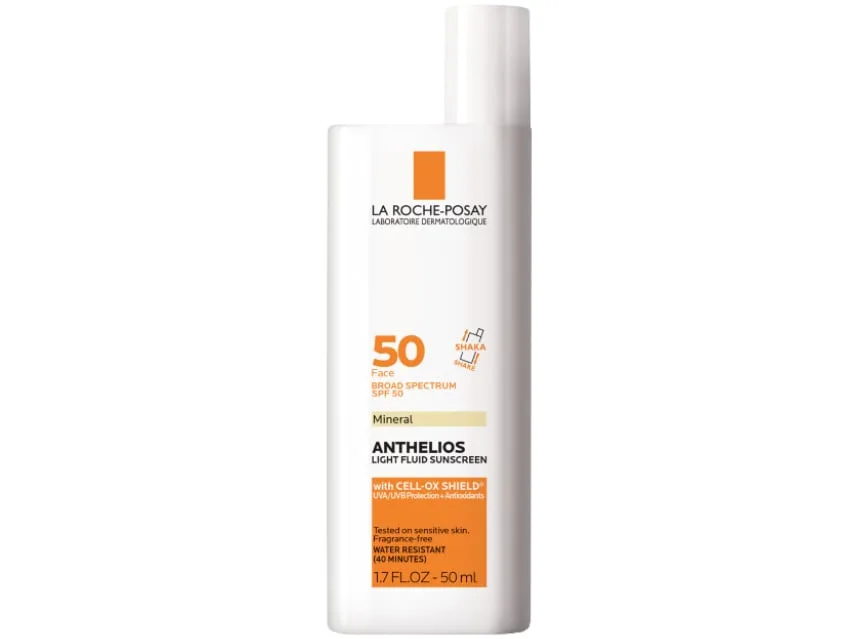
Sunscreen is the only step with the outcome data above, and it is also the step most degraded by dislike. A formula you find unpleasant is one you apply thinly and don't reapply, so texture is efficacy here rather than vanity — which is the entire argument for owning a fluid like La Roche-Posay Anthelios Light Fluid Face Sunscreen SPF 50 or something drier such as Neutrogena Invisible Daily Defense Sunscreen SPF 60+ rather than whichever scored best on paper.
Adherence is the variable that decides the outcome
Every efficacy figure you have ever read assumes the treatment was used. In the real world that assumption fails constantly, and it fails in a way that dwarfs the differences between products.
A worldwide investigation of acne patients found poor adherence in roughly half, varying by region — better in Europe, worse in the Americas — and the dermatology literature is consistent that adherence to topical treatment runs worse than adherence to oral agents. Poor adherence is repeatedly identified as a leading reason topical treatment fails, ahead of the formulation being wrong.
Sit with the arithmetic implied by that. If a serum delivers a 20% better result than its alternative, and adding it to your routine drops your completion rate from most nights to half of nights, you have made your skin worse while buying something better. This is not a hypothetical: it is the ordinary experience of anyone who has assembled a nine-step evening routine and then quietly stopped doing all of it on the third Tuesday.
Routine length is therefore a clinical variable, not a lifestyle preference. Each additional step adds a decision, a wait time, a chance of a sting, and one more thing to run out of. Three steps survives a bad week, a hotel bathroom and a flu. Nine does not, and what happens when nine collapses is rarely a graceful fallback to the important three — it is usually a collapse to nothing, then a fortnight of guilt, then a restart. Our answer on missing three weeks of treatment deals with the recovery, which is more forgiving than people assume.
The five-minute routine exists for exactly this reason: a version with a realistic ceiling on how long it can take, so that the ceiling is what you design against rather than what you discover. And the Routine Order tool is worth a minute of your time even for three products, because sequence errors — sunscreen under moisturiser, actives on damp skin — are a quiet way to lose the benefit of things you did buy.
What a fourth product has to clear
None of this is an argument against a fourth step. It is an argument that the fourth step should have to make a case, and there is a good worked example of what a strong case looks like.
A 2025 systematic review and meta-analysis in Dermatology Practical & Conceptual pooled eight randomised controlled trials of tretinoin for photodamaged facial skin across 1,361 participants. Tretinoin significantly improved both fine wrinkles (mean difference 0.412) and coarse wrinkles (0.245) against vehicle, and participants themselves rated overall improvement significantly higher. That is a real effect on a real complaint, replicated across trials.
The same analysis found tretinoin raised the odds of an adverse event by a factor of about three — dryness, erythema, peeling, burning, stinging, mostly mild to moderate. That is the honest shape of the deal, and it is a deal worth taking for plenty of people. But note what it implies: the fourth product is the one most likely to make you stop doing the first three, which is precisely why it should go in deliberately rather than opportunistically.
So the test for anything you are considering adding. Does it target a problem you actually have, rather than one you learned to notice from an advert? Is the evidence for it clinical rather than mechanistic — has it improved something in people, or only inhibited something in a dish? And can your current routine absorb its side effects without the first three steps degrading? A retinoid added to a routine with no moisturiser is a retinoid you will abandon by week three. Added to a routine that already has one, it is a treatment.
One at a time, and give it twelve weeks. Two new products introduced together tell you nothing about which one worked or which one caused the reaction, and the temptation to run that experiment is why so many people cannot say what actually helps them.
Where three steps genuinely under-delivers
Minimalism becomes a doctrine at exactly the point it stops being useful, so it is worth being explicit about where it fails.
Three steps maintains skin. It does not treat disease. Anything with a mechanism that a cleanser, a moisturiser and a sunscreen do not touch requires an active, and no amount of restraint substitutes: inflammatory acne needs something that addresses follicular occlusion and C. acnes, and the acne pathway sets out that ladder. Rosacea needs anti-inflammatory therapy. Melasma needs tyrosinase inhibition and visible-light protection together. Actinic keratosis needs field treatment. Established photoageing needs a retinoid, per the meta-analysis above.
Eczema is the instructive edge case, because there minimalism and treatment converge: the emollient is the therapy, applied in quantities most people would consider absurd, and reducing the number of other things touching the skin is itself the intervention. The eczema pathway treats it that way.
The practical distinction is between a routine and a treatment. A routine is what you do indefinitely to keep skin functioning and protected. A treatment is a time-limited intervention aimed at a specific pathology, and it sits on top of a routine rather than replacing it — which is the framing that makes both the minimalism and the escalation make sense at the same time.
Where minimalism is least defensible is as an identity. "I only use three products" is not a virtue if one of your three is a foaming cleanser that leaves your skin tight and you have rosacea. The point was never the count.
Building up from three, rather than accumulating toward it
Most people arrive at a large routine by accretion — a recommendation here, a sale there, a bad week that prompted a purchase — and end up unable to say what any individual item is for. Building deliberately from three inverts that, and it is not complicated.
Run the three for a full eight weeks before you change anything, with the specific goal of finding out what your skin does when it is neither stripped nor overloaded. A surprising number of "my skin is oily and sensitive and dehydrated" pictures resolve at this stage, because they were being produced by the routine. If your cleanser leaves tightness, that is the first thing to change, not the thing to layer over.
Then add for a reason. Write down the problem before you buy anything, in specific terms — "congestion along the jaw that hasn't shifted in six months" rather than "dullness." One product, twelve weeks, and a note of what changed. The Routine Finder is a faster way to work out which slot the problem belongs in, and My Skin is worth using to keep the record, because the honest answer to "is this working?" four months later is otherwise reconstructed from vibes.
And protect the three. When a routine gets busy, the steps that get dropped first are the boring ones — moisturiser on a night you got in late, sunscreen on an overcast Tuesday, and those are the steps carrying the actual outcome data. If something has to go on a bad week, let it be the fourth thing.
The position, stated plainly: three steps done every day beats seven steps done most days, and it isn't close. The category has spent two decades selling addition as sophistication, and the evidence has quietly stayed with the boring core the whole time. Add to it when you have a reason. Just stop treating the reason as optional.
Products mentioned
Independently reviewed and scored — the real products behind this piece.



- Therapy guide Acne Where a three-step routine is insufficient and an active is required.
- Therapy guide Melasma A condition needing tyrosinase inhibition alongside photoprotection.
- Therapy guide Eczema The case where the emollient itself is the treatment.
- Routine The Minimalist 3-Step Skincare Routine, Backed by Evidence The three-step routine as an actual sequence to follow.
- Routine A 5-Minute Skincare Routine That Doesn't Cut Corners A routine designed against a realistic time ceiling.
- Ingredient Ceramides Lipid species the barrier itself uses, central to the moisturising step.
- Ingredient Glycerin The humectant half of what a moisturiser does.
- Ingredient Niacinamide (Vitamin B3) Common pairing in barrier-repair moisturisers.
- Ingredient Retinol The archetypal fourth product and the trade it demands.
- Question I stopped for a few weeks — do I start the clock again? What happens after adherence lapses, and how recoverable it is.
References
- Reduced melanoma after regular sunscreen use: randomized trial follow-up — Journal of Clinical Oncology, 2011
- Sunscreen and prevention of skin aging: a randomized trial — Annals of Internal Medicine, 2013
- Study of the usefulness of moisturizers on adherence of acne patients treated with adapalene — The Journal of Dermatology, 2014
- pH-induced alterations in stratum corneum properties — International Journal of Cosmetic Science, 2003
- Tretinoin for Photodamaged Facial Skin: Systematic Review and Meta-Analysis of Randomized Controlled Trials — Dermatology Practical & Conceptual, 2025
Every cited link is verified to resolve to the paper named. Where a source could not be independently confirmed, it is listed without a link rather than pointing you somewhere wrong.
Frequently asked
Is a three-step routine really enough, or is that just what beginners are told?
It is where the strongest evidence sits. Daily sunscreen use in the Nambour trial produced fewer melanomas and measurably less photoageing over years of follow-up — endpoints no eight-week serum trial can offer. Three steps maintains and protects skin very well; what it doesn't do is treat an active condition, which is a separate job.
Why does routine length matter if the products are good?
Because roughly half of acne patients in a worldwide survey didn't adhere to treatment, and topical adherence runs worse than oral. Every step you add is another decision, wait and chance of irritation, so a longer routine reliably converts into a less-completed one. A product that's 20% better but drops your completion rate in half is a net loss.
Do I need a moisturiser if my skin is oily?
Usually yes, and the reason is less about hydration than about keeping everything else usable. In a randomised study of acne patients on adapalene, all of those given a moisturiser from the start were still on treatment at four weeks against 70% of those who weren't — and the moisturiser didn't blunt the drug's effect on lesions. Choose a lighter texture rather than skipping it.
When is it worth adding a retinoid to a three-step routine?
When you have a specific complaint it treats and a routine that can absorb its side effects. Pooled data from eight randomised trials shows tretinoin significantly improves both fine and coarse wrinkles — and roughly triples the odds of an adverse event. Adding it to a routine without a moisturiser is how people end up abandoning both.
Does cleanser choice actually matter, or is it all marketing?
It matters through pH and surfactant type. Skin surface sits around pH 4 to 6 and traditional soap is 8.5 to 11, and raising stratum corneum pH disrupts the enzymes that govern lipid processing and shedding. A synthetic detergent formulated near skin pH cleans effectively with less barrier disruption — the common mistake is over-cleansing, not under-cleansing.
How should I add a fourth product without wrecking what's working?
One at a time, twelve weeks, and write down the problem before you buy. Introducing two products together makes it impossible to attribute either a benefit or a reaction, which is why so many people can't say what actually helps them. Run the three steps alone for eight weeks first — a fair amount of apparent sensitivity resolves at that stage.