



Octocrylene and Homosalate: The Filters America Is Stuck With
The critics are right about the data gap, and they are right that it took two decades to move. What follows from that is not the conclusion most people draw.

Goes beyond basic UV filtration by incorporating Neutrogena's patented feverfew antioxidant extract alongside vitamin E, creating a dual-defense system that protects against both UV rays and environmental aggressors like pollution and ozone. Most drugstore sunscreens at this price point offer UV protection only — this formula adds a meaningful antioxidant dimension.
A smart daily sunscreen that goes beyond basic UV protection with Neutrogena's patented feverfew antioxidant complex, delivering SPF 60+ in a genuinely lightweight formula that disappears on skin. The environmental defense angle is more than marketing — but fragrance, alcohol, and eye-stinging issues mean this isn't for everyone.
The case for it
Same rule for everyone. “Full protection” is the verdict on 2,288 of 45,024 concern verdicts across the catalog; rule P1 decided 2,232 of them. Unchanged since September 5, 2026, engine 5.1.1.
Brand or formulator? Disclose a concentration or correct a fact →
The studies behind the evidence row
The case for it
What would change this: A concentration inside the studied range would raise this a step.
Same rule for everyone. “Full protection” is the verdict on 2,288 of 45,024 concern verdicts across the catalog; rule P1 decided 2,232 of them. Unchanged since September 5, 2026, engine 5.1.1.
Brand or formulator? Disclose a concentration or correct a fact →
The studies behind the evidence row
Does the jobDoes what a sunscreen is for: UVA coverage, holds up in sunlight. Not measured from the label: pleasant enough to actually use.
A verdict is DermApproved’s assessment of how well a product’s ingredients fit a concern — never a claim about what the product treats. Evidence dots and collected reviews sit beside it and are never blended in. Rules 0.5.1 · evidence table ev-2026.09-r228 · how we decide
Somewhere around 2020, the sunscreen conversation shifted. It was no longer enough to slap an SPF number on a bottle and call it protection. Consumers started asking about pollution, blue light, ozone, and all the other invisible environmental threats that make skin age faster than genetics alone would dictate. Neutrogena's Invisible Daily Defense SPF 60+, launched in 2021, is the brand's direct response to that shift — a sunscreen designed not just as a UV shield but as a comprehensive daily environmental defense system.
The UV protection itself is serious. Four chemical filters — avobenzone at 3%, homosalate at 13.5%, octisalate at 5%, and octocrylene at 10% — deliver broad-spectrum SPF 60+ with 80 minutes of water resistance. That's a robust filter system, and the SPF 60+ rating provides a meaningful real-world advantage over SPF 30 or even SPF 50 when you account for the fact that virtually nobody applies sunscreen as generously as the testing protocol requires.
The Helioplex technology stabilizing the avobenzone is proven science at this point. Neutrogena introduced it in 2005, and decades of use have validated that the octocrylene-avobenzone partnership maintains UVA protection significantly longer than unstabilized formulations. In a sunscreen you're meant to wear all day, that stability matters.
But the real differentiator — what justifies the 'Invisible Daily Defense' branding rather than just another SPF number — is the antioxidant layer. Chrysanthemum parthenium, commonly known as feverfew, is a Neutrogena-patented ingredient that Johnson and Johnson developed for skin care applications. Paired with tocopheryl acetate (vitamin E), it creates an antioxidant system designed to neutralize the free radicals that UV exposure and environmental pollutants generate in skin cells. UV filters block rays; antioxidants mop up the oxidative damage that gets through. Most drugstore sunscreens don't bother with the second part.
Is the feverfew inclusion transformative? Probably not at the concentration present here — it appears near the end of the ingredient list. But the research behind it is real, and even modest amounts of antioxidant support add a layer of protection that a UV-filter-only formula simply doesn't provide. Think of it as the difference between a good lock and a good lock plus an alarm system. Neither prevents every break-in, but together they're meaningfully better.
On skin, the formula delivers on the 'invisible' promise convincingly. It's a lightweight lotion that absorbs in about a minute, leaving no white cast whatsoever on any skin tone. For deeper-toned individuals tired of mineral sunscreens giving them an ashy cast, this is a genuine relief. The glycerin provides enough moisture that the formula doubles as a light hydrating layer for normal and combination skin types, which is practical for a daily-use product — one less step in the morning routine.
The finish leans dewy rather than matte. On normal skin, this reads as fresh and healthy. On oily skin, it can tip into shiny territory by midday. Aluminum starch octenylsuccinate provides some oil absorption, but this isn't the matte-focused formula that the Clear Face line is. Know your skin before committing.
The menthyl lactate adds a subtle cooling sensation on application. Some people find this refreshing; others find it irritating, particularly those with reactive or compromised skin barriers. It's a polarizing inclusion in a product meant for daily use.
And here's where honesty requires directness: this sunscreen contains fragrance and alcohol denat. Both are listed in the inactive ingredients. Both are unnecessary. The fragrance is light and fresh, and it dissipates quickly, but it's still a sensitizer that has no business in a product marketed for daily use on every skin type. The alcohol denat. aids absorption speed and texture but adds a drying element. Neutrogena does offer a fragrance-free version of this product as a separate SKU — if you're at all sensitive, that's the one to choose.
The eye-stinging issue that plagues virtually all of Neutrogena's chemical sunscreens is present here too. Avobenzone and homosalate migrate during perspiration and cause a burning sensation in the eyes. If you exercise outdoors or sweat during your commute, this is a practical limitation you'll encounter.
At approximately twelve dollars for three ounces, the value is excellent for what you're getting. SPF 60+ broad-spectrum, 80-minute water resistance, patented antioxidant complex, and a genuinely invisible finish at a drugstore price point. You'd pay thirty to fifty dollars for a comparable formulation philosophy from a premium brand — and their version probably wouldn't have better UV protection.
Neutrogena's nearly century-long history and the resources of Kenvue (formerly J&J Consumer Health) behind this formula provide a level of formulation confidence that newer brands simply can't match yet. The Helioplex technology has been validated for over twenty years. The feverfew extract is patent-backed research, not a trendy botanical thrown in for label appeal.
The bottom line is pragmatic: if you want a daily sunscreen that does more than the minimum — that adds antioxidant defense to UV protection in a formula you won't mind wearing every day — this delivers real value at a real-world price. Just know its limits. It's not for sensitive skin (get the fragrance-free version at minimum), it's not matte enough for very oily skin, and it will sting your eyes if it migrates. Within those boundaries, it's a legitimately smart daily protection product.
The hero actives that drive this product's performance.
| Ingredient | Function | Evidence |
|---|---|---|
| Avobenzone (3%) | Primary UVA filter stabilized by Neutrogena's Helioplex technology via the 10% octocrylene in this formula, maintaining broad-spectrum UVA protection far longer than unstabilized avobenzone — critical for a daily-wear sunscreen meant to defend against cumulative photoaging. | Regulator-approved for Sun Damage · emerging certainty |
| Homosalate (13.5%) | High-concentration UVB filter that works with octisalate and octocrylene to achieve the SPF 60+ rating while maintaining the lightweight texture — without the heavy feel that typically accompanies very high SPF formulations. | Regulator-approved for Sun Damage · limited certainty |
| Octocrylene (10%) | Dual-role ingredient serving both as a UVB/short UVA absorber and as the critical photostabilizer for avobenzone in the Helioplex system, preventing the UVA filter from degrading under sun exposure. | Regulator-approved for Sun Damage · limited certainty |
| Chrysanthemum Parthenium (Feverfew) Extract | Neutrogena's patented antioxidant ingredient that neutralizes free radicals generated by UV exposure and environmental pollutants, adding a secondary defense layer beyond what the UV filters provide and distinguishing this from standard sunscreens that only block UV rays. | Not yet assessed |
| Tocopheryl Acetate | Vitamin E derivative that works alongside the feverfew extract in the antioxidant complex, providing additional free radical neutralization to protect skin cells from oxidative damage that UV filters alone cannot fully prevent. | Limited for Sun Damage |
Ingredient standings describe the active at treatment-level doses and vehicles; this product's own condition grades weigh its actual formula.
Active Ingredients: Avobenzone 3%, Homosalate 13.5%, Octisalate 5%, Octocrylene 10%. Inactive Ingredients: Water, Butyloctyl Salicylate, Glycerin, Alcohol Denat., Silica, Dimethicone, Aluminum Starch Octenylsuccinate, Polyurethane-62, Phenoxyethanol, Pentylene Glycol, Sodium Acryloyldimethyltaurate/VP Crosspolymer, Acrylates/Dimethicone Copolymer, Glyceryl Stearate, Chlorphenesin, Styrene/Acrylates Copolymer, Fragrance, Menthyl Lactate, Tocopheryl Acetate, Disodium EDTA, Trideceth-6, Chrysanthemum Parthenium (Feverfew) Flower/Leaf/Stem Juice, Sodium Hydroxide, Yellow 5, Red 40
sunscreen
AM
Use as the last step of your morning skincare routine, after moisturizer. Allow 15 minutes before sun exposure. The formula layers under makeup but give it 1-2 minutes to set to avoid pilling. A fragrance-free version is available for those sensitive to scent.
Sun protection is immediate upon application. The antioxidant complex provides cumulative environmental defense over consistent daily use. Over weeks and months of daily application, you'll see reduced new sun damage, dark spots, and photoaging compared to unprotected skin.
The four-filter Helioplex system in this formula targets both the UVA and UVB spectrum with optimized stabilization. Avobenzone at 3% provides UVA I protection (340-400nm), while homosalate (13.5%), octisalate (5%), and octocrylene (10%) cover the UVB range. The critical innovation is the octocrylene-avobenzone stabilization partnership: a study published in Photochemistry and Photobiology (2006) demonstrated that octocrylene acts as a triplet-state quencher for photoexcited avobenzone, preventing the structural rearrangement that causes irreversible loss of UVA-absorbing capacity. This means the SPF 60+ rating holds up better over time during actual sun exposure than an equivalent unstabilized formula.
The feverfew extract represents a more novel element. Chrysanthemum parthenium has been studied for its anti-inflammatory and antioxidant properties in dermatological applications. A paper published in the Archives of Dermatological Research demonstrated that feverfew extract inhibits the release of pro-inflammatory cytokines and reduces oxidative stress markers in skin cells exposed to UV radiation. Johnson & Johnson holds patents on its topical application in sunscreen and skincare formulations, giving Neutrogena exclusive access to this ingredient in their category.
The environmental defense claim extends beyond UV. Ambient air pollution, particularly particulate matter (PM2.5) and ozone, generates reactive oxygen species on the skin surface that accelerate photoaging and hyperpigmentation. Tocopheryl acetate (vitamin E) has been extensively studied as a topical antioxidant, with research in the Journal of Investigative Dermatology demonstrating its ability to reduce UV-induced lipid peroxidation and DNA damage. The combination of feverfew and vitamin E creates a broader antioxidant defense than either ingredient alone.
The high homosalate concentration (13.5%) raises a question worth addressing. The European Commission's Scientific Committee on Consumer Safety (SCCS) has recommended reducing the maximum concentration of homosalate from 10% to 7.34% due to potential endocrine activity. The FDA has not implemented similar restrictions in the US, and this product remains compliant with current US regulations.
Dermatologists frequently recommend SPF 60+ sunscreens for patients who are unlikely to apply the full recommended amount — which, research consistently shows, is most people. Practicing dermatologists recognize that the real-world SPF people receive is typically one-quarter to one-half of the labeled value due to underapplication. An SPF 60+ product at typical consumer application levels delivers protection closer to the SPF 15-30 range that dermatologists consider the minimum for daily defense. The added antioxidant layer is viewed favorably in dermatological practice, as UV filters alone cannot fully prevent the oxidative damage that drives photoaging. Dermatologists typically advise patients choosing chemical sunscreens like this to be aware of potential eye irritation during sweating and to consider the fragrance-free version for sensitive or reactive skin.
Apply generously to face and neck 15 minutes before sun exposure. Use approximately a nickel-sized amount for the face — most people underapply by half. Allow 1-2 minutes to absorb before applying makeup. Reapply every two hours during sun exposure, or immediately after 80 minutes of swimming or sweating. For an antioxidant-boosted morning routine, layer a vitamin C serum underneath — the antioxidant systems complement each other. Remove thoroughly at night with an oil cleanser or micellar water followed by your regular cleanser.
At approximately $12 for 3 fl oz, this represents exceptional value for an SPF 60+ broad-spectrum sunscreen with Helioplex stabilization, 80-minute water resistance, and a patented antioxidant complex. The Invisible Daily Defense line competes favorably with premium sunscreens costing three to four times more for comparable formulation philosophy. A fragrance-free version is available at a similar price point for those who need it. The 3 oz tube lasts 6-8 weeks with daily facial application, making the per-use cost negligible.
Ideal for anyone who wants a daily sunscreen that does more than block UV rays. If you live in an urban environment, commute outdoors, or want comprehensive environmental protection at a drugstore price, this delivers real value. Normal and combination skin types who appreciate a dewy finish will find the formula most comfortable.
It is not your product if you have sensitive or reactive skin — the fragrance, alcohol denat., and menthyl lactate are likely to cause irritation (consider the fragrance-free version instead). Also avoid if you have oily skin that needs a matte finish, or if you're prone to severe eye stinging from chemical sunscreens during exercise.
Ready to try Neutrogena Invisible Daily Defense Sunscreen SPF 60+?
Buy at Amazon ♥Lightweight lotion that spreads easily and absorbs quickly. Disappears completely on application without any visible residue or white cast on any skin tone.
Light, fresh fragrance that's noticeable on application but fades within minutes. A fragrance-free version is available as a separate SKU for scent-sensitive users.
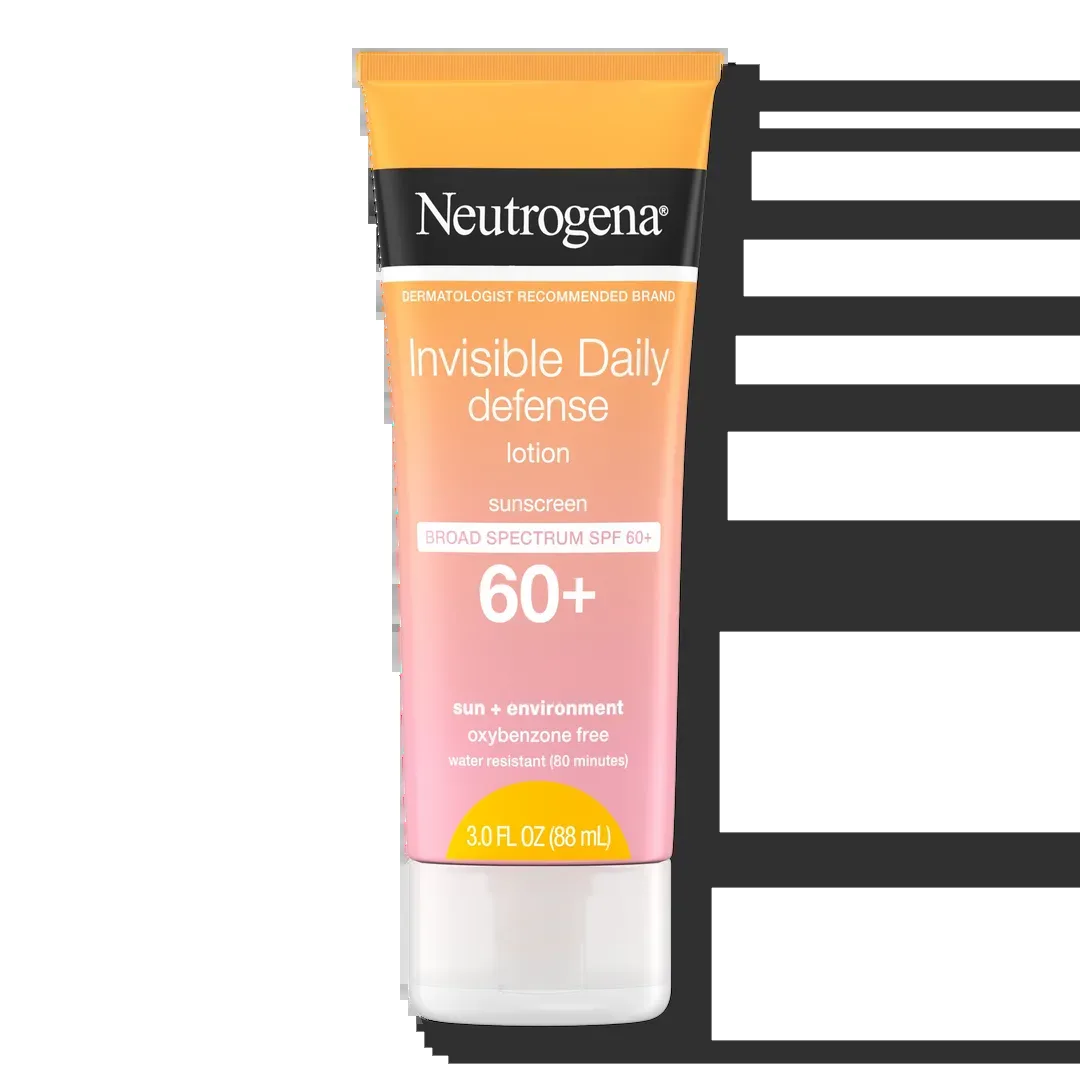
White and light blue 3 fl oz squeeze tube with flip-top cap. Compact, travel-friendly design that meets TSA carry-on requirements. Features prominent SPF 60+ and oxybenzone-free callouts on current packaging.
On first application, the lotion spreads smoothly with a subtle cooling sensation from the menthyl lactate. It absorbs within 1-2 minutes, leaving skin feeling hydrated and protected without heaviness. The fragrance is fresh but dissipates quickly. No adjustment period — wear comfort is immediate.
6-8 weeks with daily facial application and regular reapplication during sun exposure
All Year
Launched in 2021 as part of Neutrogena's push to redefine sunscreen as total environmental defense rather than just UV protection. The Invisible Daily Defense line was positioned as the everyday counterpart to the more specialized Ultra Sheer and Clear Face lines — a sunscreen for people who want comprehensive protection without thinking about it. The inclusion of patented feverfew extract, originally developed for Neutrogena's sensitive skin care line, signals the brand's strategy of differentiating through proprietary ingredients rather than just SPF numbers.
Neutrogena was founded in 1930 and is the #1 dermatologist-recommended suncare brand in the United States. The brand's Helioplex avobenzone stabilization technology, developed in the mid-2000s, remains a differentiating innovation in its sunscreen portfolio, and the proprietary feverfew extract is backed by Johnson & Johnson patents.
SPF 60+ is unnecessary — SPF 30 is enough for everyone.
While SPF 30 blocks about 97% of UVB rays, most people apply only a quarter to half the recommended amount. SPF 60+ provides a critical safety margin for real-world underapplication, delivering roughly SPF 20-30 protection at typical consumer usage levels — which is closer to what dermatologists actually want you to have.
Chemical sunscreens are absorbed into the bloodstream and dangerous.
While FDA studies have detected systemic absorption of some chemical UV filters, this does not mean they are harmful. The FDA's finding triggered a call for more safety data, not a determination of danger. The American Academy of Dermatology continues to recommend regular sunscreen use, noting that the known risks of UV exposure far outweigh the theoretical risks of UV filter absorption.
Yes — it's specifically designed as an everyday sunscreen. The lightweight, quick-absorbing formula with glycerin provides enough hydration for daily wear, and the SPF 60+ offers a strong safety margin for typical underapplication. The added feverfew antioxidant complex provides environmental protection beyond basic UV filtration.
No — this is a 100% chemical UV filter sunscreen with no zinc oxide or titanium dioxide. It absorbs completely clear on all skin tones, living up to its 'Invisible' name. The formula contains Yellow 5 and Red 40 dyes that contribute to its skin-tone-neutral appearance.
Yes — Neutrogena offers a separate fragrance-free version of the Invisible Daily Defense SPF 60+ as a different SKU. If the scent in the original formula bothers you or you have sensitive skin, look for the fragrance-free variant at your retailer.
Yes, though results vary. Allow 1-2 minutes for the sunscreen to fully absorb before applying primer or foundation. Some users report pilling when layered over multiple skincare products — keeping your morning routine minimal before this sunscreen helps prevent that. Water-based primers tend to layer better over this formula than silicone-heavy ones.
Feverfew (Chrysanthemum parthenium) is a Neutrogena-patented antioxidant ingredient backed by Johnson & Johnson research. It neutralizes free radicals generated by UV exposure and environmental pollutants, adding protection beyond what the UV filters provide. It was originally developed for Neutrogena's sensitive skin care products and has soothing properties.
The Invisible Daily Defense formula is positioned as a daily environmental shield with added antioxidants (feverfew + vitamin E), while Ultra Sheer focuses on maximum UV protection with a dry-touch matte finish. If you prioritize oil control and a matte look, Ultra Sheer may suit you better. If you want hydration and antioxidant defense for daily wear, Invisible Daily Defense is the stronger choice.
The formula is oxybenzone-free and octinoxate-free, meeting Hawaii's Act 104 reef protection requirements. However, it contains homosalate and octocrylene, which some environmental groups flag as potentially harmful to marine ecosystems. It represents an improvement over older formulations but is not reef-safe by the strictest definitions.
Recurring themes our editors read across retailer reviews of this product — summaries in our words, not quotations, and not a substitute for your own patch test.
Truly invisible finish with zero white cast on all skin tones
Lightweight, weightless feel despite the high SPF 60+ rating
Quick-drying formula that doesn't feel heavy or sticky
Good hydration with glycerin for a moisturizing daily wear experience
Affordable for SPF 60+ broad-spectrum protection
Water-resistant for 80 minutes
Can feel greasy or overly dewy on oily skin types
Eye stinging and irritation when product migrates during sweating
Pills under some foundations and makeup when layered over other products
Contains fragrance and alcohol denat. which irritate sensitive skin
Menthyl lactate cooling sensation is unwelcome for some users
Verified answers from our questions library — the nuance a product page cannot carry.