The Men's Routine That Actually Sticks: Three Products, One Habit
Nobody abandons a skincare routine because they didn't understand it. They abandon it because it had too many steps — and there's a randomised trial that puts a number on exactly how much that costs.
Read the preview
From the DermApproved blog, in Men's Skincare: why the routine keeps dying. In one trial, two groups got the same drugs. One group applied them once a day, the other twice — and the once-a-day group got better skin. The chemistry never changed. Only the step count did. There's a reason that matters more for men. For the full breakdown, visit dermapproved.com/blog.
The problem was never that you didn't know
Almost every article written for men about skincare assumes an information deficit. Explain the barrier, explain UVA, explain what a humectant is, and the behaviour will follow. It's a comfortable assumption, and the data does not support it.
Consider the hardest case available: people who went to a dermatologist, described a condition that bothered them enough to book an appointment, and walked out with a prescription. A Belgian analysis of 1,160 topical treatment courses in patients with moderate acne found a median treatment duration of two months, and calculated that the probability of having discontinued by three months was 50%. These were motivated patients, following published guidelines, treating something visible on their face.
If half of that group quits inside a season, the idea that a man with no diagnosis and no prescription will sustain a seven-step regimen because an article explained ceramides to him is not a plan. It's a wish. Adherence, not knowledge, is the binding constraint — and once you accept that, the design brief changes completely. You are no longer trying to assemble the best possible routine. You are trying to assemble the best routine that survives contact with a Tuesday.
One fewer step, measurably better skin
The most useful experiment in this whole area is small, old, and almost never cited outside adherence research. Investigators randomised patients with mild-to-moderate acne to twelve weeks of either a single combination gel applied once daily, or the same two active drugs supplied separately and applied as two daily applications. Same molecules. Same concentrations. The only variable was how many times you had to stand in front of a mirror.
Adherence was tracked with electronic monitoring caps on the tubes, so this isn't self-report. Median adherence was 88% in the once-daily group and 61% in the two-application group. Total lesions fell by 51% in the once-daily group versus 32% in the other. Removing one step did not just make the regimen more pleasant; it made the skin measurably better, using identical chemistry.
That finding deserves to be treated as a design principle rather than a curiosity. Every step you add taxes the entire routine, not just itself — because adherence is a property of the whole regimen, and the whole regimen collapses together. A four-step routine done 60% of the time delivers less than a three-step routine done 90% of the time, even though it looks better on paper. Step count behaves like a dose, and most men's routines are overdosed.
The corollary is uncomfortable for anyone selling skincare: the best product you will not use is worth less than the mediocre one you will. That is the entire justification for what follows.
Ranked by return, not by aisle
Male skin is genuinely somewhat different — androgen-driven thickening and higher sebum output are real and measurable — but those differences change formulation preferences at the margin, not the structure of the routine. What actually distinguishes men's skin outcomes is a behavioural gap, and it has a number attached to it.
In a nationally representative US survey, 18.1% of men reported regularly using sunscreen on the face, against 42.6% of women. For both the face and other exposed skin, the figures were 14.3% and 29.9%. Nearly 40% of people who did use sunscreen were unsure whether theirs was broad-spectrum. That gap does more to explain differences in visible photoaging between men and women than any hormonal argument, and it is the one item where changing behaviour has an outsized payoff.
So the ranking is not negotiable. Sunscreen first, because it is the largest deficit and the only step with a hard evidence base for preventing something you cannot reverse. The obstacle is almost never belief — it's texture, since a thick white cream over stubble is genuinely unpleasant. Format solves this: a thin, fast-absorbing fluid such as La Roche-Posay Anthelios Ultra-Light Fluid Face Sunscreen SPF 40 behaves more like an aftershave than a lotion, which is exactly the property that gets it used. If you don't know which texture you'll tolerate, the sunscreen-finder narrows the field by finish and skin type rather than by marketing claim.
Second, a cleanser — because higher sebum output is real, and because you need something that removes a day of oil and grime without stripping. A straightforward gel like Versed The Purist Daily Gel Cleanser does that job without adding a decision to your morning. Third, a moisturiser. And here the routine folds in on itself in a way most men's guides miss entirely.
Shaving isn't a grooming topic. It's your moisturiser's job description.
If you shave regularly, you are performing a controlled abrasion on your face several times a week, and the lab work on this is more damning than the phrase 'razor burn' suggests. Researchers using engineered human skin models found that a single dry razor pass produced increased epidermal proliferation, epidermal thickening, elevated cytokine production and impaired barrier function — the signature of an inflammatory insult, not a cosmetic annoyance.
The same study found the fix, and it is startlingly cheap. Those changes were attenuated by pre-application of shaving foam, or by post-application of moisturiser. Not a specialised active. Not a serum. Lubrication before, occlusion and hydration after.
Meanwhile, a survey of 340 men found that only about a third of manual shavers prepared their skin at all before shaving, and just 13% of electric shaver users did. The most commonly reported problems were exactly what you'd predict: irritation and dryness, razor burn, nicks and pseudofolliculitis barbae. There is a very large population treating the consequences of a step they skipped.
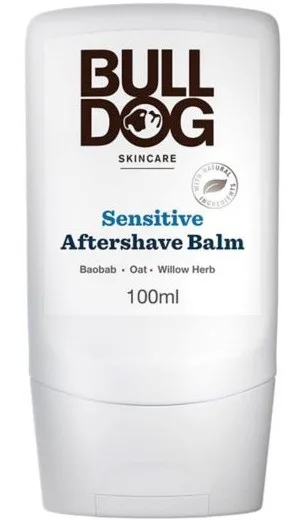
This is where the three-product routine stops being a compromise and starts being elegant, because two of the three steps are already inside a habit you perform anyway. A fragrance-free prep like Vanicream Shave Cream is the pre-application arm of that finding; a gel such as Bulldog Skincare Sensitive Shave Gel does the same job with more visibility of what you're cutting. And the post-shave balm is not a separate category from moisturiser — it is moisturiser, applied at the exact moment the barrier has been mechanically disrupted, which is when it does the most good. Bulldog Skincare Sensitive After Shave Balm is doing double duty there, and treating it as one product rather than two is how the step count stays at three.
One habit, and where to hang it
New behaviours are far easier to establish when they attach to an existing cue than when they float free in the day. For most men who shave, the cue already exists and runs on a reliable schedule — which is why the routine should be built around the sink, in one continuous sequence, rather than spread across the day as a series of independent intentions.
The practical shape: cleanse, shave with prep, balm, sunscreen — done in one stop, with nothing requiring a decision. On non-shaving days the sequence collapses to cleanse, balm, sunscreen. That is the whole thing. No morning-versus-evening matrix, no waiting intervals, no product that only gets used twice a week and therefore gets forgotten.
The discipline is in what you refuse to add. The fourth product is almost always the one that kills the regimen, because it arrives as an upgrade and functions as a tax — it's the step that turns a ninety-second sequence into something you start negotiating with when you're late. If you want a version tuned to your own skin rather than to an average, our men's routine lays out the same structure with specific slots, and the routine-finder and skin-type-quiz will tell you whether you're oily enough to want a gel cleanser or dry enough to want a cream. Use them to choose products, not to add them.
When to add an active — and the number that should govern it
None of this means three products is a ceiling. A nightly retinoid is the most evidence-backed addition available and it is worth having. But there is a sequencing rule that the adherence literature makes hard to argue with: do not add anything until the base runs without thought, and then add exactly one thing.
The reason is that actives are where the regimen becomes fragile. Retinoids produce an irritation period, and an irritation period arriving at the same moment a routine is still being learned is a reliable way to lose both. Establish the sequence first, on a stretch of weeks where nothing stings, and the retinoid becomes a modification to a working system rather than a fifth reason to give up.
The last number from that Belgian analysis is the one to keep. Ineffectiveness was the stated reason for 52% of discontinuations — the single largest category, dwarfing side effects at 9%. But the median treatment duration was two months. Most topical actives are only beginning to show what they do at eight to twelve weeks. So a large share of those 'ineffective' verdicts were delivered by people who stopped before the evidence was in, and then reasonably concluded that skincare doesn't work for them.
That is the whole argument for a three-product routine, and it isn't a lowered standard. It's the recognition that consistency is itself an active ingredient — the only one with no substitute, no premium version and no shortcut. Build something small enough that you'll still be doing it in March, and you will beat every man with a better shelf and a worse habit.
Products mentioned
Independently reviewed and scored — the real products behind this piece.


- Routine The Men's Skincare Routine That Actually Sticks The same three-step structure with specific product slots to fill.
- Question What does stripping my routine back actually mean? What cutting a routine back to essentials actually involves.
- Question Do I need to spend a lot on a rosacea routine? What a genuinely minimal routine costs to run.
References
- Real-world adherence to topical therapies in patients with moderate acne — JAAD International, 2021
- Simplifying regimens promotes greater adherence and outcomes with topical acne medications: a randomized controlled trial — Cutis, 2010
- Patterns of sunscreen use on the face and other exposed skin among US adults — Journal of the American Academy of Dermatology, 2015
- Development of a novel in vitro strategy to understand the impact of shaving on skin health: combining tape strip exfoliation and human skin equivalent technology — Frontiers in Medicine, 2023
- Facial hair shaving behavior and skin problems of shaved areas of males — The Journal of Dermatology, 2021
Every cited link is verified to resolve to the paper named. Where a source could not be independently confirmed, it is listed without a link rather than pointing you somewhere wrong.
Frequently asked
Is three products really enough, or is that just a beginner routine?
For most men it is the whole thing, indefinitely. Cleanser, moisturiser and sunscreen cover the only steps with strong preventive evidence behind them, and the randomised data shows that adding steps reduces how reliably any of them get done. A retinoid is a worthwhile fourth once the first three are automatic, but it should be an addition to a working habit, not part of the starting kit.
Do I still need a moisturiser if I use an after-shave balm?
No — the balm is the moisturiser, applied at the best possible moment. Lab work on shaving found that post-application of moisturiser reduced the barrier damage from a razor pass, so a balm used straight after shaving is that step, done at peak usefulness. Treating them as two separate products is how routines quietly grow to five items.
Why do men need sunscreen more than the advice suggests?
Not more, but they use it far less. Survey data put regular facial sunscreen use at 18.1% among men against 42.6% among women, so the deficit is behavioural rather than biological. Since photoaging and UV damage accumulate rather than reverse, closing that gap is the highest-return change available — usually by switching to a fluid or gel texture rather than trying harder with a cream you dislike.
How long should I give a new product before deciding it doesn't work?
Longer than most people do. In one real-world analysis the median course of topical treatment lasted two months, and ineffectiveness was the reason given for 52% of discontinuations — yet many topical actives are only starting to show results at eight to twelve weeks. Set a twelve-week review date at the start and don't relitigate it weekly.
Does shaving with an electric razor avoid the problem?
It changes it rather than removing it. Survey data found electric shaver users were far less likely to prepare their skin — around 13% did, versus roughly a third of manual shavers — and irritation, dryness and razor burn were still commonly reported. Whichever tool you use, the prep-and-balm bracket around it is the part that protects the barrier.
Can I skip the cleanser and just rinse with water?
You can, and for very dry skin it's a defensible choice, but higher sebum output makes it a poor default for most men. A gentle gel cleanser removes a day of oil and residue without stripping, and it costs about fifteen seconds. If your skin feels tight after washing, that's a signal to change the cleanser rather than to drop the step.