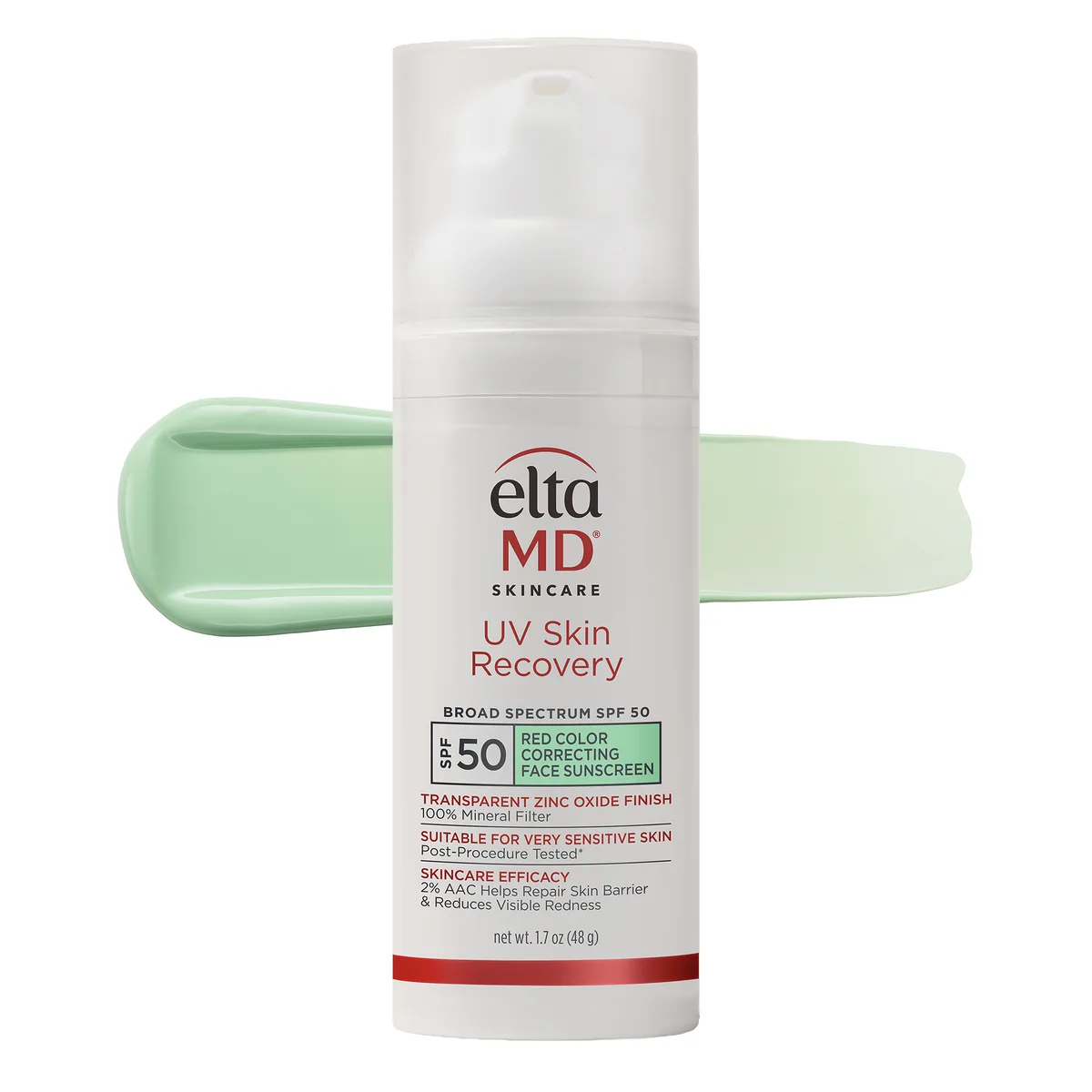
Most tinted mineral sunscreens use a flesh-toned iron-oxide tint; this one goes the opposite direction with a true green color-correcting pigment that optically cancels redness on contact. Layer that over a four-ceramide barrier system and a 2% amino-acid recovery complex and you get a sunscreen built specifically for rosacea-prone and post-procedure skin rather than a generic daily SPF.
A clever, genuinely sophisticated all-mineral SPF 50 that uses a green color-correcting tint to cancel redness on contact, layered over a real ceramide-and-amino-acid barrier system. It earns its place for rosacea-prone and post-procedure skin, though the price for 1.7 ounces asks you to pay for the formulation smarts.
Because this launched in 2024 and has only a few hundred retailer reviews so far, the rating leans on the confirmed all-mineral formula, the well-studied ceramide-cholesterol barrier complex, and EltaMD's long history in dermatologist sunscreens rather than years of real-world wear data. Long-term feedback may nudge it as more users weigh in.
Verdicts
How well it fits each concern
Verdict by concern tap a concern for the case
Supporting rolefor RosaceaIn your profileYou chose · Centella Asiatica has early evidence for rosacea, and photoprotection against a known trigger is the recognised companion to treating it — a reasonable supporting choice, short of a recommendation.Moderate evidenceStandard tolerabilityNo reviews collected yet
The case for it
Centella Asiatica Leaf Extract has early or mechanistic evidence for this concern, not trial-backed standing.
It is plausibly present at a working level, though the concentration is not declared.
The formula carries no trigger this concern is sensitive to, with the cautions noted.
Cautions: a photosensitising active — use sun protection.
What would change this: A declared concentration would move this to a firmer reading of the dose.
Same rule for everyone. “Supporting role” is the verdict on 8,197 of 45,024 concern verdicts across the catalog; rule R8a decided 1,489 of them.
Unchanged since September 5, 2026, engine 5.1.1.
R8a — A plausible-tier active in a category with a supportive job: the sentence names the active instead of saying nothing targets the concern (the AmLactin / CeraVe SA case for keratosis pilaris, where no guideline and single trials leave the keratolytics at early evidence). · the full register
Carrying active
Centella Asiatica Leaf Extract
Standing
plausible — trials support it
Form
plausible
Tolerability
standard — photosensitization
Row checked
against its sources on July 17, 2026 (evidence table ev-2026.09-r228)
Good choicefor SensitivityIn your profileYou chose · No fragrance, drying alcohol, declarable allergens or sensitising preservatives in this lotion — the profile sensitive skin looks for.Not yet assessedGentleNo reviews collected yet
The case for it
Centella Asiatica Leaf Extract has been researched for this concern and the evidence does not support it.
It is plausibly present at a working level, though the concentration is not declared.
The formula carries none of the triggers this concern is sensitive to.
What would change this: A declared concentration would move this to a firmer reading of the dose.
Same rule for everyone. “Good choice” is the verdict on 1,938 of 45,024 concern verdicts across the catalog; rule F2 decided 1,938 of them.
Unchanged since September 5, 2026, engine 5.1.1.
Falls shortfor Sun DamageIn your profileYou chose · Falls short for sun damage: no adequate UVA filter in the ingredient list.Moderate evidenceStandard tolerabilityNo reviews collected yet
The case for it
Zinc Oxide 12.9% is a first-line active — approved, monograph-listed or named in current guidelines — for this concern.
It is present at an effective concentration, declared or high in the ingredient list.
The formula carries no trigger this concern is sensitive to, with the cautions noted.
Cautions: a photosensitising active — use sun protection.
Same rule for everyone. “Falls short” is the verdict on 94 of 45,024 concern verdicts across the catalog; rule P5 decided 94 of them.
Unchanged since September 5, 2026, engine 5.1.1.
Falls shortfor Post-ProcedureIn your profileYou chose · Falls short for post procedure: no adequate UVA filter in the ingredient list.Moderate evidenceStandard tolerabilityNo reviews collected yet
The case for it
Centella Asiatica Leaf Extract has early or mechanistic evidence for this concern, not trial-backed standing.
It is plausibly present at a working level, though the concentration is not declared.
The formula carries no trigger this concern is sensitive to, with the cautions noted.
Cautions: a photosensitising active — use sun protection.
What would change this: A declared concentration would move this to a firmer reading of the dose.
Same rule for everyone. “Falls short” is the verdict on 94 of 45,024 concern verdicts across the catalog; rule P5 decided 94 of them.
Unchanged since September 5, 2026, engine 5.1.1.
Good choicefor Compromised Skin BarrierIn your profileYou chose · Ceramides is a reference standard by mechanism for compromised skin barrier; this lotion carries it.Moderate evidenceGentleNo reviews collected yet
The case for it
Ceramide Complex has trial-supported standing for this concern.
It is plausibly present at a working level, though the concentration is not declared.
The formula carries none of the triggers this concern is sensitive to.
What would change this: A declared concentration would move this to a firmer reading of the dose.
Same rule for everyone. “Good choice” is the verdict on 9,564 of 45,024 concern verdicts across the catalog; rule R5 decided 9,072 of them.
Unchanged since September 5, 2026, engine 5.1.1.
R5 — Trial-supported or guideline-supported active, adequately or plausibly dosed. · the full register
Carrying active
Ceramide Complex
Standing
supported — its mechanism is established
Form
plausible — studied range 0.5–1%, from the trials on the row; needs leave-on contact; judge it after ~4 weeks
Tolerability
gentle
Row checked
against its sources on July 17, 2026 (evidence table ev-2026.09-r228)
The studies behind the evidence row
Elias PM, Skin Barrier / Coderch et al., ceramides and skin barrier function — ceramides ~50% of SC intercellular lipid mass, essential to the permeability barrier — reference work
Falls shortJudged as a sunscreen, it comes up short on: UVA coverage. Not measured from the label: pleasant enough to actually use.
A verdict is DermApproved’s assessment of how well a product’s ingredients fit a concern — never a claim about what the product treats. Evidence dots and collected reviews sit beside it and are never blended in.
Rules 0.5.1 · evidence table ev-2026.09-r228 · how we decide
Assessment
Pros & Cons
Pros
✓ Green tint visibly neutralizes facial redness on contact
✓ All-mineral 12.9% zinc oxide filter, no chemical absorbers
✓ Genuine four-ceramide and cholesterol barrier system
✓ Fragrance-free and comfortable on reactive, post-procedure skin
✓ Silicone-smooth satin finish works as a makeup base
✓ Barrier-supporting amino-acid complex sits high in the formula
✓ No sting on freshly exfoliated or lasered skin
Cons
✗ Expensive at $52 for only 1.7 ounces
✗ Small tube empties quickly with proper reapplication
✗ Contains Yellow 5 and Blue 1 synthetic dyes
✗ Vivid green can cast in fine lines if under-blended
✗ Tint corrects tone but offers no real coverage
Review
Full Review
Squeeze this onto the back of your hand and your first instinct is mild panic: it is green. Not subtly tinted, not flesh-toned with a hint of olive, but genuinely the color of a mint leaf. That moment of doubt is exactly the point. Green sits opposite red on the color wheel, which is the oldest trick in a makeup artist's kit, and EltaMD has borrowed it for a sunscreen built around one specific job — making a red, reactive face look calmer the instant you blend it in. Within a minute the green has vanished into your skin tone, and the diffuse pink across the cheeks and around the nose looks noticeably quieter. It is a small piece of optical theater, and it works.
What keeps this from being a gimmick is everything happening underneath the pigment. The active is a single mineral filter, 12.9% zinc oxide, carrying the full broad-spectrum SPF 50 with no chemical absorbers anywhere on the list. That matters for the audience this product is courting — people with rosacea, freshly lasered or microneedled skin, and the kind of reactivity that flares at the first whiff of an irritating ingredient. A high-zinc formula like this can cast pale on its own, and rather than chase that down with iron oxides the way most tinted mineral sunscreens do, EltaMD leans on the green correction to balance the tone. It is a different solution to the white-cast problem, and on fair-to-medium skin with visible redness it arguably looks more natural than a flesh-toned tint, which can actually deepen the appearance of flushing.
The formula's recovery story rests on two pillars. The first is EltaMD's 2% AA Complex, a patented blend of three amino acids — taurine, arginine, and glycine, all of which sit high in the ingredient list — positioned to support barrier repair and visibly reduce redness. The evidence base for amino acids in this role is still maturing, so I'd file the redness claim as part chemistry, part the green pigment doing the visible heavy lifting. The second pillar is more reassuring: a genuine four-ceramide complex (NP, NS, EOP, and AP) paired with cholesterol and behenic acid, which together approximate the physiological lipid ratio of healthy skin. Seeing a full ceramide-cholesterol system inside a sunscreen base is unusual. Most SPFs treat barrier support as a marketing afterthought; here it reads like the formula was designed treatment-first and given a UV filter, rather than the other way around. Centella asiatica and a respectable dose of vitamin E round out the soothing-and-antioxidant supporting cast.
In use, the texture is one of the nicer things about it. It starts cushiony and slightly thick in the tube, then a silicone-forward glide takes over and it spreads thin and even, landing on a soft satin finish that is neither greasy nor powdery. It plays well as a light makeup base, gripping foundation without pilling, though anyone hoping it doubles as actual coverage will be disappointed — the tint corrects tone, it does not hide blemishes. There is no added fragrance and no sting, which is the whole proposition for sensitive skin, and I had no trouble wearing it over freshly exfoliated or otherwise grumpy skin.
Now the parts that require honesty. The first is the obvious one: you get 1.7 ounces, and as a sunscreen this should be applied generously and reapplied through the day, which means the tube empties faster than a once-daily face cream would. The second is the dyes — Yellow 5 and Blue 1 deliver that green tint, and while they're the reason the product works, they're worth flagging for the small subset of people who react to synthetic colorants. The third is purely cosmetic: that vivid green in the palm genuinely startles first-time users, and a sloppy application can leave a faint cast in the fine lines around the nose if you don't blend thoroughly. None of these are dealbreakers, but they're the trade-offs you accept for a sunscreen this specialized.
The lactic acid sitting low on the list is present at a formulation-support level rather than as an active exfoliant, so don't expect or fear any meaningful acid activity — it's there for pH and texture, not peeling. Likewise, the salicyloyl phytosphingosine is a barrier-supporting lipid, not the salicylic acid people associate with acne treatment, so this stays comfortably in the gentle camp despite a couple of intimidating-looking INCI entries.
So who is this actually for? If your main skin complaint is persistent redness — rosacea, flushing, the lingering pink after a procedure — and you've been frustrated that flesh-toned mineral sunscreens make you look more flushed rather than less, this is a genuinely thoughtful answer to that exact problem. The barrier ingredients are real, the filter is gentle, and the optical correction does something no untinted formula can. If you don't have redness to manage, you're paying a premium for a clever trick you won't use, and EltaMD makes other excellent untinted and flesh-toned options that will serve you for less fuss. Buy it for the redness, not for the SPF number alone — the SPF you can get cheaper, but the green correction over a ceramide base is the part worth the money.
Formula
Key Ingredients
The hero actives that drive this product's performance.
The sole UV filter here, providing broad-spectrum mineral protection without any chemical absorbers. At 12.9% it carries the full SPF 50 load on its own, which is why the green tint is doing double duty — it cosmetically offsets the slight cast a high-zinc formula can leave.
Regulator-approvedfor Sun Damage · limited certainty
EltaMD's patented three-amino-acid blend sits high in this list and is the formula's recovery angle — the trio supports barrier repair and is positioned to visibly calm redness alongside the green pigment, so the soothing claim is partly chemistry and partly optics.
Four ceramides paired with cholesterol and behenic acid recreate a physiological lipid ratio inside a sunscreen base — unusual for an SPF, and the reason this reads more like a treatment that happens to protect than a sunscreen with token extras.
Established mechanismfor Compromised Skin Barrier · established mechanism
Reinforces the redness-reduction story alongside the AA Complex, contributing antioxidant and soothing activity that suits the sensitive, reactive, post-procedure skin this product is aimed at.
Antioxidant support that helps mop up free radicals generated by any UV that gets through, complementing the mineral filter rather than replacing the need to reapply.
Limitedfor Sun Damage
Ingredient standings describe the active at treatment-level doses and
vehicles; this product's own condition grades weigh its actual formula.
This goes on last in the morning, over moisturizer and any serums. Let treatments fully absorb first, then apply an even layer and give the green tint a minute to settle so the color correction looks natural rather than ashy.
Results Timeline
Redness looks visibly reduced the moment it's blended in thanks to the green pigment. The barrier-supporting amino acids and ceramides work over weeks, so genuine improvement in reactivity tends to show after 4-6 weeks of daily use.
The protection here is the easy part to stand behind: zinc oxide is a broad-spectrum mineral filter with decades of regulatory and clinical use, and at 12.9% it covers both UVA and UVB without the photostability concerns that dog some chemical filters. The more interesting science is the barrier system. The combination of ceramides, cholesterol, and free fatty acids in a roughly physiological ratio is one of the better-validated approaches to repairing a compromised stratum corneum; work by Man and colleagues in the 1990s established that an incomplete or imbalanced lipid mixture can actually delay barrier recovery, while a complete one accelerates it — which is why a four-ceramide-plus-cholesterol-plus-behenic-acid blend is more meaningful than ceramides alone. Centella asiatica's active triterpenes (asiaticoside, madecassoside) have a growing literature supporting wound-healing and anti-inflammatory effects, fitting the post-procedure positioning. The amino-acid redness claim is where the evidence is thinnest: taurine, arginine, and glycine are plausible osmolytes and barrier substrates, but robust independent trials on this specific anti-redness function are limited, so the visible redness reduction you see on application is fairly attributed to the color-correcting pigment. In short, the sun protection and barrier repair rest on solid ground; the amino-acid soothing claim is promising but not yet proven, and the green tint is doing honest cosmetic work rather than masquerading as pharmacology.
References
Optimization of physiological lipid mixtures for barrier repair — Journal of Investigative Dermatology (1996)
Centella asiatica in cosmetology — Postepy Dermatologii i Alergologii (2013)
Dermatologist Perspective
Mineral sunscreens built around zinc oxide are a standard recommendation for rosacea, sensitive, and post-procedure skin in clinical practice, since they avoid the chemical filters that more often provoke stinging or flares. Dermatologists tend to value the inclusion of a complete ceramide-cholesterol barrier system in a daily SPF, because patients recovering from lasers, peels, or microneedling benefit from sustained barrier support layered under photoprotection. The green color-correcting tint is generally framed as a cosmetic aid for visible redness rather than a treatment, and clinicians typically remind patients that any tinted sunscreen still requires reapplication and an adequate quantity to deliver its labeled SPF. For genuinely red, reactive complexions, this kind of all-mineral, fragrance-free formula is considered a sensible everyday choice.
Guidance
Usage & Recommendations
How to Use
Use it as the final step of your morning routine, after moisturizer and any serums have fully absorbed. Dispense a generous amount — roughly a quarter-teaspoon for the face — and warm it briefly between fingertips before pressing and spreading it across the skin; the green pigment neutralizes into your tone within about a minute. Don't skimp, since under-application undercuts both the SPF and the color correction. Reapply every two hours of sun exposure, or after sweating or swimming. It layers cleanly under makeup, so apply foundation once it has set if you want additional coverage.
Value Assessment
At $52 for 1.7 ounces, this is priced firmly in the premium dermatologist-dispensed tier, and as a pure SPF number that's a hard sell — plenty of competent mineral sunscreens cost far less per ounce. What you're actually paying for is the combination: a true green color-correcting pigment that no drugstore option offers, sitting over a four-ceramide barrier system you'd normally buy separately in a treatment. For someone managing rosacea or recovering from in-office procedures, that bundled value is real and the price is defensible. For anyone without redness to correct, it's an expensive way to buy sun protection, and there's no larger size to improve the per-ounce math. Judge it by the redness job, not the SPF.
Who Should Buy
Reach for this if persistent facial redness is your main concern — rosacea, chronic flushing, or the pink that lingers after lasers, peels, and microneedling. It's ideal for sensitive, reactive skin that needs an all-mineral, fragrance-free filter with genuine barrier support baked in, and for anyone frustrated that flesh-toned tinted sunscreens make their redness look worse.
Who Should Skip
Pass if you have no redness to neutralize, since the green correction is the feature you'd be overpaying for. Anyone needing real coverage should look to a tinted foundation instead, as this only corrects tone. Those sensitive to synthetic dyes, or who simply want the most sunscreen per dollar for full-body use, will be better served elsewhere.
Ready to try EltaMD UV Skin Recovery Red Color Correcting Green Tint Broad-Spectrum SPF 50?
A cushiony, slightly thick lotion that breaks down into a smooth silicone-led glide and disappears into skin with a soft, satin landing.
Scent
No added fragrance; faintly mineral and neutral straight from the tube.
Packaging
Squeeze tube with a flip cap, sized for a single bathroom-shelf product rather than body use.
Finish
satinnatural
What to Expect on First Use
On first application the green pigment looks alarming in the palm, then neutralizes into skin tone once spread — the color correction is the whole point and reads natural within a minute. No stinging, even on freshly treated or reactive skin.
How Long It Lasts
About 6-8 weeks of daily full-face use, sooner if you reapply through the day as a sunscreen should be.
EltaMD built its reputation on the UV Clear line favored by dermatologists, then extended into recovery-focused formulas as in-office procedures like lasers and microneedling drove demand for sunscreens gentle enough for healing skin. This green-tint version answers a specific complaint — that flesh-toned tints can deepen the look of redness — by correcting color instead of matching it.
About EltaMD Established Brand (5–20 years)
EltaMD has manufactured sunscreens and wound-care products since 1988 and is one of the most frequently recommended sunscreen brands in US dermatology offices. Its formulations are widely stocked through physician-dispensed channels and supported by extensive clinical use.
Brand founded: 1988 · Product launched: 2024
Myth vs. Reality
Common Myths
Myth
A green sunscreen will leave you looking green.
Reality
The pigment is dosed to neutralize red tones, not deposit color. Once blended it disappears into the skin and counteracts redness; you only see green in the tube and for the first few seconds of application.
Myth
All-mineral SPF 50 always leaves a white cast.
Reality
This formula carries 12.9% zinc oxide, which can cast on its own, but the green tint is specifically there to offset that — the color correction is what lets a high-zinc mineral filter look natural on a range of skin tones.
FAQ
Frequently Asked Questions
Will the green tint in EltaMD UV Skin Recovery make my face look green?
No. The pigment is dosed to neutralize red tones, not deposit color, so it disappears into your skin within about a minute of blending. You only see green in the tube and for the first few seconds of application, after which it visibly quiets redness.
Is EltaMD UV Skin Recovery green tint good for rosacea?
Yes — it's essentially built for it. The all-mineral 12.9% zinc oxide filter avoids common irritants, the four-ceramide barrier system supports compromised skin, and the green color correction optically cancels the redness rosacea-prone skin tends to show.
Does this EltaMD sunscreen have a white cast?
It uses 12.9% zinc oxide, which can cast pale on its own, but the green color-correcting tint is specifically there to offset that. The result reads natural on fair-to-medium skin with visible redness rather than chalky.
Is the EltaMD UV Skin Recovery green tint safe to use after a laser or peel?
Yes. It's fragrance-free, all-mineral, and includes ceramides, cholesterol, and centella asiatica to support healing skin, which is why it's commonly used on post-procedure complexions. As always, follow your provider's specific aftercare timeline.
How is this different from regular EltaMD UV Clear?
This formula is all-mineral with no chemical filters, carries a genuine four-ceramide barrier complex, and uses a green color-correcting tint aimed specifically at redness, rather than the niacinamide-led, partly chemical approach of UV Clear.
Can I wear makeup over EltaMD UV Skin Recovery green tint?
Yes. Its silicone-smooth satin finish makes a clean makeup base — let it set for a minute, then apply foundation on top. The tint corrects tone but offers no coverage, so makeup handles any blemish concealing.
Reviews
What Reviewers Tend to Say
Recurring themes our editors read across retailer reviews of this product — summaries in our words, not quotations, and not a substitute for your own patch test.
Common Praise
Visibly cancels redness
No white cast despite all-mineral
Comfortable on reactive skin
Doubles as a light makeup base
Common Complaints
Expensive for the size
Green tint can look odd before blending
Smaller tube runs out fast
Not enough coverage to replace tinted foundation
Notable Endorsements
Frequently dispensed in dermatology and medical-spa offices
Western sensitive skincare works by subtraction — remove the fragrance, remove the alcohol, shorten the list. Japan's answer adds a designed molecule back in, and one of the two bets has a trial literature.
A wrecked barrier is the most common self-inflicted skin condition and the one with the clearest fix — the difficulty is that the routine which caused it feels productive and the one that repairs it feels like giving up.
'Barrier damage' has become the internet's all-purpose diagnosis. It's also a real, specific condition with a specific and slightly boring cure: mostly, stop doing things.
The K-beauty buzzword slaps a green leaf on half the shelf — but centella is one of the rare botanicals with genuine wound-healing data. The trick is knowing which molecule is doing the job.
Feb 27, 2026· 6 min
Questions people ask about Rosacea
Verified answers from our questions library — the nuance a product page cannot carry.
Products, answers, therapy guides, tools and articles in one search. Brand names,
slang and abbreviations all work — accutane finds isotretinoin, bacne finds truncal acne.