

Your Routine Is Still Fighting an Oil Slick That Dried Up Years Ago
Sebum output falls by roughly a third per decade in women, which quietly invalidates the cleanser, the acid schedule and the weightless gel you picked when your face ran wet.

This is the first widely available sunscreen built around Mexoryl 400, a filter that genuinely closes the 380-400 nm gap left by every other commercial UVA filter system. The 'Hydrating Cream' variant is the version that sacrifices the least comfort to do it — most other UVMune 400 formulas trade glycerin content for a drier finish, while this one keeps the long-UVA chemistry without leaving skin tight.
The most technically significant sunscreen launch of the last decade — Mexoryl 400 genuinely closes the 380-400 nm UVA gap that every other filter system leaves open. The Hydrating Cream variant keeps that chemistry comfortable on normal-to-dry skin, with the only meaningful complaint being its fragrance and the fact that you can't easily buy it in the US.
The case for it
What would change this: A declared concentration would move this to a firmer reading of the dose.
Same rule for everyone. “Full protection” is the verdict on 2,288 of 45,024 concern verdicts across the catalog; rule P1 decided 2,232 of them. Unchanged since September 5, 2026, engine 5.1.1.
Brand or formulator? Disclose a concentration or correct a fact →
The studies behind the evidence row
The case for it
What would change this: A researched evidence row for the lead active would replace this with a verdict.
Same rule for everyone. “Full protection” is the verdict on 2,288 of 45,024 concern verdicts across the catalog; rule P1 decided 2,232 of them. Unchanged since September 5, 2026, engine 5.1.1.
Brand or formulator? Disclose a concentration or correct a fact →
The case for it
What would change this: A researched evidence row for the lead active would replace this with a verdict.
Same rule for everyone. “Basic protection” is the verdict on 175 of 45,024 concern verdicts across the catalog; rule P3 decided 68 of them. Unchanged since September 5, 2026, engine 5.1.1.
Brand or formulator? Disclose a concentration or correct a fact →
The case for it
What would change this: A declared concentration would move this to a firmer reading of the dose.
Same rule for everyone. “Full protection” is the verdict on 2,288 of 45,024 concern verdicts across the catalog; rule P1 decided 2,232 of them. Unchanged since September 5, 2026, engine 5.1.1.
Brand or formulator? Disclose a concentration or correct a fact →
The studies behind the evidence row
The case for it
What would change this: A researched evidence row for the lead active would replace this with a verdict.
Same rule for everyone. “Full protection” is the verdict on 2,288 of 45,024 concern verdicts across the catalog; rule P1 decided 2,232 of them. Unchanged since September 5, 2026, engine 5.1.1.
Brand or formulator? Disclose a concentration or correct a fact →
The case for it
What would change this: A researched evidence row for the lead active would replace this with a verdict.
Same rule for everyone. “Full protection” is the verdict on 2,288 of 45,024 concern verdicts across the catalog; rule P1 decided 2,232 of them. Unchanged since September 5, 2026, engine 5.1.1.
Brand or formulator? Disclose a concentration or correct a fact →
Does the jobDoes what a sunscreen is for: UVA coverage, holds up in sunlight. Not measured from the label: pleasant enough to actually use.
A verdict is DermApproved’s assessment of how well a product’s ingredients fit a concern — never a claim about what the product treats. Evidence dots and collected reviews sit beside it and are never blended in. Rules 0.5.1 · evidence table ev-2026.09-r228 · how we decide
There is a specific range of light — roughly 380 to 400 nanometers — that until recently no commercial sunscreen meaningfully protected against. That sliver of long-wavelength UVA penetrates deeper than UVB or short UVA, contributes outsized damage to pigment-producing cells, and is the wavelength most implicated in stubborn melasma and slow photoaging. For years, sun-protection scientists wrote about this gap in the literature while shoppers bought SPF 50 sunscreens that quietly stopped protecting around 370 nm. UVMune 400 is the first widely available answer to that problem.
The answer comes in the form of Methoxypropylamino Cyclohexenylidene Ethoxyethylcyanoacetate — Mexoryl 400, in friendlier branding. L'Oréal Research spent roughly fifteen years developing this filter, and what they delivered is a molecule whose absorption curve peaks near 385 nm, exactly where the older filters fall off a cliff. La Roche-Posay was given the first commercial rights, and the Anthelios UVMune 400 line — launched across Europe in 2022 — is where the chemistry lives. The Hydrating Cream is the variant aimed at normal-to-dry skin, which is the version most people end up choosing because the other formulations skew drier on the finish.
The formula doesn't lean on Mexoryl 400 alone. The filter system also includes Tinosorb S, Mexoryl XL, Uvinul T 150, octocrylene, and ethylhexyl salicylate, layered so the absorption curve covers the full 290-400 nm window without gaps. Each has a job: Uvinul T 150 does the heavy UVB lifting so the UVA filters can be tuned for breadth rather than inflating the SPF number, Mexoryl XL is silicone-anchored and clings through water, and Tinosorb S quietly stabilizes the octocrylene and the salicylate against the photodegradation that silently erodes protection over a long afternoon. The result, in independent in vitro testing reported in dermatology journals, is one of the broadest and flattest UVA-UVB protection profiles available on a commercial shelf. That is the technical case for the product, and it holds up.
It also reframes the tired SPF-30-versus-50 argument. The number on the front measures UVB blocking and tells you almost nothing about what happens at 390 nm. The interesting part of this bottle is the part the label can't express.
The sensory case is where 'Hydrating Cream' earns its name. Sunscreens with this much filter load typically feel like wet plastic, drag across the skin, or finish so dry they ghost makeup off your face by lunchtime. This one breaks down on contact into something closer to a milky lotion and absorbs in under a minute. Glycerin sits second on the INCI, which is unusually high for a sunscreen and is precisely why the filter film doesn't leave skin feeling tight. There is no white cast on any skin tone — the filters are entirely organic, no zinc, no titanium — and the finish is satin, neither dewy nor matte. It sits under foundation without pilling, which is the test most fancy sunscreens fail.
Application is where good sunscreens still go to die. Two finger-lengths for face and neck, as the last step of the morning, about fifteen minutes before you meet the sun, with a minute's pause before makeup so the film can set. Under-application is the single biggest reason real-world SPF performance falls short of the lab number, and no amount of clever filter chemistry rescues a thin smear. Reapply every couple of hours in direct sun or after swimming; keep it out of your eyes, because like every organic filter system it stings.
The texture is a clear pick for normal-to-dry skin. Oily and combination users will probably prefer the UVMune 400 Invisible Fluid in the same line, which lightens the vehicle without sacrificing the filter chemistry. Sensitive users have one real consideration: the cream is fragranced. The perfume is restrained and fades within minutes, but it's there on the INCI, and if you've spent years cultivating a fragrance-free routine, this is the line you have to decide whether to cross. The unfragranced Anthelios variants carry the same filter system if that's a non-starter. The C12-15 alkyl benzoate also earns a comedogenic flag, and the formula isn't fungal-acne safe.
One place to set expectations honestly is on the bigger claims people attach to this filter. UVMune 400 will not erase existing pigmentation. It is not a treatment. What it does — uniquely well — is prevent the long-UVA-driven damage that creates and worsens pigmentation, photoaging, and the deep dermal stress older sunscreens missed. For someone managing melasma, where relapse is driven precisely by the wavelengths conventional filters ignore, that distinction is enormous. For someone with already-healthy skin, it's the difference between a sunscreen that's competent and one that's actively future-proofing.
Value is reasonable but not generous. A 50 mL tube runs around thirty-five to forty dollars at European pharmacies and import retailers, and at the proper dose you'll get six or seven weeks from it. There is no larger size, which is the most frequent complaint in reviews and a genuinely fair one — for a product this committed to daily protection, the absence of a 100 mL option is an unforced error. The US availability problem compounds it: you're paying import markups or carrying tubes home in a suitcase. That absence, incidentally, has nothing to do with safety. The FDA simply hasn't approved most modern UVA filters under its ageing monograph process, which is why these molecules sit on shelves in Paris and not in Pittsburgh despite decades of European use data.
Against those gripes is a remarkably consistent body of user feedback. Several thousand reviews across European retailers cluster around the same observations: no white cast, no greasy slip, no tight pulling, and a measurable reduction in summer freckle and pigmentation development with daily use. Dermatology coverage has been similarly positive — this is a product reviewed not on marketing but on its filter chemistry, and the chemistry holds. Four years in, UVMune 400 has become the benchmark European pharmacy sunscreen, and most newer European launches are now positioned in conversation with it.
This is the right pick for anyone with normal-to-dry skin who is serious about pigmentation prevention, melasma management, retinoid or post-procedure photosensitivity, or who simply wants the deepest UVA protection currently available without resorting to a heavy mineral formula. The fragrance and the 50 mL ceiling are real limitations. The Mexoryl 400 system is not theoretical — it does what it claims, and that fact alone makes this sunscreen worth importing if you can't buy it locally.
The hero actives that drive this product's performance.
| Ingredient | Function | Evidence |
|---|---|---|
| Mexoryl 400 (Methoxypropylamino Cyclohexenylidene Ethoxyethylcyanoacetate) (3%) | The headline filter — a L'Oréal-patented UVA absorber engineered to peak around 385 nm, deeper into the long-UVA range than older organic filters reach. In this formula it sits alongside Tinosorb S and Mexoryl XL so the absorption curve covers the full 290-400 nm window, which is why the cream can claim genuine UVA1 protection without relying on a heavy mineral load. | Not yet assessed |
| Tinosorb S (Bis-Ethylhexyloxyphenol Methoxyphenyl Triazine) | Photostable broad-spectrum filter that backstops the new Mexoryl 400 across UVB and shorter UVA. It also stabilizes octocrylene and the salicylate filter present here, preventing the kind of photodegradation that quietly drops protection during long sun exposure. | Regulator-approved for Sun Damage · limited certainty |
| Mexoryl XL (Drometrizole Trisiloxane) | Silicone-anchored UVA/UVB filter that lingers on skin and resists wash-off, contributing to the high water resistance rating. Pairs with Mexoryl 400 to layer protection across the entire UVA range rather than leaving the 380-400 nm gap that older filter systems have. | Regulator-approved for Sun Damage · limited certainty |
| Uvinul T 150 (Diethylhexyl Butamido Triazone) | Pure UVB absorber with one of the highest extinction coefficients available, doing the heavy lifting on the SPF 50+ rating so the UVA filters can be tuned for breadth rather than SPF inflation. | Regulator-approved for Sun Damage · limited certainty |
| Glycerin | Sits high on the INCI for a sunscreen, which is why this 'Hydrating' variant earns the name — it pulls water into the upper layers underneath the filter film, addressing the tightness that plagues filter-heavy European sunscreens. | Not yet assessed |
| Tocopherol | Lipid-phase antioxidant that quenches free radicals formed during UV exposure, complementing rather than replacing the filter system. In a cream this rich in organic filters it also helps preserve octocrylene from oxidative breakdown over the bottle's life. | Limited for Aging |
Ingredient standings describe the active at treatment-level doses and vehicles; this product's own condition grades weigh its actual formula.
Aqua / Water, Glycerin, Diethylhexyl Butamido Triazone, Drometrizole Trisiloxane, Methoxypropylamino Cyclohexenylidene Ethoxyethylcyanoacetate, Diisopropyl Sebacate, Bis-Ethylhexyloxyphenol Methoxyphenyl Triazine, Ethylhexyl Salicylate, Octocrylene, C12-15 Alkyl Benzoate, Propylene Glycol, Cetyl Alcohol, Behenyl Alcohol, Polyglyceryl-3 Distearate, Glyceryl Stearate, PEG-100 Stearate, Tocopherol, Caprylyl Glycol, Capryloyl Salicylic Acid, Carbomer, Disodium EDTA, Dimethicone, Inulin Lauryl Carbamate, Sodium Hydroxide, Stearic Acid, Phenoxyethanol, Parfum / Fragrance.
sunscreen
AM
Goes on as the last step of morning skincare before makeup; the cream needs a minute to settle into the inulin-based film, so resist the urge to immediately layer foundation.
UV protection is immediate once the film sets, roughly 15 minutes after application. Pigmentation prevention shows up over months of daily compliance, with measurable reductions in new sun-induced spots typically reported at the 8-12 week mark in user feedback.
The technical case for this sunscreen rests on a specific gap in older filter systems. Conventional UVA filters — including avobenzone, the most common UVA filter in US sunscreens — have absorption curves that drop off sharply around 370-380 nm. The 380-400 nm band, sometimes called UVA1 or long-UVA, penetrates deeper into the dermis than shorter wavelengths and contributes disproportionately to pigment-driven conditions like melasma and to long-term photoaging via dermal matrix degradation. Research published in the Journal of the European Academy of Dermatology and Venereology and in the British Journal of Dermatology has consistently flagged this as the photoprotection priority for the next generation of sunscreens.
Mexoryl 400, chemically Methoxypropylamino Cyclohexenylidene Ethoxyethylcyanoacetate, is engineered with an absorption maximum near 385 nm — precisely targeting that gap. In vitro spectrophotometry reported by L'Oréal Research and confirmed in independent dermatology coverage shows that combining Mexoryl 400 with Tinosorb S, Mexoryl XL, and Uvinul T 150 produces a remarkably flat absorption curve across 290-400 nm, where older systems show a steep cliff after 370 nm.
Clinical relevance for pigmentation conditions is increasingly well-documented. Studies on melasma management — including work published in JAMA Dermatology examining sunscreen filter breadth and pigment outcomes — point to UVA1 and visible-light contribution as a major driver of relapse and severity. A filter system that genuinely covers the 380-400 nm range is therefore more than a marketing improvement; it represents a meaningful intervention for the most common stubborn pigment condition seen in clinic.
The broader filter combination in this product is also notable for photostability. Octocrylene, present here, stabilizes more fragile filters and is itself stabilized by Tinosorb S; the inclusion of both is intentional. Glycerin and tocopherol round out the formula, addressing the comfort and oxidative-stress aspects that the filter chemistry alone cannot solve. Overall, the product represents one of the better-validated formulation cases in current sun-care literature.
Dermatologists managing melasma and chronic pigmentation increasingly point to long-UVA and visible-light protection as the most important development in sun care of the last decade. The Mexoryl 400 filter system in UVMune 400 is widely cited in European dermatology coverage as the first commercial formulation to close the 380-400 nm gap meaningfully — a wavelength range that has been understood to drive pigment instability since photobiology research in the early 2010s flagged it. Within European practice this product has become a standard recommendation for melasma patients, post-inflammatory hyperpigmentation, and any patient on retinoid therapy or post-procedure photo-sensitization. The Hydrating Cream variant is generally suggested for normal-to-dry skin types, with the Invisible Fluid pointed to oily and combination patients. The main caveat clinicians flag is the included fragrance, which makes the unfragranced Anthelios variants in the same Mexoryl 400 family a better choice for patients with documented fragrance sensitivity or contact dermatitis.
Apply two finger-lengths of cream as the final step of morning skincare, after moisturizer and at least fifteen minutes before sun exposure. Spread evenly across face, neck, and ears — sunscreen is a quantity game, and underapplication is the single biggest reason real-world SPF performance lags lab claims. Allow about a minute for the cream to settle into the filter film before applying makeup. Reapply every two hours during direct sun exposure or after swimming and heavy sweating; for indoor days, a single morning application is reasonable. Pairs well with morning vitamin C and niacinamide serums layered underneath. Avoid getting it into the eyes — like all chemical sunscreens, it stings ocular tissue.
At roughly $35-39 for 50 mL, this sits at the higher end of pharmacy sunscreens — and there is no larger size, which is the value question that comes up most. Compared to a US drugstore SPF 50, the per-mL cost is roughly double. Compared to what you get in return — a filter system not legally available in the US, broad-spectrum protection across the full UVA range, and a sensory profile that competes with luxury sunscreens twice the price — the math works for people with specific protection goals. For general daily sunscreen use without a pigmentation concern, a competent US alternative is perfectly defensible. For melasma, photoaging, or post-procedure care, the Mexoryl 400 system is worth the import cost. The 50 mL ceiling is the only sticking point that genuinely deserves a complaint — La Roche-Posay should ship a larger size.
Anyone managing melasma, hyperpigmentation, or sun-driven photoaging who wants the deepest commercially available UVA protection. Normal-to-dry skin types will find the texture perfectly tuned. Patients on retinoids, recent procedure recipients, or anyone serious about long-term photoaging prevention should consider this a top-tier daily option.
If fragrance triggers reactivity, skip this variant in favor of the unfragranced UVMune 400 options. Oily and combination types may prefer the lighter Invisible Fluid format from the same family. Anyone whose budget can't absorb import markups and who isn't managing a specific pigmentation condition can get adequate daily protection from a competent US-formulated SPF.
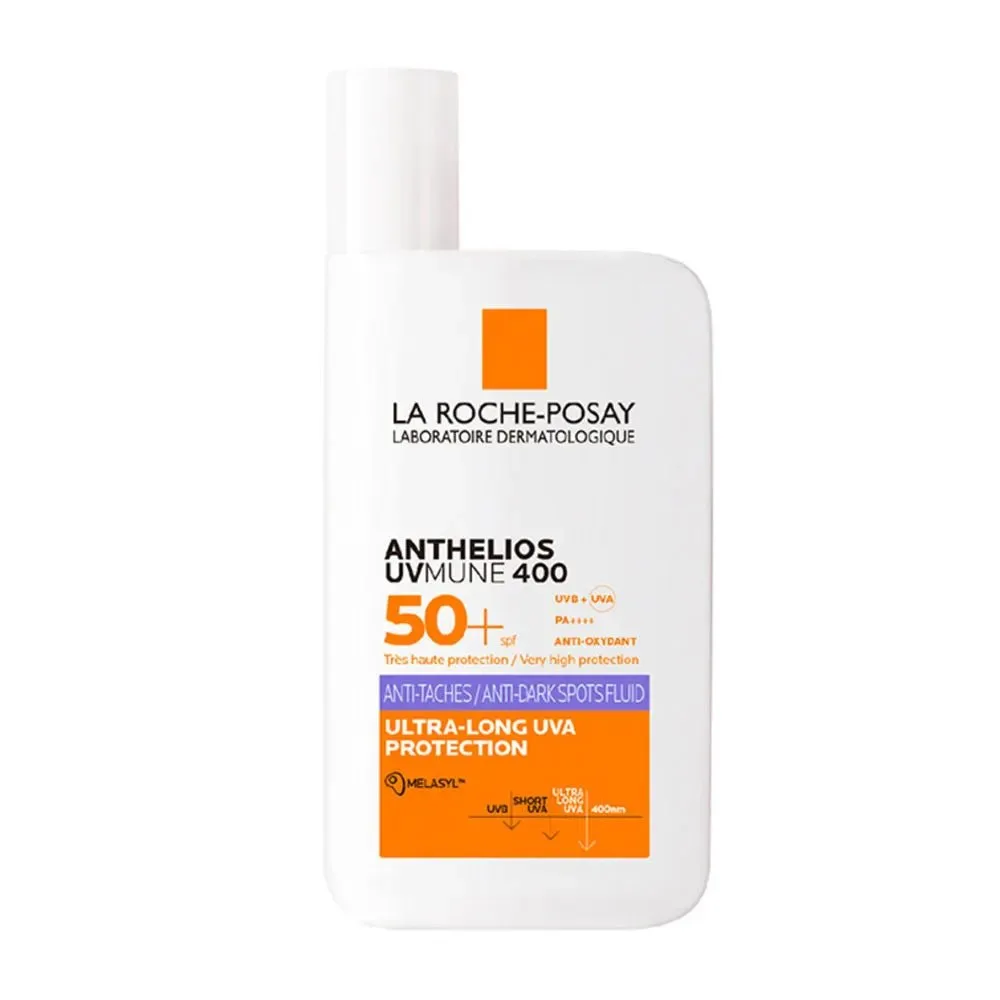
Ready to try La Roche-Posay Anthelios UVMune 400 Hydrating Cream SPF 50+?
Buy at Amazon ♥A satin cream that breaks down on contact into something closer to a milky lotion. Pulls into skin in about a minute without the chalky drag of mineral SPF or the slick sheen of pure chemical formulas.
A soft, slightly powdery fragrance that fades within minutes — present, but restrained for a French pharmacy product.
Squeeze tube with a flip cap, opaque and air-protective — the right call for filter stability. The 50 mL size is the only option, which is the most-cited gripe given how generously sunscreen needs to be applied.
First application feels deceptively light for an SPF 50+. There is no white cast on any skin tone tested in independent reviews, and no stinging on intact skin. The fragrance is the loudest thing on initial impression; if you've come from a fragrance-free routine, it will register.
Roughly 6-7 weeks with the recommended two-finger face-and-neck dose applied daily, less if you also use it on chest and ears.
All Year
L'Oréal Research patented Methoxypropylamino Cyclohexenylidene Ethoxyethylcyanoacetate after roughly fifteen years of development aimed at solving a specific problem — that even premium sunscreens were leaving a measurable gap in the long-UVA range that contributes most heavily to pigmentation and photoaging. UVMune 400 launched in Europe in 2022 as the first commercial deployment of the filter, with the Hydrating Cream the variant tuned for normal-to-dry skin.
La Roche-Posay launched in 1975 and the Anthelios sun-care line has been the most-recommended sunscreen brand among European dermatologists for over a decade, with the UVMune 400 platform backed by L'Oréal Research's photobiology labs and peer-reviewed UVA1 studies.
SPF 50+ is overkill versus SPF 30 once you apply enough.
SPF measures UVB blocking, but this product's argument lives in the UVA range — and at 380-400 nm, the difference between a generic SPF 50 and UVMune 400 is measurable in clinical phototesting. The headline number is the least interesting part of the formula.
European chemical filters are 'safer' than US filters because of EU regulation.
It's not about safety — it's about availability. The US FDA hasn't approved most modern UVA filters under its outdated monograph process, which is why Mexoryl 400, Tinosorb S, and Mexoryl XL all sit on shelves in Paris but not in Pittsburgh. The European versions have decades of real-world use data.
No — the US version of Anthelios uses a different filter system because the FDA has not approved Mexoryl 400. Buyers in the US either import from European pharmacies or use the US-formulated Anthelios Melt-in Milk, which is excellent but lacks the 380-400 nm coverage that defines UVMune 400.
No. The filter system is entirely organic — no zinc oxide or titanium dioxide — so the cream finishes invisibly across all skin tones, which is one of the most consistent themes in user reviews.
Same Mexoryl 400 filter system, different vehicle. The Hydrating Cream is glycerin-forward and feels best on normal-to-dry skin; the Invisible Fluid is lighter and better for oily or combination types who find creams too rich under makeup.
Yes — and this is one of the strongest cases for the product. Melasma is heavily driven by long-wavelength UVA and visible light, and a sunscreen that closes the 380-400 nm gap is meaningfully better positioned for daily melasma management than older filter systems. It is not a treatment, but it is a key prevention tool.
It can. The cream is fragranced, and while the scent dissipates fast, the perfume components remain on skin. For genuinely fragrance-reactive users, the unfragranced Anthelios variants in the same family are the safer choice.
Sunscreen filters in this formula are widely considered acceptable during pregnancy, including octocrylene and the Mexoryl filters. If you prefer to be cautious, mineral sunscreens with zinc oxide remain the most conservative option — but UVMune 400 is not flagged as off-limits.
Recurring themes our editors read across retailer reviews of this product — summaries in our words, not quotations, and not a substitute for your own patch test.
Truly invisible finish for an SPF this high
No tight or pulling sensation despite the filter load
Sits well under makeup
Noticeable reduction in summer freckle development with daily use
Fragranced — disqualifies it for many sensitive-skin users
Only available in 50 mL
Not sold in the US, so requires importing
Verified answers from our questions library — the nuance a product page cannot carry.