Your Routine Is Still Fighting an Oil Slick That Dried Up Years Ago
Sebum output falls by roughly a third per decade in women, which quietly invalidates the cleanser, the acid schedule and the weightless gel you picked when your face ran wet.
Read the preview
From the DermApproved blog, in Anti-Aging: the routine you built in your twenties. Your face makes about a third less oil every decade, so by forty-five the cleanser, the acid, and the weightless gel are all fighting a slick that dried up years ago. And the dryness you feel? Your barrier isn't leaking — it's something stranger. For the full breakdown, visit dermapproved.com/blog.
The enemy your routine was built to fight
Nobody announces the moment your face stops being oily. There is no flare, no rash, no single week where it goes wrong. What happens instead is that a routine assembled around one problem keeps running long after that problem has quietly retired — and starts, slowly, to cause a different one.
The underlying number is unglamorous and rarely quoted. Researchers measuring sustainable wax ester secretion on the foreheads of 109 men and 167 women aged 15 to 97 found rates peaked in the 15-to-35 bracket and declined continuously across the whole adult range. Fitted against age, the curves suggested sebum secretion falls about 23% per decade in men and about 32% per decade in women. Read that forward from your mid-twenties and the arithmetic is blunt: by the mid-forties a woman's face is running on roughly half the oil it once had, and the decline steepens rather than flattens through the menopausal transition.
Now look at what a routine built at 25 actually does. The foaming cleanser exists to remove surplus oil. The acid toner exists because pores kept filling. The gel moisturiser was chosen precisely because it left nothing behind. Every one of those decisions was a control system aimed at a supply that has since fallen away by half. The products didn't stop working. They kept working perfectly on a problem that isn't there any more.
Dry skin that isn't actually leaking
The usual advice gets this backwards. If skin at 45 feels tight and papery, the intuitive explanation is that water is escaping faster — a leaky barrier. Measured, that turns out to be the wrong story.
When researchers compared transepidermal water loss across 11 anatomic sites in young adults and much older volunteers, water loss was significantly lower in the aged group at nearly every region tested, while sebum, hydration and surface pH showed no significant difference at most sites. A later study using Raman confocal microspectroscopy on 40 women across four age brackets found the same direction of travel: water loss decreases slightly with age, partly explained by the stratum corneum getting thicker — while the lipid-to-protein ratio and the compactness of the lipid packing fall significantly. Skin ages into a wall that is thicker and less well mortared.
So the felt dryness is not a hole. It is a supply problem and an organisation problem: less sebum arriving at the surface, and an intercellular lipid cement that is looser and less ordered than it used to be. That distinction changes what you buy. Pure occlusion — sealing an empty room — reduces the symptom without addressing the cause. Refilling the mortar means creams built around the lipids skin is short of, which in practice means ceramides paired with cholesterol and fatty acids rather than a humectant serum doing the heavy lifting alone. A dense, cholesterol-containing cream like CeraVe Moisturizing Cream or a fatty-acid-and-cholesterol formula such as Illiyoon Ceramide Ato Concentrate Cream is doing something structurally different from a hyaluronic acid gel, even though both are sold as hydration. If you want the niacinamide alongside the ceramides, La Roche-Posay Toleriane Double Repair covers that ground in a lighter base. The ingredient itself is worth understanding on its own terms — see ceramides for what the class does and doesn't do.
Perimenopause moves the goalposts, and not in a straight line
The forties are harder to plan for than the fifties, and the reason is variance rather than direction. Postmenopausal skin is a settled state; perimenopausal skin is a moving one. Oestrogen doesn't taper politely — it swings, sometimes for years before the final period, and skin that behaves for a fortnight can turn reactive without an obvious trigger.
A cross-sectional survey of 278 Dutch women aged 20 to 65 put numbers to the perception: about 42% of premenopausal women reported increased skin sensitivity just before and during menstruation, and about 32% of peri- and postmenopausal women reported increased sensitivity following the menopause. The most-cited symptoms were bumps, dryness, itching and redness — a cluster that is easy to misread as a bad product rather than a shifting substrate.
That variance has a practical consequence: this is the wrong decade to judge a product on a single fortnight. A cream that felt too rich in July may be exactly right in November, and a serum that stung one week may be fine the next. Build the routine with a stable core and a small number of things you're willing to dial up and down, then keep a rough record of when skin turned. If you want a starting scaffold rather than a blank page, the forties routine lays out the stable core, and the menopause routine is where to look once cycles stop entirely. The Routine Finder will assemble either around what your skin is actually doing now rather than what it did at thirty.
The retinoid stays. The delivery changes.
The reflex, when skin turns touchy, is to drop the strongest thing in the routine. That is usually the wrong cut, because the strongest thing is also the best-evidenced one.
A systematic review restricted to randomised controlled trials of topical tretinoin for photoaging pulled seven studies spanning concentrations from 0.025% to 5% and durations from three months to two years. Improvement in wrinkling, mottled hyperpigmentation, sallowness and lentigines showed up as early as one month and held at 24 months, and every included study reported the drug was tolerated. Nothing else in an over-the-counter routine has that shape of evidence behind it.
What should change is not the molecule but everything around it. Tolerance in the forties is genuinely lower than it was, so the levers are vehicle, frequency and buffering. A cream base holds better than an alcohol-forward gel. Applying to fully dry skin rather than damp skin slows penetration enough to matter. Two nights a week for a month, then three, is a slower ramp than most people give themselves and it is the ramp that survives. Dropping down a rung — a low-strength retinal such as Medik8 Crystal Retinal 3 or a gentle entry serum like The INKEY List Starter Retinol Serum — is a better move than quitting and restarting every six months, which is the pattern that actually wastes the decade. The Retinoid Ladder maps the rungs in order, and retinaldehyde is worth reading on if you're deciding between forms.
Exfoliation is the line item to cut first
If something has to give to make room, cut the acids before you cut anything else. There are two independent reasons, and they compound.
The first is that the surface you're exfoliating has changed. A thicker, more slowly renewed stratum corneum with looser lipid packing does not respond to the same weekly dose as a 25-year-old's, and the sensitivity data above says the margin for getting it wrong has narrowed.
The second is a cost most routines never price in. In a randomised, double-blinded study, 29 subjects had 10% glycolic acid at pH 3.5 applied six days a week for four weeks; treated sites then received ultraviolet exposure. Glycolic acid raised sunburn-cell counts, lowered the minimal erythema dose and increased cyclobutane pyrimidine dimers — direct UV-induced DNA damage. The heightened sensitivity was still measurable a week after applications stopped. In a decade where the main long-term goal is limiting photodamage, running daily acid into daylight is working against your own objective.
None of this makes acids useless. It makes them a twice-weekly tool with a night-time slot and a genuinely non-negotiable sunscreen the next morning, not a daily habit. The question of how acids sit alongside pigment work is a common one — the layering question covers where they belong in the sequence.
What earns a slot at 45
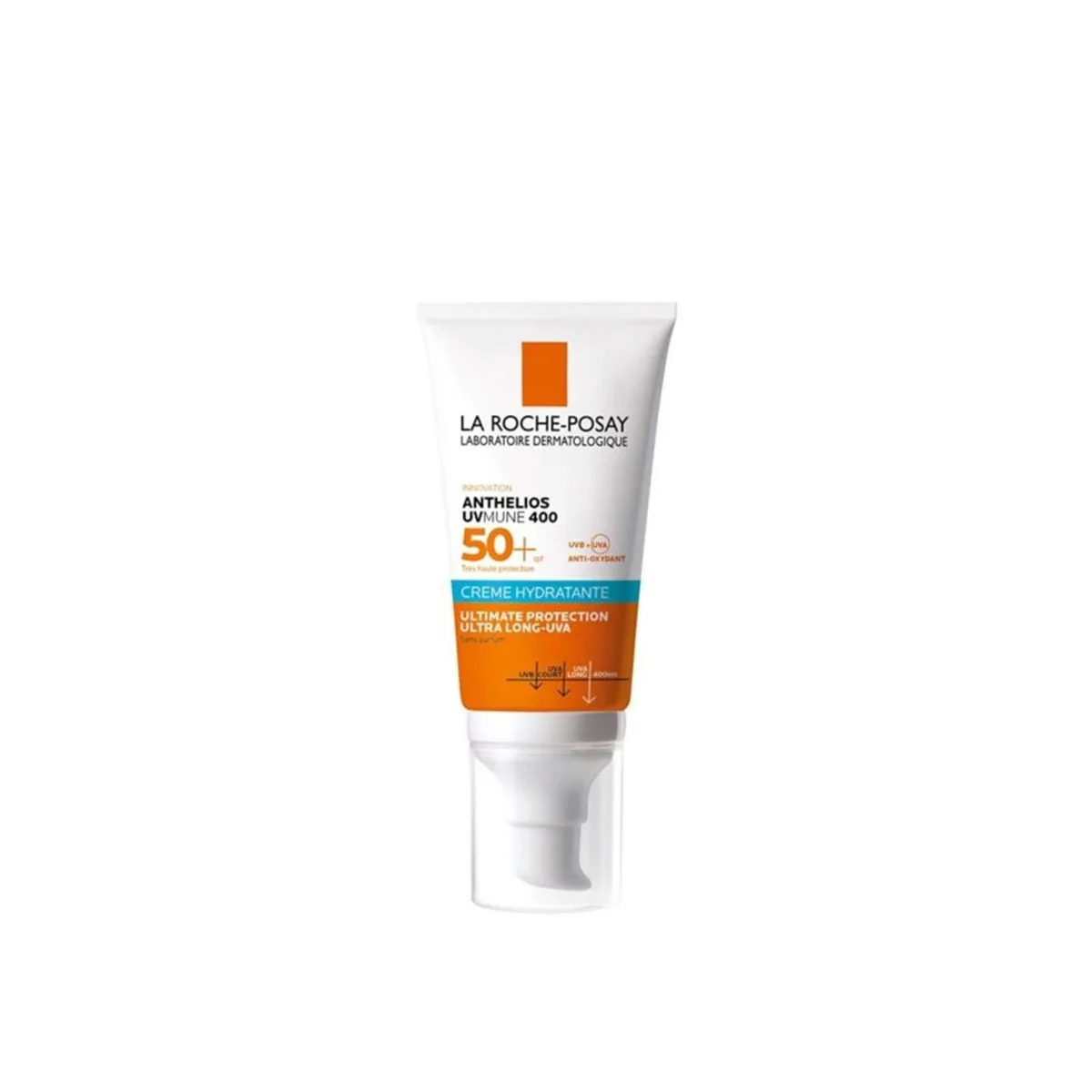
Strip it down and the forties routine is short, which is the opposite of what the category sells. Sunscreen stays exactly where it was and gets more important, not less, because the collagen you are trying to keep is now being drawn down from both ends; a hydrating high-protection base like Anthelios UVMune 400 Hydrating Cream doubles as the morning moisturiser and removes a step.
The cleanser gets demoted from an active to a neutral: something that removes sunscreen without stripping, on the reasoning that there is much less oil to remove than there used to be. CeraVe Hydrating Facial Cleanser is the unexciting, correct answer to a question that no longer needs an exciting one. The moisturiser gets promoted in the other direction, from afterthought to the load-bearing step — and if the dryness runs beyond the face, a urea-containing option such as CeraVe Intensive Moisturizing Cream handles the rougher patches that start showing up on limbs.
The retinoid keeps its place on a slower schedule. Everything else — the essences, the second serum, the weekly mask — is discretionary, and the honest test is whether you would notice its absence after a month. Most people wouldn't.
What makes this decade feel like failure is the assumption that skin misbehaving means you're doing too little. Usually it means the routine is calibrated to a face from twenty years ago and nobody sent the memo. Save the profile, note when things shift, and let the record — not the marketing — decide what gets a slot.
Products mentioned
Independently reviewed and scored — the real products behind this piece.



- Routine Rebuilding Your Skincare Routine in Your 40s The stable core this post argues for, assembled step by step
- Routine Menopause Skincare Routine for Dry, Changing Skin Where to move once cycles stop and the variance settles
- Ingredient Ceramides The lipid class that thins and disorganises with age
- Ingredient Retinal (Retinaldehyde) Form comparison when stepping down a rung
- Question Can I keep using exfoliating acids? Where twice-weekly acids belong in the layering order
References
- Age-related changes in sebaceous wax ester secretion rates in men and women — Journal of Investigative Dermatology, 1985
- Skin aging. Effect on transepidermal water loss, stratum corneum hydration, skin surface pH, and casual sebum content — Archives of Dermatology, 1991
- Age-dependent changes in stratum corneum barrier function — Skin Research and Technology, 2014
- Sensitive skin and the influence of female hormone fluctuations: results from a cross-sectional digital survey in the Dutch population — European Journal of Dermatology, 2017
- Topical tretinoin for treating photoaging: A systematic review of randomized controlled trials — International Journal of Women's Dermatology, 2022
- Topical glycolic acid enhances photodamage by ultraviolet light — Photodermatology, Photoimmunology & Photomedicine, 2003
Every cited link is verified to resolve to the paper named. Where a source could not be independently confirmed, it is listed without a link rather than pointing you somewhere wrong.
Frequently asked
My skin got drier in my forties but my dermatologist says my barrier is fine. Can both be true?
Yes, and the measurements support it. Water loss through aged skin at rest is typically lower, not higher, than in young skin — the stratum corneum thickens with age. What falls is the amount of sebum reaching the surface and the compactness of the intercellular lipids, so skin feels short on oil without being measurably leaky.
Should I stop my retinoid if my face has become more reactive?
Stopping is usually the wrong cut. Trial evidence for tretinoin runs to 24 months with tolerability reported throughout, and nothing else in a non-prescription routine matches it. Change the vehicle to a cream, apply to fully dry skin, and drop to two nights a week before you consider abandoning the molecule.
How often should I exfoliate at 45 if I used an acid nightly at 25?
Twice weekly at night is a reasonable ceiling for most people. Four weeks of daily 10% glycolic acid measurably lowered the minimal erythema dose and increased UV-induced DNA damage, with the effect persisting a week after stopping — which sits badly against the main goal of this decade.
Is perimenopause different from menopause for skincare purposes?
Practically, yes. Perimenopause is the fluctuating phase, so skin behaviour varies week to week and single-fortnight product verdicts are unreliable. Post-menopause is a settled state you can build a fixed routine around, which is why the two get separate routine templates here.
Do I need to change my cleanser, or is that a marketing upsell?
It is a real change, for an arithmetic reason. Sebum secretion falls roughly a third per decade in women, so a cleanser chosen to strip surplus oil is now removing lipids you are short of. The swap is from an active cleanser to a neutral one, not to a more expensive one.