



Your Routine Assumes a Clock You Don't Have
"Just swap AM and PM" is half right — one of the three things that label stands for flips with your schedule, and the other two refuse.
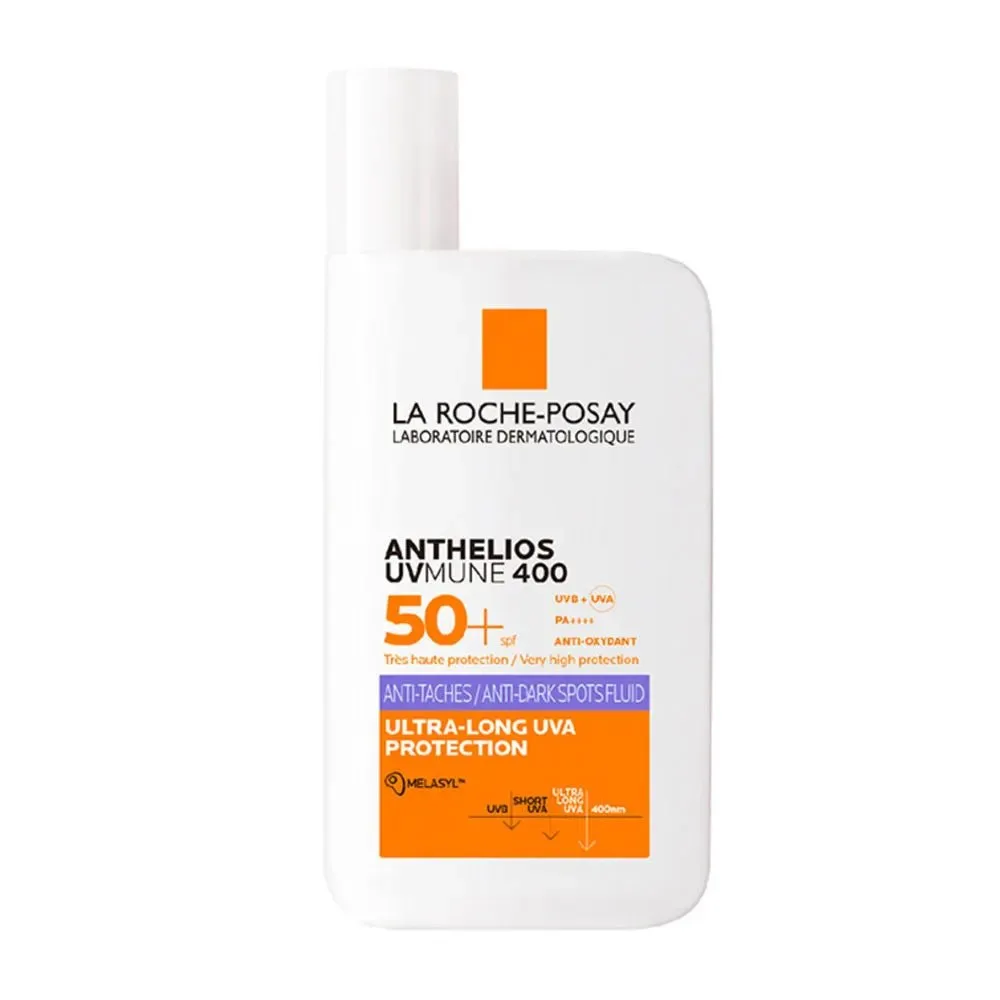
Most sunscreens treat pigmentation passively, by simply blocking the rays that worsen it. This one is active on both fronts: the UVMune 400 filter system shuts down the long-UVA that drives dark spots, while the Melasyl active intercepts melanin precursors before they become visible pigment. It is a sunscreen and a corrective step folded into one bottle.
A sunscreen that takes the dark-spot problem seriously from both directions. The UVMune 400 filter system blocks the long-UVA that drives pigmentation, while the Melasyl active works to fade existing marks. The lightweight fluid wears beautifully, though denatured alcohol makes it better suited to combination and oily skin than dry. For pigmentation-prone skin, it's an excellent daily anchor.
Note: This Anti-Dark Spots variant and its Melasyl active reached the market relatively recently. While the underlying UVMune 400 filter platform is extensively validated, our assessment of the pigmentation claims relies on formulation analysis and early real-world feedback. The rating should firm up as user feedback keeps coming in.
The case for it
What would change this: A researched evidence row for the lead active would replace this with a verdict.
Same rule for everyone. “Full protection” is the verdict on 2,288 of 45,024 concern verdicts across the catalog; rule P1 decided 2,232 of them. Unchanged since September 5, 2026, engine 5.1.1.
Brand or formulator? Disclose a concentration or correct a fact →
The case for it
What would change this: A researched evidence row for the lead active would replace this with a verdict.
Same rule for everyone. “Full protection” is the verdict on 2,288 of 45,024 concern verdicts across the catalog; rule P1 decided 2,232 of them. Unchanged since September 5, 2026, engine 5.1.1.
Brand or formulator? Disclose a concentration or correct a fact →
The case for it
What would change this: A researched evidence row for the lead active would replace this with a verdict.
Same rule for everyone. “Basic protection” is the verdict on 175 of 45,024 concern verdicts across the catalog; rule P3 decided 68 of them. Unchanged since September 5, 2026, engine 5.1.1.
Brand or formulator? Disclose a concentration or correct a fact →
The case for it
What would change this: A declared concentration would move this to a firmer reading of the dose.
Same rule for everyone. “Full protection” is the verdict on 2,288 of 45,024 concern verdicts across the catalog; rule P1 decided 2,232 of them. Unchanged since September 5, 2026, engine 5.1.1.
Brand or formulator? Disclose a concentration or correct a fact →
The studies behind the evidence row
The case for it
What would change this: A researched evidence row for the lead active would replace this with a verdict.
Same rule for everyone. “Full protection” is the verdict on 2,288 of 45,024 concern verdicts across the catalog; rule P1 decided 2,232 of them. Unchanged since September 5, 2026, engine 5.1.1.
Brand or formulator? Disclose a concentration or correct a fact →
Does the jobDoes what a sunscreen is for: UVA coverage, holds up in sunlight. Not measured from the label: pleasant enough to actually use.
A verdict is DermApproved’s assessment of how well a product’s ingredients fit a concern — never a claim about what the product treats. Evidence dots and collected reviews sit beside it and are never blended in. Rules 0.5.1 · evidence table ev-2026.09-r228 · how we decide
Anyone who has tried to fade dark spots knows the frustrating arithmetic of it. You apply a brightening serum at night, you wait, you check the mirror — and the marks barely budge, because every sunny morning quietly undoes a week of progress. Pigmentation is not a one-front problem. It is a tug-of-war between whatever you are using to fade the spots and the ultraviolet light that keeps re-darkening them. The Anthelios UVMune 400 Anti-Dark Spots Fluid is interesting because it tries to fight on both fronts from a single bottle, and it does so with genuinely current technology rather than marketing.
The protective half is built on La Roche-Posay's UVMune 400 platform, and the centerpiece is Mexoryl 400 — a filter engineered to absorb ultra-long UVA wavelengths reaching all the way to 400 nanometres. This is the part that matters most for pigmentation. Long UVA penetrates deep, it is present year-round, it passes through windows and clouds, and it is one of the principal drivers of melasma and post-inflammatory hyperpigmentation. A sunscreen that covers that band well is doing more for your dark spots than most dedicated brightening products. And this formula does not stop at one filter: the INCI list reveals a remarkable seven-filter system, stacking Mexoryl 400 with Mexoryl SX, Mexoryl XL, avobenzone, Tinosorb S, and two triazine filters. The UVA coverage in particular is deliberately, almost obsessively redundant — which is exactly the right design choice for skin that pigments easily.
The corrective half is Melasyl, listed on the INCI as 2-mercaptonicotinoyl glycine. This is a patented active that L'Oreal spent years developing, and its mechanism is worth understanding because it differs from the usual suspects. Classic brightening ingredients tend to inhibit tyrosinase, the enzyme that kicks off melanin production. Melasyl works further downstream: it intercepts a melanin precursor before that precursor converts into visible pigment. Because it acts on a precursor rather than shutting down an enzyme wholesale, it is designed to be gentle enough for indefinite daily use — and indefinite daily use is what fading pigmentation genuinely requires. There is no shortcut on that timeline.
In practice, the fluid is a pleasure to wear. It is genuinely fluid — thin, fast-spreading, absorbed within a minute or two — and it sets to a soft, lightly blurred finish that looks like skin rather than sunscreen. There is no white cast, which is unsurprising given it uses only organic filters, and it sits cleanly under makeup. Perlite and silica give it a faintly soft-focus, slightly mattifying quality without tipping into a hard matte. For combination and oily skin, this texture is close to ideal.
Now the honest caveat, and it is the same one that applies to several products in this Anthelios range: denatured alcohol sits second on the ingredient list, right after water. Alcohol in sunscreen is not the villain some corners of the internet make it out to be — it helps these formulas spread thinly, dry quickly, and feel weightless, and it evaporates off rather than lingering. But at that concentration it can feel drying, and for genuinely dry or alcohol-sensitive skin it can read as tight or slightly stripping over a long day. The glycerin and propanediol in the formula buffer this to a degree, but they do not erase it. If your skin runs dry, this is not your sunscreen, and that is worth saying plainly.
The other thing worth managing is expectation. This is a real anti-pigmentation product, but it is not a spot eraser. The biggest contribution it makes to an even skin tone is preventive — relentlessly blocking the UVA that would otherwise deepen every existing mark and trigger new ones. The Melasyl works on the spots already there, but slowly. Realistically you are looking at around eight weeks of daily, no-exceptions use before the mirror tells you anything, and the marks fade rather than vanish. Anyone expecting a dramatic before-and-after in a fortnight will be disappointed; anyone who understands that pigmentation is a months-long discipline will be quietly pleased.
Value lands in fair territory. At roughly 34 dollars for 50ml it is a premium sunscreen, and there is no larger size to improve the per-millilitre math. But you are buying a filter system that is genuinely among the best available anywhere, plus an active ingredient that is not yet widely found in cheaper products, all backed by La Roche-Posay's five decades of sun-care research. For someone whose primary skin concern is pigmentation, consolidating sun protection and a corrective step into one daily product is both practical and a reasonable use of money.
The Anthelios UVMune 400 Anti-Dark Spots Fluid is not magic, and it does not pretend to be. What it is, is an unusually intelligent piece of formulation: it understands that you cannot fade dark spots while UV keeps recreating them, so it attacks both sides of the equation at once. For pigmentation-prone skin that is not too dry to tolerate the alcohol, it earns a permanent place in the morning routine.
The hero actives that drive this product's performance.
| Ingredient | Function | Evidence |
|---|---|---|
| Mexoryl 400 (Methoxypropylamino Cyclohexenylidene Ethoxyethylcyanoacetate) | The UVMune 400 platform's signature filter, absorbing ultra-long UVA up to 400nm. In an anti-dark-spot product this matters more than usual — long UVA is a major driver of the pigmentation this fluid is trying to fade, so blocking it is effectively half of the treatment. | Not yet assessed |
| Melasyl (2-Mercaptonicotinoyl Glycine) | La Roche-Posay's patented melanin-intercepting active. Rather than inhibiting the tyrosinase enzyme like older brighteners, Melasyl captures a melanin precursor before it converts into visible pigment. Paired here with comprehensive UV filtering, it works to fade existing marks while the filters block the rays that would create new ones. | Not yet assessed |
| Avobenzone (Butyl Methoxydibenzoylmethane) | A conventional broad-spectrum UVA filter that, alongside Mexoryl SX, Mexoryl XL, and the triazine filters, builds deliberately redundant UVA coverage. This formula stacks UVA protection because UVA is the wavelength most responsible for the dark spots the product is designed to address. | Regulator-approved for Sun Damage · emerging certainty |
| Tinosorb S (Bis-Ethylhexyloxyphenol Methoxyphenyl Triazine) | A photostable filter covering UVB and short UVA. It helps stabilize the overall filter system so protection holds steady through the day — important here because intermittent, patchy protection is precisely what lets pigmentation creep back. | Regulator-approved for Sun Damage · limited certainty |
| Glycerin | A humectant that offsets the mild dryness the formula's denatured alcohol can cause, keeping the lightweight fluid comfortable on combination and oily skin without adding any weight or shine. | Not yet assessed |
Ingredient standings describe the active at treatment-level doses and vehicles; this product's own condition grades weigh its actual formula.
Aqua/Water/Eau, Alcohol Denat., Silica, Diisopropyl Adipate, Diisopropyl Sebacate, Ethylhexyl Triazone, Butyl Methoxydibenzoylmethane, Bis-Ethylhexyloxyphenol Methoxyphenyl Triazine, Dicaprylyl Carbonate, Glycerin, Propanediol, C12-22 Alkyl Acrylate/Hydroxyethylacrylate Copolymer, Diethylamino Hydroxybenzoyl Hexyl Benzoate, C12-15 Alkyl Benzoate, Methoxypropylamino Cyclohexenylidene Ethoxyethylcyanoacetate, Perlite, Drometrizole Trisiloxane, Acrylates/C10-30 Alkyl Acrylate Crosspolymer, Citric Acid, Disodium Phosphate, Hydroxyacetophenone, Hydroxyethylcellulose, 2-Mercaptonicotinoyl Glycine, Pentaerythrityl Tetra-Di-T-Butyl Hydroxyhydrocinnamate, Pentylene Glycol, Polysorbate 60, Sodium Phosphate, Sodium Thiosulfate, Terephthalylidene Dicamphor Sulfonic Acid, Tocopherol, Triethanolamine, Trisodium Ethylenediamine Disuccinate
sunscreen
AM
Apply as the final AM step over moisturizer and any pigmentation serums. It layers cleanly under makeup thanks to the soft, slightly blurred finish. For best dark-spot results, use it every single day — sun protection is the non-negotiable foundation of any pigmentation routine.
UV protection is immediate. Dark-spot improvement is gradual — expect a more even tone over roughly 8 weeks of consistent daily use, with the biggest benefit coming from preventing new marks rather than erasing old ones overnight.
This fluid is best understood as two technologies working toward one goal. The protective technology is the UVMune 400 filter system, and its scientific significance lies in long-UVA coverage. UVA radiation in the 380-400nm range penetrates deeply into the dermis and is strongly implicated in both photoaging and pigmentary disorders, including melasma and post-inflammatory hyperpigmentation. Mexoryl 400 (methoxypropylamino cyclohexenylidene ethoxyethylcyanoacetate) was developed specifically to absorb this band, which many older sunscreens covered incompletely. Crucially, this formula does not rely on it alone — it combines seven organic filters, including Mexoryl SX (terephthalylidene dicamphor sulfonic acid), Mexoryl XL (drometrizole trisiloxane), avobenzone, Tinosorb S, and triazine filters. Overlapping the filters this way produces a smoother, more complete absorption curve and means the failure of any single filter has a limited effect on overall protection.
The corrective technology is Melasyl (2-mercaptonicotinoyl glycine), a patented active. Conventional pigment-control ingredients such as hydroquinone, kojic acid, or arbutin act largely by inhibiting tyrosinase, the rate-limiting enzyme in melanin synthesis. Melasyl is reported to act differently — intercepting an intermediate melanin precursor downstream of tyrosinase activity, before it is incorporated into mature pigment. The intended advantage of acting on a precursor rather than broadly suppressing the enzyme is selectivity and tolerability, allowing the long-term daily use that pigmentation correction requires. As a relatively new active, the body of independent published evidence on Melasyl is still developing, so its classification here is emerging rather than well-established. The combination logic, however, is sound: preventing new pigment formation through comprehensive UVA filtering while simultaneously addressing precursor melanin attacks hyperpigmentation from two complementary directions. Tocopherol contributes antioxidant support against UV-generated free radicals.
Dermatologists consistently identify daily broad-spectrum sun protection as the foundation of any hyperpigmentation or melasma treatment plan, frequently noting that even the most effective brightening regimen fails without it because UV exposure continually re-stimulates pigment production. Long-UVA coverage is especially emphasized for pigment-prone skin, since UVA penetrates deeply and is present year-round, which makes a filter system built around Mexoryl 400 well aligned with current clinical thinking. Dermatologists also point out that products combining sun protection with a corrective active improve patient adherence by simplifying routines. Melasyl is generally regarded as a promising newer pigment-intercepting ingredient, though clinicians tend to advise patients that meaningful results take months and that this fluid works best as part of a broader regimen rather than as a standalone fix.
Apply as the final step of your morning routine, after moisturizer and any pigmentation serums. Use a generous amount — roughly two finger-lengths for the face and neck — to reach the labeled SPF 50+ protection; under-application is the most common mistake. Allow a minute or two to absorb before makeup. Reapply every 2 hours of direct sun exposure. Use it every single day, year-round, including cloudy days and indoors near windows, since the UVA it targets passes through both. Consistency is the entire point with pigmentation.
At around 34 dollars for 50ml, this is a premium sunscreen, and the absence of a larger size means committed users pay full freight on every repurchase. The price is easier to justify than most: the seven-filter UVMune 400 system is among the most advanced available in any sunscreen, and Melasyl is a patented active not yet found in budget products. For someone whose main concern is pigmentation, folding sun protection and a corrective step into one bottle is genuinely efficient. For someone who simply wants daily UV protection without the dark-spot focus, the standard UVMune 400 fluid covers that need at a lower price.
Anyone whose primary skin concern is dark spots, melasma, or post-acne marks, particularly with combination, oily, or normal skin. It is an ideal daily anchor for a pigmentation routine and pairs well with niacinamide, vitamin C, or evening tranexamic and azelaic treatments.
Those with dry or alcohol-sensitive skin may find the denatured alcohol uncomfortable over a long day and should look to a more emollient sunscreen. Anyone expecting a fast spot-eraser will be disappointed — the corrective effect is gradual. Shoppers without pigmentation concerns can save money with a standard daily sunscreen.
Ready to try La Roche-Posay Anthelios UVMune 400 Anti-Dark Spots Fluid SPF 50+?
Buy at Amazon ♥A genuinely fluid lotion — thin, fast-spreading, and quick to absorb. It sets to a soft, lightly blurred finish that reads as skin rather than sunscreen.
Fragrance-free, with only a faint cosmetic base note that fades within a minute.
A 50ml squeeze tube with a flip cap — practical, hygienic, and easy to control, though there is no larger value size.
The fluid spreads easily and absorbs within a minute or two with no greasy afterfeel. There is no purging or tingling. UV protection is immediate; the pigmentation benefit is slow and cumulative, so the first weeks will feel uneventful — that is normal.
Roughly 2 months with daily face and neck application of the recommended sunscreen amount.
All Year
After La Roche-Posay launched the UVMune 400 platform around its Mexoryl 400 filter, the brand built targeted variants on the same base. This one pairs that filter system with Melasyl, an active L'Oreal spent years developing as a next-generation approach to pigmentation — designed to be gentle enough for the long-term daily use that fading dark spots actually requires.
La Roche-Posay was founded in 1975 near the thermal spring water of La Roche-Posay, France, and has been dermatologist-recommended for nearly five decades. Owned by L'Oreal, its Anthelios sun-care line is backed by extensive clinical research, and the brand is the #1 dermatologist-recommended skincare brand in Europe.
A sunscreen cannot actually fade dark spots — only treatments do that.
Sun protection is the single most important factor in any pigmentation routine, since UV constantly re-darkens spots. This fluid adds Melasyl, an active ingredient that works on existing pigment, so it does more than passively prevent — though serious fading still needs months of consistency.
You only need anti-dark-spot sunscreen in summer.
UVA, the wavelength most responsible for pigmentation, is present year-round and passes through clouds and glass. The UVMune 400 system specifically targets long UVA, which is why this fluid is built for daily all-season use, not just beach days.
It works on dark spots in two ways: the UVMune 400 filter system blocks the long-UVA that worsens pigmentation, and the Melasyl active intercepts melanin precursors before they become visible pigment. Expect gradual evening of tone over about 8 weeks of daily use, not an overnight fix.
Melasyl (2-mercaptonicotinoyl glycine) is La Roche-Posay's patented pigment-correcting active. Instead of inhibiting the tyrosinase enzyme like older brighteners, it captures a melanin precursor before it converts into visible pigment, which is designed to be gentle enough for long-term daily use.
No. It uses only organic UV filters with no zinc oxide or titanium dioxide, so it absorbs invisibly on all skin tones and sets to a soft, lightly blurred finish that looks like skin.
Not ideally. Denatured alcohol sits high in the formula, which helps it feel weightless but can be drying. It suits combination and oily skin best. Dry or alcohol-sensitive skin should consider a more emollient sunscreen.
Yes. It layers well over morning vitamin C or niacinamide serums and complements them — the serums work on pigment while this fluid protects against the UV that would otherwise undo that progress. Pair it with evening tranexamic or azelaic treatments for a complete routine.
The UV filters in this fluid are generally considered acceptable during pregnancy, and sunscreen is widely recommended for managing pregnancy-related melasma. As with any product, those who are pregnant should confirm with their healthcare provider, particularly regarding the newer Melasyl active.
Recurring themes our editors read across retailer reviews of this product — summaries in our words, not quotations, and not a substitute for your own patch test.
Lightweight, non-greasy fluid that disappears into skin
No white cast and sits well under makeup
Visible evening of tone with daily use
Soft, slightly blurring finish
Denatured alcohol can feel drying on dry skin
Premium price for a 50ml bottle
Limited availability outside Europe
Dark-spot results require months of consistency
Verified answers from our questions library — the nuance a product page cannot carry.