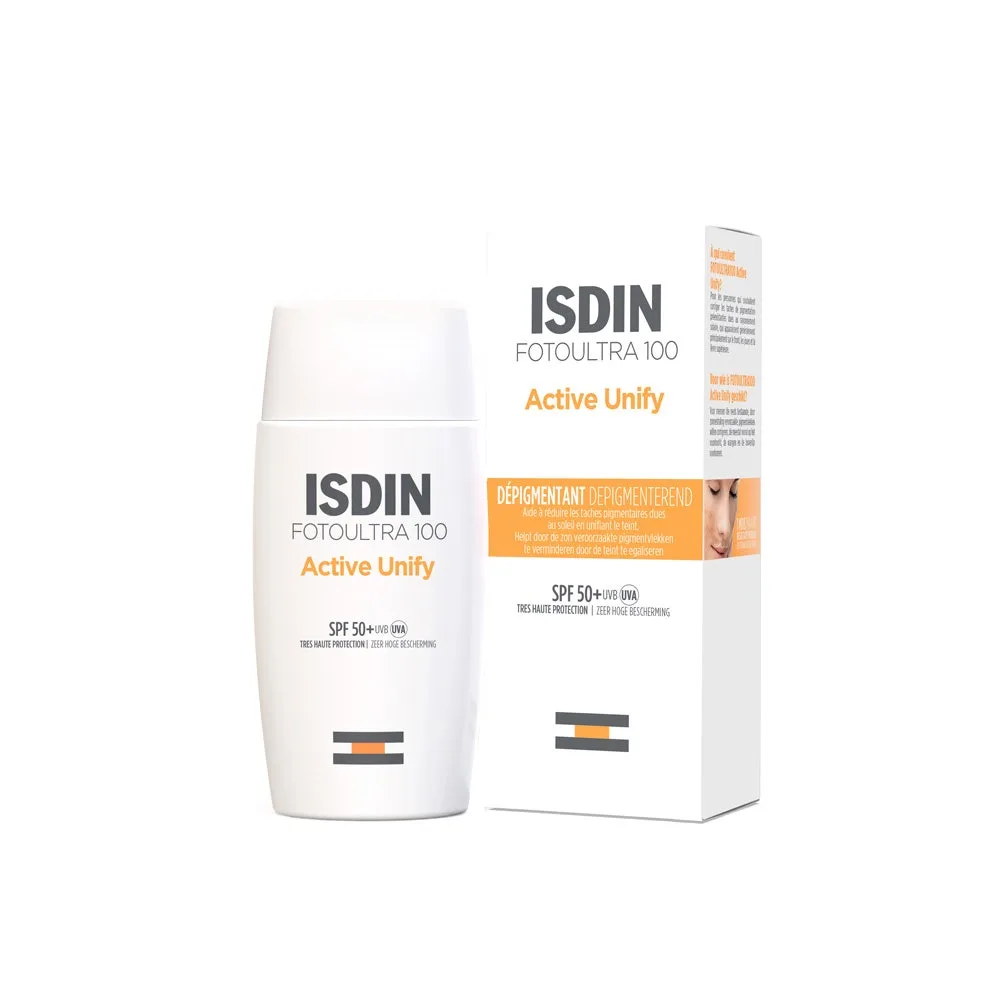
This is a European-formulated sunscreen that uses next-generation UV filters (DHHB, Tinosorb S, Ethylhexyl Triazone) not commonly available in US-only products, providing broader and more photostable UV protection than many American sunscreens. The addition of niacinamide and signal peptides transforms it from passive protection to active brightening and anti-aging treatment. The 'Active Unify' designation refers to its DP3-Unify Complex designed to regulate melanin production.
A European sunscreen that does what most American sunscreens cannot: combine next-generation UV filters with active brightening ingredients to simultaneously protect against sun damage and treat existing hyperpigmentation. The fluid texture vanishes on every skin tone, and the niacinamide-peptide complex makes this one of the few sunscreens that genuinely works as a treatment product.
Full protectionfor HyperpigmentationIn your profileYou chose · Broad-spectrum SPF 50 with Uvinul A Plus, bemotrizinol (Tinosorb S), titanium dioxide: the protection hyperpigmentation calls for.Moderate evidenceGentleNo reviews collected yet
The case for it
Niacinamide has trial-supported standing for this concern.
It is plausibly present at a working level, though the concentration is not declared.
The formula carries none of the triggers this concern is sensitive to.
What would change this: A declared concentration would move this to a firmer reading of the dose.
Same rule for everyone. “Full protection” is the verdict on 2,288 of 45,024 concern verdicts across the catalog; rule P1 decided 2,232 of them.
Unchanged since September 5, 2026, engine 5.1.1.
P1 — Photoprotection standing is regulatory (M020 / Annex VI filters; 21 CFR 201.327 attaches the early-skin-aging claim to tested broad-spectrum SPF 15+). SPF 30 is the AAD daily-use bar. · the full register
Carrying active
Niacinamide
Standing
supported — trials support it
Form
plausible — studied range 2–5%, from the trials on the row; needs leave-on contact; judge it after ~8 weeks
Tolerability
gentle
Row checked
against its sources on July 17, 2026 (evidence table ev-2026.09-r228)
Full protectionfor Dark SpotsIn your profileYou chose · Broad-spectrum SPF 50 with Uvinul A Plus, bemotrizinol (Tinosorb S), titanium dioxide: the protection dark spots calls for.Moderate evidenceGentleNo reviews collected yet
The case for it
Niacinamide has early or mechanistic evidence for this concern, not trial-backed standing.
It is plausibly present at a working level, though the concentration is not declared.
The formula carries none of the triggers this concern is sensitive to.
What would change this: A declared concentration would move this to a firmer reading of the dose.
Same rule for everyone. “Full protection” is the verdict on 2,288 of 45,024 concern verdicts across the catalog; rule P1 decided 2,232 of them.
Unchanged since September 5, 2026, engine 5.1.1.
P1 — Photoprotection standing is regulatory (M020 / Annex VI filters; 21 CFR 201.327 attaches the early-skin-aging claim to tested broad-spectrum SPF 15+). SPF 30 is the AAD daily-use bar. · the full register
Carrying active
Niacinamide
Standing
plausible — trials support it
Form
plausible
Tolerability
gentle
Row checked
against its sources on July 17, 2026 (evidence table ev-2026.09-r228)
Basic protectionfor MelasmaIn your profileYou chose · Broad-spectrum SPF 50, but no iron oxides — melasma is worsened by visible light, which UV filters alone do not block.Moderate evidenceGentleNo reviews collected yet
The case for it
Niacinamide has early or mechanistic evidence for this concern, not trial-backed standing.
It is plausibly present at a working level, though the concentration is not declared.
The formula carries none of the triggers this concern is sensitive to.
What would change this: A declared concentration would move this to a firmer reading of the dose.
Same rule for everyone. “Basic protection” is the verdict on 175 of 45,024 concern verdicts across the catalog; rule P3 decided 68 of them.
Unchanged since September 5, 2026, engine 5.1.1.
Latin American consensus on the treatment of melasma — International Journal of Dermatology — Delphi regional expert consensus (9 dermatologists), NOT GRADE, NOT a tier-1 guideline body (2024), opened July 16, 2026
Full protectionfor Sun DamageIn your profileYou chose · Broad-spectrum SPF 50 with Uvinul A Plus, bemotrizinol (Tinosorb S), titanium dioxide: the protection sun damage calls for.Moderate evidenceGentleNo reviews collected yet
The case for it
Diethylamino Hydroxybenzoyl Hexyl Benzoate is a first-line active — approved, monograph-listed or named in current guidelines — for this concern.
It is plausibly present at a working level, though the concentration is not declared.
The formula carries none of the triggers this concern is sensitive to.
What would change this: A declared concentration would move this to a firmer reading of the dose.
Same rule for everyone. “Full protection” is the verdict on 2,288 of 45,024 concern verdicts across the catalog; rule P1 decided 2,232 of them.
Unchanged since September 5, 2026, engine 5.1.1.
P1 — Photoprotection standing is regulatory (M020 / Annex VI filters; 21 CFR 201.327 attaches the early-skin-aging claim to tested broad-spectrum SPF 15+). SPF 30 is the AAD daily-use bar. · the full register
Full protectionfor AgingIn your profileYou chose · Broad-spectrum SPF 50 with Uvinul A Plus, bemotrizinol (Tinosorb S), titanium dioxide: the protection aging calls for.Moderate evidenceGentleNo reviews collected yet
The case for it
Niacinamide has early or mechanistic evidence for this concern, not trial-backed standing.
It is plausibly present at a working level, though the concentration is not declared.
The formula carries none of the triggers this concern is sensitive to.
What would change this: A declared concentration would move this to a firmer reading of the dose.
Same rule for everyone. “Full protection” is the verdict on 2,288 of 45,024 concern verdicts across the catalog; rule P1 decided 2,232 of them.
Unchanged since September 5, 2026, engine 5.1.1.
P1 — Photoprotection standing is regulatory (M020 / Annex VI filters; 21 CFR 201.327 attaches the early-skin-aging claim to tested broad-spectrum SPF 15+). SPF 30 is the AAD daily-use bar. · the full register
Carrying active
Niacinamide
Standing
plausible — trials support it
Form
plausible — studied range 4–5%, from the trials on the row; needs leave-on contact; judge it after ~8 weeks
Tolerability
gentle
Row checked
against its sources on July 17, 2026 (evidence table ev-2026.09-r228)
Does the jobDoes what a sunscreen is for: UVA coverage, kind to the skin wearing it. Not measured from the label: pleasant enough to actually use.
A verdict is DermApproved’s assessment of how well a product’s ingredients fit a concern — never a claim about what the product treats. Evidence dots and collected reviews sit beside it and are never blended in.
Rules 0.5.1 · evidence table ev-2026.09-r228 · how we decide
Assessment
Pros & Cons
Pros
✓ Next-generation European UV filters (DHHB, Tinosorb S) provide superior photostable UVA protection
✓ Niacinamide actively treats hyperpigmentation while protecting against new dark spot formation
✓ Completely invisible on all skin tones with zero white cast
✓ Ultralight fusion fluid texture absorbs instantly without any greasy or heavy feel
✓ Signal peptides add collagen-stimulating and anti-inflammatory anti-aging benefits
✓ Fragrance-free and alcohol-free in the latest formulation
✓ Nearly five decades of ISDIN photoprotection research behind the formula
Cons
✗ 50mL tube is small for a daily-use sunscreen — requires frequent repurchasing
✗ Limited availability in US retail channels — primarily online or specialty stores
✗ Contains nano titanium dioxide which some consumers prefer to avoid
✗ European formulation may not be familiar to those accustomed to US sunscreens
Review
Full Review
There is a reason European sunscreens have developed a near-cult following among skincare enthusiasts who care about more than just an SPF number. It comes down to a regulatory reality: the European Union has approved UV filters that the US FDA has not, and some of those filters provide meaningfully better protection against the UVA radiation that drives photoaging, dark spots, and melasma. ISDIN's Foto Ultra Active Unify Fusion Fluid is a product that could only have been born in Europe — specifically, in Barcelona, where a pharmaceutical company that has been studying photoprotection since 1975 decided to build a sunscreen that does more than just block UV light.
The UV filter system is the foundation, and it is impressive. Diethylamino hydroxybenzoyl hexyl benzoate provides potent, photostable UVA protection. Bis-ethylhexyloxyphenol methoxyphenyl triazine offers broad-spectrum coverage across both UVA and UVB while also stabilizing neighboring filters against degradation. Ethylhexyl salicylate and ethylhexyl triazone handle additional UVB protection. And titanium dioxide, in both nano and non-nano forms, adds a mineral layer. This is not a one-or-two-filter system — it is a coordinated network designed to provide comprehensive, photostable protection that holds up across hours of exposure.
That word photostable is doing quiet work, and it exposes the flaw in treating an SPF number as the whole story. Two sunscreens can both read SPF 50+ and protect very differently, because the number describes UVB defense almost exclusively. UVA — the wavelength that reaches deeper, that drives pigmentation and collagen loss, that passes through window glass on an overcast Tuesday — is measured separately and advertised rarely. Worse, some older filters degrade under the very light they absorb, so protection quietly decays across the morning. The combination here is chosen so that the filters hold each other together, and the brand's claim is double the minimum UVA protection its SPF class requires.
What elevates this from excellent sunscreen to exceptional skincare is the treatment component. Niacinamide, sitting just after glycerin in the ingredient list, inhibits the transfer of melanin from melanocytes to keratinocytes. The product is therefore not just preventing new UV-induced pigmentation — it is working on the mechanism that makes existing dark spots visible. For melasma patients and anyone with stubborn hyperpigmentation, that dual action of prevent-plus-treat is precisely what a clinician would prescribe. A pea extract and diethylhexyl syringylidenemalonate, an antioxidant that also absorbs a little UV, reinforce the tone-evening agenda from adjacent angles.
The signal peptides — palmitoyl tripeptide-1 and palmitoyl tetrapeptide-7 — are an unexpected bonus. The first stimulates collagen production, the second modulates inflammation-driven aging. Finding these in a sunscreen is unusual and reflects an ambition to make daily photoprotection a multi-functional step rather than a passive barrier.
The texture is where this product wins converts, and it's the product of unglamorous formulation engineering: a cascade of polyglyceryl emulsifiers holding a water-in-oil system together, silica and stearalkonium hectorite tuning the finish, isododecane flashing off on contact. It is a true fusion fluid — thinner than water-based serums, flowing between your fingers and disappearing on the skin. There is zero white cast. None. On every skin tone from fair to deep, it is invisible within seconds. Under makeup it sits perfectly, with no pilling and no sliding. If you have ever skipped sunscreen because you disliked how it looked, this product exists specifically to end that excuse.
The nano titanium dioxide that makes that invisibility possible attracts more alarm than it deserves. Regulatory bodies including the EU's own scientific committee have assessed nano titanium dioxide in sunscreen and found it safe for topical use; the particles do not penetrate healthy intact skin. The nano scale is not a shortcut around safety testing. It is the reason a mineral filter can protect without turning a deep complexion grey, which in practice means it is the reason a great many people wear sunscreen at all.
The 50mL size is the most practical limitation. Applied properly — roughly a quarter-teaspoon for the face, fifteen minutes before exposure, reapplied every two hours outdoors — a tube lasts one to two months. At around $42 the monthly cost is modest, but the repurchasing rhythm feels brisk to anyone raised on large drugstore bottles. Availability is the other consideration: this is largely an online and specialty-retailer purchase rather than something you grab at a pharmacy counter. A few smaller notes for particular readers — the emollient esters mean it isn't fungal-acne safe, and the formula is neither vegan nor cruelty-free certified, though it is safe in pregnancy. The several hundred reviews available are consistent and enthusiastic, if too few to call a consensus: invisibility and texture praised, size and availability lamented.
ISDIN has been studying photoprotection since before most competing brands existed. The company was born in a city where UV exposure is a year-round fact rather than a summer concern, and that geographic reality shaped a research philosophy treating sun protection as daily healthcare rather than seasonal cosmetics. The Foto Ultra Active Unify is perhaps the purest expression of it: a product that protects, treats, and disappears, asking nothing of the wearer except the willingness to apply it every morning.
For those battling dark spots, managing melasma, or simply wanting the most cosmetically elegant, treatment-enhanced sun protection available, this fusion fluid sets a standard that remarkably few sunscreens currently match.
Formula
Key Ingredients
The hero actives that drive this product's performance.
A next-generation UVA filter with exceptional photostability that provides the formula's robust UVA protection — critical for preventing the UV-induced melanogenesis that causes dark spots, which is the central concern this sunscreen was designed to address.
Regulator-approvedfor Sun Damage · limited certainty
A broad-spectrum UV filter that absorbs both UVA and UVB radiation while also stabilizing other photolabile filters in the formula — its photostability is what allows this sunscreen to maintain consistent protection throughout extended sun exposure.
Regulator-approvedfor Sun Damage · limited certainty
Goes beyond basic sun protection to actively address existing hyperpigmentation by inhibiting melanin transfer to keratinocytes — this ingredient transforms the product from a passive UV shield into an active brightening treatment that works while protecting.
Provides mineral UV protection that complements the organic filters, reflecting and scattering UV radiation for an additional layer of defense — the nano form ensures cosmetic elegance without the white cast associated with conventional mineral sunscreens.
Regulator-approvedfor Sun Damage · limited certainty
Signal peptides that stimulate collagen production and reduce inflammation-driven skin aging — an unusual addition to a sunscreen that elevates this from photoprotection to active anti-aging treatment during daily sun exposure.
Not yet assessed
Ingredient standings describe the active at treatment-level doses and
vehicles; this product's own condition grades weigh its actual formula.
Make this the final step in your morning skincare routine, after moisturizer. The fluid texture layers easily over serums and treatments without pilling. Reapply every 2 hours during extended sun exposure.
Results Timeline
Immediate UV protection and a smooth, non-greasy finish. Visible reduction in dark spot formation within 4-6 weeks of daily use. Progressive improvement in skin tone evenness at 8-12 weeks when combined with a brightening routine.
Pairs Well With
vitamin C serumsniacinamide serumsbrightening treatmentsmoisturizer
ISDIN Foto Ultra Active Unify Fusion Fluid SPF 50+
Sample PM Routine
Gentle cleanser
Brightening serum (alpha-arbutin or niacinamide)
Moisturizer
Evidence
Science & Expert Perspective
The Science
The UV filter system in this product represents the current state of the art in photoprotection science. Diethylamino hydroxybenzoyl hexyl benzoate (DHHB/Uvinul A Plus) is a next-generation UVA filter approved in the EU but not yet in the US. One trial published in Photodermatology, Photoimmunology & Photomedicine has documented its exceptional photostability and high UVA absorption coefficient, making it one of the most effective UVA filters available. Combined with bis-ethylhexyloxyphenol methoxyphenyl triazine (Tinosorb S), which functions as both a UV absorber and a photostabilizer for neighboring filters, the system provides robust, lasting UVA/UVB protection.
Niacinamide's role in this formula extends beyond its well-known barrier-supporting properties. A pivotal study published in the British Journal of Dermatology (2002) demonstrated that topical niacinamide significantly reduces melanin transfer from melanocytes to keratinocytes by up to 68%. In a sunscreen context, this creates a dual mechanism: UV filters prevent new melanogenesis, while niacinamide reduces the visibility of existing pigmentation. For melasma management, where strict photoprotection is the single most important intervention, this combination is particularly valuable.
The signal peptides palmitoyl tripeptide-1 and palmitoyl tetrapeptide-7 have been studied for their skin-rejuvenating properties. Research documented in the International Journal of Cosmetic Science showed that the combination stimulated collagen production and reduced interleukin-6 expression, suggesting anti-aging and anti-inflammatory benefits that complement the photoprotective function.
New trends in photobiology: Photoprotection by newer UV filters — Photodermatology, Photoimmunology & Photomedicine (2010)
Dermatologist Perspective
European dermatologists have long recommended ISDIN's Foto Ultra line for patients with melasma and hyperpigmentation, where superior UVA protection is considered the cornerstone of treatment. Clinical dermatologists frequently point out that the combination of DHHB and Tinosorb S provides more robust UVA coverage than avobenzone-based American sunscreens, and the addition of niacinamide transforms daily photoprotection into active pigmentation management. This product is commonly recommended as part of a comprehensive melasma protocol alongside depigmenting agents like hydroquinone, alpha-arbutin, or tranexamic acid.
Guidance
Usage & Recommendations
How to Use
Apply generously (approximately 1/4 teaspoon for the face) as the last step in your morning skincare routine, after serums and moisturizer. Allow 15 minutes before sun exposure for optimal absorption. Reapply every 2 hours during continuous outdoor sun exposure, after swimming, or after sweating. For daily office use with minimal sun exposure, a single morning application is typically sufficient with reapplication before afternoon outdoor activities.
Value Assessment
At approximately $42 for 50mL, the Foto Ultra Active Unify is priced at the premium end of daily sunscreens but delivers exceptional value when considered as both a sunscreen and a brightening treatment. The next-generation UV filter system alone justifies the price over conventional sunscreens, and the niacinamide and peptide additions make it a multi-functional morning step. For melasma patients who would otherwise spend on separate photoprotection and brightening products, the combination approach offers genuine consolidation value.
Who Should Buy
Anyone dealing with hyperpigmentation, melasma, or dark spots who wants a sunscreen that actively treats while protecting. Ideal for those who have struggled with heavy, white-cast sunscreens and want the most cosmetically elegant option available. Particularly valuable for melanin-rich skin tones where white cast is a major barrier to sunscreen compliance.
Who Should Skip
Those who prefer to buy sunscreen in-store at US pharmacies may find the online-only availability inconvenient. If you are firmly committed to 100% mineral-only sunscreens, the organic UV filters in this formula may not align with your preferences.
Ready to try ISDIN Foto Ultra Active Unify Fusion Fluid SPF 50+?
Ultra-fluid, water-like consistency that spreads effortlessly and absorbs instantly. Leaves a completely invisible, non-greasy finish.
Scent
No added fragrance. Virtually undetectable scent.
Packaging
Squeeze tube with a small dispensing opening for controlled application. Compact and travel-friendly.
Finish
invisiblenon-greasymattelightweight
What to Expect on First Use
Applies like a very lightweight fluid — nothing like the thick, white sunscreens many are accustomed to. Disappears completely on all skin tones within seconds. No white cast, no greasy residue. Makeup applies normally on top.
Developed by ISDIN in Barcelona, where intense Mediterranean sun exposure makes photoprotection a daily necessity, the Foto Ultra Active Unify was designed specifically for skin prone to dark spots and hyperpigmentation. Unlike conventional sunscreens that only prevent UV damage, this product was formulated to actively work on existing pigmentation through niacinamide and peptide technology while providing the highest level of SPF 50+ protection using a combination of modern European UV filters.
About ISDIN Legacy Brand (20+ years)
ISDIN was founded in 1975 in Barcelona, Spain, as a joint venture between pharmaceutical laboratory Esteve and cosmetics company Puig. It is Spain's number one dermatological brand, widely recommended by dermatologists across Europe and increasingly in the United States. The brand's photoprotection research spans nearly five decades.
Brand founded: 1975 · Product launched: 2018
Myth vs. Reality
Common Myths
Myth
All SPF 50+ sunscreens provide the same protection.
Reality
UVA protection varies dramatically between sunscreens. This formula uses DHHB and Tinosorb S — next-generation UVA filters that provide more robust and photostable UVA protection than older filters like avobenzone. ISDIN states this product provides double the minimum UVA protection required for SPF 50+ classification.
Myth
Nano titanium dioxide is unsafe for skin.
Reality
Multiple regulatory agencies including the EU Scientific Committee on Consumer Safety have evaluated nano titanium dioxide in sunscreens and concluded it is safe for topical application. The nanoparticles do not penetrate healthy, intact skin and are what allow mineral sunscreens to avoid the white cast.
FAQ
Frequently Asked Questions
Is ISDIN Foto Ultra Active Unify available in the US?
Yes, though it is more commonly found through online retailers, European pharmacy importers, and select authorized skincare retailers rather than in mainstream US drugstores. The formula uses European UV filters (DHHB, Tinosorb S) that provide broader protection than what's typically available in US-only sunscreens.
Does ISDIN Foto Ultra Active Unify leave a white cast?
No — the fluid texture and nano titanium dioxide formulation ensure complete invisibility on all skin tones. This is one of the product's most praised qualities. It disappears within seconds of application.
Can ISDIN Foto Ultra Active Unify help with melasma?
The combination of broad-spectrum SPF 50+ protection with niacinamide and the DP3-Unify Complex (designed to regulate melanin production) makes this particularly suitable for melasma management. Consistent daily use helps prevent UV-triggered melanogenesis while the niacinamide works to reduce existing pigmentation.
How often should I reapply ISDIN Foto Ultra Active Unify?
Reapply every 2 hours during continuous sun exposure, after swimming, sweating, or toweling off. For indoor/office environments with minimal UV exposure, a morning application may be sufficient, but reapplication before afternoon outdoor activities is recommended.
What makes European sunscreen filters better for dark spots?
European sunscreens like this one can use newer UV filters (DHHB, Tinosorb S, Ethylhexyl Triazone) that provide more comprehensive and photostable UVA protection than older filters. UVA radiation is the primary driver of melanogenesis (dark spot formation), so superior UVA protection translates directly to better dark spot prevention.
Reviews
What Reviewers Tend to Say
Recurring themes our editors read across retailer reviews of this product — summaries in our words, not quotations, and not a substitute for your own patch test.
Common Praise
Completely invisible on skin with no white cast
Ultralight fluid texture that doesn't feel like sunscreen
Noticeably reduces dark spot formation with consistent use
Excellent under makeup with no pilling or greasiness
Common Complaints
Availability can be limited in some US retail channels
50mL bottle is relatively small for daily sunscreen use
Contains nano titanium dioxide which some consumers prefer to avoid
Not widely available in US pharmacies or drugstores
Notable Endorsements
Spain's number one dermatological brandWidely recommended by European dermatologistsPraised by skincare enthusiasts for its advanced UV filter system
It was invented to stop bleeding during surgery. In 2026 it's in dozens of brightening serums — and the evidence is better than most trend ingredients can claim.
'Dark spots' bundles at least five distinct processes that sit at different depths, respond to different things, and have wildly different prognoses — one clears on its own, one relapses forever, and one will not move for any serum ever made.
'Peptides' is one word standing in for a dozen unrelated molecules with wildly different evidence — most serums are hope in a bottle, but a few classes earn their place.
Japan runs a third regulatory tier between cosmetic and pharmaceutical, and once you can see it, the entire J-beauty aisle stops looking modest and starts looking legally precise.
Aug 28, 2026· 11 min
Questions people ask about Hyperpigmentation
Verified answers from our questions library — the nuance a product page cannot carry.
Products, answers, therapy guides, tools and articles in one search. Brand names,
slang and abbreviations all work — accutane finds isotretinoin, bacne finds truncal acne.