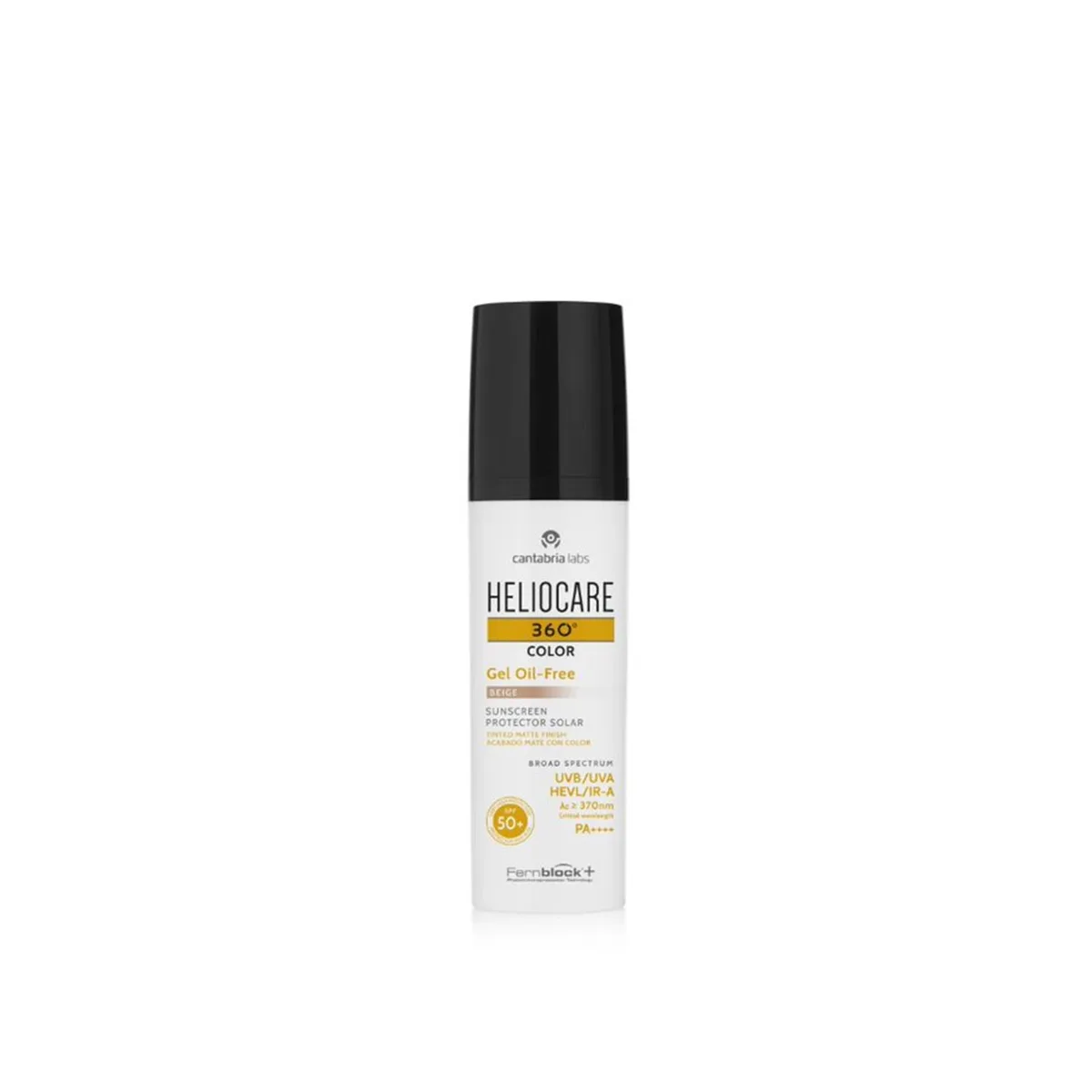
It folds Heliocare's seven-filter, Fernblock-powered 360 protection into a tinted, mattifying gel whose iron oxides add genuine visible-light defense — the wavelength that drives melasma — while doubling as a sheer foundation. Few sunscreens combine this depth of pigment protection with a cosmetically finished, oil-free tint.
Take the excellent original 360 gel, add an iron-oxide tint, and you get one of the smartest tinted sunscreens for pigment-prone and oily skin. The color evens tone like a sheer foundation while genuinely defending against the visible light that drives melasma — backed by the same seven-filter deck and researched Fernblock. The shade range is narrow and it is fragranced, but for melasma management in a matte, makeup-replacing format, it is hard to beat.
Basic protectionfor MelasmaIn your profileYou chose · Broad-spectrum SPF 50, but no iron oxides — melasma is worsened by visible light, which UV filters alone do not block.Not yet assessedStandard tolerabilityNo reviews collected yet
The case for it
Seven-Filter Broad-Spectrum System has no evidence row yet for this concern — it is in the research queue.
The formula carries no trigger this concern is sensitive to, with the cautions noted.
What would change this: A researched evidence row for the lead active would replace this with a verdict.
Same rule for everyone. “Basic protection” is the verdict on 175 of 45,024 concern verdicts across the catalog; rule P3 decided 68 of them.
Unchanged since September 5, 2026, engine 5.1.1.
Full protectionfor HyperpigmentationIn your profileYou chose · Broad-spectrum SPF 50 with titanium dioxide, bemotrizinol (Tinosorb S), Uvinul A Plus, iscotrizinol (Uvasorb HEB): the protection hyperpigmentation calls for.Not yet assessedStandard tolerabilityNo reviews collected yet
The case for it
Seven-Filter Broad-Spectrum System has no evidence row yet for this concern — it is in the research queue.
The formula carries no trigger this concern is sensitive to, with the cautions noted.
What would change this: A researched evidence row for the lead active would replace this with a verdict.
Same rule for everyone. “Full protection” is the verdict on 2,288 of 45,024 concern verdicts across the catalog; rule P1 decided 2,232 of them.
Unchanged since September 5, 2026, engine 5.1.1.
P1 — Photoprotection standing is regulatory (M020 / Annex VI filters; 21 CFR 201.327 attaches the early-skin-aging claim to tested broad-spectrum SPF 15+). SPF 30 is the AAD daily-use bar. · the full register
Full protectionfor Sun DamageIn your profileYou chose · Broad-spectrum SPF 50 with titanium dioxide, bemotrizinol (Tinosorb S), Uvinul A Plus, iscotrizinol (Uvasorb HEB): the protection sun damage calls for.Moderate evidenceStandard tolerabilityNo reviews collected yet
The case for it
Seven-Filter Broad-Spectrum System is a first-line active — approved, monograph-listed or named in current guidelines — for this concern.
It is plausibly present at a working level, though the concentration is not declared.
The formula carries no trigger this concern is sensitive to, with the cautions noted.
What would change this: A declared concentration would move this to a firmer reading of the dose.
Same rule for everyone. “Full protection” is the verdict on 2,288 of 45,024 concern verdicts across the catalog; rule P1 decided 2,232 of them.
Unchanged since September 5, 2026, engine 5.1.1.
P1 — Photoprotection standing is regulatory (M020 / Annex VI filters; 21 CFR 201.327 attaches the early-skin-aging claim to tested broad-spectrum SPF 15+). SPF 30 is the AAD daily-use bar. · the full register
21 CFR § 352.10 Sunscreen active ingredients — US FDA — 21 CFR Part 352 (Sunscreen Drug Products for Over-the-Counter Human Use), via Cornell Legal Information Institute; part heading marked [STAYED INDEFINITELY], effective date stayed at 66 FR 67485, opened September 1, 2026
Full protectionfor AgingIn your profileYou chose · Broad-spectrum SPF 50 with titanium dioxide, bemotrizinol (Tinosorb S), Uvinul A Plus, iscotrizinol (Uvasorb HEB): the protection aging calls for.Limited evidenceStandard tolerabilityNo reviews collected yet
The case for it
Antioxidant & Repair Complex has early or mechanistic evidence for this concern, not trial-backed standing.
It is plausibly present at a working level, though the concentration is not declared.
The formula carries no trigger this concern is sensitive to, with the cautions noted.
What would change this: A declared concentration would move this to a firmer reading of the dose.
Same rule for everyone. “Full protection” is the verdict on 2,288 of 45,024 concern verdicts across the catalog; rule P1 decided 2,232 of them.
Unchanged since September 5, 2026, engine 5.1.1.
P1 — Photoprotection standing is regulatory (M020 / Annex VI filters; 21 CFR 201.327 attaches the early-skin-aging claim to tested broad-spectrum SPF 15+). SPF 30 is the AAD daily-use bar. · the full register
Carrying active
Antioxidant & Repair Complex
Standing
plausible — trials support it
Form
plausible — studied range 0.5–1%, from the OTC monograph or label; needs leave-on contact
Tolerability
standard
Row checked
against its sources on July 17, 2026 (evidence table ev-2026.09-r228)
Full protectionfor Dark SpotsIn your profileYou chose · Broad-spectrum SPF 50 with titanium dioxide, bemotrizinol (Tinosorb S), Uvinul A Plus, iscotrizinol (Uvasorb HEB): the protection dark spots calls for.Not yet assessedStandard tolerabilityNo reviews collected yet
The case for it
Seven-Filter Broad-Spectrum System has no evidence row yet for this concern — it is in the research queue.
The formula carries no trigger this concern is sensitive to, with the cautions noted.
What would change this: A researched evidence row for the lead active would replace this with a verdict.
Same rule for everyone. “Full protection” is the verdict on 2,288 of 45,024 concern verdicts across the catalog; rule P1 decided 2,232 of them.
Unchanged since September 5, 2026, engine 5.1.1.
P1 — Photoprotection standing is regulatory (M020 / Annex VI filters; 21 CFR 201.327 attaches the early-skin-aging claim to tested broad-spectrum SPF 15+). SPF 30 is the AAD daily-use bar. · the full register
Also listed for Excess Oiliness — the actives here (Tinosorb, Ferulic Acid, Iron Oxides, Polypodium Leucotomos (Fernblock) are in our research queue for that concern; there is no verdict until their evidence rows are written. That is a gap in our table, not a mark against the product.
Does the jobDoes what a sunscreen is for: UVA coverage, holds up in sunlight. Not measured from the label: pleasant enough to actually use.
A verdict is DermApproved’s assessment of how well a product’s ingredients fit a concern — never a claim about what the product treats. Evidence dots and collected reviews sit beside it and are never blended in.
Rules 0.5.1 · evidence table ev-2026.09-r228 · how we decide
Assessment
Pros & Cons
Pros
✓ Iron-oxide tint adds real visible-light protection for melasma
✓ Same seven-filter UVB-to-long-UVA system as the original gel
✓ Researched Fernblock plus a reinforced antioxidant and repair deck
✓ Evens tone like a sheer foundation, often worn instead of one
✓ Matte, oil-controlling finish ideal for oily skin
✓ Strong value as a sunscreen-and-tint hybrid
Cons
✗ Narrow shade range underserves deeper skin tones
✗ Tint can deepen slightly with skin oils over the day
✗ Contains fragrance, limonene and linalool
✗ Mattifying finish can cling to very dry, flaky skin
✗ Not certified fungal-acne-safe
Review
Full Review
The most common misunderstanding about tinted sunscreen is that the color is purely cosmetic, a nice-to-have that evens out your reflection while the real protecting happens invisibly underneath. With this one, the tint is arguably the entire point, and for a reason most people never guess. The iron oxides that give Heliocare's 360 Color Gel its skin-tone shade also absorb visible light, the slice of the spectrum increasingly implicated in melasma and stubborn post-inflammatory pigmentation. Clear sunscreens, no matter how high the SPF number, largely let that visible light stream straight through. So for anyone fighting brown patches, the color here is doing genuine protective labor, not just flattering the mirror, and that reframes the whole product as a melasma tool that happens to look like makeup.
Underneath that functional tint sits the same impressive engine as Heliocare's untinted 360 gel: a seven-filter European deck spanning titanium dioxide, Tinosorb S, ethylhexyl triazone, Uvinul A Plus, iscotrizinol, bisdisulizole, and ensulizole. That combination covers UVB through long UVA with overlapping, photostable filters, and the long-UVA range matters because it is a major driver of photoaging that thinner filter systems often under-address. Heliocare's signature Fernblock, the researched Polypodium leucotomos fern extract, adds antioxidant and DNA-repair support documented in the dermatology literature, and the antioxidant package is, if anything, beefier in this version, layering ferulic acid, green tea, vitamins C and E, troxerutin, and an Arabidopsis thaliana extract studied for photolyase-style repair. Filters handle the UV, iron oxides handle the visible light, and the biological actives mop up the oxidative and DNA damage that slips past everything else. That genuinely multi-wavelength approach is the 360-degree positioning the range is named for, sharpened here toward pigment.
The melasma angle deserves emphasis because it is where this version genuinely separates itself from its untinted sibling, and from most of the sunscreen aisle. Melasma is notoriously stubborn precisely because so much of what drives it sits in the visible-light range that conventional UV filters wave straight through, which is why patients diligently wearing high-SPF clear sunscreen so often watch their patches relapse anyway. Tinted formulas with iron oxides change that equation, and the dermatology literature increasingly treats them as a frontline tool rather than a cosmetic afterthought for pigmentary disorders. Building that protection into a sunscreen that also happens to mattify and even tone means a melasma-prone person can fold the single most important preventive step into a product they would wear regardless, which is exactly the kind of compliance-friendly design that actually moves the needle on a chronic condition.
In use it behaves like a sheer, fuss-free base. It blends from a tinted gel into a smoothing, mattified veil that evens tone on contact and reads more like a light foundation than a sunscreen, and the oil control is strong enough that plenty of people wear it instead of foundation for low-to-medium coverage needs. The matte, second-skin finish is exactly what oily and combination skin want from a daily SPF, and the benefit lands immediately: evened tone, knocked-back shine, and full broad-spectrum-plus-visible-light protection on the very first day, with the pigment-prevention payoff accruing the longer you wear it consistently.
The trade-offs cluster around the tint and the fragrance, and they are real. The shade range is narrow, built around a handful of universal tones meant to adapt rather than precisely match, which means deeper complexions in particular may struggle to find a true match and risk a faint mismatch line at the jaw if they pick wrong. Some users find the color deepens slightly through the day as it mingles with skin oils, a tendency a thin, even, well-set layer minimizes. The formula carries parfum along with limonene and linalool, so reactive or rosacea-prone skin should be cautious, and it is not certified fungal-acne-safe. On very dry skin the mattifying finish can cling to flaky patches, so prep matters more here than it does for the relatively forgiving untinted gel. None of these undo the science; they define who the product is for.
Heliocare's pedigree gives the whole thing weight. The brand belongs to the Spanish pharmaceutical group Cantabria Labs and has been recommended in dermatology offices for over twenty years on the strength of extensive published research into Fernblock, so this is legacy science rather than a trend-chasing launch. The value calculus mirrors the untinted version: a modest premium over basic sunscreen buys a filter system, antioxidant deck, and pigment-protection profile that rival prestige products costing far more, with the bonus that it replaces a separate tinted moisturizer or light foundation. For someone managing melasma or dark spots on oily-to-normal skin, that bundle is genuinely compelling, and the per-use cost over daily wear is reasonable.
Where it lands is specific and confident. This sits close to the front of the category for tinted, pigment-protective sunscreen on oily and combination skin, and especially for melasma management. Two things would send you elsewhere: a deeper skin tone the shade range simply cannot serve, or skin too sensitive to handle fragrance. Short of those, it is one of the quietly cleverest sunscreens on the shelf, doing far more under the surface than its makeup-like finish lets on.
Formula
Key Ingredients
The hero actives that drive this product's performance.
The tint is doing double duty here: iron oxides give a sheer skin-tone color that evens the complexion while also absorbing visible light, the wavelength range most implicated in melasma — making this version measurably better than the untinted gel for pigment-prone skin.
The same comprehensive European filter deck as the original gel, covering UVB through long UVA with photostable, overlapping filters — the UV backbone beneath the cosmetic tint.
Regulator-approvedfor Sun Damage · limited certainty
Heliocare's researched fern antioxidant scavenges UV-induced free radicals and supports DNA repair, complementing both the filters and the iron-oxide tint to round out the line's signature 360-degree defense.
A reinforced antioxidant deck — with an Arabidopsis thaliana extract studied for photolyase-style repair support — that helps neutralize the oxidative stress sunlight triggers under any tint or filter.
Limitedfor Sun Damage
Ingredient standings describe the active at treatment-level doses and
vehicles; this product's own condition grades weigh its actual formula.
Apply as the last skincare step and let it set; the tint means many users wear it instead of foundation. Blend a generous amount evenly to avoid patchiness, and choose the shade closest to your tone — it comes in more than one.
Results Timeline
Immediate evened tone, mattified finish and full broad-spectrum plus visible-light protection on day one; pigment-prevention benefits accrue with consistent daily use.
The standout science here is the pairing of a modern filter system with iron-oxide visible-light protection. The seven UV filters — including the highly photostable Tinosorb S, ethylhexyl triazone and Uvinul A Plus — deliver balanced UVB and full-UVA coverage, the long-UVA range being a key driver of photoaging. What distinguishes the tinted version is the iron oxides (CI 77491 and CI 77492): multiple dermatology studies have shown that iron-oxide-containing tinted sunscreens outperform non-tinted mineral or chemical sunscreens at preventing melasma relapse and pigment darkening, precisely because they attenuate visible light, which conventional UV filters do not. Heliocare layers this with Fernblock (Polypodium leucotomos), whose photoprotective antioxidant and DNA-repair-supportive activity is documented in peer-reviewed dermatology literature, and a reinforced antioxidant complex; the Arabidopsis thaliana extract is included for its association with DNA-photolyase-style repair support, an area with promising but still-developing evidence. Together, the filters address UV, the iron oxides address visible light, and the biological actives address the oxidative and DNA damage that slips through — a genuinely multi-wavelength approach that aligns with current thinking on comprehensive photoprotection, particularly for pigmentary disorders.
References
Tinted Sunscreens and Their Role in Photoprotection of Visible Light — Photochemistry and Photobiology (2021)
Visible Light and the Skin: Iron Oxide-Containing Sunscreens in Melasma — Journal of the American Academy of Dermatology (2020)
Dermatologist Perspective
Dermatologists frequently recommend iron-oxide-tinted sunscreens like this one specifically for patients with melasma and post-inflammatory hyperpigmentation, because the visible-light protection from iron oxides has clinical evidence behind it that clear sunscreens cannot match. The Heliocare 360 Color Gel is valued for delivering that protection alongside a comprehensive UV filter system, the researched Fernblock active and a cosmetically elegant matte finish suited to oily skin. Clinicians do note the limited shade range as a real drawback for deeper skin tones and flag the fragrance for sensitive or rosacea-prone patients, who are usually directed toward the brand's mineral tolerance fluid instead. For pigment-prone, oily-to-normal skin, it is regarded as a strong, evidence-aligned daily choice.
Guidance
Usage & Recommendations
How to Use
In the morning, after your moisturizer, apply a generous, even layer as the final step, blending thoroughly for uniform tone and protection. Choose the shade closest to your skin and set it for a couple of minutes; many people wear it in place of foundation, but it can also go under makeup. Reapply every two hours with sun exposure, and prep dry areas with hydration first so the mattifying finish does not cling to flakes. Use it daily year-round, including indoors near windows, since visible light and UVA penetrate glass.
Value Assessment
At around $42 for 50ml, this carries a small premium over the untinted gel and basic sunscreens, but it justifies the cost twice over: it provides melasma-relevant visible-light protection that most sunscreens lack, and it doubles as a tinted moisturizer or light foundation, often replacing a separate product. Compared with prestige tinted sunscreens and visible-light-protective formulas that cost two to three times more, the protection-to-price ratio is excellent. For oily, pigment-prone skin in particular, consolidating sun protection and a sheer base into one well-formulated step makes this an easy value case, provided the shade range works for you.
Who Should Buy
This one's for you if you have oily, combination or normal skin and want a tinted daily sunscreen that evens tone, controls shine and — crucially — protects against the visible light that drives melasma and dark spots. It is an outstanding pick for pigment-prone skin and for anyone wanting a sunscreen that doubles as a sheer base.
Who Should Skip
Skip it if your skin tone falls outside its narrow shade range, if you have very dry skin that the mattifying finish may emphasize, or if you are sensitive to fragrance, in which case the brand's mineral tolerance fluid is a better fit. Also look elsewhere if you need a certified fungal-acne-safe formula.
Ready to try Heliocare 360 Color Gel Oil-Free SPF 50+?
Tinted gel that blends thin and sets to a mattifying, second-skin finish
Scent
Light fragrance that dissipates after blending
Packaging
Squeeze tube in Heliocare's clinical livery, shade marked on the label
Finish
mattenaturallightweight
What to Expect on First Use
Blends out from a tinted gel into a smoothing, mattified veil that evens tone immediately, reading like a sheer foundation more than a sunscreen. It sets quickly with strong oil control; very dry skin may find it clings to flaky patches, so good prep helps, and the shade should be matched to avoid a faint mismatch line.
Building on the original 360 Gel, Heliocare added a tinted version to answer two requests at once: patients with melasma who needed visible-light protection that clear sunscreens cannot provide, and oily-skinned users who wanted a single step that protects, mattifies and evens tone. The iron-oxide tint serves both goals, reflecting the brand's pigment-focused clinical positioning.
About Heliocare Legacy Brand (20+ years)
Heliocare, by Spanish pharmaceutical group Cantabria Labs, has been recommended in dermatology offices for over twenty years on the strength of extensive published research into its Fernblock (Polypodium leucotomos) active. The tinted 360 Color Gel applies that science in a cosmetically elegant daily formula.
Brand founded: 2002 · Product launched: 2015
Myth vs. Reality
Common Myths
Myth
A tinted sunscreen's color is purely cosmetic.
Reality
The iron oxides that create the tint also absorb visible light, which research links to melasma and dark-spot formation, so the color in this formula provides real added protection that untinted sunscreens lack.
FAQ
Frequently Asked Questions
Why is a tinted sunscreen better for melasma?
The iron oxides that give this gel its color also absorb visible light, a wavelength shown to worsen melasma and post-inflammatory pigmentation that clear UV filters do not block, so the tint provides protection a non-tinted sunscreen cannot.
How many shades does the Heliocare 360 Color Gel come in?
It is offered in a small range of universal shades such as Beige and Bronze designed to adapt to a span of tones, but the selection is limited, so deeper complexions may not find a precise match.
Can I wear the Color Gel instead of foundation?
Many users do — it blends to a sheer, evening, mattified finish that works as light base coverage on its own, though it is sheer by nature and will not conceal significant discoloration like a full-coverage foundation.
Is the tinted version good for oily skin?
Yes — it is oil-free with silica and a mattifying finish that controls shine well, making it a strong sunscreen-and-tint hybrid for oily and combination skin, though it is not certified fungal-acne-safe.
Does the tint oxidize or change color during the day?
Some users notice the shade deepening slightly as it interacts with skin oils over the day; applying a thin, even layer and setting it well minimizes any shift.
Reviews
What Reviewers Tend to Say
Recurring themes our editors read across retailer reviews of this product — summaries in our words, not quotations, and not a substitute for your own patch test.
Common Praise
Evens skin tone like a light foundation
Strong visible-light protection for melasma
Genuinely matte, oil-controlling finish
No greasy feel, comfortable all day
Common Complaints
Limited shade range for deeper tones
Tint can oxidize slightly through the day
Contains fragrance
Can look dry on very dry skin
Notable Endorsements
Dermatologist pick for melasma and pigmentationPopular sunscreen-as-foundation for oily skin
Every pigment-fading active runs against a re-pigmenting stimulus, and for melasma part of that stimulus is visible light — which broad-spectrum sunscreen does essentially nothing about unless you can see it on your face.
'Dark spots' bundles at least five distinct processes that sit at different depths, respond to different things, and have wildly different prognoses — one clears on its own, one relapses forever, and one will not move for any serum ever made.
IPL is a filtered flashlamp, a true vascular laser is one wavelength aimed at haemoglobin, and the choice between them turns on a distinction almost no consult makes: whether your redness is vessels or a state.
Sep 2, 2026· 9 min
Questions people ask about Melasma
Verified answers from our questions library — the nuance a product page cannot carry.
Products, answers, therapy guides, tools and articles in one search. Brand names,
slang and abbreviations all work — accutane finds isotretinoin, bacne finds truncal acne.