Polypodium Leucotomos (Fernblock)
Products with Polypodium Leucotomos (Fernblock)
 Sensitive-Skin Mineral MVP
 360 Mineral Tolerance Fluid SPF 50+
Close to a benchmark mineral sunscreen for sensitive, rosacea-prone and post-procedure skin. It uses only titanium dioxide and zinc oxide — no chemical filters, fragrance or alcohol — yet still carries Heliocare's researched Fernblock, a full antioxidant complex and a melanin tint that tames the usual mineral whiteness. It blends more easily than most minerals and rarely stings. A faint cast on deep tones and a price above basic mineral SPF are the only real caveats.
 Full-Spectrum Daily Shield
 360 Water Gel SPF 50
A near-weightless gel sunscreen that absorbs in seconds and reaches beyond ordinary SPF into visible-light and infrared defense via melanin, Physalis, and Heliocare's Fernblock antioxidant. A genuinely hydrating base makes it suit more skin types than most oil-control screens — the main caveats are added fragrance and a premium price for a small tube.
 Derm-Office Matte SPF
 360 Gel Oil-Free SPF 50
One of the best matte sunscreens you can buy for oily and combination skin. A seven-filter European UV deck covers UVB through long UVA, while Heliocare's well-studied Fernblock, a topical antioxidant complex and melanin push protection toward visible and infrared light — all in a genuinely dry-touch, makeup-friendly gel. The only real caveats are the fragrance and a price above basic drugstore SPF; otherwise this earns its derm-office reputation.
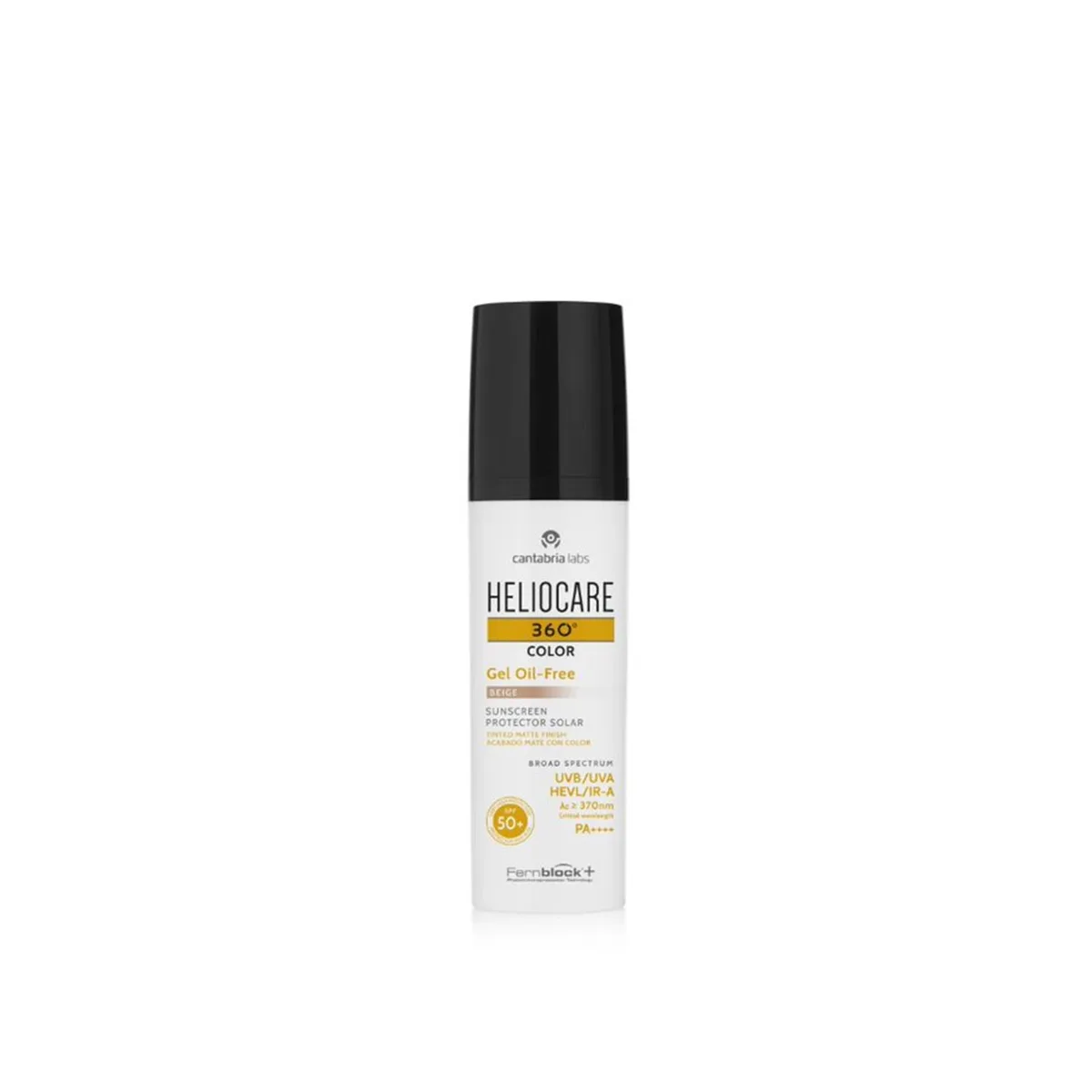 Tinted Melasma-Defense SPF
 360 Color Gel Oil-Free SPF 50+
Take the excellent original 360 gel, add an iron-oxide tint, and you get one of the smartest tinted sunscreens for pigment-prone and oily skin. The color evens tone like a sheer foundation while genuinely defending against the visible light that drives melasma — backed by the same seven-filter deck and researched Fernblock. The shade range is narrow and it is fragranced, but for melasma management in a matte, makeup-replacing format, it is hard to beat.
 Glow-Boosting Hydration Mist
 Plump & Glow Hydrating Facial Mist
A genuinely lovely hydrating mist that earns the 'glow' in its name with light-reflecting mica, layered over a solid humectant base and a touch of antioxidant fern. It refreshes and subtly brightens in one spritz — just know it's a fragranced, largely cosmetic step priced at a premium, so the value depends on how much you love a good mist.
 Reapply-Over-Makeup SPF Compact
 360 Oil-Free Compact SPF 50+
A genuinely useful answer to the question nobody solves well: how do you reapply sunscreen over makeup? This tinted cream-to-powder compact packs real SPF 50+/PA++++ protection, Fernblock antioxidants and visible-light-absorbing iron oxides into a foundation format you can pat on at midday. Coverage is buildable and the finish is matte. The trade-offs are a three-shade range, fragrance and parabens, and a finish that can look dry if you overdo it.
The full polypodium leucotomos (fernblock) guide
A fern native to the tropical forests of Central and South America, Polypodium leucotomos has spent decades being studied as an internal photoprotectant — the kind of active that earns its reputation in placebo-controlled trials rather than on a mood board.
Its standardized extract, best known under the trade name Fernblock, turns up in both oral supplements and a handful of topical formulas, where it works as an antioxidant defense rather than a UV filter. It is unusual among botanicals for having genuine human trial data behind it, though the effect sizes are moderate and it is no replacement for sunscreen.
How it's regulated in the US
FDA does not classify ingredients — it classifies products, by what they are sold to do. The same molecule can be a drug active in one product and a cosmetic ingredient in the next, and only the claim on the label decides which. What follows is a statement about that legal standing, not about whether it works — the evidence question is answered separately above.
Cosmetic Polypodium Leucotomos (Fernblock) is a cosmetic ingredient in the US: no OTC monograph covers it and it is not an active in any FDA-approved drug, so a product built around it is a cosmetic rather than a drug.
The evidence base for Polypodium leucotomos is genuinely stronger than for most botanical actives, but it sits at "promising" rather than "well-established" because the human trials are mostly small, effect sizes are moderate, and several key endpoints come from combination supplements rather than PLE alone. The most-cited human data is a randomized double-blind trial in healthy adults (published in JCAD) in which subjects taking 240 mg twice daily were about 22 times more likely than placebo to show an increased minimal erythema dose (MED) — the UV threshold at which skin begins to redden — and were also less likely to burn. A precise percentage MED increase is harder to pin to PLE in isolation: studies reporting roughly 24% MED gains used PLE combined with other antioxidants, so that figure cannot be attributed to the fern alone. For melasma, a randomized placebo-controlled JAAD trial used PLE as an adjunct to hydroquinone and SPF and found significantly improved MASI scores in the PLE group at 8 and 12 weeks, though by study end both arms had improved. For vitiligo, randomized work pairing oral PLE with narrowband UVB phototherapy reported higher head-and-neck repigmentation than phototherapy alone (around 50% vs 19% in one trial). A prospective JAAD study by Tanew and colleagues found oral PLE raised the UV dose needed to provoke polymorphic light eruption lesions under controlled provocation; broader claims that it reduces real-world flare frequency rest largely on open-label data. What the evidence does not support: that it replaces SPF, that it prevents skin cancer at studied doses, or that topical PLE at cosmetic concentrations delivers the same effect as the oral form.
How it works
The active chemistry here is a dense mix of phenolic compounds — caffeic acid, ferulic acid, chlorogenic acid and related hydroxycinnamic derivatives — that intercept the oxidative chain reaction UV light sets off in skin. When UV photons strike, they generate reactive oxygen species that attack lipids, proteins and DNA almost at once. PLE scavenges those free radicals directly and also appears to dampen the downstream inflammatory signaling, including pro-inflammatory cytokine release and NF-κB activation that amplifies UV-induced redness and immune disruption. Beyond simple radical scavenging, laboratory and human studies suggest PLE helps preserve Langerhans cells, the skin's resident immune sentinels that UV exposure tends to deplete. That matters because losing those cells is one of the routes through which UV suppresses local immunity, a step linked to photocarcinogenesis. PLE has also been reported to reduce UV-induced thymine dimer formation — the specific DNA lesion that accumulates over a lifetime of sun and contributes to both photoaging and malignant change. Delivery route shapes the benefit. Taken orally, PLE distributes through the bloodstream to reach skin across the whole body, which is the form carrying nearly all the clinical data. Applied topically, it can add an antioxidant layer that mops up some oxidative stress even a good sunscreen lets through, but its topical efficacy at cosmetic concentrations is far less established. The two routes are complementary rather than interchangeable.
Key benefits
- Raises the UV dose skin tolerates before reddening (increased MED) in placebo-controlled human trials
- Reduces UV-induced DNA damage and thymine dimer formation in human skin studies
- Helps preserve UV-sensitive Langerhans cells that support skin's local immune defense
- Supports repigmentation in vitiligo when added to narrowband UVB phototherapy
- Improves melasma severity scores as an adjunct to sunscreen and topical brighteners
- Raises the threshold for provoking polymorphic light eruption lesions under UV challenge
Concentration & usage
Oral doses in clinical trials typically run 240 mg to 480 mg per day, with 240 mg taken roughly 30 minutes before sun exposure being the most-studied single dose; some post-procedure protocols started at 960 mg/day for a month before tapering to 480 mg. Topical data is thin — one documented sunscreen formulation used about 0.38% of the extract, and PLE remains genuinely rare on cosmetic ingredient lists. On an INCI label it reads as POLYPODIUM LEUCOTOMOS LEAF EXTRACT. Because no minimum effective topical concentration has been established in peer-reviewed literature, seeing it on a label tells you little about efficacy without knowing the dose and how the extract was standardized; the oral form is where the clinical backing actually lives.
Who it's for & who should be cautious
Who it's for
People with sun-sensitive conditions — polymorphic light eruption, melasma, vitiligo undergoing phototherapy, or post-procedure skin wanting extra oxidative defense — are the clearest candidates. Anyone spending long stretches outdoors who wants an antioxidant layer working from the inside out, on top of (never instead of) topical SPF, has a reasonable case to try it, particularly in the well-studied oral Fernblock/Heliocare form. Fair-skinned people who burn easily and those concerned about cumulative photoaging are the group dermatologists most often discuss it with.
Who should be cautious
Pregnancy and breastfeeding are legitimate reasons to hold off — there simply is not enough safety data to recommend oral PLE during pregnancy, so staying conservative is sensible. Anyone with a known sensitivity to ferns or phenolic-rich botanicals should patch-test topical formulas and talk to a clinician before starting a supplement. And no one should treat oral PLE as a stand-in for sunscreen: skipping SPF because you took a capsule accepts far more UV damage than the extract can offset.
Pairs with & conflicts
Myths & facts
Myth: Polypodium leucotomos is a sunscreen pill — take it and you can skip SPF
Reality: The human trials show it raises the skin's UV-reddening threshold and lowers the odds of burning, which is meaningful added protection, but nowhere near the 98%-plus UV blocking of a broad-spectrum SPF 50. Dermatologists who use it frame it as a complement to topical sunscreen, not a replacement.
Myth: If it's in a topical sunscreen, it's boosting the SPF number on the label
Reality: PLE is not a UV filter — it doesn't absorb UV the way chemical filters do. The SPF number comes entirely from the registered filters; PLE's role is to neutralize some of the oxidative damage from the UV that still reaches skin. Its contribution is antioxidant, not filter-based.
Myth: It's all lab work — PLE has never been tested in actual people
Reality: Several randomized, double-blind, placebo-controlled human trials exist, including JAAD and JCAD studies on melasma, vitiligo and MED endpoints. The data is real human trial evidence, not purely in-vitro — the honest caveat is that the studies are mostly small and would benefit from larger independent replication.
Frequently asked questions
Does swallowing a Polypodium leucotomos capsule actually protect skin, or is it just an expensive fern?
The oral form carries the strongest evidence of any route. Placebo-controlled trials have shown it raises the UV dose needed to redden skin and lowers markers of UV-induced DNA damage. The effect is real but modest — think of it as backup for your sunscreen, not a substitute for it.
How far ahead of sun exposure should I take a Fernblock supplement?
Most trial protocols had participants dose roughly 30 to 60 minutes before going out. The reasoning is that the phenolic compounds need time to absorb and circulate before UV exposure starts.
Could PLE help with my melasma?
There's direct clinical support: a randomized double-blind placebo-controlled JAAD trial used oral PLE alongside hydroquinone and SPF and found better MASI scores in the PLE group at 8 and 12 weeks. It's used as a systemic antioxidant adjunct to topical brighteners and strict sun protection, not as a standalone melasma cure.
Is it safe to take every day over the long term?
Trials have used 240 to 480 mg daily for up to about six months without flagging serious adverse events, and the published safety record is consistently reassuring. Data much beyond six months is limited, so anyone taking it long term for a chronic photosensitive condition should check in with a dermatologist periodically.
Why do you almost never see PLE in actual topical products?
Cost, the complexity of standardizing the extract, and a lack of published guidance on what topical concentration actually works all keep it out of most formulas. The oral route — especially Heliocare's standardized Fernblock extract — has the clearer evidence trail, which is where the clinical literature has concentrated.
Can it help with sun allergy (polymorphic light eruption)?
A prospective JAAD study by Tanew and colleagues found oral PLE raised the UV dose needed to provoke PLE lesions under controlled UV challenge, and open-label reports describe fewer and milder flares. It's one of the conditions dermatologists most often consider it for, particularly for patients who can't get adequate control from sunscreen alone — though the real-world flare-reduction data is less rigorous than the provocation testing.