Until 2017, No Product Sold in Japan Was Allowed to Say It Improved Wrinkles
Japan runs a third regulatory tier between cosmetic and pharmaceutical, and once you can see it, the entire J-beauty aisle stops looking modest and starts looking legally precise.
Read the preview
From the DermApproved blog, in J-Beauty: until 2017, nothing sold in Japan could legally say it improved wrinkles. Not a cream, not a serum, not at any price — because no ingredient had ever been approved for that sentence. One company spent fifteen years earning it. Which tells you what those modest Japanese labels are doing. For the full breakdown, visit dermapproved.com/blog.
The tier that does not exist in American law
Western shoppers encountering Japanese skincare usually reach for a cultural explanation. The labels are restrained, the claims are oddly specific, the packaging refuses to shout — and the conclusion drawn is something about Japanese aesthetics or modesty. The real explanation is statutory, and once you have it, almost nothing about the category is mysterious any more.
Japan's Pharmaceutical and Medical Device Act recognises three tiers rather than two. Drugs sit at the top. Cosmetics sit at the bottom. Between them sits a category with no equivalent in US law: iyakubugaihin, translated as quasi-drug, defined as substances that have mild effects on the human body and a specific function, which are neither drugs nor medical devices.
The gap between the bottom two tiers is where everything interesting happens. A cosmetic in Japan is notified, not approved — the company files and sells. In exchange for that ease, it is boxed in: Japanese cosmetics may only make claims drawn from a fixed list of 56 permitted efficacy statements, set out in the Standards for Advertisements of Drugs, Quasi Drugs, Cosmetics and Medical Devices. Anti-ageing is not on the list. Lifting is not on the list. Neither is any use of numerical data, percentages, or before-and-after photography to demonstrate efficacy.
Read that last clause again and consider what it prohibits. The entire visual grammar of Western skincare marketing — the 87%-of-users graphic, the split-face photograph, the clinical-looking bar chart — is simply unavailable to a Japanese cosmetic. Not discouraged. Not frowned upon. Unavailable.
A quasi-drug escapes those limits, and pays for the privilege. Approval is granted product by product, and the review covers the trade name, the ingredients and their content, the manufacturing process, the dosage and directions, the efficacy claim, the storage conditions and the specifications. Approval typically runs six to eight months at minimum for a product using an established active. A product built on a genuinely new active can take five years or more.
So a Japanese brand faces a real choice on every product: stay a cosmetic and say almost nothing, or spend years and money to be permitted one narrow sentence. That trade-off, repeated across an industry for decades, is what produced the aisle.
The approved actives are a short list, and knowing it makes the aisle readable
Because claims attach to approved actives, the set of things a Japanese brightening product can be built on is finite and public. A 2010 review in the International Journal of Molecular Sciences catalogued them by mechanism, and the taxonomy is more useful than any marketing copy.
Some target the melanocyte directly. Ascorbic acid and its derivatives inhibit tyrosinase through antioxidation. Kojic acid and ellagic acid work by chelating the copper atom at the enzyme's active site. Arbutin, 4MSK, rucinol and 4-HPB act as competitive inhibitors. Linoleic acid accelerates tyrosinase degradation; magnolignan interferes with the enzyme's maturation. Others act on the keratinocyte side of the transaction — chamomilla extract and tranexamic acid interrupt the signalling that recruits melanocytes after ultraviolet inflammation. Niacinamide does something different again, blocking the transfer of melanosomes from melanocyte to keratinocyte, which is why it appears in both camps. Placental extract and adenosine monophosphate work by accelerating epidermal turnover so pigment leaves faster.
That is the whole vocabulary. Once you hold it, a shelf of Japanese pigment products resolves into a handful of mechanisms wearing different brand names.
It also explains the pairings you keep seeing. HAKU Melano Focus EV runs tranexamic acid alongside potassium methoxysalicylate, combining a keratinocyte-signalling interrupt with a competitive tyrosinase inhibitor — two different points in the same pathway, which is a formulation logic rather than a marketing one. Elixir Skin Reflect Brightening Lotion uses the same pairing. Hada Labo Shirojyun Premium Whitening Lotion brings the identical tranexamic acid active down to drugstore level, which is possible precisely because the approval attaches to the ingredient rather than to the brand. And Shiseido's Benefiance Dark Spot and Wrinkle Smoothing Serum carries 4MSK into a line sold in Western markets, where the molecule arrives with no regulatory meaning attached at all.
Our tranexamic acid page and niacinamide page cover the clinical evidence for the two that have travelled furthest. Licorice-derived dipotassium glycyrrhizate is worth knowing too — it is the approved anti-inflammatory active that turns up in an enormous number of Japanese formulas, and its presence is usually the reason a product is a quasi-drug at all.
Nobody in Japan could claim wrinkle improvement until 2017
This is the fact that makes the tier concrete, and it startles most people who hear it.
For decades, no product sold in Japan was permitted to state that it improved wrinkles. Not a serum, not a cream, not at any price. Wrinkle improvement was not among the 56 cosmetic claims, and no quasi-drug active had ever been approved for it. Brands could say a product moisturised, which makes lines look better, and that was the ceiling.
That changed in January 2017, when POLA became the first company in Japan to obtain quasi-drug approval for the claim that a product improves wrinkles. The active was NEI-L1, a complex built from four amino acid derivatives that inhibits neutrophil elastase, the enzyme whose activity degrades dermal structural components — reportedly the product of roughly fifteen years of development. Shiseido followed on 28 February 2017 with an approval for pure retinol, on data showing improvement in wrinkles around grade four after nine weeks of use, and remains the only company in Japan permitted to manufacture and sell quasi-drugs formulated with retinol as the active ingredient.
Set that beside the American situation. In the United States, "reduces the appearance of fine lines and wrinkles" is a cosmetic claim. It requires no approval, no active, no filing, and no evidence beyond whatever the company is willing to defend if challenged. Any brand may print it on any product tomorrow. In Japan, two companies acquired the right to say something narrower than that, one of them after fifteen years of work, and the announcement was corporate news.
Neither system is straightforwardly better, and it is worth resisting the reflex to declare the stricter one superior. Japan's regime produces claims you can trust and a market where a genuinely useful ingredient can be locked behind a single licence holder for years. The American approach produces a flood of unverifiable claims and a market where anyone can bring a good formula to shelf next month. What the Japanese system does give you, unambiguously, is that when a claim appears on a box, a regulator looked at it first.
There is also a methodological piece that rarely gets mentioned. The Japan Cosmetic Industry Association publishes a guideline for evaluating anti-wrinkle effects, and studies of both retinol and niacinamide formulations have been run against it. A shared evaluation protocol is what makes competing wrinkle claims commensurable rather than each company grading its own homework — and it is the reason Elixir Superieur Retinol Power Wrinkle Cream and its competitors are describing the same measured thing.
Reading the tier off the box, including in translation
On Japanese domestic packaging the marker is unmissable once you know it: the characters 医薬部外品 appear on the carton, and the approved active is listed separately from the other ingredients under a heading marking it as the effective component rather than part of the general formula. Cosmetics carry no such split — just one undifferentiated list.
Export packaging translates the status in a specific and consistent way, and this is the practical tell for anyone shopping in English. The Japanese word 薬用, meaning medicated, is conventionally rendered as "Medicated" in the product name. When you see it, you are looking at a quasi-drug, and the word is doing regulatory work rather than marketing work.
The clearest demonstration is a brand selling both versions of what appears to be one product. Medicated Sekkisei Lotion and Kose Sekkisei Lotion look, on a shelf, like the same thing in the same bottle from the same line — but one carries an approved active with an approved claim and the other is a cosmetic. Melano CC's Medicated Anti-Spot Whitening Emulsion sits beside Melano CC's Intensive Spots Prevention Brightening Lotion in exactly the same relationship. Neither pairing is a trick. The brand built a cosmetic for people who want the routine and a quasi-drug for people who want the claim, and the price gap between them is often small.
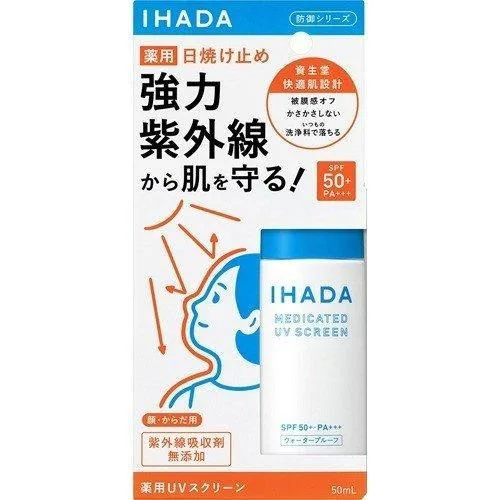
Sunscreens complicate this pleasantly. IHADA Medicated UV Screen is a quasi-drug not because of its filters but because of its anti-inflammatory active, and Anessa Brightening UV Sunscreen Gel carries tranexamic acid alongside its filter system — so a product you bought for ultraviolet protection is also carrying an approved pigment active. Our Japanese sunscreen ranking covers the filter side of that story, and our answer on whether an expensive sunscreen is better handles the question this inevitably raises.
If a product's status is unclear, paste the ingredient list into our ingredient decoder and look for the approved actives named above. Their presence is not proof of quasi-drug status — an unapproved concentration of the same molecule can appear in a cosmetic — but their absence is fairly conclusive evidence against it.
What approval does not buy you
A regulatory tier this rigorous invites a reasonable assumption: approved means safe. The most important thing this piece can tell you is that the assumption failed, publicly and at scale, and that the people who distrusted it were right.
Rhododendrol was an approved quasi-drug skin-whitening active. It had passed the review described above — mechanism, concentration, claim, manufacturing, specifications. In July 2013 the products containing it were recalled after users began developing leukoderma: patchy loss of pigment on the face, neck and hands. The numbers that eventually emerged are not small. In the marketing authorisation holder's own survey, 19,606 individuals had developed symptoms as of late 2020, of whom 11,919 had completely or almost completely recovered, out of an estimated user base in the region of 800,000.
The mechanism is the part that should stay with you. Rhododendrol is metabolised by tyrosinase — the very enzyme it was designed to engage — into products that are cytotoxic to melanocytes. The property that made it an effective whitening agent and the property that destroyed pigment cells were not two separate risks. They were the same chemistry, seen from two ends, and a review process focused on efficacy and short-term tolerance did not catch the difference before eight hundred thousand people had used it.
That is not an argument for abandoning regulation, and anyone reading it that way has drawn the wrong conclusion. It is an argument for holding two things at once: an approved active carries meaningfully more scrutiny than an unapproved one, and approval is a floor rather than a warranty. The subsequent literature on this case — two substantial reviews in the Journal of Dermatology set out the clinical findings and the pathophysiology — exists because Japanese dermatology treated the failure as something to study openly rather than to bury, which is more than several comparable episodes elsewhere have received. Our answer on distinguishing melasma from drug-induced pigmentation covers the general problem of pigment changes caused by the things meant to fix them.
There is a second, duller limitation worth stating alongside it. Approval attaches to the active, its concentration and its claim. It says nothing whatever about the rest of the formula. A quasi-drug can carry a well-chosen approved active inside a vehicle full of fragrance and denatured alcohol, and the box will still legitimately bear the claim. The tier tells you something specific is present and something specific was reviewed. It does not tell you the product around it is good.
What the tier is actually worth when you are shopping
Strip the structure back to what it changes for a person holding two bottles, and the answer is narrower than the enthusiasm around J-beauty suggests — and more useful.
A quasi-drug marking tells you three things. An active from a known list is present. It is there at a concentration a regulator signed off on rather than at whatever level survived the cost meeting. And the sentence on the front was reviewed before it was printed, which means it is likely to be modest, specific, and true. That is genuinely more information than a Western pigment product gives you, where "brightening" is an unregulated word attached to no defined active at any defined level.
It tells you nothing about three other things, all of which matter. It says nothing about the vehicle, the texture, the preservative system, or the fragrance load. It says nothing about whether the approved active is the best available answer to your particular problem — the list is a product of Japanese regulatory history, not a ranking of global efficacy, and several molecules with strong evidence behind them are absent from it for reasons that are administrative rather than scientific. And it says nothing about dose-response above the approved concentration, because that question is outside what the approval asks.
The comparison worth holding is with the American OTC monograph system, which does something structurally similar for sunscreen filters and acne actives and nothing at all for pigment. An American consumer gets a regulated active with a defined concentration when buying benzoyl peroxide or avobenzone, and gets marketing language when buying anything for dark spots. A Japanese consumer gets the regulated version in all three categories. That difference, rather than any national aesthetic, is why the two aisles read so differently.
Our position: the tier is a real signal and worth weighting, particularly for pigment, where the Western market offers almost no equivalent guidance. Treat it as evidence that a specific ingredient is present at a serious level and that the claim was checked — then evaluate the rest of the product exactly as you would any other, because the regulator did not do that part for you.
Products mentioned
Independently reviewed and scored — the real products behind this piece.



- Ranked list Best Japanese Sunscreens The filter side of the Japanese sunscreen story.
- Ingredient Tranexamic Acid The approved active that has travelled furthest outside Japan.
- Ingredient Niacinamide (Vitamin B3) Approved on both the pigment and wrinkle sides, via melanosome-transfer inhibition.
- Ingredient Licorice Root Extract Dipotassium glycyrrhizate is the approved anti-inflammatory that makes many Japanese formulas quasi-drugs at all.
- Question Is expensive sunscreen better than cheap sunscreen? The question a regulated-active sunscreen inevitably raises.
- Question Could a medication be causing my pigmentation? Pigment change caused by the thing meant to fix it — the general case behind the rhododendrol story.
References
- Quasi-Drugs Developed in Japan for the Prevention or Treatment of Hyperpigmentary Disorders — International Journal of Molecular Sciences, 2010
- Rhododendrol-induced leukoderma update I: Clinical findings and treatment — The Journal of Dermatology, 2021
- Rhododendrol-induced leukoderma update II: Pathophysiology, mechanisms, risk evaluation, and possible mechanism-based treatments in comparison with vitiligo — The Journal of Dermatology, 2021
- Evaluation of anti-wrinkle effects of a novel cosmetic containing retinol using the guideline of the Japan Cosmetic Industry Association — The Journal of Dermatology, 2009
- Evaluation of anti-wrinkle effects of a novel cosmetic containing niacinamide — The Journal of Dermatology, 2008
- Recognition of effect and efficacy in improving skin wrinkles with retinol acting ingredient acquired for the first time in Japan — Shiseido Company news release, 2017
Every cited link is verified to resolve to the paper named. Where a source could not be independently confirmed, it is listed without a link rather than pointing you somewhere wrong.
Frequently asked
What is a Japanese quasi-drug?
A middle regulatory tier between cosmetic and pharmaceutical, defined as a substance with mild effects on the body and a specific function. It requires pre-market approval of the active ingredient, its concentration and the exact claim, unlike a cosmetic, which is merely notified before sale.
How can I tell whether a Japanese product is a quasi-drug?
On domestic packaging, look for 医薬部外品 and a separately listed effective component. On export packaging, the word 'Medicated' in the product name is the standard translation of 薬用 and reliably signals the tier. Many brands sell a cosmetic and a quasi-drug version of the same line.
Why do Japanese skincare labels make such modest claims?
Because they legally must. Japanese cosmetics may only use claims from a fixed list of 56 permitted statements, and are barred from using numerical data, percentages or before-and-after photographs to demonstrate efficacy. Anything stronger requires the quasi-drug approval route.
Is a quasi-drug guaranteed to be safe?
No, and the counterexample is significant. Rhododendrol was an approved whitening active until 2013, when products were recalled after users developed leukoderma; nearly twenty thousand people were eventually affected. Approval means more scrutiny than none, not a warranty.
Does quasi-drug status mean the whole product is better?
Only the active is approved. The review covers that ingredient, its concentration and the claim — not the vehicle, the fragrance load, the preservative system or the texture. A quasi-drug can carry an excellent active inside a mediocre formula and still bear its claim legitimately.
Why did wrinkle claims only become possible in Japan in 2017?
No active had ever been approved for that claim. POLA obtained the first approval in January 2017 with a neutrophil elastase inhibitor complex, and Shiseido followed weeks later with pure retinol. In the United States the same claim has always been available to any cosmetic, with no approval required.