Your Routine Assumes a Clock You Don't Have
"Just swap AM and PM" is half right — one of the three things that label stands for flips with your schedule, and the other two refuse.
Read the preview
From the DermApproved blog, in Sleep, Stress and Skin: work nights, and everyone says just swap your morning and evening routines. That's one third right — AM and PM are quietly doing three different jobs, and only one cares when you wake up. The other two answer to the sun. One exposure gets missed by almost everyone. For the full breakdown, visit dermapproved.com/blog.
Three different things wearing one label
Every routine you have ever read is written for someone whose alarm goes off in daylight. For the substantial minority of people who work nights — nurses, drivers, warehouse staff, air crew, anyone in hospitality — the standard advice is to swap the morning and evening steps and carry on. It is not wrong, exactly. It is one third right.
"AM" and "PM" are doing three separate jobs under one label. The first is light exposure: sunscreen belongs in the daylight half, and photolabile ingredients belong away from it. The second is the skin's own physiology, which genuinely varies across twenty-four hours. The third is behavioural convenience — the PM slot is where actives go because that is when a product gets six uninterrupted hours on unwashed, unrubbed skin.
Only the third one flips cleanly when your schedule flips. The first is keyed to the sun, which is indifferent to your rota. The second is keyed to a body clock that adjusts slowly, partially, and then gets dragged back the moment you have a weekend off. Untangling those three is the whole exercise.
The skin does keep time, and not in the way you'd guess
There is real circadian physiology in skin, measured rather than inferred. Sampling sixteen healthy volunteers every two hours across a full twenty-four-hour span, at forehead, forearm, back and shin, researchers found statistically significant rhythmicity in transepidermal water loss, skin surface pH and skin temperature, with peak-to-trough differences at every site. The summary conclusion is the useful part: skin permeability is higher in the evening and night than in the morning.
One variable notably did not oscillate — stratum corneum hydration showed no reliable rhythm. Which is worth holding onto, because a lot of marketing built on "night-time skin" implies your moisture levels swing on a schedule. They do not appear to. What swings is how leaky the barrier is and how readily things cross it.
Underneath that sit peripheral clocks. Every nucleated cell in the body carries clock machinery, skin cells included, and those clocks can run autonomously while still being entrained by the master pacemaker in the hypothalamus. That hierarchy is the crux for shift workers: the peripheral clock in your skin is not taking instructions from your work schedule directly. It is taking them from a central clock that light, and only slowly, resets — and which never fully resets for most people on rotating shifts.
The honest implication is deflating, and worth saying plainly: there is no reliable "your skin's night" to target once your schedule has inverted, and no product timing that can reconstruct one. The absorption advantage of evening application is a small effect anyway. Do not build a routine around chasing it. Build it around the two things that genuinely matter, which are light and contact time.
Retinoids: two different sun problems, only one of which you can dodge
The reason retinoids live in the evening slot is usually explained as "they make you sun-sensitive." That is true, and it is not the main mechanism.
The first problem is that the molecule itself falls apart in light. When formulations were exposed to simulated solar ultraviolet, only 19% of the tretinoin in a plain 0.025% gel remained intact after two hours, dropping to 10% by six. A microsphere formulation of the same drug retained 94% at two hours and 84% at six — and combining plain gel with a benzoyl-peroxide-containing product drove the surviving tretinoin to zero by six hours. Vehicle, in other words, is not a detail. It is most of the difference between a dose delivered and a dose destroyed.
The second problem is the skin, not the drug: retinoids thin the stratum corneum during the adjustment period and leave you more vulnerable to ultraviolet for weeks afterward. That one does not care when you applied it. It is a property of the skin you are walking around in.
So the translation for a night worker is specific. Apply the retinoid at the start of your sleep block, whenever that falls, in a room dark enough to sleep in — which handles the photodegradation problem completely. Then treat the sun sensitivity as a permanent condition of the following waking period rather than a morning-only concern. A photostable or encapsulated format like The Ordinary Retinal 0.2% Emulsion is a reasonable hedge for anyone whose blackout curtains are aspirational rather than real. And go slower than the standard schedule suggests: our retinoid-ramp tool builds the escalation around your own frequency rather than assuming five nights a week.
The commute home is the exposure nobody plans for
Here is the part of the night-shift day that reliably goes unprotected. You finish at seven in the morning, you are going straight to bed, and sunscreen feels absurd — so you drive home into a low sun with the light coming in sideways through the driver's window.
That exposure is not theoretical. A retrospective review of skin cancers in a Mohs surgery referral population found more cancers on the left side than the right overall — 52.6% versus 47.4% — with the effect stronger in men, and a far more striking split in one diagnosis: malignant melanoma in situ appeared on the left side in 74% of cases against 26% on the right. In a left-hand-drive country, the left side of the body is the window side. Laminated windscreens block most ultraviolet; side glass frequently does not.
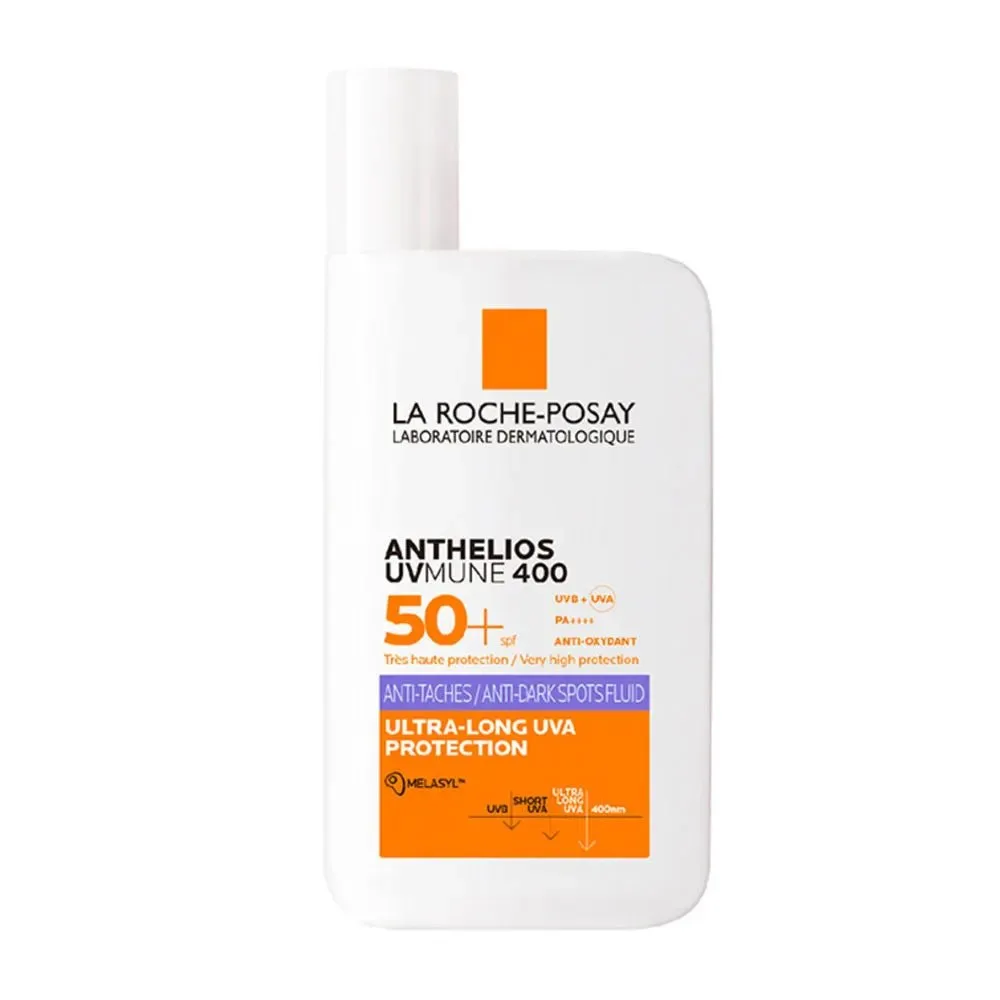
For a night worker this is the single most predictable ultraviolet dose in the entire schedule, taken daily, at the exact moment motivation is lowest. It is also the one that compounds, because it happens every shift for years. Sunscreen on the drive home is not optional fussiness — it is the highest-return thirty seconds in the routine. A fluid with strong long-wavelength UVA coverage such as La Roche-Posay Anthelios UVMune 400 suits the use case, and anything that goes on fast enough to survive a car park at dawn — Supergoop! Unseen Sunscreen is the low-friction version — beats the better formula you leave in a locker. Our sun-safety tool works from your actual daylight window rather than assuming you are outdoors at noon.
Sleep debt is a barrier variable, not a beauty cliché
"Beauty sleep" is easy to dismiss as folklore, which is a shame, because the measurement exists. In a study of stressors and skin function, eleven women underwent a single night of sleep deprivation with barrier recovery measured after tape stripping. One night reduced the rate of barrier recovery, alongside rises in interleukin-1beta and tumour necrosis factor alpha. The same protocol found psychological stress delaying recovery too, while exercise did not — so this is specific rather than a general "stress is bad" finding.
The practical consequence for a run of nights is about timing, not products. If your barrier repairs more slowly while you are sleep-deprived, then a stretch of consecutive shifts is the wrong week to introduce an acid, escalate a retinoid, or try a new active. Any insult you take will sit on the skin longer than it would on a rested schedule.
What does help is unglamorous support: a humectant layer under an occlusive one, because the deficit is in recovery capacity rather than in any particular ingredient. A hyaluronic acid serum like CeraVe Hydrating Hyaluronic Acid Serum under a barrier cream such as Tower 28 SOS Daily Barrier Recovery Cream is the whole intervention. Save experiments for your rest days. The question of how sleep interacts with a pigment routine runs on the same logic — the routine is only as good as the recovery underneath it.
A schedule that survives a rotating rota
Stop thinking in mornings and evenings. Think in two blocks that float: the wake block, whenever you get up, and the sleep block, whenever you go down. Every step attaches to a block, and the blocks attach to your rota rather than to a clock face.
The wake block is cleanse, an antioxidant if you use one, moisturiser, and sunscreen if you will encounter daylight at any point before the next sleep block — including the drive, the school run, and the twenty minutes on a balcony you had not counted. The sleep block is cleanse, treatment two or three times a week, moisturiser, and darkness.
What that arrangement buys you is portability. On a rotating rota the clock times move constantly, but the order never does, and order is what actually matters — our routine-order tool exists precisely because sequence errors cost more than timing errors. The night-shift routine lays the whole thing out as a schedule you can follow through a rotation rather than a fixed day.
One last piece of realism. On the day you rotate — the transition shift, the one after which you sleep at a genuinely strange hour — do less rather than more. Cleanse, moisturise, protect, and skip the actives entirely. Nothing in a bottle compensates for a body clock in mid-argument with itself, and the routine that survives shift work is the one that asks least of you on the days you have least to give.
Products mentioned
Independently reviewed and scored — the real products behind this piece.



References
- Time-dependent variations of the skin barrier function in humans: transepidermal water loss, stratum corneum hydration, skin surface pH, and skin temperature — Journal of Investigative Dermatology, 1998
- Biological Rhythms in the Skin — International Journal of Molecular Sciences, 2016
- The effect of simulated solar UV irradiation on tretinoin in tretinoin gel microsphere 0.1% and tretinoin gel 0.025% — Cutis, 2006
- Increased prevalence of left-sided skin cancers — Journal of the American Academy of Dermatology, 2010
- Stress-induced changes in skin barrier function in healthy women — Journal of Investigative Dermatology, 2001
Every cited link is verified to resolve to the paper named. Where a source could not be independently confirmed, it is listed without a link rather than pointing you somewhere wrong.
Frequently asked
If I sleep during the day, should I just use my PM products in the morning?
Partly. Contact time genuinely flips with your schedule, so leave-on treatments belong at the start of whichever block you sleep through. Sunscreen does not flip, because it is keyed to daylight rather than to your alarm — and if you will see the sun at any point before your next sleep, you need it regardless of what the clock says.
Does a retinoid still work if I apply it at nine in the morning?
Yes, provided you then sleep somewhere dark. The reason retinoids avoid daylight is partly that they photodegrade — plain tretinoin gel retained under a fifth of its active after two hours of simulated solar ultraviolet — and partly that they raise your own sun sensitivity for weeks. Darkness during the sleep block handles the first problem; sunscreen during the waking block handles the second.
Do I really need sunscreen if I'm going straight to bed after a night shift?
For the drive or walk home, yes. Side window glass transmits substantial UVA, and it is a daily exposure over years. A review of skin cancers in a surgical referral population found melanoma in situ on the window side of the body roughly three times as often as the other side.
Does my skin adjust to a night schedule the way my sleep does?
Incompletely, and that is the point. Skin cells carry their own peripheral clocks, which run autonomously but are entrained by the central pacemaker, and central entrainment shifts slowly with light exposure. Rotating shifts keep interrupting that adjustment, which is why chasing a supposed optimal absorption window is not worth building a routine around.
Is it a bad idea to start a new active during a run of night shifts?
Usually. A single night of sleep deprivation measurably slowed barrier recovery after tape stripping and raised inflammatory cytokines, so any irritation you provoke resolves more slowly than it would on rest days. Introduce new actives at the start of a stretch of days off, not on shift three of six.