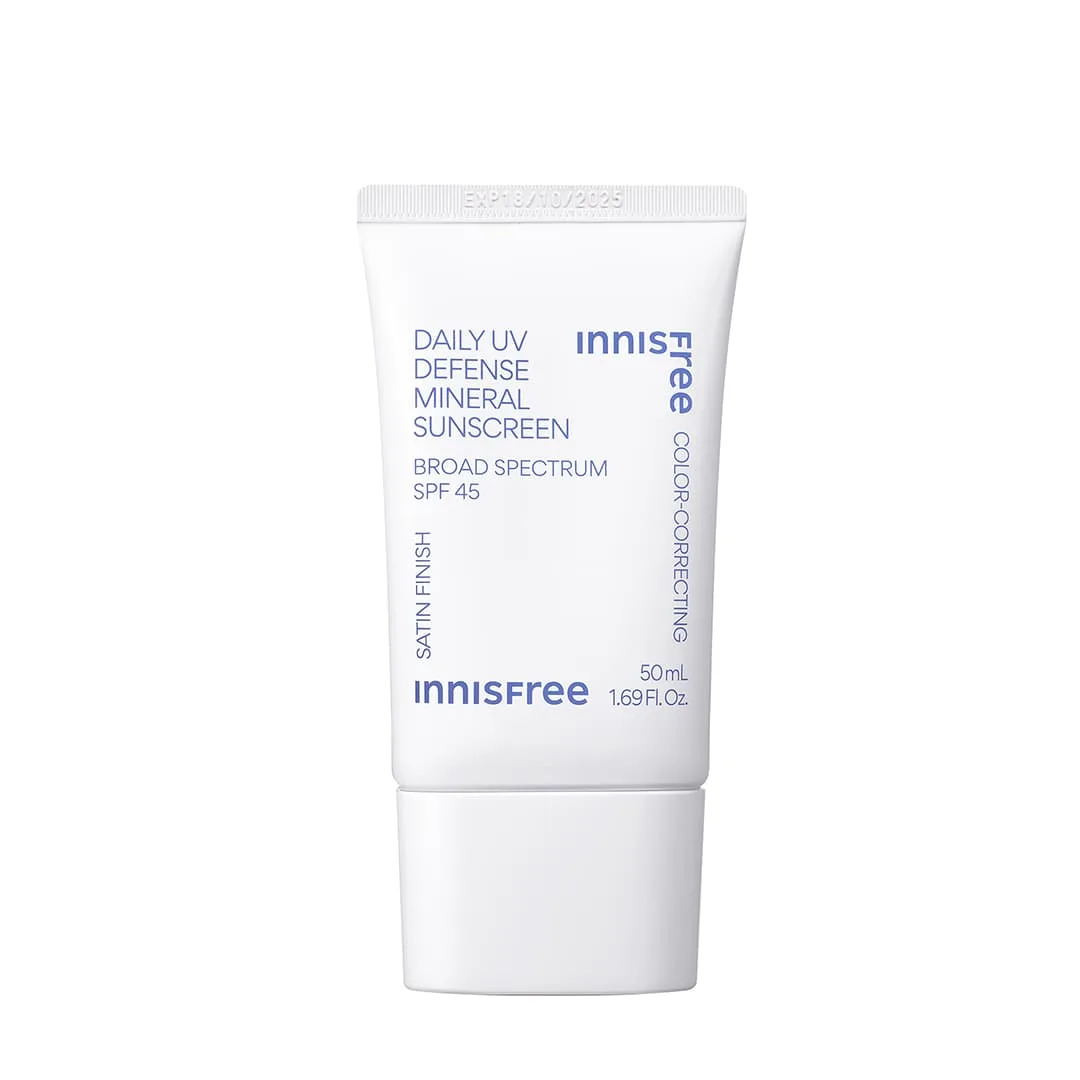
This is an Innisfree sunscreen built specifically for the U.S. market as an FDA over-the-counter drug, so its SPF 45 is tested to U.S. methodology rather than Korean standards. It also solves the classic mineral-sunscreen white cast with a green color-correcting pigment that neutralizes both chalkiness and facial redness — backed by a remarkably thorough cica and hyaluronic acid support cast.
A genuinely clever mineral sunscreen. Innisfree built this 17% zinc oxide formula for the U.S. market as a real FDA over-the-counter drug, then solved the white-cast problem with a green color-correcting pigment that quietly cancels both chalkiness and redness. Add a thorough cica and hyaluronic acid support cast, and you get one of the gentler, better-value mineral sunscreens around.
Note: This mineral sunscreen has been sold for the U.S. market for roughly three years with a moderate review volume. Our assessment reflects that feedback alongside ingredient analysis, and we'll revisit the review as more long-term data accumulates.
Verdicts
How well it fits each concern
Verdict by concern tap a concern for the case
Full protectionfor Sun DamageIn your profileYou chose · Broad-spectrum SPF 45 with zinc oxide: the protection sun damage calls for.Moderate evidenceGentleNo reviews collected yet
The case for it
Zinc Oxide 17% is a first-line active — approved, monograph-listed or named in current guidelines — for this concern.
It is present at an effective concentration, declared or high in the ingredient list.
The formula carries none of the triggers this concern is sensitive to.
Same rule for everyone. “Full protection” is the verdict on 2,288 of 45,024 concern verdicts across the catalog; rule P1 decided 2,232 of them.
Unchanged since September 5, 2026, engine 5.1.1.
P1 — Photoprotection standing is regulatory (M020 / Annex VI filters; 21 CFR 201.327 attaches the early-skin-aging claim to tested broad-spectrum SPF 15+). SPF 30 is the AAD daily-use bar. · the full register
Good choicefor SensitivityIn your profileYou chose · No fragrance, drying alcohol, declarable allergens or sensitising preservatives in this lotion — the profile sensitive skin looks for.Not yet assessedGentleNo reviews collected yet
The case for it
Centella Asiatica Complex has been researched for this concern and the evidence does not support it.
It is plausibly present at a working level, though the concentration is not declared.
The formula carries none of the triggers this concern is sensitive to.
What would change this: A declared concentration would move this to a firmer reading of the dose.
Same rule for everyone. “Good choice” is the verdict on 1,938 of 45,024 concern verdicts across the catalog; rule F2 decided 1,938 of them.
Unchanged since September 5, 2026, engine 5.1.1.
Full protectionfor AgingIn your profileYou chose · Broad-spectrum SPF 45 with zinc oxide: the protection aging calls for.Not yet assessedGentleNo reviews collected yet
The case for it
Zinc Oxide 17% has no evidence row yet for this concern — it is in the research queue.
The formula carries none of the triggers this concern is sensitive to.
What would change this: A researched evidence row for the lead active would replace this with a verdict.
Same rule for everyone. “Full protection” is the verdict on 2,288 of 45,024 concern verdicts across the catalog; rule P1 decided 2,232 of them.
Unchanged since September 5, 2026, engine 5.1.1.
P1 — Photoprotection standing is regulatory (M020 / Annex VI filters; 21 CFR 201.327 attaches the early-skin-aging claim to tested broad-spectrum SPF 15+). SPF 30 is the AAD daily-use bar. · the full register
Good choicefor DehydrationIn your profileYou chose · Hyaluronic Acid is a reference standard by mechanism for dehydration; this lotion carries it.Moderate evidenceGentleNo reviews collected yet
The case for it
Hyaluronic Acid Complex has trial-supported standing for this concern.
It is plausibly present at a working level, though the concentration is not declared.
The formula carries none of the triggers this concern is sensitive to.
What would change this: A declared concentration would move this to a firmer reading of the dose.
Same rule for everyone. “Good choice” is the verdict on 9,564 of 45,024 concern verdicts across the catalog; rule R5 decided 9,072 of them.
Unchanged since September 5, 2026, engine 5.1.1.
R5 — Trial-supported or guideline-supported active, adequately or plausibly dosed. · the full register
Carrying active
Hyaluronic Acid Complex
Standing
supported — its mechanism is established
Form
plausible — studied range 0.1%, from the trials on the row; needs leave-on contact; judge it after ~1 weeks
Tolerability
gentle
Row checked
against its sources on July 17, 2026 (evidence table ev-2026.09-r228)
The studies behind the evidence row
Draelos ZD, Cosmetic Dermatology: Products and Procedures — hyaluronic acid classified as a humectant water-binding agent holding many times its weight in water — reference work
Good choicefor Compromised Skin BarrierIn your profileYou chose · Ceramides is a reference standard by mechanism for compromised skin barrier; this lotion carries it.Moderate evidenceGentleNo reviews collected yet
The case for it
Ceramide NP has trial-supported standing for this concern.
It is plausibly present at a working level, though the concentration is not declared.
The formula carries none of the triggers this concern is sensitive to.
What would change this: A declared concentration would move this to a firmer reading of the dose.
Same rule for everyone. “Good choice” is the verdict on 9,564 of 45,024 concern verdicts across the catalog; rule R5 decided 9,072 of them.
Unchanged since September 5, 2026, engine 5.1.1.
R5 — Trial-supported or guideline-supported active, adequately or plausibly dosed. · the full register
Carrying active
Ceramide NP
Standing
supported — its mechanism is established
Form
plausible — studied range 0.5–1%, from the trials on the row; needs leave-on contact; judge it after ~4 weeks
Tolerability
gentle
Row checked
against its sources on July 17, 2026 (evidence table ev-2026.09-r228)
The studies behind the evidence row
Elias PM, Skin Barrier / Coderch et al., ceramides and skin barrier function — ceramides ~50% of SC intercellular lipid mass, essential to the permeability barrier — reference work
Does the jobDoes what a sunscreen is for: UVA coverage, kind to the skin wearing it. Not measured from the label: pleasant enough to actually use.
A verdict is DermApproved’s assessment of how well a product’s ingredients fit a concern — never a claim about what the product treats. Evidence dots and collected reviews sit beside it and are never blended in.
Rules 0.5.1 · evidence table ev-2026.09-r228 · how we decide
Assessment
Pros & Cons
Pros
✓ 17% non-nano zinc oxide — substantial mineral protection
✓ Green color-correcting pigment cuts white cast and redness
✓ FDA over-the-counter regulated, so SPF is U.S.-tested
✓ Genuinely gentle — fragrance-free and very low irritation risk
✓ Unusually thorough cica complex for soothing support
✓ Seven hyaluronic acid forms plus ceramide for a comfortable finish
✓ Affordable price and reef-compliant formula
Cons
✗ Still leaves a faint cast on deeper skin tones
✗ Mineral texture feels slightly more present than a chemical sunscreen
✗ Can pill if makeup is applied over it too soon
✗ Over-application can tip the finish slightly gray
✗ Polyglyceryl esters mean it is not fungal-acne-safe
Review
Full Review
Two things make this sunscreen unusual, and they're both worth understanding before anything else. The first: despite being from Innisfree, a Korean brand, this particular product is sold for the U.S. market as a genuine FDA over-the-counter drug. Its SPF 45 isn't a Korean MFDS number imported under cosmetic rules — it's tested to U.S. methodology, with a Drug Facts panel and everything. For anyone who's been frustrated trying to square a love of K-beauty sunscreens with a preference for FDA-tested SPF, this one resolves the tension. The second unusual thing: it fights the classic mineral-sunscreen white cast not with ever-smaller nanoparticles, but with color theory. There's a whisper of green pigment in here, and that green is doing something genuinely smart.
Start with the active, because a mineral sunscreen is only as good as its filter. This one runs on zinc oxide at 17 percent — a substantial dose, non-nano, and the only UV filter in the formula. No organic filters, no titanium dioxide, just zinc. That's what earns it the reef-compliant designation, including compliance with Hawaii's sunscreen law, and it's what makes the sunscreen so gentle: zinc oxide is the filter dermatologists reach for most often when skin is reactive, rosacea-prone, or recovering from a procedure, because it largely sits on the skin's surface rather than being absorbed. Seventeen percent is enough zinc to deliver real broad-spectrum coverage, and the SPF 45 rating — tested properly — puts it within a hair of SPF 50 in practical terms. The gap between 45 and 50 is far smaller than most people assume; both block around 98 percent of UVB when applied correctly, and how much you apply matters infinitely more than that last numerical step.
Now the green. Mineral sunscreens leave a white cast because zinc oxide is, fundamentally, a white powder. The usual industry fix is to grind it into smaller and smaller particles, which raises its own questions and never fully eliminates the chalkiness. Innisfree took a different route: a tiny amount of chromium oxide greens, a green pigment. Green sits directly opposite red on the color wheel, so it optically neutralizes facial redness — and it also offsets the white of the zinc, because a faint green-white reads as far more neutral on skin than a pure white. The green disappears as you blend, and what's left is a finish that's dramatically more natural than a typical untinted mineral sunscreen. It's not magic — on deeper skin tones a faint cast can still show, and over-applying can tip the finish slightly gray — but it's a real, visible improvement, and it's the single best reason to choose this over a generic mineral SPF.
The supporting cast punches above the price. The cica content is genuinely thorough: leaf, root, and whole-plant centella extracts plus isolated asiaticoside and madecassoside, which is a more complete centella package than many dedicated cica creams offer. There are seven forms of hyaluronic acid for hydration, plus ceramide NP and squalane for barrier support, and a modest dose of niacinamide. None of this is window dressing — the soothing and hydrating ingredients matter in a mineral sunscreen, because they counter the slightly drying, slightly present feel that mineral formulas can have. The result is a lotion that feels conditioned and comfortable rather than tight, with a natural semi-matte finish.
The caveats here are mild. This is still a mineral sunscreen, so it has a mineral sunscreen's texture — it feels a touch more present on the skin than a featherweight chemical formula, and like most mineral SPFs it can occasionally pill if you rub makeup over it too aggressively before it's set. Patting it in and letting it settle solves most of that. Deeper skin tones will still see a faint cast despite the green pigment's help — better than average for a mineral, but not invisible. And while the formula is mineral and fragrance-free, it does contain polyglyceryl esters and emollients, so it doesn't meet the strict fungal-acne-safe standard. None of these are dealbreakers; they're just the normal trade-offs of choosing mineral over chemical.
One practical note worth making: because mineral sunscreens are best reapplied without rubbing, the smaller travel size is genuinely useful here — it lets you carry the same formula for midday top-ups and pat it on over makeup, rather than abandoning sun protection after the morning application the way many people do.
On value, this is one of the easier recommendations in the category. It's priced in the affordable range — well below most premium mineral sunscreens — and a 50ml tube lasts a couple of months of daily use, with a smaller travel size also available. For roughly the cost of a basic drugstore SPF, you're getting a 17 percent zinc formula, a genuinely useful color-correcting trick, a serious soothing-and-hydrating support cast, and FDA-tested numbers. If you want a gentle, reef-compliant mineral sunscreen and you've been put off mineral formulas by white cast in the past, this is close to an ideal place to start.
Formula
Key Ingredients
The hero actives that drive this product's performance.
The sole active and the only UV filter in the formula — a non-nano mineral that physically deflects and absorbs broad-spectrum UVA and UVB. At 17% it is a substantial dose, which is what supports the SPF 45 rating and keeps the formula reef-compliant, with no organic filters in the mix at all.
Regulator-approvedfor Sun Damage · limited certainty
A whisper of green pigment is the formula's clever fix for two mineral-sunscreen problems at once: it optically neutralizes both the chalky white cast of zinc oxide and the look of facial redness, so the sunscreen settles into a more natural, less ashy finish than a typical untinted mineral.
An unusually thorough cica package — leaf, root, and whole-plant centella extracts plus isolated asiaticoside and madecassoside. This soothing, antioxidant complex is well matched to mineral sunscreen, reinforcing the gentle, low-irritation profile that makes zinc oxide a sensitive-skin favorite.
Seven hyaluronic acid forms — from sodium hyaluronate to crosspolymer and acetylated variants — give the lotion its hydrating slip and counter the slightly drying feel mineral sunscreens can have, helping it sit comfortably rather than tight.
Established mechanismfor Dehydration · established mechanism
A barrier-identical lipid that, alongside squalane, keeps the formula supportive of the skin barrier. In a mineral sunscreen it helps the product leave skin feeling conditioned rather than stripped through a day of wear.
Established mechanismfor Compromised Skin Barrier · established mechanism
A lightweight, skin-mimicking emollient that smooths the application of the mineral particles and adds non-greasy softness, working with the ceramide and hyaluronic acid to keep the finish comfortable.
Not yet assessed
Ingredient standings describe the active at treatment-level doses and
vehicles; this product's own condition grades weigh its actual formula.
Slot it in last in the AM, settling over moisturizer. Mineral sunscreens benefit from being patted and pressed in rather than rubbed thin. The green color-correcting pigment helps it settle in without a heavy white cast; blend well into the hairline and jaw. Reapply every two hours during sun exposure.
Results Timeline
Immediate broad-spectrum sun protection on application — mineral filters work the moment they are on the skin. The hydrated, comfortable feel is felt right away; long-term photoaging prevention accrues over months to years of consistent daily use.
Innisfree Daily UV Defense Mineral Sunscreen Broad Spectrum SPF 45
Sample PM Routine
Oil cleanser
Gentle cleanser
Treatment serum
Barrier moisturizer
Evidence
Science & Expert Perspective
The Science
Zinc oxide is one of the most thoroughly studied UV filters in dermatology. It provides broad-spectrum protection across UVB and into UVA, works the moment it is applied, and is recognized by the FDA as both safe and effective — it is one of only two filters the agency has proposed for that status. At 17 percent, the concentration here is high enough to support the SPF 45 rating with zinc as the sole active. Because zinc oxide largely remains on the skin surface rather than being systemically absorbed, it is the filter most often recommended for sensitive, reactive, and post-procedure skin, and for pregnancy. The color-correcting pigment deserves a scientific note: chromium oxide greens is an inert mineral pigment, and the use of green to neutralize red is grounded in basic color theory — green and red are complementary, so a thin green layer optically cancels redness while also reducing the perceived whiteness of the zinc. Iron oxide and related cosmetic pigments in tinted sunscreens have also been shown to contribute attenuation of visible light, which is relevant for pigmentation-prone skin. On the supporting actives, centella asiatica and its isolated compounds asiaticoside and madecassoside have a solid body of evidence for soothing and supporting wound healing and barrier recovery. Niacinamide is well supported for barrier function, though it is dosed modestly here. Ceramide NP has established evidence for barrier support. The key practical caveat for any sunscreen, mineral included, is application amount: the labeled SPF assumes the standard two-milligram-per-square-centimeter dose, and underapplication is the leading reason real-world protection falls short.
Dermatologist Perspective
Dermatologists frequently recommend zinc oxide mineral sunscreens for sensitive, reactive, rosacea-prone, and post-procedure skin, as well as during pregnancy, because the filter is well tolerated and stays largely on the skin surface. A 17 percent zinc concentration is considered a strong mineral dose, and dermatology professionals often note that the practical difference between SPF 45 and SPF 50 is negligible compared with how much sunscreen a person actually applies. The green color-correcting approach is the kind of formulation choice dermatologists tend to view favorably, since white cast is one of the main reasons patients abandon mineral sunscreens, and better cosmetic acceptability translates directly into better real-world protection. The FDA over-the-counter status is also commonly highlighted as a point in this product's favor relative to imported cosmetic-regulated sunscreens. Standard guidance still applies: apply generously, reapply every two hours of sun exposure, and pat mineral formulas in to minimize pilling.
Guidance
Usage & Recommendations
How to Use
Smooth on a generous coat once your moisturizer has settled, after moisturizer. Use a generous amount — what looks like a generous nickel-sized dollop for the face, or the two-finger rule — since underapplication is the main reason labeled SPF is not achieved. With mineral sunscreens, pat and press the product into the skin rather than rubbing it thin, and blend well into the hairline, ears, and jaw. Let it set for a minute or two before applying makeup to reduce any pilling. Reapply every two hours during sun exposure, and after sweating or swimming.
Value Assessment
This is one of the better value propositions in the mineral sunscreen category. The price sits in the affordable range — comparable to a basic drugstore sunscreen and well below most premium mineral SPFs — yet the formula delivers a substantial 17 percent zinc oxide active, a genuinely useful color-correcting pigment, and a soothing-and-hydrating support cast more thorough than many products twice the price. A 50ml tube lasts roughly two to three months of daily use, and a smaller travel size is available for those who want to try it first or carry it for reapplication. Factor in the FDA over-the-counter testing, which most imported K-beauty sunscreens cannot claim, and the value case gets stronger still. For anyone who wants a gentle, reef-compliant mineral sunscreen without paying a premium, this delivers clearly more than its price suggests.
Who Should Buy
This is an excellent pick for sensitive, reactive, rosacea-prone, or barrier-compromised skin, and for anyone who prefers a mineral-only, reef-compliant sunscreen. It's especially worth considering for people who've been put off mineral formulas by white cast, since the green color-correcting pigment makes a real difference, and for those who specifically want an FDA-tested SPF from a K-beauty brand.
Who Should Skip
Anyone with deeper skin tones who wants a completely invisible finish may still find the faint cast noticeable and could prefer a tinted-to-match or organic-filter sunscreen. Those who dislike the slightly more present feel of mineral sunscreens, or who are managing fungal acne, should look at a chemical or dedicated fungal-acne-safe formula instead.
Ready to try Innisfree Daily UV Defense Mineral Sunscreen Broad Spectrum SPF 45?
Light mineral lotion with a faint green tint that blends to a natural, semi-matte finish
Scent
Fragrance-free with essentially no scent
Packaging
Plastic tube with a flip cap; 50ml, with a smaller travel size also available
Finish
naturalsatinlightweight
What to Expect on First Use
Dispenses with a faint green tint that disappears as you blend, neutralizing both white cast and redness. Mineral sunscreens feel slightly more present on skin than chemical ones — expect a light, conditioned veil rather than a disappearing act. No stinging or scent. A faint cast can remain on deeper skin tones, and over-applying can look slightly gray.
How Long It Lasts
About two to three months of daily face use at the recommended application amount
Innisfree's original Daily UV Defense sunscreen is a chemical formula sold widely in Asian markets. This Mineral version was developed for the U.S. market, where demand for reef-compliant, mineral-only sunscreens and FDA-regulated SPF has grown sharply. The green color-correcting pigment is a direct response to the most common complaint about mineral sunscreens — the white cast.
About Innisfree Established Brand (5–20 years)
Innisfree launched in 2000 as Amorepacific's nature-focused K-beauty brand and has decades of formulating history and broad global distribution. This particular sunscreen is sold for the U.S. market as an FDA over-the-counter drug, meaning its SPF claim is tested to U.S. methodology rather than Korean MFDS standards.
Brand founded: 2000 · Product launched: 2022
Myth vs. Reality
Common Myths
Myth
Mineral sunscreens always leave a heavy white cast.
Reality
This formula tackles that directly. The non-nano zinc oxide is paired with a green color-correcting pigment that optically cancels chalkiness, so it settles far more naturally than a typical untinted mineral — though a faint cast can still show on deeper skin tones.
Myth
SPF 45 offers meaningfully less protection than SPF 50.
Reality
The real-world gap between SPF 45 and SPF 50 is small — both block roughly 98 percent of UVB when applied correctly. Application amount and reapplication matter far more to actual protection than the difference between those two numbers.
FAQ
Frequently Asked Questions
Does the Innisfree Daily UV Defense Mineral Sunscreen leave a white cast?
Far less than most mineral sunscreens. It pairs non-nano zinc oxide with a green color-correcting pigment that optically neutralizes both chalkiness and redness, so it settles into a natural finish. A faint cast can still show on deeper skin tones, but it is noticeably better than a typical untinted mineral sunscreen.
Is this an FDA-approved sunscreen?
Yes. Unlike most Korean-brand sunscreens, this version is sold for the U.S. market as an FDA over-the-counter drug, so its SPF 45 rating is tested under U.S. methodology. Zinc oxide is an FDA-recognized sunscreen active.
Can sensitive skin tolerate Daily UV Defense Mineral Sunscreen Broad Spectrum SPF 45?
Yes — it is one of the gentler sunscreens available. The only UV filter is zinc oxide, a mineral well tolerated by reactive skin, and it is fragrance-free, alcohol-free, and packed with soothing centella and hydrating hyaluronic acid. It is a strong choice for sensitive, rosacea-prone, or barrier-compromised skin.
What does the green tint do?
The green color-correcting pigment, chromium oxide greens, sits opposite red on the color wheel, so it optically cancels facial redness while also offsetting the white cast of zinc oxide. The green disappears as you blend the sunscreen in, leaving a more even, natural-looking finish.
Is it safe for use during pregnancy?
Mineral sunscreens with zinc oxide as the only active are commonly recommended during pregnancy because the filter stays largely on the skin's surface. As always, anyone pregnant should confirm their full routine with their healthcare provider.
Can I wear it under makeup?
Yes, though mineral sunscreens behave differently from chemical ones. Let it set fully before applying makeup, and use gentle pressing motions rather than heavy rubbing for both the sunscreen and the makeup, as mineral formulas can occasionally pill if disturbed too much.
Is it reef-safe?
It is formulated to be reef-compliant, including with Hawaii's sunscreen regulations, because it uses only mineral zinc oxide and contains no oxybenzone or octinoxate — the organic filters most associated with reef concerns.
Reviews
What Reviewers Tend to Say
Recurring themes our editors read across retailer reviews of this product — summaries in our words, not quotations, and not a substitute for your own patch test.
Common Praise
Far less white cast than typical mineral sunscreens
Gentle and non-irritating
Hydrating, comfortable finish
Genuine FDA-tested SPF
Common Complaints
Still leaves a faint cast on deeper skin tones
Mineral texture can pill under some makeup
SPF 45 rather than 50
Slight grayish tint if over-applied
Notable Endorsements
FDA over-the-counter regulated sunscreenHawaii reef-compliant mineral formulaStocked at U.S. retailers including Kohl's
Western sensitive skincare works by subtraction — remove the fragrance, remove the alcohol, shorten the list. Japan's answer adds a designed molecule back in, and one of the two bets has a trial literature.
A wrecked barrier is the most common self-inflicted skin condition and the one with the clearest fix — the difficulty is that the routine which caused it feels productive and the one that repairs it feels like giving up.
Products, answers, therapy guides, tools and articles in one search. Brand names,
slang and abbreviations all work — accutane finds isotretinoin, bacne finds truncal acne.