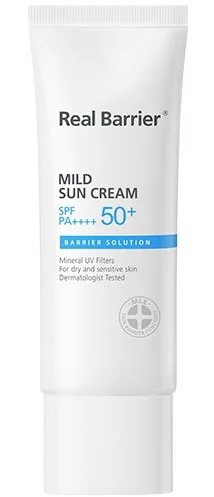
It is a true zinc-and-titanium mineral sunscreen built on Real Barrier's ceramide MLE base, so it pairs physical-filter gentleness with genuine barrier support, an uncommon combination. The catch that distinguishes it the other way is a botanical oil blend that gives it a polarizing herbal scent.
A genuine all-mineral SPF50+ on Real Barrier's ceramide MLE base, which gives it the barrier support most physical sunscreens lack and keeps the white cast unusually low. The wrinkle is a botanical oil blend, including mugwort, that makes the herbal scent and the tolerance profile more divisive than the name suggests.
This assessment rests more on the published INCI and the well-understood behavior of zinc and titanium filters than on review volume, since the few hundred ratings across Amazon, Stylevana and Jolse are solid but not extensive. Because the formula carries four botanical oils, individual tolerance diverges from the average more than usual, so the irritation score is set conservatively and a patch test is wise for reactive skin.
Verdicts
How well it fits each concern
Verdict by concern tap a concern for the case
Full protectionfor Sun DamageIn your profileYou chose · Broad-spectrum SPF 50 with zinc oxide, titanium dioxide: the protection sun damage calls for.Moderate evidenceGentleNo reviews collected yet
The case for it
Zinc Oxide is a first-line active — approved, monograph-listed or named in current guidelines — for this concern.
It is present at an effective concentration, declared or high in the ingredient list.
The formula carries none of the triggers this concern is sensitive to.
Same rule for everyone. “Full protection” is the verdict on 2,288 of 45,024 concern verdicts across the catalog; rule P1 decided 2,232 of them.
Unchanged since September 5, 2026, engine 5.1.1.
P1 — Photoprotection standing is regulatory (M020 / Annex VI filters; 21 CFR 201.327 attaches the early-skin-aging claim to tested broad-spectrum SPF 15+). SPF 30 is the AAD daily-use bar. · the full register
Full protectionfor AgingIn your profileYou chose · Broad-spectrum SPF 50 with zinc oxide, titanium dioxide: the protection aging calls for.Not yet assessedGentleNo reviews collected yet
The case for it
Zinc Oxide has no evidence row yet for this concern — it is in the research queue.
The formula carries none of the triggers this concern is sensitive to.
What would change this: A researched evidence row for the lead active would replace this with a verdict.
Same rule for everyone. “Full protection” is the verdict on 2,288 of 45,024 concern verdicts across the catalog; rule P1 decided 2,232 of them.
Unchanged since September 5, 2026, engine 5.1.1.
P1 — Photoprotection standing is regulatory (M020 / Annex VI filters; 21 CFR 201.327 attaches the early-skin-aging claim to tested broad-spectrum SPF 15+). SPF 30 is the AAD daily-use bar. · the full register
Supporting rolefor SensitivityIn your profileYou chose · Mostly gentle: known irritants — usable for sensitive skin with a patch test.Not yet assessedStandard tolerabilityNo reviews collected yet
The case for it
Madecassoside has been researched for this concern and the evidence does not support it.
It is plausibly present at a working level, though the concentration is not declared.
The formula carries no trigger this concern is sensitive to, with the cautions noted.
Cautions: known irritants.
What would change this: A declared concentration would move this to a firmer reading of the dose.
Same rule for everyone. “Supporting role” is the verdict on 8,197 of 45,024 concern verdicts across the catalog; rule F3 decided 183 of them.
Unchanged since September 5, 2026, engine 5.1.1.
Good choicefor Compromised Skin BarrierIn your profileYou chose · Ceramides is a reference standard by mechanism for compromised skin barrier; this cream carries it.Moderate evidenceStandard tolerabilityNo reviews collected yet
The case for it
Ceramide-MLE Lipid Base has trial-supported standing for this concern.
It is plausibly present at a working level, though the concentration is not declared.
The formula carries no trigger this concern is sensitive to, with the cautions noted.
Cautions: known irritants.
What would change this: A declared concentration would move this to a firmer reading of the dose.
Same rule for everyone. “Good choice” is the verdict on 9,564 of 45,024 concern verdicts across the catalog; rule R5 decided 9,072 of them.
Unchanged since September 5, 2026, engine 5.1.1.
R5 — Trial-supported or guideline-supported active, adequately or plausibly dosed. · the full register
Carrying active
Ceramide-MLE Lipid Base
Standing
supported — its mechanism is established
Form
plausible — studied range 0.5–1%, from the trials on the row; needs leave-on contact; judge it after ~4 weeks
Tolerability
standard — irritant load
Row checked
against its sources on July 17, 2026 (evidence table ev-2026.09-r228)
The studies behind the evidence row
Elias PM, Skin Barrier / Coderch et al., ceramides and skin barrier function — ceramides ~50% of SC intercellular lipid mass, essential to the permeability barrier — reference work
Does the jobDoes what a sunscreen is for: UVA coverage, kind to the skin wearing it. Not measured from the label: pleasant enough to actually use.
A verdict is DermApproved’s assessment of how well a product’s ingredients fit a concern — never a claim about what the product treats. Evidence dots and collected reviews sit beside it and are never blended in.
Rules 0.5.1 · evidence table ev-2026.09-r228 · how we decide
Assessment
Pros & Cons
Pros
✓ Fully mineral SPF50+ from zinc oxide and titanium dioxide
✓ Ceramide MLE base makes it unusually comfortable for a mineral
✓ Minimal white cast for a physical sunscreen
✓ Madecassoside, panthenol and aloe add real soothing
✓ Photostable, non-sensitizing filter choice
✓ Sets to a soft semi-matte rather than greasy film
✓ Good fit for those who avoid chemical filters
Cons
✗ Four botanical oils including mugwort can irritate reactive skin
✗ Pronounced herbal scent despite the mild branding
✗ Faint cast lingers on deeper skin tones
✗ Small 40ml tube empties fast with reapplication
Review
Full Review
There is a quiet irony built into the name of this sunscreen. It is called Mild, and in the most important sense it is: the only UV filters are zinc oxide and titanium dioxide, the two physical minerals that are about as gentle and non-reactive as sun protection gets. Yet read a little further down the ingredient list and you find patchouli oil, juniper oil, mugwort oil and mint oil, a quartet of fragrant botanicals that no truly minimalist sensitive-skin formula would go near. So the Mild Sun Cream is mild in its filters and decidedly not mild in its scent, and understanding that tension is the key to knowing whether it belongs on your shelf.
Start with what it gets right, because there is a lot. This is a real mineral sunscreen, not a hybrid quietly leaning on a chemical filter to do the heavy lifting. Zinc oxide sits second on the list as the dominant active, with titanium dioxide backing it up for UVB, and together they reach SPF50+ through pure physical scattering. That matters for people who genuinely cannot tolerate organic filters, or who simply prefer minerals for their inherent photostability and their non-sensitizing track record. Where most mineral sunscreens then fall down, on texture and on that dreaded chalky drag, Real Barrier has an answer that is entirely its own. The cream is built on the brand's MLE lamellar-lipid base, the same ceramide-and-cholesterol barrier system that powers its moisturizers, so the formula behaves less like a mineral paste and more like a protective cream that happens to contain a lot of zinc.
The payoff is a finish that, for a physical sunscreen, is impressively restrained. The white cast is minimal on most skin tones thanks to micronized, well-dispersed filters, though I will be honest that deeper tones may still catch a faint residue, especially in the first minute before it sets. The texture is cushiony and spreads with a little resistance, the way mineral formulas tend to, but it dries down to a soft semi-matte rather than a greasy film. Madecassoside from centella and panthenol round out a soothing base, and aloe sits in there too, so the cream reads as calming rather than merely protective. On normal, combination and dry skin this is a comfortable daily wear, and on reactive skin the mineral-plus-ceramide foundation is genuinely reassuring.
And then there is the scent, which is where this product earns its asterisk. The patchouli, juniper, mugwort and mint oils give it a woody-herbal aroma that is pronounced on application and mellows as it sets. Some people will find it pleasant, even spa-like; others will find it distracting on their face all morning. The more serious issue is not the smell but the skin response. Mugwort, in particular, is a known sensitizer for a subset of people, and a blend of four essential oils in a leave-on product worn daily is exactly the kind of thing that can provoke a reaction in eczema-prone, rosacea-prone, or fragrance-allergic skin. It is a strange choice for a sunscreen marketed on the word Mild, and it is the single biggest reason this cannot be a blanket recommendation for sensitive skin. If your skin is robust and tolerates botanicals without fuss, this is a non-issue and you can enjoy the calming actives without worry. If your skin reacts to plant oils, the mineral filters will not save you from the fragrance.
The smaller practical limitations are familiar for the category. Mineral sunscreens ask you to apply a real layer and let it set, so this is not the kind of SPF you can rush. The 40ml tube, like the rest of the Real Barrier sun line, empties faster than you would like if you reapply properly through the day, which nudges the true cost upward. And while the semi-matte finish suits most skin, it can feel slightly draggy during application compared with a slick chemical lotion, a textural quirk inherent to physical filters rather than a flaw in this particular formula.
Value is fair rather than generous. At around twenty dollars for 40ml you are paying mid-tier money for a mineral sunscreen with a better-than-average base, which is reasonable, but the small size and the need for generous application mean you will repurchase often. What you are really paying for is the combination of pure physical filters and a real barrier-support base, a pairing that is genuinely uncommon and worth something to the right person.
Who should buy it? People who want or need a fully mineral sunscreen and have skin tough enough to shrug off botanical oils, and who appreciate that the ceramide base makes this one of the more comfortable zinc formulas around. Who should skip it? Anyone whose skin reacts to fragrance or essential oils, especially mugwort, and anyone seeking a completely scent-free mineral option, because despite its name this is one of the more aromatic sunscreens in its class.
Formula
Key Ingredients
The hero actives that drive this product's performance.
The lead mineral filter, sitting second on the list, providing broad-spectrum UVA and UVB scattering that is inherently photostable and non-sensitizing. As the dominant active in this cream it is what makes the formula a genuine physical sunscreen rather than a hybrid leaning on chemical filters.
Regulator-approvedfor Sun Damage · limited certainty
The second mineral filter, paired with zinc to broaden and strengthen UVB coverage so the cream reaches SPF50+ without organic absorbers. Together the two minerals are why this is marketed as the mild, sensitive-skin option in the line.
Regulator-approvedfor Sun Damage · limited certainty
The standardized calming triterpene from centella, included to soothe the skin the minerals protect and to soften the slightly draggy feel mineral filters can have. It supports the cream's sensitive-skin positioning by addressing reactivity rather than just blocking UV.
Neopharm's lamellar lipid system, with 7-dehydrocholesterol and the brand's ceramide amide, gives this mineral cream a barrier-supporting base most physical sunscreens lack. It is what keeps a high-zinc formula from feeling purely chalky and dry on the skin.
Established mechanismfor Compromised Skin Barrier · established mechanism
Provitamin B5 adds humectancy and a mild anti-irritant effect, smoothing the wear of the mineral filters and helping the cream feel less tight as it sets. It rounds out the soothing trio with madecassoside and aloe in a formula aimed at reactive skin.
Not yet assessed
Ingredient standings describe the active at treatment-level doses and
vehicles; this product's own condition grades weigh its actual formula.
The final morning step over moisturizer. Press rather than rub to avoid disturbing the mineral film, and let it set before makeup.
Results Timeline
Immediate broad-spectrum mineral protection on application; comfort and soothed feel from first use; long-term photoprotection benefits to tone and aging accrue with daily use.
The protection here is purely mineral, and the science on that is settled: zinc oxide and titanium dioxide work by sitting on the skin and scattering and absorbing UV across a broad spectrum, and both are inherently photostable, meaning they do not degrade under sunlight the way some organic filters can. Zinc oxide in particular offers strong, even UVA-to-UVB coverage and has one of the lowest sensitization rates of any sunscreen active, which is the basis for the cream's mild, sensitive-skin positioning. What distinguishes this formula from a generic mineral sunscreen is the vehicle. Real Barrier builds it on its MLE lamellar-lipid base, incorporating 7-dehydrocholesterol and its proprietary ceramide amide so the cream reinforces the stratum corneum barrier while it shields it, addressing the dryness and tightness that drive many people away from physical sunscreens. Madecassoside, the standardized triterpene from centella, brings a documented anti-inflammatory action that complements the non-irritating filters. The countervailing consideration is the botanical oil blend. Patchouli, juniper, mugwort and Mentha arvensis oils contribute fragrance and some traditional-use soothing claims, but mugwort (Artemisia) is a recognized contact allergen for sensitized individuals and the wider essential-oil content sits at odds with the formula's gentle intent. From an evidence standpoint, the mineral filters and ceramide base are the strongly supported elements; the botanical oils are a sensory and marketing choice whose benefit is far less established than their potential to irritate a reactive subset of users.
Dermatologist Perspective
Mineral sunscreens built on zinc oxide and titanium dioxide are frequently the filters of choice in clinical guidance for sensitive, rosacea-prone and post-procedure skin, precisely because they are photostable and rarely sensitizing. A mineral formula carried on a ceramide-rich barrier base aligns well with how dermatologists tend to think about reactive skin, where protecting and reinforcing the barrier matter as much as blocking UV. The notable caveat with this particular product is its botanical oil content: leave-on formulas containing mugwort and other essential oils are commonly flagged for patients with eczema or a history of contact dermatitis, for whom a fragrance-free mineral sunscreen is usually the safer suggestion. As with all sunscreens, adequate application amount and reapplication during sustained sun exposure remain essential to achieving the labeled level of protection, and a faint cast on deeper skin tones is a known trade-off of physical filters.
Guidance
Usage & Recommendations
How to Use
As the last step each morning, work a generous, even layer over moisturizer, since mineral sunscreens lose protection quickly when under-applied. Press and pat it into the skin rather than rubbing vigorously so the mineral film stays smooth, and give it a minute or two to set before makeup. Reapply every two hours during prolonged sun exposure and after swimming or heavy sweating. Use it in daylight only. Because of the botanical oils, patch test on the inner arm first if your skin is fragrance-sensitive or allergy-prone before committing to daily facial use.
Value Assessment
At roughly twenty dollars for 40ml, the Mild Sun Cream sits in the middle of the mineral-sunscreen market and is fairly priced for a formula that pairs pure physical filters with a genuine ceramide barrier base, an uncommon combination. The practical drag on value is the small tube: mineral sunscreens demand a generous layer and regular reapplication, so you will move through it and repurchase more often than the sticker price implies. There is no larger format to bring the per-milliliter cost down. You are paying for the rare pairing of zinc-and-titanium gentleness with real barrier support, which is worth a small premium to anyone who specifically needs mineral filters, but the value case weakens if the botanical scent rules it out for your skin.
Who Should Buy
Choose this if you want a fully mineral sunscreen and your skin is tough enough to handle botanical oils; the ceramide base makes it one of the more comfortable, least chalky zinc formulas you can buy, with real soothing actives layered in.
Who Should Skip
Avoid this if fragrance or essential oils, mugwort especially, set off your skin, or if you have eczema or rosacea that flares easily. Anyone wanting a completely unscented mineral sunscreen, or the deepest skin tones chasing zero cast, should look at a fragrance-free alternative instead.
A cushiony mineral cream that spreads with a little resistance and dries down to a soft, semi-matte finish without the heavy grease of older zinc formulas.
Scent
A distinct herbal-woody note from patchouli, juniper and mint oils; pronounced on application and mellowing as it sets.
Packaging
Squeeze tube that shields the formula and travels well, though the 40ml size runs low quickly with proper reapplication.
Finish
naturalsatin
What to Expect on First Use
Spreads more slowly than a chemical sunscreen and leaves a faint initial tint that settles within a minute or two. The botanical scent is the most noticeable thing up front; there is no sting on application.
How Long It Lasts
About 4-6 weeks as a daily face sunscreen with reapplication; longer as a single morning step.
Real Barrier created the Mild Sun Cream as the all-mineral counterpart to its chemical Moisture Sun Lotion, aimed at users who prefer physical filters but still want the brand's signature ceramide-and-centella barrier support rather than a bare mineral base.
About Real Barrier Established Brand (5–20 years)
Real Barrier is Neopharm's dermo-cosmetic line, built on the patented MLE lamellar-lipid technology shared with the clinic-sold Atopalm brand. Its mineral sunscreen carries the same ceramide-barrier focus into a zinc-and-titanium base.
Brand founded: 2015 · Product launched: 2021
Myth vs. Reality
Common Myths
Myth
All mineral sunscreens leave a heavy white cast.
Reality
Modern micronized zinc and titanium, dispersed as they are here, keep the cast minimal on most skin tones, though deeper tones may still notice a slight residue.
FAQ
Frequently Asked Questions
Is the Mild Sun Cream a fully mineral sunscreen?
Yes. Its only UV filters are zinc oxide and titanium dioxide, with no chemical absorbers, which is why it is positioned as the gentle, physical option in the Real Barrier sun range.
Does it leave a white cast?
The cast is minimal for a mineral formula thanks to micronized filters, but as with any zinc-based sunscreen, deeper skin tones may notice a slight residue, especially before it fully sets.
Why does the Mild Sun Cream smell herbal?
It contains patchouli, juniper, mugwort and mint oils, which give it a woody-herbal scent. Despite the mild name these essential oils can bother fragrance-sensitive or allergy-prone skin.
Is this Real Barrier sunscreen good for sensitive skin?
The mineral filters and ceramide-centella base are well suited to reactive skin, but the botanical oil blend, including mugwort, is a genuine caution for anyone with plant-oil sensitivities or eczema.
Can I wear the Mild Sun Cream under makeup?
Yes, though it sets to a soft semi-matte film that benefits from a minute to settle. Press it in evenly rather than rubbing so the mineral layer stays smooth under foundation.
Reviews
What Reviewers Tend to Say
Recurring themes our editors read across retailer reviews of this product — summaries in our words, not quotations, and not a substitute for your own patch test.
Every cica, calming, and barrier product leans on the same three ingredients, and the real mechanisms are far more specific — and more limited — than 'soothing' lets on.
Western sensitive skincare works by subtraction — remove the fragrance, remove the alcohol, shorten the list. Japan's answer adds a designed molecule back in, and one of the two bets has a trial literature.
A wrecked barrier is the most common self-inflicted skin condition and the one with the clearest fix — the difficulty is that the routine which caused it feels productive and the one that repairs it feels like giving up.
Products, answers, therapy guides, tools and articles in one search. Brand names,
slang and abbreviations all work — accutane finds isotretinoin, bacne finds truncal acne.