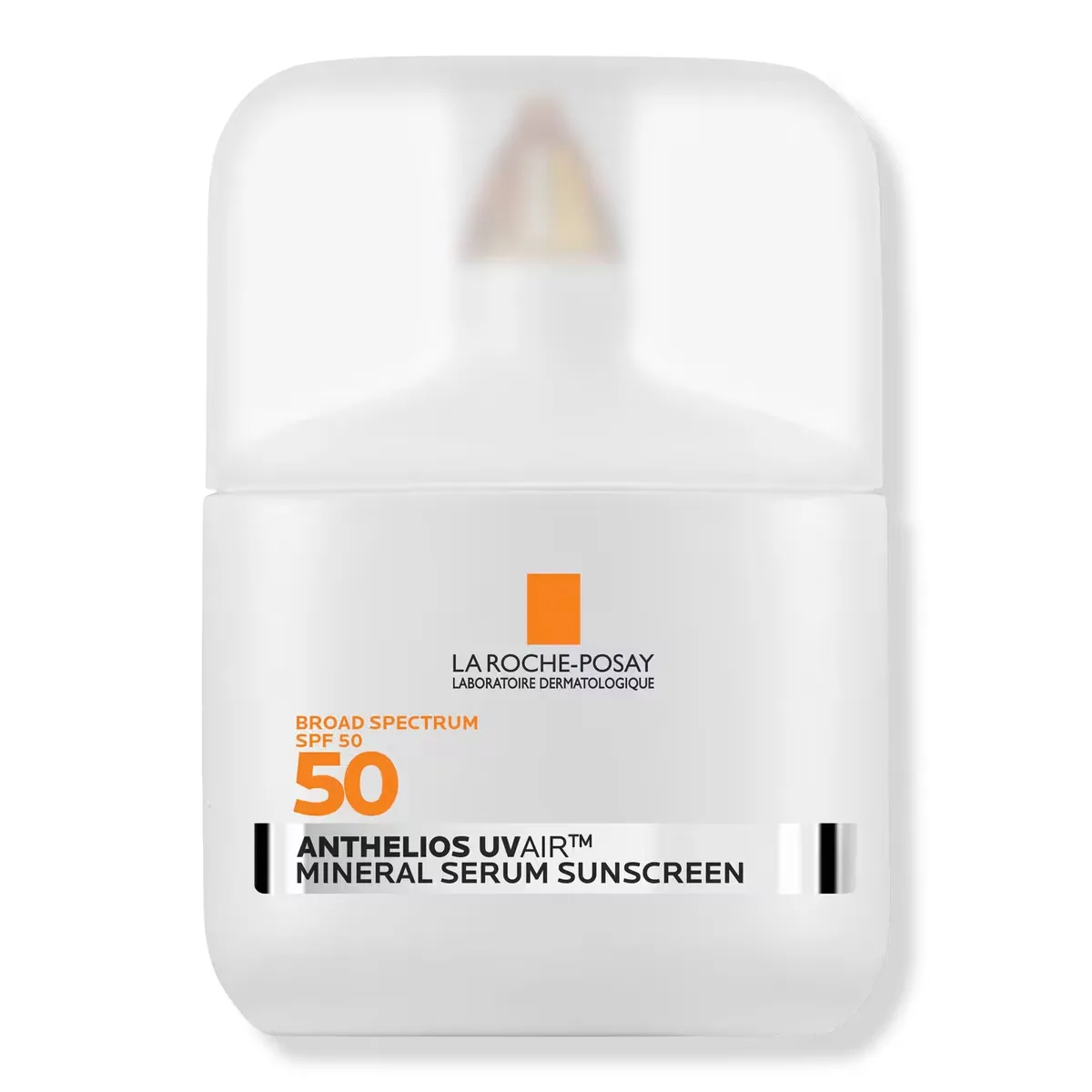
This is the all-mineral member of the UVAir line, using 15.3% zinc oxide and 2.7% titanium dioxide instead of chemical filters — but engineered with La Roche-Posay's MINER-ALL technology to blend out like a chemical sunscreen, minimizing the white cast and heavy feel that usually come with physical filters. It pairs that with niacinamide, hyaluronic acid, and an antioxidant complex.
Mineral sunscreen has long carried an unspoken tax: choose physical filters and you accept white cast and a heavier feel. La Roche-Posay's UVAir Mineral Serum is built to waive that tax — a 15.3% zinc and 2.7% titanium dioxide formula engineered to blend like a chemical sunscreen, with niacinamide, hyaluronic acid, and antioxidants folded in. For sensitive skin or pregnancy, it is one of the most elegant mineral options going.
The UVAir mineral serum is recent, so scoring here weighs formulation quality and La Roche-Posay's Anthelios pedigree alongside an early, still-growing review base. The review will be updated over time.
Verdicts
How well it fits each concern
Verdict by concern tap a concern for the case
Full protectionfor Sun DamageIn your profileYou chose · Broad-spectrum SPF 50 with titanium dioxide, zinc oxide: the protection sun damage calls for.Moderate evidenceGentleNo reviews collected yet
The case for it
Mineral UV Filter System is a first-line active — approved, monograph-listed or named in current guidelines — for this concern.
It is present at an effective concentration, declared or high in the ingredient list.
The formula carries none of the triggers this concern is sensitive to.
Same rule for everyone. “Full protection” is the verdict on 2,288 of 45,024 concern verdicts across the catalog; rule P1 decided 2,232 of them.
Unchanged since September 5, 2026, engine 5.1.1.
P1 — Photoprotection standing is regulatory (M020 / Annex VI filters; 21 CFR 201.327 attaches the early-skin-aging claim to tested broad-spectrum SPF 15+). SPF 30 is the AAD daily-use bar. · the full register
Good choicefor SensitivityIn your profileYou chose · No fragrance, drying alcohol, declarable allergens or sensitising preservatives in this serum — the profile sensitive skin looks for.Not yet assessedGentleNo reviews collected yet
The case for it
Mineral UV Filter System has no evidence row yet for this concern — it is in the research queue.
The formula carries none of the triggers this concern is sensitive to.
What would change this: A researched evidence row for the lead active would replace this with a verdict.
Same rule for everyone. “Good choice” is the verdict on 1,938 of 45,024 concern verdicts across the catalog; rule F2 decided 1,938 of them.
Unchanged since September 5, 2026, engine 5.1.1.
Full protectionfor AgingIn your profileYou chose · Broad-spectrum SPF 50 with titanium dioxide, zinc oxide: the protection aging calls for.Moderate evidenceGentleNo reviews collected yet
The case for it
Niacinamide has early or mechanistic evidence for this concern, not trial-backed standing.
It is plausibly present at a working level, though the concentration is not declared.
The formula carries none of the triggers this concern is sensitive to.
What would change this: A declared concentration would move this to a firmer reading of the dose.
Same rule for everyone. “Full protection” is the verdict on 2,288 of 45,024 concern verdicts across the catalog; rule P1 decided 2,232 of them.
Unchanged since September 5, 2026, engine 5.1.1.
P1 — Photoprotection standing is regulatory (M020 / Annex VI filters; 21 CFR 201.327 attaches the early-skin-aging claim to tested broad-spectrum SPF 15+). SPF 30 is the AAD daily-use bar. · the full register
Carrying active
Niacinamide
Standing
plausible — trials support it
Form
plausible — studied range 4–5%, from the trials on the row; needs leave-on contact; judge it after ~8 weeks
Tolerability
gentle
Row checked
against its sources on July 17, 2026 (evidence table ev-2026.09-r228)
Good choicefor DehydrationIn your profileYou chose · Hyaluronic Acid is a reference standard by mechanism for dehydration; this serum carries it.Moderate evidenceGentleNo reviews collected yet
The case for it
Hyaluronic Acid has trial-supported standing for this concern.
It is plausibly present at a working level, though the concentration is not declared.
The formula carries none of the triggers this concern is sensitive to.
What would change this: A declared concentration would move this to a firmer reading of the dose.
Same rule for everyone. “Good choice” is the verdict on 9,564 of 45,024 concern verdicts across the catalog; rule R5 decided 9,072 of them.
Unchanged since September 5, 2026, engine 5.1.1.
R5 — Trial-supported or guideline-supported active, adequately or plausibly dosed. · the full register
Carrying active
Hyaluronic Acid
Standing
supported — its mechanism is established
Form
plausible — studied range 0.1%, from the trials on the row; needs leave-on contact; judge it after ~1 weeks
Tolerability
gentle
Row checked
against its sources on July 17, 2026 (evidence table ev-2026.09-r228)
The studies behind the evidence row
Draelos ZD, Cosmetic Dermatology: Products and Procedures — hyaluronic acid classified as a humectant water-binding agent holding many times its weight in water — reference work
Does the jobDoes what a sunscreen is for: UVA coverage, kind to the skin wearing it. Not measured from the label: pleasant enough to actually use.
A verdict is DermApproved’s assessment of how well a product’s ingredients fit a concern — never a claim about what the product treats. Evidence dots and collected reviews sit beside it and are never blended in.
Rules 0.5.1 · evidence table ev-2026.09-r228 · how we decide
Assessment
Pros & Cons
Pros
✓ High 15.3% zinc oxide plus titanium dioxide for full broad-spectrum mineral protection
✓ MINER-ALL technology blends out far closer to clear than typical mineral formulas
✓ Weightless, air-light serum texture rare for a 100% mineral sunscreen
✓ Fragrance-free and gentle — a strong pregnancy and sensitive-skin pick
✓ Built-in niacinamide, hyaluronic acid, and antioxidants
✓ Mineral filters are not absorbed systemically
✓ Backed by La Roche-Posay's dermatology pedigree
Cons
✗ Faint white cast still possible on the deepest skin tones
✗ Slightly less invisible than the chemical UVAir version
✗ Not fungal-acne safe due to jojoba esters and fatty acids
✗ Only one 50 ml size, with no larger-value option
✗ Premium price point
Review
Full Review
For years, choosing a mineral sunscreen meant accepting a quiet trade-off. You wanted physical filters — maybe for pregnancy, maybe for reactive skin, maybe just because the idea appealed to you — and in exchange you tolerated a ghostly white cast and a texture that sat on your face like a layer of paint. That was simply the cost of admission. La Roche-Posay's Anthelios UVAir Mineral Serum exists to argue that the cost should no longer be that high.
The protection is fully mineral and generously dosed: 15.3% zinc oxide reinforced by 2.7% titanium dioxide. Zinc oxide is the broadest single UV filter available, covering UVB straight through the long-UVA range, and a load above 15% gives this formula real protective margin for its SPF 50 rating. Titanium dioxide shores up the UVB and shorter-UVA end. There are no chemical filters in the formula at all, which is the entire point: the minerals are not absorbed systemically in any meaningful amount, which is why dermatologists so often steer pregnant patients and reactive skin toward exactly this kind of formula.
The difficult part of any mineral sunscreen has never been the protection — it is the optics. Mineral particles scatter visible light along with UV, and that visible-light scattering is precisely what produces white cast. How much cast a formula leaves comes down to engineering: particle size, the coating on each particle, and how evenly those particles are dispersed through the base. La Roche-Posay's MINER-ALL technology is essentially the brand's answer to those three variables — tuning the dispersion and emollient system so a high mineral load lays down as a thin, uniform, more translucent film.
Read the inactive list and you can see that engineering laid out in order. Polyhydroxystearic acid and isostearic acid are the dispersants that keep eighteen percent of mineral particles from flocculating into visible clumps; C15-19 alkane, a plant-derived alternative to volatile silicone, provides the slip that lets that load spread thin; silica takes the shine off the finish; sclerotium gum and polyglycerin-3 hold the whole suspension stable in the bottle. Nothing here is decorative. Every entry exists so that the zinc lies flat instead of piling up, which is the entire difference between an elegant mineral sunscreen and a chalky one.
In practice it works well. This blends out far closer to clear than the mineral sunscreens of even a few years ago, and on light-to-medium skin most people will not see a meaningful cast once it is worked in. Honesty requires one caveat: physics has a floor. On the very deepest skin tones, some faint cast can linger, because you cannot fully eliminate visible-light scattering from a particulate filter. If your skin is deep and you cannot tolerate any cast at all, a tinted formula is the better route.
The texture genuinely earns the UVAir name. For a 100% mineral sunscreen this is remarkably light — an air-textured serum that spreads thin and absorbs rather than sitting heavy. That alone separates it from most of the mineral category. La Roche-Posay also folded in real skincare: niacinamide sits high in the formula, supporting the barrier and contributing to the 24-hour hydration and tone-evening claims, while hyaluronic acid and glycerin handle humectant hydration so the light base never feels drying. A Cell-Ox Shield antioxidant complex, built around tocopherol and cassia alata leaf extract, mops up the free radicals generated by whatever UV slips past the filters, with a syringylidenemalonate photostabilizer helping the whole system hold up under light. None of these extras are treatment-strength, but together they make the product mildly skin-improving rather than purely protective — the barrier and tone benefit accrues quietly over several weeks, while the UV protection is doing its job from the moment the film dries.
Which raises the single thing that matters more than any of the above: how much you actually apply. A quarter-teaspoon for the face, more for neck and ears, is the dose the SPF 50 on the label assumes, and under-application is the reason most people are getting a fraction of the protection they think they are. With a mineral formula there is a second discipline — take the extra ten seconds to work it in evenly, because a patchy film both looks worse and protects worse. The upside is that physical filters work on contact; there is no fifteen-minute wait to manage before you leave the house. Reapply every couple of hours of real exposure, and after swimming or sweating.
Only a couple of limitations need stating beyond the deep-tone caveat. This mineral serum is, by a hair, slightly less invisible than the chemical-filter version of the UVAir line — that is simply the nature of physical filters, and most people will consider it a fair trade. The formula contains jojoba esters and fatty-acid-derived ingredients, so it is not fungal-acne safe. And it comes in a single 50 ml size with no larger-value option.
Value holds up well. Around forty dollars for 50 ml places this alongside premium dermatologist-favorite sunscreens, including its own chemical-filter sibling. A genuinely elegant 100% mineral formula is harder to engineer than a chemical one, and the dispersion work, the high zinc load, and the added niacinamide and antioxidants are real value rather than packaging. A 50 ml pump bottle should last two to three months of honest daily use. The review base is still building — this launched in 2025 — but what exists is consistent, and revealingly so: people praise the blend and the weight, and the only recurring complaint is the faint cast on deeper skin, which is precisely the limitation the formula itself cannot engineer away. Coming from a legacy pharmacy brand with decades of dermatological credibility behind the Anthelios name, you are paying for proven formulation quality.
If you want or need mineral filters — during pregnancy, for sensitive or reactive skin, or simply by preference — and you have been holding out for a mineral sunscreen that does not feel like a compromise, this is among the best options available right now. It is gentle, light, fragrance-free, and blends far better than the category's reputation would suggest. The exceptions are narrow: skin deep enough that any cast is unacceptable is better served by a tinted formula, and anyone managing fungal acne should pass on the jojoba esters. For most people seeking a mineral sunscreen, though, this is the rare one that does not ask you to give anything up.
Formula
Key Ingredients
The hero actives that drive this product's performance.
A 100% mineral filter pair — a high 15.3% zinc oxide for full broad-spectrum coverage, reinforced by 2.7% titanium dioxide on UVB and shorter UVA. La Roche-Posay's MINER-ALL technology optimizes how these particles disperse, so this much mineral filter still lays down a thin, near-clear film rather than a chalky mask.
Regulator-approvedfor Sun Damage · limited certainty
Placed high in the formula, where it reinforces the skin barrier and underpins the 24-hour hydration and tone-evening claims — giving this mineral sunscreen mild skincare value beyond pure protection.
Works with glycerin to draw water into the skin, keeping the air-light mineral base comfortable and non-drying so it wears well straight over bare skin.
Established mechanismfor Dehydration · established mechanism
Tocopherol with cassia alata leaf extract forms the Cell-Ox Shield system, neutralizing the free radicals generated by the fraction of UV the mineral filters do not catch — buffering the oxidative damage that drives photoaging.
Limitedfor Sun Damage
Ingredient standings describe the active at treatment-level doses and
vehicles; this product's own condition grades weigh its actual formula.
Apply as the final morning step, after serums and moisturizer, before makeup. Blend fully and evenly — working a mineral formula in well is what minimizes any cast.
Results Timeline
Mineral UV protection is immediate on application. Any barrier and tone benefit from the niacinamide builds gradually over several weeks of daily use.
La Roche-Posay Anthelios UVAir Mineral Serum Sunscreen SPF 50
Sample PM Routine
Not applicable
Evidence
Science & Expert Perspective
The Science
Mineral and chemical sunscreens protect by different mechanisms, and understanding the difference clarifies what this formula achieves. Titanium dioxide and zinc oxide are inorganic particulate filters: they sit on and within the surface of the skin and protect by absorbing and scattering ultraviolet radiation. Zinc oxide, at 15.3% here, is the broadest single filter available, covering UVB through the full UVA range, while the 2.7% titanium dioxide reinforces UVB and shorter-UVA defense. Together they form a complete broad-spectrum SPF 50 system with no chemical filters at all. The historic drawback of mineral filters has never been their protection — it is their optics. Mineral particles scatter visible light as well as UV, and that visible-light scattering is what produces white cast and an opaque, heavy appearance. The variables that govern how much cast a mineral sunscreen leaves are particle size, the surface coating on each particle, and how evenly the particles are dispersed through the base. La Roche-Posay's MINER-ALL technology is essentially an engineering answer to those variables — optimizing dispersion and the emollient system so the minerals lay down in a thinner, more uniform, more translucent film. The result blends far closer to clear than legacy mineral sunscreens, though physics sets a limit: on the deepest skin tones, some faint cast can remain, because visible-light scattering cannot be fully eliminated from a particulate filter. The supporting actives mirror the rest of the UVAir line. Niacinamide supports the barrier and contributes to the hydration and tone-evening claims; sodium hyaluronate and glycerin handle humectant hydration; and a Cell-Ox Shield antioxidant complex built around tocopherol and cassia alata leaf extract neutralizes the free radicals generated by any UV the filters do not catch — reducing the downstream oxidative damage that drives photoaging.
Dermatologist Perspective
Dermatologists frequently recommend 100% mineral sunscreens for specific populations: patients who are pregnant or breastfeeding, those with sensitive or reactive skin, and anyone with a compromised barrier or a history of stinging from chemical filters. Zinc oxide and titanium dioxide are not absorbed systemically in any meaningful amount and rarely provoke irritation, which is the basis for that preference. Clinicians also point out that the historic barrier to mineral sunscreen use was cosmetic — white cast and a heavy feel discouraged daily wear — so a mineral formula engineered to blend closer to clear directly addresses an adherence problem. The fragrance-free composition adds to its suitability for reactive skin. Two honest caveats are usually noted: even well-engineered mineral sunscreens can leave a faint cast on the deepest skin tones, and as with any sunscreen, generous application and reapplication matter more than the formula itself. For sensitive skin and for use during pregnancy, this type of elegant, high-zinc mineral formula is widely regarded as an excellent everyday choice.
Guidance
Usage & Recommendations
How to Use
As the final morning step, press this over serums and moisturizer, before any makeup. Use a generous amount — about a quarter-teaspoon for the face, plus more for the neck and ears — since under-application is the most common reason any sunscreen falls short of its rated SPF. Because this is a mineral formula, take a moment to blend it fully and evenly; working it in well is what minimizes any cast. Allow a minute for it to settle before applying makeup. Reapply every two hours of meaningful sun exposure and after sweating or swimming. Mineral filters protect immediately, with no wait time needed, and there is no reason to use it at night.
Value Assessment
At around forty dollars for 50 ml, the UVAir Mineral Serum is priced alongside its chemical-filter sibling and other premium dermatologist-favorite sunscreens. Only the one size is sold, so there is no per-unit discount to chase, but 50 ml of a facial sunscreen lasts roughly two to three months of honest daily use. The price is defensible: a genuinely elegant 100% mineral formula is harder to engineer than a chemical one, and the MINER-ALL dispersion work, the high zinc load, and the added niacinamide and antioxidants are real value rather than packaging. For anyone who specifically needs or wants mineral filters — particularly during pregnancy or for reactive skin — paying a premium for a mineral sunscreen that does not feel like a compromise is money well spent. From a legacy pharmacy brand, the cost reflects proven quality.
Who Should Buy
Anyone who wants or needs mineral filters without the traditional chalky penalty is the core audience — particularly those who are pregnant or breastfeeding, have sensitive or reactive skin, or simply prefer physical sunscreens. The air-light texture and built-in niacinamide and hydration make it comfortable for daily wear across most skin types.
Who Should Skip
Two groups should look elsewhere: the deepest skin tones, where any cast is unwelcome and a tinted formula serves better, and fungal-acne-prone skin put off by the jojoba esters and fatty acids. Anyone chasing the absolute most invisible finish may also prefer the line's chemical-filter version.
Ready to try La Roche-Posay Anthelios UVAir Mineral Serum Sunscreen SPF 50?
Weightless, air-light mineral serum that spreads thin
Scent
Fragrance-free, with no perceptible scent once applied
Packaging
Pump bottle
Finish
lightweightnaturalsatin
What to Expect on First Use
This goes on as a light serum that spreads more easily than most mineral sunscreens, blending down with only a faint, quickly-fading cast on most skin tones. Take a moment to work it in evenly. There is no purging or adjustment period, and mineral protection is immediate on application.
How Long It Lasts
About 2-3 months with daily full-face and neck application
La Roche-Posay launched the Anthelios UVAir line in 2025 around an air-light texture. This mineral version exists for the substantial group of people who want or need physical filters — during pregnancy, with reactive skin, or by preference — but have been unwilling to accept the chalky compromise mineral sunscreens have traditionally demanded.
About La Roche-Posay Legacy Brand (20+ years)
La Roche-Posay is a French pharmacy brand founded in 1975 and owned by L'Oreal, with a long dermatology-recommendation history. Anthelios is its flagship sunscreen line, widely studied and recommended in clinical settings.
Brand founded: 1975 · Product launched: 2025
Myth vs. Reality
Common Myths
Myth
Mineral sunscreens always leave a white cast.
Reality
White cast comes from how mineral particles are sized, coated, and dispersed — not from mineral filters being inherently chalky. This formula's MINER-ALL technology is built around that engineering, so it blends far closer to clear than older mineral sunscreens, though the deepest skin tones may still see a faint cast.
FAQ
Frequently Asked Questions
Does the UVAir Mineral Serum leave a white cast?
It minimizes white cast through MINER-ALL dispersion technology and blends close to clear on most skin tones. A faint cast can still show on the deepest skin tones, since some visible-light scattering is unavoidable with mineral filters.
Is the UVAir Mineral Serum safe to use during pregnancy?
Yes. It is a 100% mineral sunscreen using only zinc oxide and titanium dioxide, which are not absorbed systemically and are widely considered pregnancy-friendly. It is also fragrance-free. Confirm with your OB if you have specific concerns.
How is this different from the regular UVAir Daily Serum?
Both share the air-light UVAir texture, but this version uses mineral filters — zinc oxide and titanium dioxide — instead of chemical ones. The mineral formula is the better choice for pregnancy, sensitive skin, or anyone who prefers to avoid chemical UV filters.
Is Anthelios UVAir Mineral Serum Sunscreen SPF 50 suitable for sensitive skin?
Yes. The combination of 100% mineral filters and a fragrance-free formula makes it one of the gentler facial sunscreens available, well suited to reactive and easily-irritated skin.
Is the UVAir Mineral Serum fragrance-free?
Yes — there is no added fragrance in the formula, which adds to its suitability for sensitive skin.
Is Anthelios UVAir Mineral Serum Sunscreen SPF 50 safe for fungal-acne-prone skin?
No. The formula contains jojoba esters and fatty-acid-derived ingredients that can feed the yeast behind fungal acne. Those managing fungal acne should choose a different sunscreen.
Can you wear it under makeup?
Yes. The light serum texture settles into a natural finish that layers well under foundation; give it a minute to set first.
Reviews
What Reviewers Tend to Say
Recurring themes our editors read across retailer reviews of this product — summaries in our words, not quotations, and not a substitute for your own patch test.
Common Praise
Blends close to clear for a mineral formula
Light, comfortable serum texture
Gentle and fragrance-free
Common Complaints
Faint cast can show on deeper skin tones
Slightly less invisible than the chemical UVAir version
Social media says every full upper lip is migrated product. The industry would rather not discuss it at all. Both positions bury the thing that actually matters: one filler class has an eraser and the others do not.
Five brands that own the feed, judged on their ingredient lists rather than their view counts — including the one active all five suddenly added at once, and what that tells you.
Products, answers, therapy guides, tools and articles in one search. Brand names,
slang and abbreviations all work — accutane finds isotretinoin, bacne finds truncal acne.