

Glycolic vs Lactic Acid: Which AHA Is Actually Right for You
Glycolic gets the hype and the higher numbers. But lactic acid does something glycolic can't — and for a lot of skin, that changes the whole calculation.

This is the rare chemical exfoliant that sensitive skin can actually claim. At 5% lactic acid with the same Tasmannia Lanceolata anti-irritant, glycerin, and HA crosspolymer as the 10% version, it delivers the gentlest effective AHA exfoliation in The Ordinary's lineup. It's specifically designed as either a permanent solution for sensitive skin or a stepping-stone to the 10% for those building acid tolerance.
The gateway AHA — a 5% lactic acid serum gentle enough for sensitive skin that still delivers real exfoliation results, backed by the same smart supporting ingredients as its 10% sibling. For first-time acid users and reactive skin types, this is where the journey begins.
The case for it
What would change this: Guideline or regulatory standing for the active on this concern would move this from a promising bet to a recommendation.
Same rule for everyone. “Promising” is the verdict on 7,858 of 45,024 concern verdicts across the catalog; rule R9p decided 7,858 of them. Unchanged since September 5, 2026, engine 5.1.1.
Brand or formulator? Disclose a concentration or correct a fact →
The studies behind the evidence row
The case for it
Same rule for everyone. “Good choice” is the verdict on 9,564 of 45,024 concern verdicts across the catalog; rule R5 decided 9,072 of them. Unchanged since September 5, 2026, engine 5.1.1.
Brand or formulator? Disclose a concentration or correct a fact →
The studies behind the evidence row
The case for it
Same rule for everyone. “Good choice” is the verdict on 9,564 of 45,024 concern verdicts across the catalog; rule R5 decided 9,072 of them. Unchanged since September 5, 2026, engine 5.1.1.
Brand or formulator? Disclose a concentration or correct a fact →
The studies behind the evidence row
The case for it
What would change this: A researched evidence row for the lead active would replace this with a verdict.
Same rule for everyone. “Good choice” is the verdict on 1,938 of 45,024 concern verdicts across the catalog; rule F2 decided 1,938 of them. Unchanged since September 5, 2026, engine 5.1.1.
Brand or formulator? Disclose a concentration or correct a fact →
Also listed for Dark Spots — the actives here (Lactic Acid, Glycerin, Hyaluronic Acid, Tasmannia Lanceolata (Pepper Berry) are in our research queue for that concern; there is no verdict until their evidence rows are written. That is a gap in our table, not a mark against the product.
Where our review and the verdict differ. The review below was written on the formulation and the published trials; the verdicts above apply the stricter standing test in our methodology — an active earns a recommendation only with guideline or regulatory standing for the concern. Where the two disagree, the verdict is DermApproved’s position.
A verdict is DermApproved’s assessment of how well a product’s ingredients fit a concern — never a claim about what the product treats. Evidence dots and collected reviews sit beside it and are never blended in. Rules 0.5.1 · evidence table ev-2026.09-r228 · how we decide
There's a particular frustration that comes with having sensitive skin in a skincare world increasingly obsessed with acids. Every dermatologist, every beauty editor, every knowledgeable friend tells you that chemical exfoliation will transform your texture, brighten your tone, fade your dark spots. And then you try a glycolic acid toner and your face turns into a red, stinging reminder that not all skin was built for trendy actives. The Ordinary's Lactic Acid 5% + HA exists for exactly this moment of defeat — it's the product that says, "There's another way."
Living perpetually in the shadow of its 10% sibling (which gets more reviews, more attention, and more dramatic before-and-after content), the 5% formulation is quietly one of the most important products in The Ordinary's lineup. Not because it does anything revolutionary on paper — it's lactic acid at a low concentration with some supporting ingredients — but because it proves that effective chemical exfoliation has a lower entry point than most people think.
The formula is essentially identical to the 10% version, with the obvious distinction of half the acid concentration. The same INCI list appears in the same order: lactic acid followed immediately by glycerin at a meaningful concentration, then the usual supporting cast of pentylene glycol, propanediol, sodium hyaluronate crosspolymer, and Tasmannia Lanceolata extract. The pH sits at 3.6-3.8 — the same range as the 10%, which means the proportion of free acid is also similar, just with less total acid to work with. This isn't a diluted formula; it's a calibrated one.
What this calibration delivers is exfoliation that most sensitive skin types can actually tolerate. Where the 10% produces a noticeable tingling that some users need to build tolerance for, the 5% lands somewhere between "barely perceptible" and "I think I felt something." The Tasmannia Lanceolata extract — already effective at managing sensation in the 10% — renders the 5% almost sensation-free for most users. This absence of drama is the entire point. Sensitive skin needs to not be aggravated before it can be improved, and a product that causes no discomfort on application is a product that gets used consistently.
Consistency is where the 5% earns its results. They come more gradually than the 10% — this is a tradeoff, not a failure. Where the 10% delivers noticeable texture improvements in one to two weeks, the 5% takes two to three. Where the 10% visibly fades dark spots in four to six weeks, the 5% needs six to eight. The destination is remarkably similar; the journey is just slower and considerably more comfortable. For someone whose alternative was "no chemical exfoliation at all because everything burns," this timeline is not a compromise — it's a revelation.
The hydrating architecture is identical to the 10%, and at the lower acid concentration, the balance tips even further toward moisture. Lactic acid's inherent humectant properties, combined with high-position glycerin and the sustained-release HA crosspolymer, create a formula that actively hydrates while it gently exfoliates. Dry, sensitive skin — the exact demographic this product targets — gets to address two concerns simultaneously without adding another product to an already cautious routine.
Application is straightforward and uneventful in the best possible way. The serum is lightweight, slightly viscous, and absorbs cleanly. No stinging, no redness, no drama. Follow with a hydrating serum and moisturizer, apply sunscreen the next morning, and move on with your life. The product can be used daily from the start — no tolerance-building phase required for most users, which is a significant practical advantage. Every-other-day protocols introduce scheduling complexity that leads to inconsistent use, and inconsistent use leads to underwhelming results.
The limitations are the flip side of the product's gentleness. Experienced acid users will find this concentration underwhelming — if your skin happily tolerates 10% glycolic acid nightly, 5% lactic acid will feel like bringing a spoon to a sword fight. It's not a treatment for deep hyperpigmentation, severe texture, or stubborn congestion. It's a mild daily exfoliant for skin that needs gentle, consistent improvement rather than aggressive intervention. Knowing which one you need is half the battle.
The product also exists in an interesting psychological space. Some users interpret the lack of sensation as a lack of activity — "if it doesn't tingle, it's not working" is a persistent myth in acid skincare. But stinging is an irritation response, not an efficacy indicator. The Tasmannia Lanceolata extract specifically suppresses the sensation while the acid continues its work unimpeded. Trust the formulation, not the feeling.
At $8.10, this is one of the most accessible entry points to chemical exfoliation available. A bottle lasts three to four months of daily use, bringing the per-application cost below seven cents. For anyone who has looked at the wall of AHA products and felt that none of them were made for their skin, this one might be. The Ordinary's Lactic Acid 5% + HA won't generate the most dramatic transformation stories. But for the people it's designed for, it generates something more valuable: the confidence that chemical exfoliation is actually an option.
The hero actives that drive this product's performance.
| Ingredient | Function | Evidence |
|---|---|---|
| Lactic Acid (5%) | At 5% concentration and pH 3.6-3.8, this delivers milder exfoliation than the 10% version while retaining lactic acid's unique dual nature as both exfoliant and humectant. The lower concentration means less free acid on the skin at any time, making this suitable for sensitive-leaning skin types that can't tolerate the 10% — while still providing enough activity to dissolve surface dead cells and improve texture over time. | Established mechanism for Rough Texture · established mechanism |
| Sodium Hyaluronate Crosspolymer | The same cross-linked HA used in the 10% version, providing sustained hydration that counterbalances any transient dryness from the lactic acid. At the 5% acid concentration, the ratio of hydration to exfoliation tips even further toward moisture support, making this formula particularly comfortable for dry, sensitive skin. | Plausible mechanism for Dullness |
| Tasmannia Lanceolata Fruit/Leaf Extract | The Tasmanian Pepperberry sensory modifier that reduces stinging by modulating TRPV1 receptors. At 5% lactic acid, there's already less stinging potential than the 10% version, so this extract provides an additional comfort margin that makes the product genuinely gentle for most skin types. | Not yet assessed |
| Glycerin | Present at a meaningful concentration (listed third in INCI) to provide additional humectant support. Works alongside lactic acid's own moisture-drawing properties and the HA crosspolymer to create a formula where hydration is as prominent as exfoliation. | Established mechanism for Dryness · established mechanism |
Ingredient standings describe the active at treatment-level doses and vehicles; this product's own condition grades weigh its actual formula.
Aqua (Water), Lactic Acid, Glycerin, Pentylene Glycol, Propanediol, Sodium Hyaluronate Crosspolymer, Tasmannia Lanceolata Fruit/Leaf Extract, Acacia Senegal Gum, Xanthan Gum, Isoceteth-20, Trisodium Ethylenediamine Disuccinate, Sodium Hydroxide, Ethylhexylglycerin, 1,2-Hexanediol, Caprylyl Glycol
treatment
PM
Apply once daily in the evening after cleansing. Can be diluted with a hydrating serum during initial use. Follow with moisturizer to seal in hydration. Do not layer with other direct acids, retinoids, or vitamin C in the same routine.
Subtle brightening after the first few applications. Within 2-3 weeks, smoother texture and more even skin tone. At 6-8 weeks, visible reduction in dullness and mild dark spots. Results are more gradual than the 10% version but achieved with significantly less irritation risk.
Lactic acid at 5% concentration operates at the milder end of the AHA therapeutic range, but published research confirms that low-concentration lactic acid still delivers meaningful clinical benefits. One trial published in Dermatologic Surgery by Stiller et al. (1996) demonstrated that even 5% lactic acid applied daily produced statistically significant improvements in skin smoothness, with measurable increases in epidermal and dermal firmness. The study also confirmed that lactic acid at this concentration increases ceramide synthesis in the stratum corneum — a benefit not shared by glycolic acid at any concentration.
The ceramide-synthesis stimulation is particularly relevant for the sensitive and dry skin types this product targets. A weakened ceramide barrier is a hallmark of both dry and sensitive skin, and a product that simultaneously exfoliates and promotes barrier lipid production addresses both the symptom (dull, textured surface) and an underlying cause (impaired moisture retention).
At pH 3.6-3.8 with 5% lactic acid (pKa 3.86), approximately 40-50% of the acid exists in its free form — enough for gentle desmosome disruption at the stratum corneum surface. The lower total acid amount compared to the 10% version means the exfoliation is more superficial and less likely to trigger inflammatory responses in reactive skin. This is the pharmacological basis for why the 5% is suitable for sensitive skin: same pH, same proportion of free acid, but half the total dose.
The Tasmannia Lanceolata extract's TRPV1-modulating effect is arguably more impactful at 5% than at 10%, because at this lower concentration the extract can effectively suppress nearly all subjective irritation — creating a product that exfoliates without any perceptible sensation for most users.
Dermatologists widely recommend low-concentration lactic acid as the most appropriate first AHA for patients with sensitive skin, rosacea tendencies, or a history of irritation from chemical exfoliants. Most dermatologists emphasize that lactic acid's dual function as exfoliant and humectant — combined with its documented ability to stimulate ceramide synthesis — makes it uniquely suited for skin types that need both exfoliation and barrier support. This 5% formulation is frequently suggested as either a permanent daily exfoliant for sensitive skin or as a 4-6 week introductory phase before progressing to the 10% concentration. Dermatologists appreciate the Tasmannia Lanceolata inclusion for improving patient compliance by minimizing the stinging that causes many patients to abandon AHA products prematurely.
Apply a small amount to clean, dry face in the evening. Most users can begin with daily application. Can be diluted by mixing with a hydrating serum or moisturizer if preferred during the first week. Follow with a hydrating serum and moisturizer. Apply broad-spectrum SPF 30+ every morning. Do not use with other direct acids, retinoids, or vitamin C in the same routine. Avoid the eye contour and any broken or compromised skin.
At $8.10 for 30ml, this is among the most affordable chemical exfoliants available from any reputable brand — and the formulation quality would justify a price three to four times higher. The per-use cost with daily application is approximately six to seven cents. The only value limitation is the lack of a larger size option, though at this price point, even purchasing two bottles for extended body use remains more affordable than most single-bottle AHA products. For sensitive skin types who may have spent significant money trying and discarding harsher exfoliants, the low price of entry also means low risk if it doesn't work out.
First-time chemical exfoliant users who want to start gently, anyone with sensitive or reactive skin who has found other AHAs too irritating, and dry skin types seeking mild exfoliation that doesn't compromise moisture. Also ideal as a stepping-stone product for those building tolerance before graduating to the 10% concentration.
Experienced AHA users who need stronger exfoliation for significant texture or pigmentation concerns — the 10% version or glycolic acid will deliver faster, more dramatic results. Anyone with an actively compromised barrier should wait until it's healed before introducing any acid, even at this mild concentration.
Ready to try The Ordinary Lactic Acid 5% + HA?
Buy at Amazon ♥Lightweight, slightly viscous serum identical to the 10% version — smooth application and quick absorption without heaviness
Essentially unscented with an extremely faint acidic note detectable only from the bottle
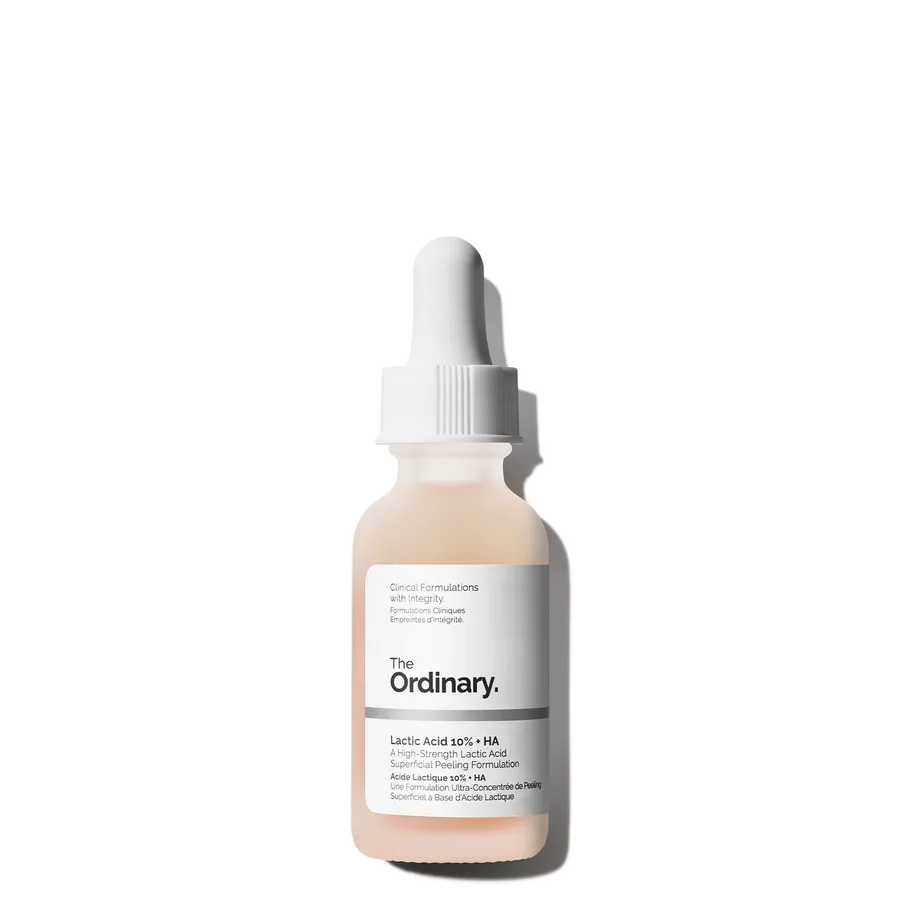
Frosted glass dropper bottle with white pipette cap, identical to the 10% version — distinguished by the label concentration
Minimal to no tingling for most users — a stark contrast to higher-concentration AHAs. Some users report feeling nothing at all, which can feel anticlimactic but is actually the product working as designed. No purging is typical at this concentration, though a very small percentage of congested skin may experience mild breakouts in week one. Can be used daily from the start for most skin types.
3-4 months with daily evening use on face
All Year
Released alongside the 10% version in The Ordinary's original lineup, the 5% has always lived slightly in its sibling's shadow — fewer reviews, less buzz, less dramatic before-and-after content. But it fills a crucial gap that the 10% cannot: it's the AHA for people who've been told their skin is too reactive for chemical exfoliation. By proving that effective acid exfoliation exists at gentler concentrations, this product has served as many people's gateway to an entire category of skincare they thought was off-limits.
The Ordinary launched in 2016 under parent company DECIEM and quickly became one of the most recognized names in affordable, ingredient-focused skincare. While the brand lacks proprietary clinical trials on its specific formulations, it builds products around well-studied actives at transparent concentrations, earning widespread dermatologist acknowledgment.
The 5% is just a diluted version of the 10% and therefore half as effective.
The relationship between acid concentration and efficacy isn't linear. At 5% and the same pH, this formula still provides meaningful free acid for exfoliation — enough to improve texture, brightness, and mild pigmentation over time. The lower concentration means gentler, more gradual results, not no results.
If the 5% doesn't sting, it's not working.
Stinging is an irritation response, not an efficacy indicator. The Tasmannia Lanceolata extract specifically reduces stinging without altering the acid's exfoliating activity. A lack of sensation means the anti-irritant is doing its job, not that the lactic acid isn't.
If you've never used a chemical exfoliant before or have sensitive or reactive skin, start with the 5%. It provides genuine exfoliation with significantly less irritation risk. You can graduate to the 10% after 4-6 weeks if your skin tolerates the 5% well and you want stronger results. If you've used other mild acids before and don't have sensitive skin, starting at 10% is reasonable.
Yes — the 5% concentration is formulated for daily evening use. Most users can apply it nightly from the start without a buildup period, though patch testing first is always advised. If you notice any dryness or sensitivity, reduce to every other day.
Yes, though results are more gradual than the 10% version. Expect smoother texture within 2-3 weeks and improved skin brightness at 6-8 weeks. For mild dark spots and uneven tone, consistent use over 8-12 weeks delivers visible improvement. The lower concentration trades speed for comfort — the destination is the same, the journey is just gentler.
Yes, but not ideally in the same routine step. Niacinamide at a higher pH can reduce the efficacy of lactic acid if applied immediately before or after. Use the lactic acid in the evening and niacinamide in the morning, or wait 20-30 minutes between the two in the same routine.
Use with caution. While this is one of the gentlest AHAs available, rosacea-prone skin has an impaired barrier that may react even to mild acids. If you want to try it, patch test on a small area for several days, start with every third day, and discontinue immediately if you see redness or flaring. Many rosacea patients find even 5% lactic acid too activating.
Recurring themes our editors read across retailer reviews of this product — summaries in our words, not quotations, and not a substitute for your own patch test.
Noticeably smoother skin texture within two weeks of regular use
Gentle enough for sensitive skin with minimal stinging or irritation
Excellent value at $8.10 for a well-formulated mild AHA
Quick visible results without the harshness of stronger exfoliants
Works well as an entry-level chemical exfoliant for acid beginners
May not be strong enough for experienced AHA users seeking dramatic results
Still requires sunscreen compliance which some find inconvenient
30ml only — no larger size option for extended use
Results are more gradual compared to the 10% version
Verified answers from our questions library — the nuance a product page cannot carry.