Four Kitchen Masks, Graded: One Is a Drug, One Stains, Two Are Just Nice
The blanket dismissal of DIY masks is lazy, because these four grade completely differently once you look at what is actually in them and at what dose.
Read the preview
From the DermApproved blog, in DIY and At-Home: one of the four big kitchen face masks is not folklore. Its active ingredient holds a federal drug monograph, with the anti-inflammatory chemistry worked out down to the molecule. But the version you make in a blender is not the same substance — it fails one specification. For the full breakdown, visit dermapproved.com/blog.
Grade them separately or you learn nothing
There are two standard positions on kitchen skincare and both are useless. One treats the pantry as a suppressed pharmacy. The other waves the whole category away as folklore, usually in the same breath as recommending a product whose hero ingredient is an oat extract.
The honest approach is to grade each one on its own terms: what is the active compound, is there human evidence, what concentration does the kitchen version actually deliver, and what goes wrong. Do that with the four masks that dominate the genre and they separate immediately — one holds regulatory drug status, one has a strong clinical file that the supermarket version cannot inherit, one fails on arithmetic, and one works well enough to have accumulated its own list of side effects.
None of that requires condescension. Two of these ingredients are in serious commercial dermatological products for good reasons.
Oatmeal: the one that is legally a drug
Colloidal oatmeal is not a folk remedy that happens to be soothing. In the United States it is a recognised over-the-counter skin protectant active ingredient under the skin protectant monograph, permitted from a minimum of 0.007% — or 0.003% in combination with mineral oil — and carrying monograph labelling for temporarily protecting and relieving minor skin irritation and itching due to rashes, eczema, poison ivy, oak or sumac, and insect bites. That is a drug claim, granted on a reviewed evidence base.
The mechanism has been chased down to specific molecules. Oats contain avenanthramides, phenolic compounds present at roughly 300 parts per million. In work published in Archives of Dermatological Research, avenanthramides at concentrations as low as one part per billion inhibited degradation of IκB-α in keratinocytes, with correspondingly reduced phosphorylation of the NF-κB p65 subunit; treated cells showed significantly inhibited TNF-α-induced NF-κB activity and reduced interleukin-8 release. Applied topically at one to three parts per million, they reduced inflammation in contact hypersensitivity and neurogenic inflammation models and cut pruritogen-induced scratching. That is a real anti-inflammatory and anti-itch pathway, not a moisturising effect described flatteringly.
Here is the catch that the kitchen version runs into. "Colloidal" is a specification, not an adjective. It denotes oat that has been milled and processed so that it disperses and stays suspended in water rather than settling out, which is what allows it to coat skin in a continuous film and stay there. Breakfast oats pulsed in a blender do not meet it. They produce a coarse slurry that sinks, sits on the surface in lumps, and rinses off taking most of the benefit with it. The bath water goes cloudy either way, which is why nobody notices.
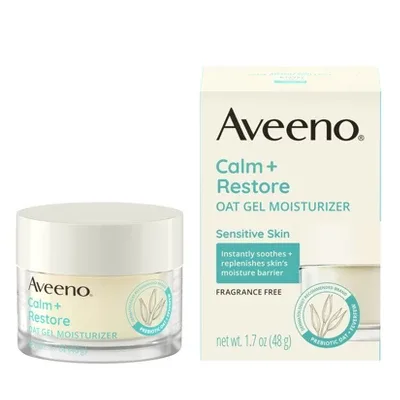
So the sensible move is to buy the specification rather than approximate it. Aveeno Eczema Therapy Moisturizing Cream carries colloidal oatmeal as a declared active with a drug facts panel; Aveeno Calm + Restore Oat Gel Moisturizer is the lighter daily version. If you want the ingredient in a fuller barrier formula, A-Derma Exomega Control Emollient Cream is built around Rhealba oat, a specific oat cultivar extract used across a European derm range. The colloidal oatmeal entry covers where the evidence is strongest, and if eczema is the reason you are reading this, whether oat and ceramide products actually do anything and whether bath additives help are the two questions worth settling before you buy anything.
Honey: the distinction that is not pedantry
Honey has the best clinical file of the four, and it is also the one where the gap between the evidence and the kitchen is widest.
A Cochrane review identified 26 eligible trials with 3,011 participants across acute and chronic wounds. Its strongest finding is genuinely strong: high-quality evidence from two trials with 992 participants that honey dressings heal partial-thickness burns more quickly than conventional dressings, by a weighted mean difference of about 4.7 days. Against silver sulfadiazine, six trials found no difference in overall healing within six weeks but a reduction in adverse events with honey. For venous leg ulcers and minor acute wounds the effects were unclear on low or very low quality evidence. So: real, specific, and narrower than the headline.
Now read what was actually used. Wound-care honey is medical grade — ultra-filtered, sterilised, and standardised for antibacterial activity batch to batch. The sterilisation matters more than it sounds. Raw honey routinely carries dormant bacterial spores including Clostridium botulinum, which are harmless swallowed by a healthy adult and are not harmless introduced into an open wound. Gamma irradiation is used precisely because it kills those spores without heat; work spiking honey with around a million C. botulinum spores found batches sterile after a 25 kGy dose, with antibacterial activity unaltered. Supermarket honey has had none of this done to it and is not standardised for potency either — activity varies enormously by floral source and batch.
And the trials were on wounds. On intact facial skin honey is a humectant sugar solution: it draws water, it feels pleasant, it rinses off, and there is no evidence base for it doing anything more than that. That is not nothing — it is simply a much smaller claim than the wound literature makes, and transferring one to the other is the single most common error in this whole genre. The honey entry separates the two evidence bases properly. If you want the ingredient in a form that is preserved, stable and formulated for the face, Farmacy Honey Halo Ceramide Face Moisturizer pairs honey extract with ceramides rather than asking a sugar syrup to do barrier work on its own.
Yogurt: the arithmetic does not work
The yogurt mask is credited with gentle exfoliation via lactic acid, and this is the one claim in the genre that can be settled with a calculator rather than an opinion.
Start with what yogurt is required to be. Under its US standard of identity, yogurt has a pH of 4.6 or lower measured on the finished product. Lactic acid has a pKa of 3.86, which means that at pH 4.6 the great majority of the lactic acid present is sitting as lactate — the salt form — rather than as free acid. Only the free acid fraction does exfoliative work, and at that pH it is a small minority of an already modest total.
Compare that with how lactic acid is actually formulated when the intent is exfoliation: single-digit to low-double-digit percentages, deliberately adjusted to a lower pH so that a meaningful proportion stays in the free acid form. The gap between those two situations is not a matter of degree. It is the difference between a dose and a trace.
This does not mean the yogurt mask does nothing perceptible. It is cold, it is bland, it holds water against the skin for twenty minutes, and it comes off leaving skin soft and slightly plumped. Every one of those effects is real and every one of them is also true of any cool, occlusive, water-rich substance you leave on your face. Attributing them to acid exfoliation is the error, and the reason it matters is that people conclude their skin "can't handle" acids because yogurt did nothing, or conversely double down on a mask that was never going to address the pigment or texture they are targeting. If low-strength lactic acid at a working pH is what you actually want, The Ordinary Lactic Acid 5% + HA is the entry point, and it is formulated to be one.
Turmeric: it works, and then it stains you
Turmeric is the one where the pharmacology is more credible than the sceptics allow and the practical downside is more real than the enthusiasts admit.
A systematic review screened 234 articles and included 18 clinical studies of turmeric or curcumin in skin health, covering acne, alopecia, atopic dermatitis, facial photoaging, oral lichen planus, pruritus, psoriasis, radiodermatitis and vitiligo. Ten of those studies reported statistically significant improvement in disease severity versus control. That is a meaningful signal across a genuinely broad set of conditions, and it is why curcumin keeps appearing in serious formulation work rather than only in wellness marketing.
The problems are practical rather than theoretical. Curcumin is an intense yellow pigment and it stains — skin for a day or two, and towels, pillowcases and grouting rather more permanently. It is also a documented contact allergen: the dermatology literature carries reported cases of contact dermatitis from turmeric in a massage oil and contact allergy to tetrahydrocurcumin, a derivative used specifically because it is colourless. Being plant-derived confers no exemption from sensitisation; if anything the botanicals are over-represented in patch-test clinics.
There is a formulation problem too. Curcumin is poorly soluble and does not cross an intact stratum corneum efficiently on its own, which is why commercial products that take it seriously build a delivery system around it rather than suspending root powder in a carrier. A paste mixed at the sink is the least efficient possible way to present it. The turmeric entry covers what the evidence supports, and Cocokind Turmeric Spot Treatment is the version of this idea that has been formulated, preserved and dosed rather than improvised.
The rule that applies to all four
Whatever you mix at home has one property in common: it is unpreserved, and most of it is mostly water.
A preservative system is the least glamorous part of a cosmetic formula and the reason a jar can sit open in a warm bathroom for months. Anything blended from yogurt, honey, mashed fruit or a wet oat slurry has none, and it is a nutrient-rich medium sitting at room temperature. The rule is therefore simple and non-negotiable: mix it, use it, throw the rest away the same day. Never store a batch in the fridge for the week. And never apply any of it to skin that is broken, weeping, freshly exfoliated, sunburned or actively eczematous — a compromised barrier is the one situation where an unsterile preparation can cause a problem far worse than the one it was meant to help. That is also exactly when people reach for a soothing mask, which is what makes it worth saying plainly. The eczema pathway sets out what genuinely belongs on inflamed skin.
Two habits make the whole category safer. Patch test anything new, including anything you would happily eat, on a small area for several days and log it — the Patch Test Log exists because a delayed reaction at day four is otherwise unattributable, and botanicals are precisely the ingredients that produce delayed reactions. And before you assume a commercial product is the inferior option, run its label through the Ingredient Decoder; you will frequently find the same botanical you were about to mash, present at a known concentration, in a preserved base, with an actual delivery system.
The fair summary of the four: oatmeal is a genuine active and worth buying properly specified rather than approximating. Honey has strong wound evidence that a supermarket jar cannot claim, and on intact skin it is a pleasant humectant. Yogurt is a nice cold compress that is not exfoliating you. Turmeric works and stains. Two of those are worth your time, and neither of them is the one with the best photographs.
Products mentioned
Independently reviewed and scored — the real products behind this piece.



- Therapy guide Eczema What genuinely belongs on inflamed skin — and what does not.
- Ingredient Colloidal Oatmeal The monographed active, and where its evidence is strongest.
- Ingredient Honey (Mel) Separates the wound-care evidence from the intact-skin claim.
- Ingredient Turmeric (Curcuma Longa) Real signal, real staining, real sensitisation.
- Ingredient Rhealba Oat Extract (Oat Plantlet Extract) The specific oat cultivar extract behind a European derm range.
- Question Do colloidal oatmeal and ceramide products actually do anything? The evidence question behind the oat aisle.
- Question Do bath oils and emollient bath additives help? Relevant to anyone about to tip oats into a bath.
References
- Avenanthramides, polyphenols from oats, exhibit anti-inflammatory and anti-itch activity — Archives of Dermatological Research, 2008
- Honey as a topical treatment for wounds — Cochrane Database of Systematic Reviews, 2015
- The sterilization of honey with cobalt 60 gamma radiation: a study of honey spiked with spores of Clostridium botulinum and Bacillus subtilis — Experientia, 1995
- Effects of Turmeric (Curcuma longa) on Skin Health: A Systematic Review of the Clinical Evidence — Phytotherapy Research, 2016
- Contact dermatitis caused by turmeric in a massage oil — Contact Dermatitis, 2016
- Contact allergy to tetrahydrocurcumin — Contact Dermatitis, 2003
- 21 CFR Part 347 — Skin Protectant Drug Products for Over-the-Counter Human Use — US Code of Federal Regulations, 2003
- 21 CFR 131.200 — Yogurt — US Code of Federal Regulations, 2021
Every cited link is verified to resolve to the paper named. Where a source could not be independently confirmed, it is listed without a link rather than pointing you somewhere wrong.
Frequently asked
Can I just blend porridge oats to make colloidal oatmeal?
Not really, and the reason is mechanical rather than snobbery. Colloidal oatmeal is a specification: oat milled and processed so that it disperses in water and stays suspended, which is what lets it form a continuous film on skin. Home-blitzed oats produce a coarse slurry that settles out and rinses away. Cloudy bath water looks like success and is not a measure of anything.
Why does the honey research not apply to the honey in my kitchen?
Two reasons. Medical honey is filtered, sterilised — usually by gamma irradiation, which kills bacterial spores without heat — and standardised so each batch has known antibacterial potency. Supermarket honey has had none of that and varies enormously by floral source. Second, the trials studied wounds, principally partial-thickness burns. On intact skin honey is a humectant, which is a much smaller and much less impressive claim.
So a yogurt mask does absolutely nothing?
It does something; it just is not exfoliation. It is cold, bland and water-rich, and holding that against skin for twenty minutes leaves it soft and temporarily plumped. What it does not do is deliver a working dose of free lactic acid, because yogurt sits at a pH where most of the lactic acid present is in its inactive salt form and the total amount is small to begin with. Enjoy it as a compress, not as a peel.
Turmeric is natural, so why would it cause a reaction?
Botanical origin has no bearing on allergenicity — plant extracts are heavily represented among positive patch tests. Contact dermatitis from turmeric and contact allergy to tetrahydrocurcumin are both documented in the dermatology literature. Curcumin also stains skin and fabric intensely, and it penetrates intact skin poorly without a delivery system, which is why formulated products outperform a paste even before you consider the yellow towels.
How long can I keep a homemade mask?
Use it the day you make it and discard the rest. Anything mixed from dairy, honey, fruit or oats is a water-rich, nutrient-dense medium with no preservative system, sitting in a warm bathroom. Preservatives are the boring reason commercial products stay safe for months after opening. Never apply an unpreserved mixture to broken, weeping, freshly exfoliated or sunburned skin, which is unfortunately exactly when a soothing mask is most tempting.