Promisingfor AcneIn your profileYou chose · Glycolic Acid has trial-level evidence for acne but no guideline or regulatory standing yet — promising, short of a recommendation; the other actives here are not yet assessed for it.Moderate evidenceGentle11 reviews collected
The case for it
Triple Acid Complex has trial-level evidence for this concern but no guideline or regulatory standing yet.
It is plausibly present at a working level, though the concentration is not declared.
The formula carries none of the triggers this concern is sensitive to.
What would change this: A declared concentration would move this to a firmer reading of the dose.
Same rule for everyone. “Promising” is the verdict on 7,858 of 45,024 concern verdicts across the catalog; rule R9p decided 7,858 of them.
Unchanged since September 5, 2026, engine 5.1.1.
R9p — 0.5.0: 'Unproven' beside three filled dots read as one question answered twice with opposite words (7,018 rows). The chip measures standing, the dots measure trial volume; where the row carries at least one RCT or a tier-2 source (moderate dots) and the active is present at a working level, the honest word is Promising. Unproven is reserved for plausible-standing rows with limited or weak evidence, or an under-dosed form. Same rank as Unproven — a bet either way; the dots order them. · the full register
Carrying active
Triple Acid Complex
Standing
plausible — trials support it
Form
plausible — studied range 10%, from the OTC monograph or label; needs leave-on contact; judge it after ~8 weeks
Tolerability
gentle
Row checked
against its sources on July 17, 2026 (evidence table ev-2026.09-r228)
Promisingfor BlackheadsIn your profileYou chose · Glycolic Acid has trial-level evidence for blackheads but no guideline or regulatory standing yet — promising, short of a recommendation; the other actives here are not yet assessed for it.Moderate evidenceGentle11 reviews collected
The case for it
Triple Acid Complex has trial-level evidence for this concern but no guideline or regulatory standing yet.
It is plausibly present at a working level, though the concentration is not declared.
The formula carries none of the triggers this concern is sensitive to.
What would change this: A declared concentration would move this to a firmer reading of the dose.
Same rule for everyone. “Promising” is the verdict on 7,858 of 45,024 concern verdicts across the catalog; rule R9p decided 7,858 of them.
Unchanged since September 5, 2026, engine 5.1.1.
R9p — 0.5.0: 'Unproven' beside three filled dots read as one question answered twice with opposite words (7,018 rows). The chip measures standing, the dots measure trial volume; where the row carries at least one RCT or a tier-2 source (moderate dots) and the active is present at a working level, the honest word is Promising. Unproven is reserved for plausible-standing rows with limited or weak evidence, or an under-dosed form. Same rank as Unproven — a bet either way; the dots order them. · the full register
Carrying active
Triple Acid Complex
Standing
plausible — trials support it
Form
plausible — studied range 5–10%, from the OTC monograph or label; needs leave-on contact; judge it after ~8 weeks
Tolerability
gentle
Row checked
against its sources on July 17, 2026 (evidence table ev-2026.09-r228)
Guidelines of care for the management of acne vulgaris — Journal of the American Academy of Dermatology (AAD clinical guideline, GRADE-based) — cited as evidence that glycolic acid appears in NONE of its 18 recommendations (2024), opened July 16, 2026
Good choicefor DullnessIn your profileYou chose · Glycolic Acid is a reference standard by mechanism for dullness; this liquid carries it.Moderate evidenceGentle11 reviews collected
The case for it
Triple Acid Complex has trial-supported standing for this concern.
It is plausibly present at a working level, though the concentration is not declared.
The formula carries none of the triggers this concern is sensitive to.
What would change this: A declared concentration would move this to a firmer reading of the dose.
Same rule for everyone. “Good choice” is the verdict on 9,564 of 45,024 concern verdicts across the catalog; rule R5 decided 9,072 of them.
Unchanged since September 5, 2026, engine 5.1.1.
Good choicefor Rough TextureIn your profileYou chose · Glycolic Acid is a reference standard by mechanism for rough texture; this liquid carries it.Moderate evidenceGentle11 reviews collected
The case for it
Triple Acid Complex has trial-supported standing for this concern.
It is plausibly present at a working level, though the concentration is not declared.
The formula carries none of the triggers this concern is sensitive to.
What would change this: A declared concentration would move this to a firmer reading of the dose.
Same rule for everyone. “Good choice” is the verdict on 9,564 of 45,024 concern verdicts across the catalog; rule R5 decided 9,072 of them.
Unchanged since September 5, 2026, engine 5.1.1.
Not for thisfor Large PoresIn your profileYou chose · The actives here have been researched for large pores and the evidence does not support the claim.Not yet assessedGentle11 reviews collected
The case for it
Triple Acid Complex has been researched for this concern and the evidence does not support it.
It is plausibly present at a working level, though the concentration is not declared.
The formula carries none of the triggers this concern is sensitive to.
What would change this: A declared concentration would move this to a firmer reading of the dose.
Same rule for everyone. “Not for this” is the verdict on 488 of 45,024 concern verdicts across the catalog; rule R10 decided 488 of them.
Unchanged since September 5, 2026, engine 5.1.1.
The effect of glycolic acid on the treatment of acne in Asian skin — Dermatologic Surgery — cited as the PROVENANCE of the pore claim, NOT as evidence: its pore observation is subjective and uncontrolled, so it fails the admission rule (1997), opened July 16, 2026
Also listed for Excess Oiliness — the actives here (Hyaluronic Acid, Probiotics & Prebiotics, Vitamin C, Centella Asiatica) are in our research queue for that concern; there is no verdict until their evidence rows are written. That is a gap in our table, not a mark against the product.
Does the jobDoes what a toner is for: not alcohol-driven, adds something real. Not measured from the label: restores skin pH, plays well with what follows.
A verdict is DermApproved’s assessment of how well a product’s ingredients fit a concern — never a claim about what the product treats. Evidence dots and collected reviews sit beside it and are never blended in.
Rules 0.5.1 · evidence table ev-2026.09-r228 · how we decide
Assessment
Pros & Cons
Pros
✓ Triple acid complex addresses acne through multi-mechanism approach
✓ Strong drugstore-prestige value at $29 for 250ml
✓ Fungal-acne safe
Cons
✗ Pregnancy contraindication due to salicylic acid
✗ Mild drying potential for very dry skin
✗ Triple acid may be aggressive for sensitive skin
✗ Cannot combine with retinoid same-day
Review
Full Review
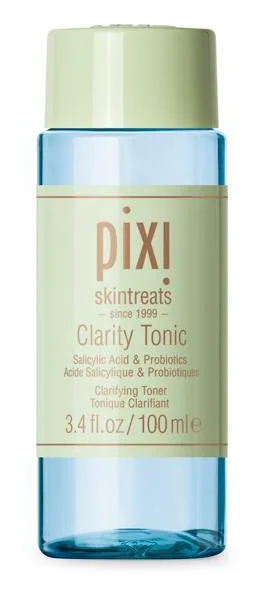
Pixi managed something most brands only dream of: it turned a single hero product, the cult Glow Tonic, into an entire exfoliating-toner empire. The Clarity Tonic is that empire's blemish-focused sibling, trading the Glow Tonic's brightening lean for a multi-acid, pore-clearing formula aimed squarely at oily and breakout-prone skin. Refreshingly for a category that often equates results with stripping the skin raw, this one pairs its actives with a real soothing-and-hydrating support layer, which is most of what separates a usable acid toner from a punishing one.
The exfoliating core is a triple-acid blend that attacks congestion from several angles at once. Glycolic acid, an AHA, drives surface turnover and smoothing; salicylic acid, an oil-soluble BHA, slips into the pores where blackheads and breakouts actually form and clears them from the inside; and lactic acid, a gentler AHA, adds a layer of additional, more forgiving exfoliation that also brings a little hydration of its own. The individual concentrations are kept modest, appropriate for a daily-leaning toner, and the multi-mechanism approach means you get meaningful clearing without leaning on one aggressive, high-percentage acid that picks a fight with your barrier. Crucially, Pixi buffers all of this rather than leaving it raw. Dual probiotic ferments from Lactobacillus and Leuconostoc lend skin-microbiome support and soften the acid action; a soothing cast of centella asiatica, licorice root, and willow bark tempers irritation while adding a brightening note from the licorice and anti-inflammatory support across the board; magnesium ascorbyl phosphate, a stable vitamin C derivative, contributes modest tone support without the instability of pure ascorbic acid; and a multi-source humectant group of aloe, sodium hyaluronate, and sodium PCA keeps the skin hydrated straight through the exfoliation, which is genuinely critical for tolerability. The acidic pH lets the acids do their job, and the formula is fragrance-free, oil-free, vegan, and fungal-acne-safe.
In practice it is a straightforward leave-on liquid swept on after cleansing, and over consistent use it gradually clears congestion, smooths rough texture, manages oil, and refines the look of large pores, with visible improvement in clarity typically arriving over two to four weeks. A down-to-earth approach matters here, though, because this is genuinely active. Starting a few times a week and building up as your skin signals tolerance is the smart route; over-using it, or stacking it on top of other strong exfoliants or a same-day retinoid, risks tipping into irritation rather than progress, and the two should not share a routine on the same evening. Because it carries both AHAs and a BHA, diligent daytime sunscreen is non-negotiable — exfoliated skin is more sun-sensitive — and the salicylic acid brings the standard pregnancy contraindication, so it should be set aside during that window. The moderate irritation-risk score is an honest reflection that even a well-buffered acid toner is still an acid toner.
Its limits are mostly about fit rather than failings. Very dry skin may find the triple-acid load mildly drying despite the humectant cushion, and sensitive skin can find it a touch much without careful easing-in. Some users who came for general radiance simply prefer the original Glow Tonic and find this more than they need — a fair preference, since Clarity is built for clearing rather than glow, and the two products genuinely serve different goals. None of that undercuts the formula; it just defines who it is for.
On value, it lands strongly. A well-buffered triple-acid toner carrying probiotics, multi-botanical soothing, a vitamin C derivative, and a real humectant system, in a generous 250ml bottle at this price, is a lot of considered formulation for the money, and the support layer makes it appreciably more usable than the many bare acid toners that cost the same or more. Pixi is an established, drugstore-prestige brand founded in 1999 by Petra Strand, and the high data confidence here is backed by a substantial review base in the thousands.
It suits oily, combination, and breakout-prone skin that wants a daily-to-few-times-weekly exfoliating toner to clear congestion without over-stripping, with the soothing-and-hydrating cast making it gentler in practice than its acid list reads on paper. Give it a miss if you are pregnant, if your skin is dry, sensitive, or already running strong exfoliants and flirting with over-exfoliation, or if you simply want a calm hydrating toner rather than an active one.
A few words on fitting it into a routine, because acid toners are easy to misuse. After cleansing, sweep it on with a cotton pad or clean hands and let it absorb before the rest of your products; there is no need to rinse. Keep it on a different night from any retinoid rather than layering the two and hoping for the best, and build frequency slowly — two or three nights a week to start is plenty until you know how your skin responds. The single most important habit, though, is unwavering daytime sunscreen, because the freshly exfoliated surface this leaves behind is more vulnerable to UV, and skipping protection can undo the clarity you came for and even deepen pigmentation. Used with that kind of patience, it earns its place. For refining and clearing oily, blemish-prone skin at a sensible price, it is one of the better-balanced options in its class.
Formula
Key Ingredients
The hero actives that drive this product's performance.
Triple acid combinations with modest individual concentrations provide multi-mechanism acne treatment that can be more tolerable than high-concentration single-acid alternatives. Glycolic acid surface exfoliation plus salicylic acid pore-level oil-soluble treatment plus lactic acid gentle additional exfoliation. Probiotic chemistry provides supportive skin-conditioning effects with growing research base. Multi-source botanical soothing buffers the acid action.
References
Multi-acid toners in acne treatment — Journal of Cosmetic Dermatology (2019)
Dermatologist Perspective
Multi-acid drugstore toners with supportive chemistry are commonly recommended for users with acne-prone, oily, or combination skin seeking accessible exfoliating treatment.
Guidance
Usage & Recommendations
How to Use
Apply with cotton pad AM and/or PM. Start 2-3x weekly, build to daily. Always SPF in AM.
Value Assessment
At $29 for 250ml ($3.43 per ounce), strong drugstore-prestige value.
Released as companion to Pixi's iconic Glow Tonic — anchored by the same Pixi philosophy of accessible glow and treatment skincare at drugstore-prestige price points.
About Pixi Established Brand (5–20 years)
Pixi is a UK-based drugstore-prestige brand founded by Petra Strand in 1999 — known for the iconic Glow Tonic and accessible glow-and-treatment skincare. Clarity Tonic is the acne-targeted companion to Glow Tonic combining glycolic acid, lactic acid, salicylic acid, probiotics, and antioxidants.
Brand founded: 1999 · Product launched: 2018
Myth vs. Reality
Common Myths
Myth
Triple acid toners are categorically harsher than single-acid alternatives.
Reality
Triple acid toners with modest individual acid concentrations can be more tolerable than single-acid alternatives at higher concentrations — multi-mechanism approach often allows lower individual percentages for similar effect. The Pixi formulation's probiotics and soothing botanicals further buffer the acid action.
FAQ
Frequently Asked Questions
How is this different from Pixi Glow Tonic?
Glow Tonic uses 5% glycolic acid alone for general radiance and texture. Clarity Tonic uses triple acid complex (glycolic + lactic + salicylic) for acne-specific treatment with probiotics, multi-botanical soothing, and vitamin C derivative.
Is the Clarity Tonic safe to use during pregnancy?
No — salicylic acid at toner concentrations is typically avoided during pregnancy. Choose pregnancy-safe alternatives during this period.
How often to use?
Start 2-3 times per week and build up to daily based on tolerance. Don't use same day as retinoid.
Is this fungal-acne safe?
Yes — oil-free formulation.
Will it dry skin?
Mild drying potential, but the probiotics and humectants buffer the acid action effectively. Sensitive or dry skin may want to use less frequently.
Will the 250ml bottle last?
Approximately 3-4 months at daily use.
Reviews
What Reviewers Tend to Say
Recurring themes our editors read across retailer reviews of this product — summaries in our words, not quotations, and not a substitute for your own patch test.
Common Praise
Triple acid complex addresses acne and texture
Probiotics and centella buffer the acid action
Fragrance-free and alcohol-free
Strong value at $29 for 250ml
Common Complaints
Pregnancy contraindication due to salicylic acid concentration
Too aggressive for very dry skin
Some users prefer the original Glow Tonic for general radiance
Notable Endorsements
Pixi UK drugstore-prestige brandCompanion to iconic Glow Tonic
A generation started using acids daily because the bottle said 'daily,' then wondered why their skin turned raw, shiny, and spotty. The right cadence is almost always lower than the label suggests.
The smallest AHA gets deepest and shows results soonest — which is precisely why routines built around it overshoot, and why the people who do best with it use it least.
The whole case for salicylic acid rests on one unglamorous fact of chemistry: it dissolves in oil. Understand that, and you know exactly when it beats a glycolic acid — and when it's overkill.
Glycolic gets the hype and the higher numbers. But lactic acid does something glycolic can't — and for a lot of skin, that changes the whole calculation.
Jan 26, 2026· 5 min
Questions people ask about Acne
Verified answers from our questions library — the nuance a product page cannot carry.
Products, answers, therapy guides, tools and articles in one search. Brand names,
slang and abbreviations all work — accutane finds isotretinoin, bacne finds truncal acne.