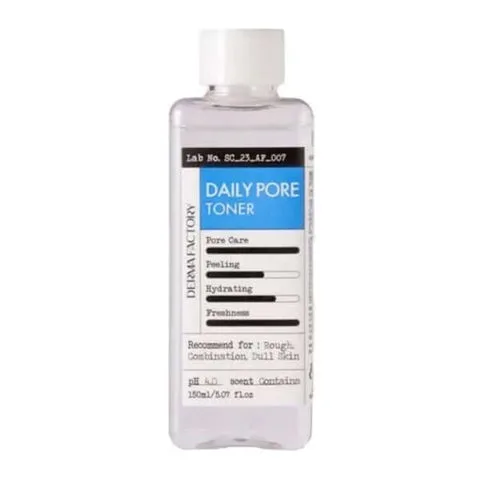
It blends three acid types — AHA, PHA and BHA — in a 76.8% bifida-ferment base, so it exfoliates pores and texture while the ferment soothes and supports the barrier, an unusually well-rounded approach for a budget acid toner.
A surprisingly well-rounded budget exfoliating toner: a multi-acid AHA/PHA/BHA blend cushioned in a 76.8% bifida-ferment base, so it smooths texture and clears pores while the ferment soothes and supports the barrier. Strong value for oily, congested skin. The added fragrance and the realities of daily acid use make it a poor pick for dry or sensitive skin.
The brand discloses the acid percentages and the ferment-heavy base is clear, so the formula is easy to assess and sensibly built for the price; pricing, however, swings widely between budget Korean retailers and marked-up importers. The exfoliating logic is sound for oily skin; this medium-confidence rating reflects the added fragrance, the over-exfoliation risk that the 'daily' name understates, and the young brand's lack of any clinical track record.
Verdicts
How well it fits each concern
Verdict by concern tap a concern for the case
Not for thisfor Large PoresIn your profileYou chose · The actives here have been researched for large pores and the evidence does not support the claim.Not yet assessedStandard tolerabilityNo reviews collected yet
The case for it
AHA/PHA/BHA Acid Blend has been researched for this concern and the evidence does not support it.
It is present below the studied range.
The formula carries no trigger this concern is sensitive to, with the cautions noted.
What would change this: A concentration inside the studied range would raise this a step.
Same rule for everyone. “Not for this” is the verdict on 488 of 45,024 concern verdicts across the catalog; rule R10 decided 488 of them.
Unchanged since September 5, 2026, engine 5.1.1.
The effect of glycolic acid on the treatment of acne in Asian skin — Dermatologic Surgery — cited as the PROVENANCE of the pore claim, NOT as evidence: its pore observation is subjective and uncontrolled, so it fails the admission rule (1997), opened July 16, 2026
Unprovenfor BlackheadsIn your profileYou chose · Glycolic Acid has early or mechanistic evidence for blackheads — a reasonable bet, not a recommendation; the other actives here are not yet assessed for it.Moderate evidenceStandard tolerabilityNo reviews collected yet
The case for it
AHA/PHA/BHA Acid Blend has early or mechanistic evidence for this concern, not trial-backed standing.
It is present below the studied range.
The formula carries no trigger this concern is sensitive to, with the cautions noted.
What would change this: A concentration inside the studied range would raise this a step.
Same rule for everyone. “Unproven” is the verdict on 1,111 of 45,024 concern verdicts across the catalog; rule R9 decided 1,111 of them.
Unchanged since September 5, 2026, engine 5.1.1.
R9 — Plausible-tier actives alone do not earn a recommendation, and 'not for this' would overstate the case against them. 'Unproven' with the evidence dots lets the reader judge the bet (added 0.2.0 after the first shadow run put a 10% niacinamide serum at 'not for this' for hyperpigmentation). 0.5.0: the closing clause reads the other heroes — "nothing else here addresses it" only when every other active has a researched 'none' row; "not yet assessed" when that is the truth. Rows whose dots read moderate or better now reach R9p first. · the full register
Carrying active
AHA/PHA/BHA Acid Blend
Standing
plausible — trials support it
Form
sub threshold (declared 3%) — studied range 5–10%, from the OTC monograph or label; needs leave-on contact; judge it after ~8 weeks
Tolerability
standard
Row checked
against its sources on July 17, 2026 (evidence table ev-2026.09-r228)
Guidelines of care for the management of acne vulgaris — Journal of the American Academy of Dermatology (AAD clinical guideline, GRADE-based) — cited as evidence that glycolic acid appears in NONE of its 18 recommendations (2024), opened July 16, 2026
Supporting rolefor Rough TextureIn your profileYou chose · Glycolic Acid is a reference standard by mechanism for rough texture, but this liquid carries it below the studied range — a supporting role at best.Moderate evidenceStandard tolerabilityNo reviews collected yet
The case for it
AHA/PHA/BHA Acid Blend has trial-supported standing for this concern.
It is present below the studied range.
The formula carries no trigger this concern is sensitive to, with the cautions noted.
What would change this: A concentration inside the studied range would raise this a step.
Same rule for everyone. “Supporting role” is the verdict on 8,197 of 45,024 concern verdicts across the catalog; rule R7 decided 258 of them.
Unchanged since September 5, 2026, engine 5.1.1.
R7 — A supported active under-dosed cannot be recommended for the concern; if the category has a supportive job it may still help alongside treatment. · the full register
Carrying active
AHA/PHA/BHA Acid Blend
Standing
supported — its mechanism is established
Form
sub threshold (declared 3%) — studied range 4–10%, from the trials on the row; needs leave-on contact; judge it after ~8 weeks
Tolerability
standard
Row checked
against its sources on July 17, 2026 (evidence table ev-2026.09-r228)
The studies behind the evidence row
International Cosmetic Ingredient Dictionary and Handbook — declared function — Personal Care Products Council
Harry's Cosmeticology / Baran & Maibach Textbook of Cosmetic Dermatology — humectant, emollient and occlusive classification — standard reference text
Supporting rolefor DullnessIn your profileYou chose · Glycolic Acid is a reference standard by mechanism for dullness, but this liquid carries it below the studied range — a supporting role at best.Moderate evidenceStandard tolerabilityNo reviews collected yet
The case for it
AHA/PHA/BHA Acid Blend has trial-supported standing for this concern.
It is present below the studied range.
The formula carries no trigger this concern is sensitive to, with the cautions noted.
What would change this: A concentration inside the studied range would raise this a step.
Same rule for everyone. “Supporting role” is the verdict on 8,197 of 45,024 concern verdicts across the catalog; rule R7 decided 258 of them.
Unchanged since September 5, 2026, engine 5.1.1.
R7 — A supported active under-dosed cannot be recommended for the concern; if the category has a supportive job it may still help alongside treatment. · the full register
Carrying active
AHA/PHA/BHA Acid Blend
Standing
supported — its mechanism is established
Form
sub threshold (declared 3%) — studied range 4–10%, from the trials on the row; needs leave-on contact; judge it after ~8 weeks
Tolerability
standard
Row checked
against its sources on July 17, 2026 (evidence table ev-2026.09-r228)
The studies behind the evidence row
Harry's Cosmeticology / Baran & Maibach Textbook of Cosmetic Dermatology — humectant, emollient and occlusive classification — standard reference text
Unprovenfor AcneIn your profileYou chose · Glycolic Acid has early or mechanistic evidence for acne — a reasonable bet, not a recommendation; the other actives here are not yet assessed for it.Moderate evidenceStandard tolerabilityNo reviews collected yet
The case for it
AHA/PHA/BHA Acid Blend has early or mechanistic evidence for this concern, not trial-backed standing.
It is present below the studied range.
The formula carries no trigger this concern is sensitive to, with the cautions noted.
Cautions: fragrance.
What would change this: A concentration inside the studied range would raise this a step.
Same rule for everyone. “Unproven” is the verdict on 1,111 of 45,024 concern verdicts across the catalog; rule R9 decided 1,111 of them.
Unchanged since September 5, 2026, engine 5.1.1.
R9 — Plausible-tier actives alone do not earn a recommendation, and 'not for this' would overstate the case against them. 'Unproven' with the evidence dots lets the reader judge the bet (added 0.2.0 after the first shadow run put a 10% niacinamide serum at 'not for this' for hyperpigmentation). 0.5.0: the closing clause reads the other heroes — "nothing else here addresses it" only when every other active has a researched 'none' row; "not yet assessed" when that is the truth. Rows whose dots read moderate or better now reach R9p first. · the full register
Carrying active
AHA/PHA/BHA Acid Blend
Standing
plausible — trials support it
Form
sub threshold (declared 3%) — studied range 10%, from the OTC monograph or label; needs leave-on contact; judge it after ~8 weeks
Tolerability
standard — fragrance load
Row checked
against its sources on July 17, 2026 (evidence table ev-2026.09-r228)
Also listed for Excess Oiliness — the actives here (Probiotics & Prebiotics, Galactomyces (Pitera) are in our research queue for that concern; there is no verdict until their evidence rows are written. That is a gap in our table, not a mark against the product.
Does the jobDoes what a toner is for: adds something real, not alcohol-driven. Not measured from the label: restores skin pH, plays well with what follows.
Where our review and the verdict differ. The review below was written on the formulation and the published trials; the verdicts above apply the stricter standing test in our methodology — an active earns a recommendation only with guideline or regulatory standing for the concern. Where the two disagree, the verdict is DermApproved’s position.
A verdict is DermApproved’s assessment of how well a product’s ingredients fit a concern — never a claim about what the product treats. Evidence dots and collected reviews sit beside it and are never blended in.
Rules 0.5.1 · evidence table ev-2026.09-r228 · how we decide
Assessment
Pros & Cons
Pros
✓ Multi-acid AHA/PHA/BHA blend works at several depths
✓ 76.8% bifida-ferment base soothes and buffers the acids
✓ Gentler than most acid toners; galactomyces and allantoin calm
✓ Oil-free and reads as fungal-acne friendly
✓ Excellent value — large 150ml bottle, low price
✓ Effective on pores, blackheads and rough texture
Cons
✗ Contains added fragrance — a risk for sensitive skin
✗ 'Daily' name invites over-exfoliation if misused
✗ Not suitable for dry or sensitive skin
✗ Requires careful layering and daily sunscreen
✗ Young brand with no clinical track record
Review
Full Review
Budget acid toners usually cut corners in the same place: they throw in one cheap acid, skip the soothing support, and trust that the tingle convinces you it's working. Derma Factory's Daily Pore Toner is more thoughtfully built than its price suggests, and the most interesting thing about it is the balance it tries to strike — real, multi-angle exfoliation cushioned by an unusually large dose of soothing ferment. For oily, congested skin on a budget, that balance makes it genuinely worth a look.
The exfoliating side isn't a single acid but a blend that works at different depths and speeds. Glycolic acid (an AHA, at 3%) resurfaces the top layer; gluconolactone (a PHA) exfoliates more gently and brings extra hydration, which suits skin that finds straight AHAs harsh; and salicylic acid plus capryloyl salicylic acid (BHA) get inside oily pores to clear the congestion behind blackheads and bumps. Using several acid types together, each at a modest level, is a smarter route to smooth, clear skin than one acid at a high, irritating percentage.
The other half of the formula is what makes it interesting: a 76.8% bifida ferment lysate base, with galactomyces ferment filtrate and allantoin alongside. These postbiotic ferments soothe and support the barrier, effectively buffering the acids so the toner can exfoliate with less of the stripping, stinging, and tightness acid toners are notorious for. It's the 'exfoliate but don't wreck the barrier' philosophy executed at a budget price, and it largely works — in use, it's a thin, fresh liquid that leaves skin smoother with only a faint tingle for most people, gentler than its acid list might suggest.
That said, the name oversells the cadence, and this is the most important caveat. 'Daily' doesn't mean unlimited. These are genuine acids, and using the toner too often, or layering it with a retinoid or another exfoliant in the same routine, can tip resilient skin into over-exfoliation, redness, and barrier damage. The ferment base raises the ceiling on how often you can use it, but it doesn't remove the rule: start a few times a week, build up only as your skin proves it can handle it, and treat it as an active, not a splash-on hydrating toner.
The other honest marks against it are narrow but real. It contains added fragrance, which is the main reason sensitive skin should steer clear, and it isn't marketed as vegan. Dry and sensitive skin generally won't enjoy daily chemical exfoliation regardless of the ferment cushion. This is firmly an oily-to-combination, congestion-prone-skin product; it's oil-free and reads as fungal-acne friendly, which helps that audience.
The brand-and-data picture is the emerging-budget one: Derma Factory is a young brand that discloses its acid percentages and trades on value rather than research or a track record. There's little to misread in a transparently-labeled formula like this, but there's also no clinical backing beyond the well-established behavior of the acids and ferments themselves.
Value is the strong suit. A 150ml bottle of a multi-acid, ferment-buffered toner for around ten dollars is excellent cost-per-use, undercutting most Western exfoliating toners that do less and soothe less. Pricing does swing between budget Korean retailers and marked-up importers, so it's worth comparing, but at its real price it's a standout deal. Used sensibly, a bottle lasts a long time.
There's a smarter way to think about where this fits than 'daily exfoliating toner,' which is how it's labeled. Realistically it's a few-times-a-week chemical exfoliation step that happens to be gentle enough that some resilient oily skin can push toward daily — but the safe default is less, not more. What makes it more forgiving than a typical acid toner is the unusually high ferment content cushioning the acids, which is a genuinely thoughtful design choice at this price; bifida and galactomyces ferments bring soothing and barrier support that offset some of the drying and sensitizing that exfoliating acids cause. That doesn't make the acids optional, though. The single biggest mistake people make with affordable exfoliating toners is treating the price as permission to overuse them, then blaming the product when their barrier gives out. Used with the same restraint you'd give a more expensive acid, this rewards you with smoother texture and clearer pores; used recklessly because it's cheap and called 'daily,' it'll strip and irritate just like any other acid would. Build up frequency gradually, watch for tightness or stinging as your cue to scale back, and pair it with a hydrating, barrier-supportive routine so the exfoliation works with your skin rather than against it over the long run.
The bottom line: a well-rounded, gentle-for-its-class multi-acid exfoliating toner that punches above its price thanks to a big ferment buffer, ideal for oily, congested skin that wants to smooth texture and clear pores affordably. Just respect the acids despite the 'daily' label — build up slowly, don't over-layer, and wear sunscreen — and skip it if your skin is dry, sensitive, or fragrance-averse.
Formula
Key Ingredients
The hero actives that drive this product's performance.
A multi-acid blend that exfoliates at different speeds and depths — glycolic (AHA) on the surface, gluconolactone (PHA) gently and with extra hydration, salicylic and capryloyl salicylic (BHA) inside oily pores — so it clears congestion and refines pores without one harsh single acid.
Established mechanismfor Rough Texture · established mechanism
The base the acids sit in, at a high 76.8% — a postbiotic ferment that soothes and supports the barrier, buffering the exfoliating acids so the toner can exfoliate daily with less of the usual stripping or stinging.
A second ferment that adds antioxidant and skin-conditioning support, working with the bifida ferment to keep the formula's overall character soothing despite its acid content.
A gentle soother that further calms the skin against the acids, part of the 'exfoliate but don't irritate' balance the high ferment base is built to achieve.
Not yet assessed
Ingredient standings describe the active at treatment-level doses and
vehicles; this product's own condition grades weigh its actual formula.
Sweep over clean skin on a cotton pad or palms before serums; start a few times a week, build up as tolerated, and don't pair it with a retinoid or another acid the same session — and wear sunscreen daily.
Results Timeline
Smoother texture and a fresher look within 1-2 weeks; clearer pores and fewer blackheads build over 4-6 weeks of regular, sensible use.
This toner combines multi-pathway chemical exfoliation with a ferment-rich soothing base. The acid system uses glycolic acid (an AHA, ~3%) for surface desquamation, gluconolactone (a PHA, ~1%) which exfoliates more gently while providing humectant and antioxidant benefit and is better tolerated by sensitive skin, and salicylic acid (~0.1%) plus capryloyl salicylic acid (BHA) which are lipophilic and penetrate sebum to address follicular congestion — a rational, evidence-based blend that distributes exfoliation rather than relying on one high, irritating concentration. The base is 76.8% Bifida Ferment Lysate with Galactomyces ferment filtrate and allantoin: postbiotic ferments have promising evidence for soothing and barrier support, and at this proportion they meaningfully buffer the acids, supporting more sustainable use. Limitations include added fragrance (a contact sensitizer at odds with regular acid use) and the inherent photosensitization and over-exfoliation risks of AHAs/BHAs, making daily sunscreen and gradual introduction important. It is oil-free and fungal-acne-friendly. Overall the formulation is well-conceived and evidence-aligned for oily, congested skin, with tolerability and sensible frequency, not efficacy, being the limiting factors.
Dermatologist Perspective
Clinically, a blended AHA/PHA/BHA toner is a reasonable approach to comedonal congestion, enlarged-pore appearance, and textural roughness in oily skin, and distributing exfoliation across multiple acids at modest concentrations is generally better tolerated than a single high-strength acid. The substantial ferment base is a sensible buffering choice that may improve tolerability. The principal cautions are standard for chemical exfoliants: the 'daily' designation should not be taken literally for most patients, as overuse or combination with retinoids and other exfoliants risks barrier compromise; gradual introduction, spacing of actives, and rigorous daytime photoprotection are essential. The added fragrance is an avoidable sensitizer that makes it less suitable for sensitive, rosacea-prone, or barrier-impaired skin. For resilient, oily, congestion-prone skin used judiciously, it is a sound and economical option.
Guidance
Usage & Recommendations
How to Use
After cleansing, sweep it over the face on a cotton pad or with the palms, avoiding the eye area, then continue with serums and moisturizer. Start two to three times a week and increase only as your skin tolerates; don't use it the same session as a retinoid or another exfoliant. Because it contains acids, wear sunscreen every morning without fail, and keep the rest of the routine hydrating and gentle. If you feel persistent tightness, stinging, or see redness, scale back the frequency.
Value Assessment
Value is the headline: roughly ten dollars for a 150ml bottle of a multi-acid, ferment-buffered exfoliating toner is excellent cost-per-use and undercuts most Western options that exfoliate with one acid and soothe with little. Used sensibly — a few times a week, not daily-aggressive — a bottle lasts months, sharpening the value further. The caveat is pricing variability: budget Korean retailers list it cheaply while some importers mark it up substantially, so it pays to compare before buying. The other value consideration is fit, since dry, sensitive, or fragrance-averse skin won't benefit regardless of price; matched to oily, congested skin, though, it's one of the better-value exfoliating toners around.
Who Should Buy
Reach for this if you have oily, combination, or congestion-prone skin and want an affordable, well-rounded exfoliating toner that smooths texture and clears pores while being gentler than most acid toners. It's a strong-value pick for blackheads, rough texture, and enlarged-looking pores, used a few times a week.
Who Should Skip
Steer clear if your skin is dry, sensitive, rosacea-prone, or barrier-compromised — daily acids plus fragrance are a poor match — or if you want a fragrance-free exfoliant. Those already using a retinoid or another strong exfoliant should be cautious about adding it, and anyone wanting a simple hydrating toner should look elsewhere.
A thin, silky liquid that wipes on fresh and absorbs without residue.
Scent
Lightly fragranced.
Packaging
A 150ml bottle.
Finish
freshsmoothnon-greasy
What to Expect on First Use
Sweeps on light and fresh, leaving skin smoother with a faint acid tingle for some. The ferment base keeps it gentler than many acid toners, but overuse can still cause dryness or irritation, and the fragrance is noticeable — start slow and build up.
How Long It Lasts
Several months of regular (not daily-aggressive) use from the 150ml bottle.
Derma Factory built the Daily Pore Toner to make daily chemical exfoliation gentle enough to sustain, pairing a multi-acid blend with a high dose of postbiotic ferment to cushion the acids and keep the price low.
About Derma Factory Established Brand (5–20 years)
Derma Factory is a budget Korean brand built on transparent, percentage-driven formulas at very low prices. The Daily Pore Toner is its multi-acid exfoliating step on a heavy ferment base — an ambitious formula for the money, though the brand is young and trades on disclosure rather than clinical backing.
Brand founded: 2019
Myth vs. Reality
Common Myths
Myth
An exfoliating toner can be used as often and freely as a hydrating one.
Reality
No — 'daily' in the name doesn't mean 'unlimited.' This contains real acids (glycolic, salicylic, gluconolactone), and using it too often, or stacking it with other exfoliants and retinoids, can over-exfoliate and damage the barrier. The ferment base makes it gentler than most, but it's still an active. Start a few times a week, build up only as your skin tolerates, and always wear sunscreen.
FAQ
Frequently Asked Questions
What does Derma Factory Daily Pore Toner do?
It's a multi-acid exfoliating toner. A blend of glycolic acid (AHA), gluconolactone (PHA), and salicylic plus capryloyl salicylic acid (BHA) clears dead-cell buildup and pore congestion at different depths, while a 76.8% bifida-ferment base soothes and supports the barrier. The result is smoother texture and clearer-looking pores, with less stripping than a typical acid toner.
How often should I apply the Daily Pore Toner?
Despite the 'daily' name, start a few times a week and build up only as your skin tolerates. It contains genuine acids, so overuse — or stacking it with retinoids or other exfoliants — can over-exfoliate and damage the barrier. The ferment base makes it gentler than most, but it's still an active treatment, not a hydrating toner you can splash on freely.
Is it good for oily, congested skin?
Yes — that's its sweet spot. The BHA component works inside oily pores, the AHA smooths the surface, and the formula is oil-free and reads as fungal-acne friendly. Oily and combination skin prone to blackheads and rough texture benefit most. Dry or sensitive skin will likely find daily acid use too much.
Is it fragrance-free or vegan?
It's not fragrance-free — it contains added fragrance, which is the main reason sensitive skin should be cautious. It isn't marketed as vegan either. If you need a fragrance-free exfoliating toner, this isn't it, though for resilient oily skin the fragrance is usually a minor issue.
Can I use it with niacinamide or retinol?
Niacinamide pairs fine and can help with oil and tone. Retinol is riskier — combining a retinoid with an acid toner in the same routine raises the chance of irritation and barrier damage, so alternate them on different nights instead. Keep the rest of the routine hydrating and gentle, and never skip daytime sunscreen with regular acid use.
Reviews
What Reviewers Tend to Say
Recurring themes our editors read across retailer reviews of this product — summaries in our words, not quotations, and not a substitute for your own patch test.
The whole case for salicylic acid rests on one unglamorous fact of chemistry: it dissolves in oil. Understand that, and you know exactly when it beats a glycolic acid — and when it's overkill.
The smallest AHA gets deepest and shows results soonest — which is precisely why routines built around it overshoot, and why the people who do best with it use it least.
A generation started using acids daily because the bottle said 'daily,' then wondered why their skin turned raw, shiny, and spotty. The right cadence is almost always lower than the label suggests.
May 28, 2026· 6 min
Questions people ask about Acne
Verified answers from our questions library — the nuance a product page cannot carry.
Products, answers, therapy guides, tools and articles in one search. Brand names,
slang and abbreviations all work — accutane finds isotretinoin, bacne finds truncal acne.