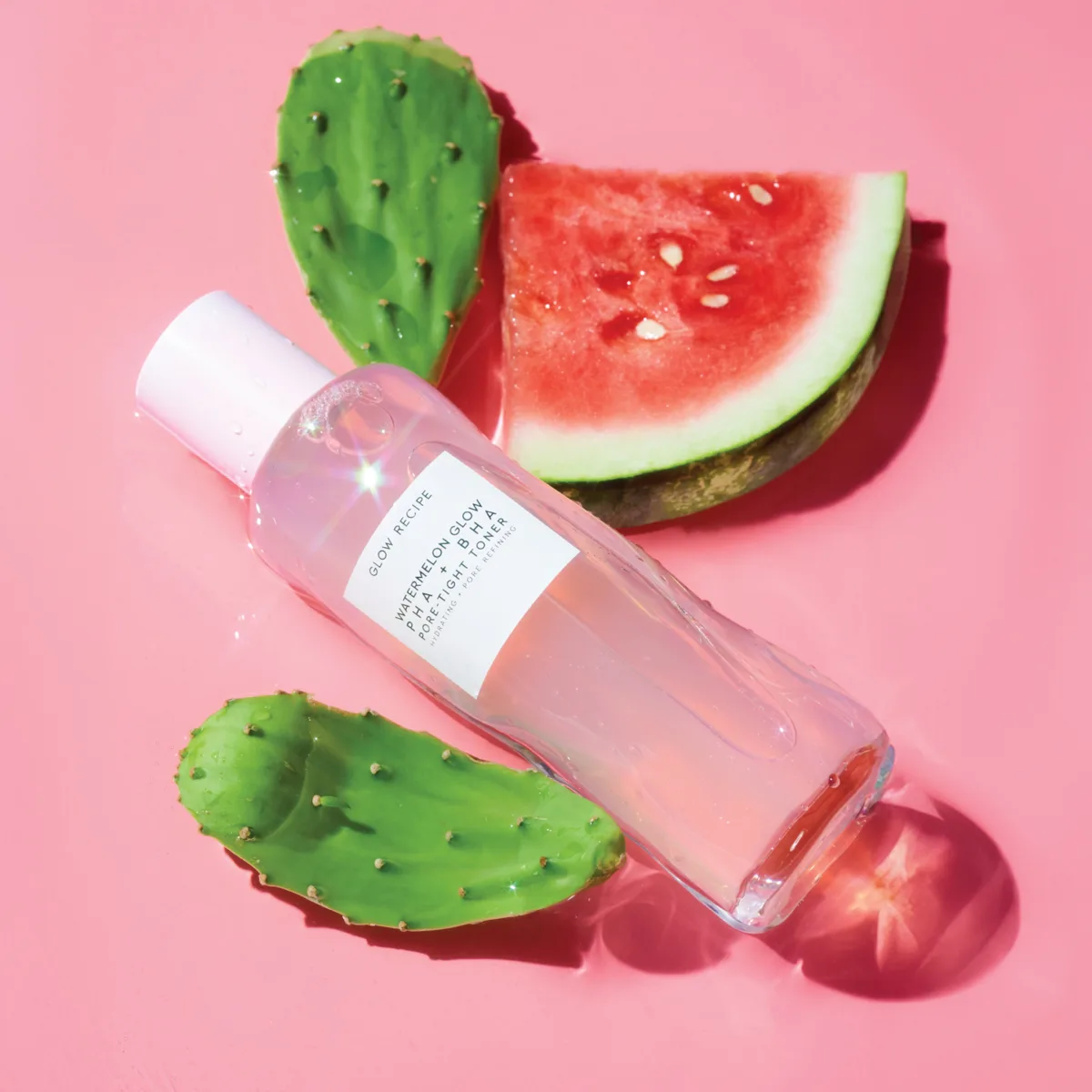
Inspired by the professional Korean Aqua Peel facial, this toner replaces water with cactus extract as its primary base and uses PHA+BHA at a higher pH (6-7) than typical acid toners. The result is a product that sits in a unique space: more active than a hydrating toner, dramatically gentler than a true exfoliating toner. The fermented watermelon extract is a proprietary ingredient that adds postbiotic microbiome support to the acid-focused formula.
Glow Recipe's PHA+BHA Pore-Tight Toner is the acid toner for people who are afraid of acid toners — and that positioning is both its greatest strength and its inherent limitation. The cactus water base and gentle acid combination at a high pH deliver genuinely hydrating exfoliation that refines pores over time, though those seeking aggressive resurfacing will need to look elsewhere.
Promisingfor DullnessIn your profileYou chose · Hyaluronic Acid has trial-level evidence for dullness but no guideline or regulatory standing yet — promising, short of a recommendation; the other actives here are not yet assessed for it.Moderate evidenceStandard tolerabilityNo reviews collected yet
The case for it
Hyaluronic Acid has trial-level evidence for this concern but no guideline or regulatory standing yet.
It is present at an effective concentration, declared or high in the ingredient list.
The formula carries no trigger this concern is sensitive to, with the cautions noted.
What would change this: Guideline or regulatory standing for the active on this concern would move this from a promising bet to a recommendation.
Same rule for everyone. “Promising” is the verdict on 7,858 of 45,024 concern verdicts across the catalog; rule R9p decided 7,858 of them.
Unchanged since September 5, 2026, engine 5.1.1.
R9p — 0.5.0: 'Unproven' beside three filled dots read as one question answered twice with opposite words (7,018 rows). The chip measures standing, the dots measure trial volume; where the row carries at least one RCT or a tier-2 source (moderate dots) and the active is present at a working level, the honest word is Promising. Unproven is reserved for plausible-standing rows with limited or weak evidence, or an under-dosed form. Same rank as Unproven — a bet either way; the dots order them. · the full register
Carrying active
Hyaluronic Acid
Standing
plausible — trials support it
Form
adequate
Tolerability
standard
Row checked
against its sources on July 17, 2026 (evidence table ev-2026.09-r228)
Good choicefor DehydrationIn your profileYou chose · Hyaluronic Acid is a reference standard by mechanism for dehydration; this liquid carries it.Moderate evidenceStandard tolerabilityNo reviews collected yet
The case for it
Hyaluronic Acid has trial-supported standing for this concern.
It is plausibly present at a working level, though the concentration is not declared.
The formula carries no trigger this concern is sensitive to, with the cautions noted.
What would change this: A declared concentration would move this to a firmer reading of the dose.
Same rule for everyone. “Good choice” is the verdict on 9,564 of 45,024 concern verdicts across the catalog; rule R5 decided 9,072 of them.
Unchanged since September 5, 2026, engine 5.1.1.
R5 — Trial-supported or guideline-supported active, adequately or plausibly dosed. · the full register
Carrying active
Hyaluronic Acid
Standing
supported — its mechanism is established
Form
plausible — studied range 0.1%, from the trials on the row; needs leave-on contact; judge it after ~1 weeks
Tolerability
standard
Row checked
against its sources on July 17, 2026 (evidence table ev-2026.09-r228)
The studies behind the evidence row
Draelos ZD, Cosmetic Dermatology: Products and Procedures — hyaluronic acid classified as a humectant water-binding agent holding many times its weight in water — reference work
Also listed for Large Pores, Excess Oiliness, Rough Texture, Acne and Blackheads — the actives here (Hyaluronic Acid, Gluconolactone, Betaine Salicylate, Prickly Pear (Cactus) are in our research queue for those concerns; there is no verdict until their evidence rows are written. That is a gap in our table, not a mark against the product.
Does the jobDoes what a toner is for: adds something real, not alcohol-driven. Not measured from the label: restores skin pH, plays well with what follows.
A verdict is DermApproved’s assessment of how well a product’s ingredients fit a concern — never a claim about what the product treats. Evidence dots and collected reviews sit beside it and are never blended in.
Rules 0.5.1 · evidence table ev-2026.09-r228 · how we decide
Assessment
Pros & Cons
Pros
✓ Gentle enough for daily twice-daily use with zero stinging, tingling, or tightness
✓ Cactus water base with hyaluronic acid makes this more hydrating than most acid toners
✓ PHA+BHA combination addresses both surface texture and pore-level congestion
✓ Fermented watermelon extract supports the skin microbiome alongside the exfoliation
✓ Excellent value at $35 for 5 ounces lasting three to four months
✓ Climate Neutral certified with recyclable packaging made from 20% recycled glass
Cons
✗ Higher pH of 6-7 significantly reduces BHA exfoliating activity compared to dedicated acid toners
✗ Contains synthetic fragrance unsuitable for very sensitive or fragrance-reactive skin
✗ Cap does not seal well and can cause leaking during storage or travel
✗ Too gentle for those with significant acne, congestion, or enlarged pores needing clinical-grade treatment
✗ Not safe during pregnancy due to betaine salicylate and willow bark salicylate content
Review
Full Review
In Korean dermatology clinics, the Aqua Peel is a popular facial treatment that combines gentle chemical exfoliation with intense hydration flooding. The patient walks in, lies down for an hour, and walks out with refined pores, glowing skin, and the kind of bounce that makes foundation unnecessary for a few days. It costs about two hundred dollars per session. Glow Recipe looked at this treatment and asked the obvious question: what if we put it in a bottle?
The Watermelon Glow PHA+BHA Pore-Tight Toner launched in April 2020 as the brand's attempt to answer that question. And the answer, like most honest answers, is complicated. It is a genuinely excellent gentle toner that hydrates as much as it exfoliates. It is also, by design, a product that will underwhelm anyone expecting the kind of acid-toner intensity that tightens your pores through sheer chemical force.
The formulation makes its priorities clear from the first ingredient. Cactus extract — not water — is the base. Opuntia ficus-indica is rich in electrolytes, amino acids, and polysaccharides that provide the kind of deep, cushioned hydration that makes your skin feel bouncy rather than tight. This is followed by watermelon fruit extract, the brand's signature ingredient, which adds lycopene antioxidants and additional amino acids. By the time you reach the actual acids — gluconolactone and betaine salicylate — you are already five ingredients deep in a formula that reads more like a hydrating essence than an exfoliating toner.
The acid approach is deliberately gentle. Gluconolactone is a PHA — a second-generation hydroxy acid with molecules significantly larger than traditional AHAs. Larger molecules mean slower, more gradual penetration and less of the stinging-tingling sensation that glycolic and lactic acid produce. The betaine salicylate is a BHA derivative where betaine is bonded to salicylic acid, creating a compound that clears pores with less irritation potential than pure salicylic acid. Willow bark extract provides additional natural salicin as a backup.
Here is the thing that makes this toner either brilliant or compromised, depending on your perspective: the pH is 6-7. Traditional acid toners operate at pH 3-4, where AHAs and BHAs are most chemically active. At pH 6-7, gluconolactone can still function as an exfoliant (PHAs are effective across a wider pH range than AHAs), but betaine salicylate's exfoliating activity is significantly reduced. Glow Recipe chose gentleness over potency — and for the product's target audience, this was probably the right call.
The experience of using this toner is unlike any acid toner you have used before. There is no sting, no tingle, no tightness. You pour a nickel-sized amount into your palms, press it into your face, and your skin feels cool, hydrated, and slightly bouncy. It absorbs in seconds and leaves behind the kind of dewy, plump finish that most people associate with a hydrating serum, not an exfoliating toner. The watermelon scent is present and pleasant — sweet, fruity, unambiguously Glow Recipe.
Results build slowly. Over the first two weeks, skin texture smooths out noticeably. The mild BHA activity clears surface-level congestion, and pore-prone areas look somewhat refined. Blackheads diminish gradually. Dullness lifts as the PHA gently removes the accumulation of dead corneocytes that make skin look flat. By the six-to-eight-week mark, the cumulative effect is a complexion that looks consistently clearer and more vibrant — not dramatically transformed, but meaningfully improved.
For people with oily, combination, or normal skin who want daily exfoliation without any irritation risk, this toner hits a sweet spot that very few products occupy. It is active enough to do something, gentle enough to do it every day, and hydrating enough that your skin never feels like it is paying a price for the exfoliation. The cactus water base, hyaluronic acid, and sodium polyglutamate ensure that moisture levels actually improve with use rather than declining.
The fermented watermelon extract is worth noting as a genuinely proprietary ingredient. Lactobacillus-fermented watermelon produces postbiotic metabolites that support the skin microbiome — an increasingly important consideration in a market that has spent decades disrupting microbial balance with harsh cleansers and strong acids. In a gentle acid toner, the inclusion of a fermented ingredient signals a more holistic approach to skin health.
The limitations are honest. If you have significant congestion, active acne, or visibly enlarged pores that need clinical-grade intervention, this toner is not potent enough to serve as your primary treatment. The higher pH reduces the BHA's exfoliating activity to a level that is more maintenance than remediation. The fragrance, while pleasant, remains the single most problematic ingredient for sensitive skin types. And the cap — several reviewers have noted that it does not seal well, making it a risky travel companion.
At thirty-five dollars for 5 ounces, the value is strong for a premium exfoliating toner. The bottle lasts three to four months with twice-daily use, making it one of the more economical products in the Glow Recipe lineup. A mini at sixteen dollars offers a trial-size entry point.
The Pore-Tight Toner does not recreate the Korean Aqua Peel — no bottled product can replicate a professional treatment. What it does is capture the philosophy behind that treatment: exfoliation should hydrate as much as it exfoliates, and gentle consistency beats aggressive intensity over time. For the audience that has been intimidated by acid toners — and that audience is large — this product offers a genuine entry point. For those who need their acids to work harder, it is a pleasant hydrating toner with a side of gentle exfoliation.
Formula
Key Ingredients
The hero actives that drive this product's performance.
A polyhydroxy acid with larger molecules than traditional AHAs, providing gentle exfoliation that works even at this formula's higher pH of 6-7. In this toner, gluconolactone doubles as both an exfoliant and a humectant — attracting water to the skin while dissolving surface-level dead cells, which is why the product feels hydrating rather than stripping.
A gentle BHA derivative created by combining betaine with salicylic acid, providing oil-soluble pore-clearing activity with less irritation potential than pure salicylic acid. At this formula's higher pH, the exfoliating intensity is deliberately reduced — prioritizing gradual pore refinement over aggressive chemical exfoliation.
Listed first in the INCI — replacing water as the formula's primary base. Cactus extract is rich in electrolytes, amino acids, and polysaccharides that provide deep hydration, making this feel more like a hydrating essence than a typical acid toner. The choice of cactus water over plain water is what gives this toner its unusually moisturizing character.
Positioned fourth in the INCI at a meaningful concentration, providing multi-depth hydration that counteracts any potential drying from the PHA and BHA. In an exfoliating toner, hyaluronic acid serves the critical role of replacing moisture that acid exfoliation can temporarily disrupt.
Established mechanismfor Dehydration · established mechanism
Provides natural antibacterial and anti-inflammatory properties that complement the BHA's pore-clearing action. In a pore-focused toner, tea tree works alongside the betaine salicylate to address acne-causing bacteria while the acids handle the physical congestion.
A proprietary Glow Recipe ingredient where watermelon fruit extract is fermented with Lactobacillus. Fermentation breaks down the extract into smaller, more bioavailable molecules while producing postbiotic metabolites that support the skin microbiome — adding a prebiotic dimension to what is otherwise an acid-focused formula.
Not yet assessed
Ingredient standings describe the active at treatment-level doses and
vehicles; this product's own condition grades weigh its actual formula.
Apply after cleansing as the first treatment step. Pour onto palms or a cotton pad and press into the face and neck. Follow with serum and moisturizer. Can be used morning and evening. Works well layered under the Watermelon Glow Dew Drops.
Results Timeline
Immediate: skin feels hydrated, cool, and refreshed after first application. Short-term (1-2 weeks): visibly smoother texture and reduced congestion in pore-prone areas. Long-term (4-8 weeks): refined pore appearance, fewer blackheads, and improved overall skin clarity with consistent use.
The dual-acid approach in this toner uses two chemically distinct exfoliation pathways. Gluconolactone, the PHA component, has been studied in Dermatologic Surgery where it demonstrated comparable exfoliation to glycolic acid at equivalent concentrations but with significantly less irritation potential. PHAs achieve this through their larger molecular structure, which slows penetration into the stratum corneum, distributing the exfoliating activity over a longer period. Importantly for this formula, gluconolactone retains meaningful activity at higher pH ranges (up to pH 6-7), unlike glycolic acid which becomes largely inactive above pH 4.5.
Betaine salicylate, the BHA component, is a compound where betaine (trimethylglycine) is bonded to salicylic acid. Research from Korean cosmetic science has characterized betaine salicylate as having comparable pore-clearing properties to free salicylic acid but with improved tolerability. However, at the formula's pH of 6-7, the proportion of unionized (active) salicylic acid is minimal — the Henderson-Hasselbalch equation predicts that less than 1% of salicylic acid would be in its active, un-ionized form at pH 6.5 (given a pKa of 2.97). This means the BHA activity is significantly attenuated, which explains why the product feels gentle but also why its pore-clearing effects develop gradually.
The cactus water base (Opuntia ficus-indica) has been studied for its bioactive composition. Research in the Journal of Ethnopharmacology documented that cactus extract contains indicaxanthin and betacyanins — betalain pigments with documented anti-inflammatory and antioxidant properties. As a formula base, it replaces inert water with a biologically active hydrating medium.
Sodium polyglutamate, included alongside hyaluronic acid, has been studied as a next-generation humectant. A clinical trial reported in Bioscience, Biotechnology, and Biochemistry demonstrated that polyglutamic acid inhibits hyaluronidase activity (the enzyme that degrades hyaluronic acid), which means it may prolong the hydrating effect of the co-formulated hyaluronic acid — a synergistic pairing that enhances both ingredients' efficacy.
Dermatologist Perspective
Dermatologists recognize the PHA+BHA toner concept as a pragmatic approach for patients who cannot tolerate traditional acid exfoliants. In clinical practice, the higher pH deliberately reduces exfoliating intensity, which makes this suitable for acid-naive patients or those with mildly sensitive skin, but limits its utility for patients with moderate to severe acne or significant textural concerns. Dermatologists appreciate the cactus water base and hyaluronic acid pairing that prevents the barrier disruption typical of acid toners. The betaine salicylate and willow bark content, while gentle, is sufficient for dermatologists to recommend against use during pregnancy. For patients seeking daily gentle exfoliation that will not compromise other treatment products in their routine, dermatologists view this as a well-designed maintenance toner.
Guidance
Usage & Recommendations
How to Use
After cleansing, pour a nickel-sized amount into clean palms and press gently into the face and neck. Alternatively, dispense onto a cotton pad and sweep across the skin. Allow 30-60 seconds to absorb before proceeding to serum and moisturizer. Use twice daily, morning and evening. Follow with sunscreen in the morning. Can be layered under any serum, moisturizer, or the Watermelon Glow Dew Drops.
Value Assessment
At thirty-five dollars for 5.07 ounces, this is one of the more generous sizes in the Glow Recipe lineup and competitive with comparable premium exfoliating toners. A bottle lasts three to four months with twice-daily use, putting the monthly cost at approximately nine to twelve dollars — strong value for a daily-use product. The mini size at sixteen dollars for 1.35 ounces provides a trial option. For a product that replaces both a toner step and a gentle daily exfoliant, the economics work well.
Who Should Buy
Anyone who wants the benefits of an exfoliating toner without any of the irritation. Ideal for oily, combination, and normal skin types seeking gentle daily pore refinement and texture improvement alongside hydration. Particularly well-suited for acid-toner beginners and those who have been burned by aggressive exfoliating products in the past.
Who Should Skip
Those with significant acne, deep congestion, or prominent pores who need clinical-grade acid activity should look for a lower-pH exfoliating toner. Not suitable during pregnancy due to salicylate content. Anyone with fragrance sensitivities should avoid due to the synthetic parfum. If you want your acid toner to deliver immediate, noticeable exfoliation, the higher pH in this formula will feel too gentle.
Ready to try Glow Recipe Watermelon Glow PHA+BHA Pore-Tight Toner?
Lightweight, slightly viscous liquid — more substantial than a watery toner but lighter than a serum. Absorbs quickly and leaves skin feeling bouncy and hydrated rather than tight or stripped.
Scent
Sweet, fresh watermelon fragrance consistent with the Glow Recipe brand. Clean and fruity with herbal undertones from the cactus and cucumber extracts. Dissipates within a minute of application.
Packaging
Pink-tinted glass bottle with textured, curvy design and pink cap. Made with 20% recycled glass and fully recyclable. Some users note the cap does not provide the best seal, which can cause minor leaking.
Finish
dewylightweightnon-greasy
What to Expect on First Use
Immediate cooling and hydrating sensation from the first application — no stinging, tingling, or tightness that traditional acid toners cause. Skin feels refreshed and plump. Some users may experience very mild purging in congested areas during the first week as the BHA clears pore blockages.
How Long It Lasts
3-4 months applied morning and evening, using a nickel-sized amount per application
Leaping Bunny CertifiedVeganClimate Neutral CertifiedClean at Sephora
Background
The Story Behind This Product
Launched in April 2020, this toner was designed to recreate the post-facial glow of a professional Korean Aqua Peel treatment at home. The Aqua Peel is a popular Korean facial that combines gentle chemical exfoliation with intense hydration — and Glow Recipe's founders wanted to bottle that experience. The PHA+BHA combination at a gentle pH was a deliberate choice to make acid exfoliation accessible to sensitive skin types. The product accounts for a significant portion of Glow Recipe's business alongside the Dew Drops, and has won multiple Best Toner awards.
About Glow Recipe Established Brand (5–20 years)
Glow Recipe was founded in 2014 by former L'Oreal executives Christine Chang and Sarah Lee. The brand is Leaping Bunny certified, Climate Neutral certified, and fully vegan. This toner won Cosmopolitan and Marie Claire Best Toner awards and was included in the 2026 Oscars celebrity gift bags.
Brand founded: 2014 · Product launched: 2020
Myth vs. Reality
Common Myths
Myth
Exfoliating toners must sting to be effective.
Reality
This toner's PHA (gluconolactone) works at a higher pH than traditional AHAs, meaning it exfoliates without the low-pH sting. The gentler approach produces subtler but real results — pore refinement and texture improvement — while dramatically reducing irritation risk. Stinging indicates acid activity but also potential barrier disruption.
Myth
BHA toners dry out the skin.
Reality
This formula counteracts the drying potential of betaine salicylate with cactus water, hyaluronic acid, glycerin, and sodium polyglutamate. The result is a toner that actually hydrates while exfoliating — most users report skin feeling more moisturized after use, not drier.
FAQ
Frequently Asked Questions
What acids are in Glow Recipe Watermelon Glow PHA+BHA Toner?
The toner contains Gluconolactone (a PHA/polyhydroxy acid) for gentle surface exfoliation and Betaine Salicylate plus Willow Bark Extract (BHA sources) for pore-clearing. The formula operates at a higher pH of 6-7 compared to typical acid toners, prioritizing gentleness and hydration over aggressive exfoliation.
Can I use Glow Recipe PHA+BHA Toner every day?
Yes — the gentle PHA+BHA combination at a higher pH is designed for daily use, both morning and evening. The formula replaces water with hydrating cactus extract and includes hyaluronic acid, making it moisturizing enough for twice-daily application without overexfoliation risk.
Is Glow Recipe PHA+BHA Toner safe during pregnancy?
Most dermatologists recommend avoiding this toner during pregnancy due to the Betaine Salicylate and Willow Bark Extract, both of which are salicylate derivatives. While the concentrations and higher pH make the product gentler than dedicated BHA treatments, the salicylate content is generally flagged for pregnancy avoidance.
Does this toner actually tighten pores?
The toner cannot physically shrink pore size — that is determined by genetics and skin structure. However, by removing dead skin cells and clearing pore congestion with PHA and BHA, pores appear refined and less visible over 4-8 weeks of consistent use. The hydrating base also plumps the surrounding skin, further reducing pore visibility.
Why does this toner not sting like other acid toners?
The pH of 6-7 is significantly higher than typical acid toners (pH 3-4). The PHA (gluconolactone) has larger molecules that exfoliate more gradually, and the Betaine Salicylate is inherently gentler than pure salicylic acid. Combined with the cactus water and hyaluronic acid base, the formula prioritizes comfort over aggressive exfoliation.
Can I use Glow Recipe toner with retinol?
Yes — the gentle exfoliation from this toner is compatible with most retinol products when used at different steps. Apply the toner after cleansing, allow it to absorb, then apply retinol. The higher pH and gentle PHA/BHA concentration make it less likely to cause the irritation that stronger acid toners can provoke when combined with retinol.
Reviews
What Reviewers Tend to Say
Recurring themes our editors read across retailer reviews of this product — summaries in our words, not quotations, and not a substitute for your own patch test.
Common Praise
Gentle enough for daily use with no stinging or irritation
Visibly tightens and refines pore appearance over time
Hydrating and cooling sensation that feels like a mini facial
Skin feels bouncy, plump, and calmer after each application
Fewer breakouts and reduced congestion within the first week
Layers beautifully under serums and moisturizers without disruption
Common Complaints
Limited visible long-term pore-tightening results for some users
Cap does not seal well and can cause leaking during travel
Fragrance may irritate sensitive or reactive skin types
More hydrating than truly exfoliating for those wanting strong acid activity
Premium price for a gentle toner that could be underperforming for its claims
Can cause initial mild purging in acne-prone areas during first week
Notable Endorsements
Cosmopolitan 2023 Readers' Choice Best TonerMarie Claire 2023 Skin Awards Best TonerThe Knot 2022 Beauty Awards Best Face TonerClimate Neutral CertifiedClean at Sephora2026 Oscars Celebrity Gift Bag
The whole case for salicylic acid rests on one unglamorous fact of chemistry: it dissolves in oil. Understand that, and you know exactly when it beats a glycolic acid — and when it's overkill.
Polyhydroxy acids get filed under 'beginner exfoliant,' as if gentle meant weak. The truth is stranger: their bulk is exactly why they work for the skin everything else sets on fire.
The strongest counterexample to blanket botanical scepticism is also one of the more common contact allergens — and holding both facts at once is the only honest way to read it.
Aug 28, 2026· 8 min
Questions people ask about Acne
Verified answers from our questions library — the nuance a product page cannot carry.
Products, answers, therapy guides, tools and articles in one search. Brand names,
slang and abbreviations all work — accutane finds isotretinoin, bacne finds truncal acne.