Salicylic Acid: How BHA Actually Gets Inside a Clogged Pore
The whole case for salicylic acid rests on one unglamorous fact of chemistry: it dissolves in oil. Understand that, and you know exactly when it beats a glycolic acid — and when it's overkill.
Read the preview
From the DermApproved blog, in Exfoliating Acids: salicylic acid — and the one weird property that makes it the only acid worth aiming at a clogged pore. Here's the setup. A pore is an oil problem. Oil repels water. So most exfoliating acids reach the mouth of a blocked pore — and stop cold, like a water drop on a greasy pan. Salicylic acid doesn't stop. It has a trick the others don't, and it dives straight in. But here's the catch nobody puts on the label: it isn't actually doing what the label says it's doing. And there's a whole category of skin complaints where reaching for it is just wrong — plus a concentration people chase that you should never bring near your bathroom shelf. We'll show you exactly when it beats a glycolic, when it's overkill, and the quiet tell that you've pushed it too far. The mechanism, decoded, at dermapproved.com/blog.
The pore is an oil problem, and oil repels water
Picture a clogged pore in cross-section. It is a narrow shaft — the follicular infundibulum — packed with a plug of sebum and dead, sticky skin cells. Sebum is a lipid. It is, chemically speaking, allergic to water. So when you paint a water-loving acid like glycolic across the skin, it does excellent work on the flat surface of the stratum corneum, but it reaches the mouth of that oily pore and stops, the way a drop of water beads on a greasy pan.
Salicylic acid does not stop. It is a beta hydroxy acid with a lipophilic — oil-loving — character, and that one trait changes everything about where it goes. Reviews of its chemistry describe it as miscible with epidermal and sebaceous lipids, which is the technical way of saying it dissolves into sebum and rides it down into the follicle. Studies of its lipophilic cousin, lipohydroxy acid, show the molecule concentrating exactly where you'd want an anti-acne agent to be: in the sebum-rich infundibulum of the pilosebaceous unit.
This is the entire reason salicylic acid earns its reputation as the pore acid. It is not stronger than glycolic in some abstract sense. It is simply built to go somewhere glycolic can't.
It doesn't dissolve keratin — it unscrews the rivets
The word you'll see on every label is 'keratolytic,' which implies salicylic acid melts keratin. It largely doesn't, and the distinction is more than pedantry. Dead skin cells in the stratum corneum are held together by protein rivets called corneodesmosomes — think of them as the spot-welds between bricks. Salicylic acid works by attacking those welds, extracting the desmosomal glue proteins so that cells lose their grip on each other and shed. Electron-microscopy work has shown fragmented corneodesmosomes clinging to corneocytes after treatment, which is why some researchers argue the honest term is 'desmolytic,' not keratolytic.
Why does this matter to you at the sink? Because it explains the texture of the result. Salicylic acid doesn't burn a layer off; it loosens the cohesion of a plug so that the whole thing can lift and clear. Inside a comedone, that means the compacted cast of cells and sebum stops behaving like cement. In one split-face study of a lipohydroxy-acid formulation, the treated side showed follicular casts reduced by roughly 47% in number and 54% in size versus the untreated side — a direct measurement of the plug being dismantled rather than merely blurred.
Blackheads yes, sun-dulled skin not really
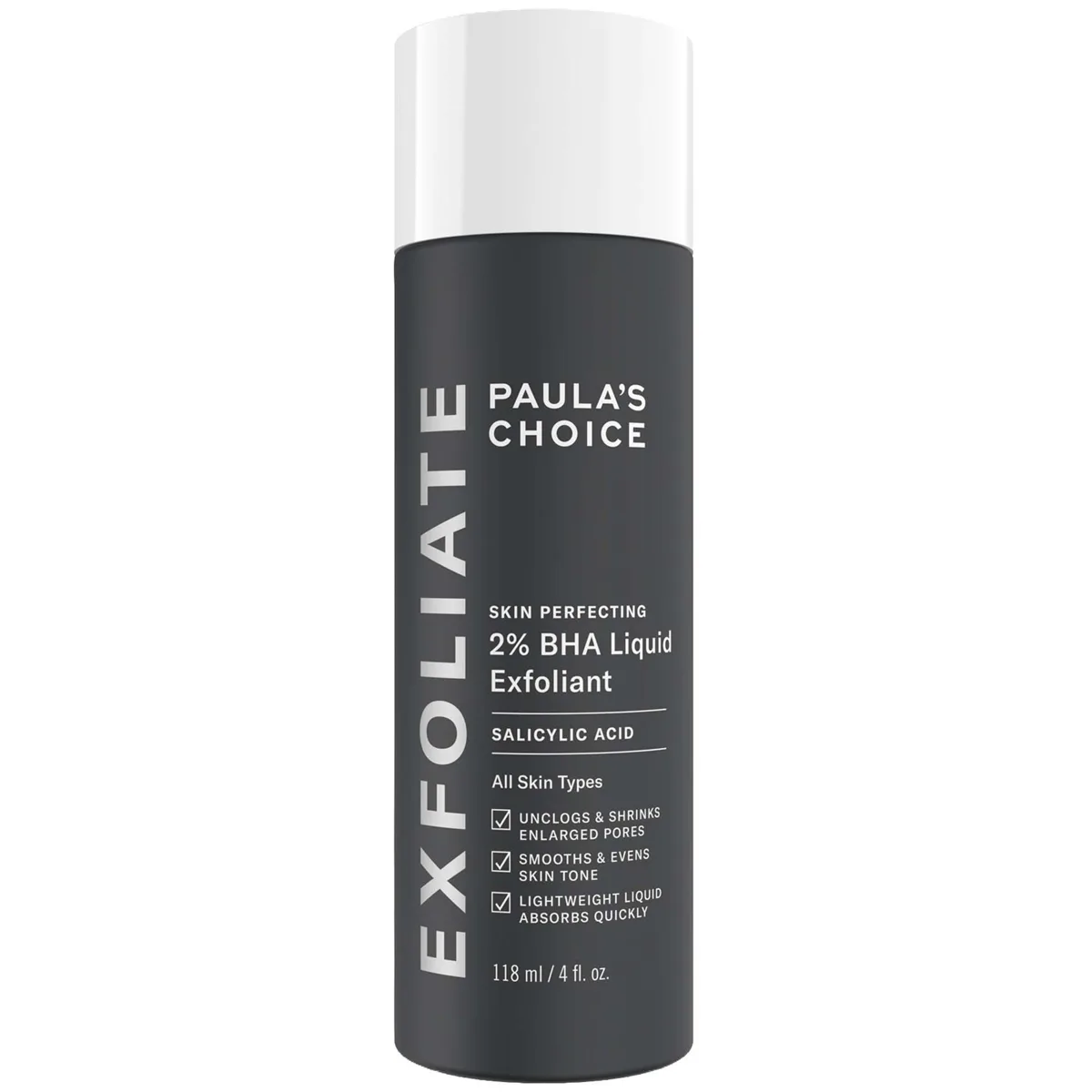
Match the mechanism to the problem and salicylic acid's job description gets specific. Blackheads and sebaceous filaments are, at bottom, oil sitting in a pore — a blackhead is just that plug oxidized dark at the surface. This is home turf: an oil-soluble acid clearing an oil-filled shaft. Closed comedones — those small, colorless bumps that never come to a head — respond for the same reason, because the trapped material is finally given a route out. A gentle daily 2% liquid like Paula's Choice 2% BHA Liquid Exfoliant or the ultra-cheap, well-formulated Minimalist 2% Salicylic Acid Face Serum is aimed squarely here.
Now the honest limit. If your complaint is flat, sun-dulled tone, uneven pigment, or the fine crepey texture of photoaging, salicylic acid is the wrong hammer. That is surface work on the water-loving stratum corneum, and it's exactly what an alpha hydroxy acid does best. This is also why so many good formulas hedge their bets by pairing acids: COSRX One Step Original Clear Skin Calming Pad leans on salicylic for pores but folds in soothing centella and niacinamide, and the barrier-minded Isntree Chestnut BHA 2% Clear Liquid wraps the acid in humectants so the oil-clearing doesn't come at the cost of comfort. If you're layering a BHA with other actives, our [conflict-checker] tool will flag the combinations that ask for trouble.
Leave-on versus rinse-off is really a contact-time question
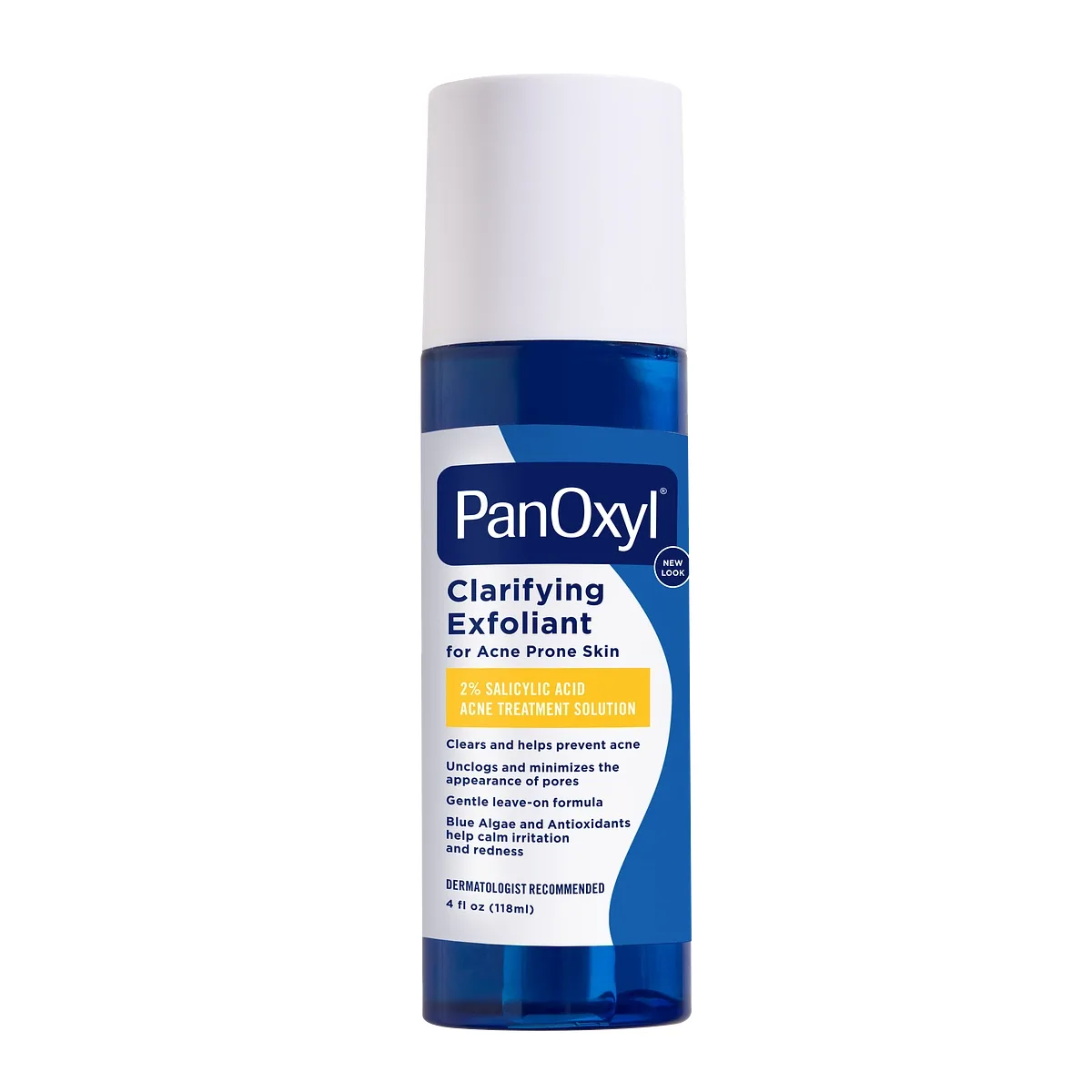
A salicylic cleanser and a salicylic serum are not doing the same job, and the difference is time. An acid can only work while it's on the skin. A cleanser like PanOxyl Clarifying Exfoliant gives the molecule maybe thirty to sixty seconds before it goes down the drain — enough to help with body acne, an oily T-zone, or as a gentle maintenance step, but not enough for deep infundibular work. A leave-on liquid, pad, or serum stays put for hours, which is where the real comedolytic action happens.
That's the practical rule: if you want salicylic acid to actually get into and clear pores, you want a leave-on. If you mainly want to keep surface oil and mild congestion in check without much commitment, a wash is a reasonable, low-risk entry point. It's also why doubling up — a salicylic cleanser and a salicylic serum and a salicylic toner pad — usually isn't three times the benefit. It's three times the contact time on skin that only needed one deliberate dose.
Format matters here too, and it's often overlooked. A liquid or a lightweight serum spreads thin and evenly, which is ideal for the delicate skin of the face. A pre-soaked pad delivers a generous, uneven dose and can tempt you into over-swiping, though it's convenient and travels well. A thicker cream or lotion vehicle can slow the acid's release and suit drier, more reactive skin that would flush at a fast liquid. The percentage on the label is only half the story; the base it's carried in decides how much of that acid actually reaches — and lingers in — the pore.
The concentrations that matter, and the ones that are marketing
Numbers get thrown around loosely here, so anchor them. In the US, over-the-counter leave-on acne products top out at 2% salicylic acid, and the vast majority of the effective serums, toners, and liquids you'll use sit at 0.5-2%. The reason you rarely need more is that the acid's behavior is concentration-dependent in a useful way: reviews describe it as keratolytic in the 3-5% range, more keratoplastic (barrier-supporting) below 3%, with its anti-inflammatory calming effect most pronounced between roughly 0.5% and 5%. Translation — a well-built 2% is doing plenty.
The eye-widening figure — 20-30% — is a superficial chemical peel performed in a clinic, not a product you leave on overnight. Don't chase it at home. And watch for the tell that you've overdone even a modest concentration: persistent tightness, a stinging that doesn't fade, or fine flaking that keeps returning rather than settling after the first week or two. That is over-exfoliation, not progress. Salicylic acid also has a mild anti-inflammatory streak, so a little redness settling is normal — but a compromised, perpetually raw barrier is the opposite of clear skin. Start two or three nights a week, [patch-test] a new formula on the jaw first, and let your skin, not the label, set the pace.
Products mentioned
Independently reviewed and scored — the real products behind this piece.


References
- Mechanism of action of a lipophilic salicylic acid derivative on normal skin — European Journal of Dermatology, 2002
- Salicylic acid as a peeling agent: a comprehensive review — Clinical, Cosmetic and Investigational Dermatology, 2015
- Comedolysis by a lipohydroxyacid formulation in acne-prone subjects — European Journal of Dermatology, 2003
Every cited link is verified to resolve to the paper named. Where a source could not be independently confirmed, it is listed without a link rather than pointing you somewhere wrong.
Frequently asked
Why does salicylic acid work on blackheads when glycolic acid doesn't?
A blackhead is an oil plug sitting inside a pore, and salicylic acid is oil-soluble, so it dissolves into that sebum and works inside the follicle. Glycolic acid is water-soluble and stays on the flat surface of the skin, so it can't follow the oil down into the pore where the clog actually is.
Is a 2% salicylic acid strong enough, or should I look for something higher?
For at-home use, 2% is the ceiling for US leave-on acne products and it's genuinely enough — the acid is already keratolytic in the 3-5% range and calming below that, so a well-built 2% does the work. The 20-30% concentrations you may read about are in-office chemical peels, not products meant to be left on skin at home.
Should I use a salicylic acid cleanser or a leave-on serum?
A cleanser only contacts skin for under a minute before rinsing, which helps with surface oil and body acne but not deep pore-clearing. A leave-on liquid or serum stays on for hours, which is where the real comedolytic action happens — so choose leave-on if your goal is actually unclogging pores.
How do I know if I'm over-exfoliating with salicylic acid?
Persistent tightness, stinging that doesn't fade, and fine flaking that keeps returning instead of settling after a week or two are the signs you've overdone it. Salicylic acid loosens dead-cell cohesion rather than burning skin, so a raw, perpetually irritated barrier is a warning to cut back frequency, not proof that it's working.
Does salicylic acid help with sun damage and dullness?
Not really — that's surface texture and pigment on the outermost skin layer, which is what an alpha hydroxy acid like glycolic addresses best. Salicylic acid's advantage is getting inside oily pores, so it shines for blackheads, sebaceous filaments, and closed comedones rather than for a flat, sun-dulled complexion.