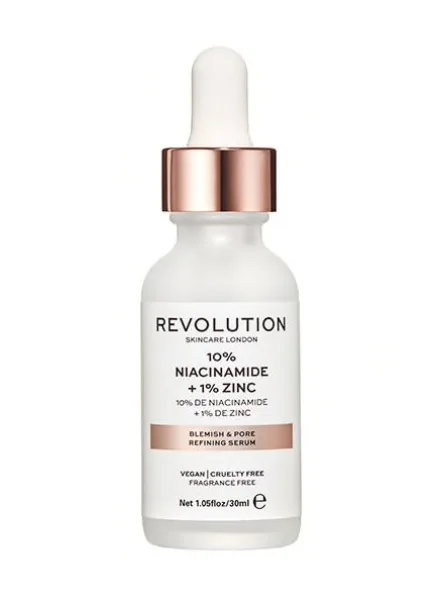
Most 10% niacinamide serums are priced at $25-40 and include fragrance or botanicals that add irritation risk. This delivers the higher concentration in a clean, fragrance-free formula with zinc PCA and sarcosine as complementary oil-control actives, at a price that makes consistent daily use genuinely accessible.
A well-supported 10% niacinamide concentrate with zinc PCA and sarcosine as complementary oil-control actives, in a clean fragrance-free vehicle at a genuinely affordable price. For users specifically targeting oiliness, pore visibility, and post-acne pigmentation, this is one of the best budget-tier options in the niacinamide category. Sensitive skin should still consider the lower-strength alternatives.
Launched in 2021, this 10% niacinamide concentrate has earned strong reception (around 1,400 reviews) from oily-skin users in enthusiast communities at 4.5 stars. We weigh that feedback against analysis of its zinc PCA and sarcosine support; broader clinical validation is limited, and the above-typical 10% strength's tingling risk is noted from user reports rather than trials.
Verdicts
How well it fits each concern
Verdict by concern tap a concern for the case
Promisingfor Excess OilinessIn your profileYou chose · Niacinamide has trial-level evidence for excess oiliness but no guideline or regulatory standing yet — promising, short of a recommendation; the other actives here are not yet assessed for it.Moderate evidenceGentleNo reviews collected yet
The case for it
Niacinamide 10% has trial-level evidence for this concern but no guideline or regulatory standing yet.
It is present at an effective concentration, declared or high in the ingredient list.
The formula carries none of the triggers this concern is sensitive to.
What would change this: Guideline or regulatory standing for the active on this concern would move this from a promising bet to a recommendation.
Same rule for everyone. “Promising” is the verdict on 7,858 of 45,024 concern verdicts across the catalog; rule R9p decided 7,858 of them.
Unchanged since September 5, 2026, engine 5.1.1.
R9p — 0.5.0: 'Unproven' beside three filled dots read as one question answered twice with opposite words (7,018 rows). The chip measures standing, the dots measure trial volume; where the row carries at least one RCT or a tier-2 source (moderate dots) and the active is present at a working level, the honest word is Promising. Unproven is reserved for plausible-standing rows with limited or weak evidence, or an under-dosed form. Same rank as Unproven — a bet either way; the dots order them. · the full register
Carrying active
Niacinamide 10%
Standing
plausible — trials support it
Form
adequate (declared 10%) — studied range 2%, from the trials on the row; needs leave-on contact; judge it after ~8 weeks
Tolerability
gentle
Row checked
against its sources on July 17, 2026 (evidence table ev-2026.09-r228)
Promisingfor Large PoresIn your profileYou chose · Niacinamide has trial-level evidence for large pores but no guideline or regulatory standing yet — promising, short of a recommendation; the other actives here are not yet assessed for it.Moderate evidenceGentleNo reviews collected yet
The case for it
Niacinamide 10% has trial-level evidence for this concern but no guideline or regulatory standing yet.
It is present at an effective concentration, declared or high in the ingredient list.
The formula carries none of the triggers this concern is sensitive to.
What would change this: Guideline or regulatory standing for the active on this concern would move this from a promising bet to a recommendation.
Same rule for everyone. “Promising” is the verdict on 7,858 of 45,024 concern verdicts across the catalog; rule R9p decided 7,858 of them.
Unchanged since September 5, 2026, engine 5.1.1.
R9p — 0.5.0: 'Unproven' beside three filled dots read as one question answered twice with opposite words (7,018 rows). The chip measures standing, the dots measure trial volume; where the row carries at least one RCT or a tier-2 source (moderate dots) and the active is present at a working level, the honest word is Promising. Unproven is reserved for plausible-standing rows with limited or weak evidence, or an under-dosed form. Same rank as Unproven — a bet either way; the dots order them. · the full register
Carrying active
Niacinamide 10%
Standing
plausible — trials support it
Form
adequate (declared 10%) — studied range 4%, from the trials on the row; needs leave-on contact; judge it after ~8 weeks
Tolerability
gentle
Row checked
against its sources on July 17, 2026 (evidence table ev-2026.09-r228)
Promisingfor AcneIn your profileYou chose · Niacinamide has trial-level evidence for acne but no guideline or regulatory standing yet — promising, short of a recommendation; the other actives here are not yet assessed for it.Moderate evidenceGentleNo reviews collected yet
The case for it
Niacinamide 10% has trial-level evidence for this concern but no guideline or regulatory standing yet.
It is present at an effective concentration, declared or high in the ingredient list.
The formula carries none of the triggers this concern is sensitive to.
What would change this: Guideline or regulatory standing for the active on this concern would move this from a promising bet to a recommendation.
Same rule for everyone. “Promising” is the verdict on 7,858 of 45,024 concern verdicts across the catalog; rule R9p decided 7,858 of them.
Unchanged since September 5, 2026, engine 5.1.1.
R9p — 0.5.0: 'Unproven' beside three filled dots read as one question answered twice with opposite words (7,018 rows). The chip measures standing, the dots measure trial volume; where the row carries at least one RCT or a tier-2 source (moderate dots) and the active is present at a working level, the honest word is Promising. Unproven is reserved for plausible-standing rows with limited or weak evidence, or an under-dosed form. Same rank as Unproven — a bet either way; the dots order them. · the full register
Carrying active
Niacinamide 10%
Standing
plausible — trials support it
Form
adequate (declared 10%) — studied range 4–5%, from the OTC monograph or label; needs leave-on contact; judge it after ~8 weeks
Tolerability
gentle
Row checked
against its sources on July 17, 2026 (evidence table ev-2026.09-r228)
Good choicefor HyperpigmentationIn your profileYou chose · Niacinamide is a trial-supported active for hyperpigmentation; this serum carries it at 10%.Moderate evidenceGentleNo reviews collected yet
The case for it
Niacinamide 10% has trial-supported standing for this concern.
It is present at an effective concentration, declared or high in the ingredient list.
The formula carries none of the triggers this concern is sensitive to.
Same rule for everyone. “Good choice” is the verdict on 9,564 of 45,024 concern verdicts across the catalog; rule R5 decided 9,072 of them.
Unchanged since September 5, 2026, engine 5.1.1.
Promisingfor Dark SpotsIn your profileYou chose · Niacinamide has trial-level evidence for dark spots but no guideline or regulatory standing yet — promising, short of a recommendation; the other actives here are not yet assessed for it.Moderate evidenceGentleNo reviews collected yet
The case for it
Niacinamide 10% has trial-level evidence for this concern but no guideline or regulatory standing yet.
It is present at an effective concentration, declared or high in the ingredient list.
The formula carries none of the triggers this concern is sensitive to.
What would change this: Guideline or regulatory standing for the active on this concern would move this from a promising bet to a recommendation.
Same rule for everyone. “Promising” is the verdict on 7,858 of 45,024 concern verdicts across the catalog; rule R9p decided 7,858 of them.
Unchanged since September 5, 2026, engine 5.1.1.
R9p — 0.5.0: 'Unproven' beside three filled dots read as one question answered twice with opposite words (7,018 rows). The chip measures standing, the dots measure trial volume; where the row carries at least one RCT or a tier-2 source (moderate dots) and the active is present at a working level, the honest word is Promising. Unproven is reserved for plausible-standing rows with limited or weak evidence, or an under-dosed form. Same rank as Unproven — a bet either way; the dots order them. · the full register
Carrying active
Niacinamide 10%
Standing
plausible — trials support it
Form
adequate (declared 10%)
Tolerability
gentle
Row checked
against its sources on July 17, 2026 (evidence table ev-2026.09-r228)
Also listed for Blackheads — the actives here (Niacinamide, Zinc, Cleansing Surfactants, Panthenol (Vitamin B5) are in our research queue for that concern; there is no verdict until their evidence rows are written. That is a gap in our table, not a mark against the product.
Where our review and the verdict differ. The review below was written on the formulation and the published trials; the verdicts above apply the stricter standing test in our methodology — an active earns a recommendation only with guideline or regulatory standing for the concern. Where the two disagree, the verdict is DermApproved’s position.
A verdict is DermApproved’s assessment of how well a product’s ingredients fit a concern — never a claim about what the product treats. Evidence dots and collected reviews sit beside it and are never blended in.
Rules 0.5.1 · evidence table ev-2026.09-r228 · how we decide
Assessment
Pros & Cons
Pros
✓ 10% niacinamide with zinc PCA and sarcosine for targeted oil control
✓ Fragrance-free, additive-minimal formula
✓ Effective sebum regulation and pore appearance refinement
✓ Pregnancy-safe and fungal-acne-safe
✓ Pairs with virtually any other active
✓ Exceptional value for a well-formulated concentrate
Cons
✗ 10% concentration can cause mild tingling in sensitive users
✗ Diminishing returns above 5% for users whose main goal isn't oil control
✗ Not the best choice for dry or very reactive skin
✗ Shipping from Europe for US buyers
Review
Full Review
Somewhere in the mid-2010s, niacinamide serums entered a percentage arms race. The active had been clinically validated at 2-5% through the 2000s — that's where the research showing pigmentation reduction, barrier support, and sebum regulation had been conducted — but as budget skincare brands started formulating around niacinamide as a headline active, the percentages on labels kept climbing. First 5%, then 10%, then 12%, then brands started adding percentage qualifiers to other ingredients to make the math more impressive. By the time the dust settled, 10% niacinamide had become the default market standard, even though the underlying clinical research supported 5% as the dose where diminishing returns set in. This Geek & Gorgeous B-Bomb is a 10% niacinamide serum, and the interesting question about it isn't whether 10% is necessary — it's whether the brand has formulated the higher concentration thoughtfully enough to justify the choice.
The answer is mostly yes, with a useful asterisk. The formula leads with niacinamide at 10%, supported by propanediol and glycerin for humectant hydration, zinc PCA for complementary sebum regulation, sodium lauroyl sarcosinate (a derivative of the amino acid sarcosine) for additional oil-modulating activity, panthenol for soothing support, sodium hyaluronate for lightweight hydration, and allantoin for gentle calming. The supporting cast is chosen specifically to buffer the higher niacinamide strength and to stack complementary oil-control mechanisms — which is exactly the right approach if you're committing to the 10% concentration. The pH is around 5.5, compatible with nearly any other active, and the formulation is fragrance-free with standard preservatives and no botanical filler.
The useful distinction between B-Bomb and the brand's 5% aPAD niacinamide alternative is the audience targeting. B-Bomb is positioned specifically for oily and combination skin targeting visible sebum control and pore refinement, where the higher concentration offers incremental benefits that matter for those specific concerns. For users whose primary goal is tone evening or general barrier support, the 5% version is equivalently effective with a lower irritation ceiling. Choosing between the two should come down to what you're actually trying to achieve rather than to label preference — higher numbers don't automatically mean better results.
The experience of using B-Bomb matches the formulation intent. It's a lightweight water-gel serum that absorbs quickly, leaves a slightly matte finish, and doesn't feel tacky or heavy under makeup or sunscreen. Most users don't experience any tingling, though a minority report mild prickling sensation in the first few applications — this is the expected side effect of higher niacinamide concentrations and typically resolves within a week. Users who find the tingling persistent should step down to a 5% serum, which delivers most of the same benefits without the adaptation friction.
Results develop over the standard niacinamide timeline. In the first 2-4 weeks, oily-skin users typically notice reduced midday shine and a slight refinement in the appearance of pores around the nose and cheeks. The zinc PCA and sarcosine support work alongside the niacinamide to produce slightly faster sebum-control effects than you'd expect from niacinamide alone. By 8-12 weeks, more substantive changes appear — visible reduction in post-inflammatory pigmentation from past acne, gradually more even skin tone, and a general quality improvement that's subtle but cumulative. These aren't dramatic transformations, and no niacinamide serum is. What they are is consistent, low-risk improvements that stack with other routine elements without creating conflicts.
Pairing is where niacinamide justifies its near-universal recommendation. B-Bomb slots into almost any routine without concern. It pairs with retinoids (and can reduce retinoid-associated irritation through its barrier support), with vitamin C (the old canceling-out myth has been thoroughly debunked), with acids, with hyaluronic acid, with sunscreen. It's fungal-acne-safe, pregnancy-safe, and free of common sensitizers. For users building an active-heavy routine or trying to layer multiple treatment ingredients, it's one of the most cooperative additions you can make.
Limitations are modest but worth naming. The 10% concentration, while popular, is slightly above the clinically-supported dose and does increase tingling risk for sensitive skin. Users with reactive skin should either start slowly (every other day for the first 1-2 weeks) or choose a 5% alternative. Dry skin users may find the oil-control positioning less relevant to their concerns — this formulation is optimized for oily skin, and users targeting hydration and barrier support can get equivalent benefits from a gentler option. The 30mL size is the only format, and the European shipping may add time for US buyers.
The value case closes everything. At around $10 for 30 mL, this is priced at the very bottom of the 10% niacinamide market while including supporting actives (zinc PCA, sarcosine, panthenol) that more expensive competitors often omit. A bottle lasts 2-3 months with daily use. The pricing isn't a marketing gimmick — it's a reflection of the brand's direct-to-consumer model and willingness to price at formulation cost plus modest margin. For anyone specifically targeting oily-skin concerns and comfortable with 10% niacinamide, this is one of the most sensible daily serums in the entire budget skincare category.
Formula
Key Ingredients
The hero actives that drive this product's performance.
A high-concentration niacinamide dose targeted at visible oil control, pore refinement, and tone evening — higher than the research-backed 5% level but within the range many users tolerate for more pronounced sebum-regulating effects. The 10% positioning reflects user preference for higher-number labels, even though research shows diminishing returns above 5%.
Complements niacinamide's sebum-regulating activity with additional oil-control support — the niacinamide-plus-zinc combination is one of the better-validated pairings for users specifically targeting oily skin and visible pores.
A derivative of the amino acid sarcosine, included here for its reported sebum-modulating and pore-tightening activity — an unusual but thoughtful addition that distinguishes this serum from simpler niacinamide products.
Provides soothing hydration and supports the skin barrier during niacinamide introduction — an important buffering ingredient in a higher-strength niacinamide formulation where the risk of tingling or flushing is slightly elevated.
Not yet assessed
Ingredient standings describe the active at treatment-level doses and
vehicles; this product's own condition grades weigh its actual formula.
Apply morning and/or night after cleansing, before moisturizer. Pairs well with nearly any active. Users sensitive to niacinamide should start with every other day to assess tolerance.
Results Timeline
Immediate: slight plumping from hydration. Short-term (2-4 weeks): noticeable reduction in midday shine and pore visibility. Full benefits (8-12 weeks): visible tone evening and reduced post-acne marks.
Pairs Well With
vitamin c serumretinoidhyaluronic acidmoisturizerspf
The clinical research foundation for topical niacinamide is strongest at 2-5% concentrations, where the majority of published studies on pigmentation, barrier function, and sebum regulation were conducted. A Hakozaki et al. study in the British Journal of Dermatology demonstrated niacinamide's role in reducing melanosome transfer and pigmentation at 5%. Bissett et al.'s research on photoaging improvements was also conducted at 5%. At 10% concentrations, the research base is thinner — some studies have examined higher doses for specific outcomes (such as sebum regulation), but the dose-response curve flattens significantly above 5% for most endpoints. Zinc PCA has published evidence for sebum-modulating activity, though the evidence is modest compared to niacinamide itself. Sodium lauroyl sarcosinate has emerging research supporting its role in sebum regulation and pore refinement, though the evidence base is limited. Panthenol and allantoin are well-established for their soothing and barrier-supporting effects. The formulation reflects a reasonable attempt to pair complementary oil-control actives with niacinamide at a higher concentration — an evidence-informed approach rather than a novel mechanism claim. Users should understand that 10% niacinamide is not dramatically more effective than 5% for most outcomes, but the supporting actives in this specific formulation do make a meaningful contribution to the oil-control positioning.
Dermatologist Perspective
Dermatologists commonly recommend niacinamide for oily, acne-prone, and post-inflammatory hyperpigmentation concerns, with 5% typically cited as the clinically-optimal dose. Many dermatologists recognize that 10% niacinamide is generally well-tolerated but may cause mild tingling in sensitive users. For patients specifically targeting sebum regulation and pore visibility, higher concentrations paired with zinc PCA are sometimes suggested as offering incremental benefits. Niacinamide is widely considered one of the most versatile topical actives and pairs well with nearly every other common skincare ingredient, making it a strong recommendation for patients building comprehensive routines.
Guidance
Usage & Recommendations
How to Use
Apply morning and/or night after cleansing, before moisturizer. Use 3-4 drops for the entire face, focusing on oilier areas like the T-zone. Follow with other serums, moisturizer, and (in the morning) broad-spectrum SPF. Pairs with virtually any other active — no sequencing conflicts. For sensitive users, start with every other day for the first week to assess tolerance before moving to daily use.
Value Assessment
At approximately $10 for 30 mL, this is priced at the absolute bottom of the 10% niacinamide market while offering a more thoughtful supporting formula than most competitors at similar price points. A bottle lasts 2-3 months with daily use. Compared to premium 10% niacinamide serums at $30-60, this is genuinely a better value for users specifically targeting oil control and pore refinement. The direct-to-consumer pricing model means there's no premium markup, just formulation cost plus modest margin — which makes daily consistent use genuinely affordable.
Who Should Buy
Oily and combination skin targeting sebum control, pore visibility, and post-acne pigmentation, users tolerant of higher niacinamide concentrations, budget-conscious shoppers wanting a well-formulated 10% option, and anyone building an active-heavy routine who needs a cooperative daily serum.
Who Should Skip
Sensitive skin that can't tolerate 10% niacinamide (try the 5% alternative), dry skin where oil control isn't the priority, rosacea-prone users prone to flushing, and anyone whose main concern is hydration rather than sebum regulation.
Ready to try Geek & Gorgeous B-Bomb Niacinamide Concentrate?
Lightweight water-gel serum with quick absorption and no tacky afterfeel.
Scent
Fragrance-free.
Packaging
Frosted dropper bottle in the 101 line's standard format.
Finish
lightweightnon-greasyfast-absorbingmatte
What to Expect on First Use
Most users experience no irritation, though sensitive skin may notice mild tingling for the first few applications. Absorbs quickly into an oil-controlled, matte-leaning finish.
B-Bomb was one of the original products in Geek & Gorgeous's 101 line, launched as the brand's answer to the popular 10% niacinamide category pioneered by other indie brands. The supporting zinc and sarcosine reflect the brand's cosmetic-chemist approach to pairing actives for maximum effect at specific skin concerns.
About Geek & Gorgeous Emerging Brand (2–5 years)
Geek & Gorgeous launched in 2020 as a Hungarian indie brand built by cosmetic chemists. B-Bomb is part of the brand's 101 line of beginner-friendly serums, positioned as a higher-strength niacinamide option for users targeting oil control and pore visibility.
Brand founded: 2020 · Product launched: 2021
Myth vs. Reality
Common Myths
Myth
10% niacinamide works twice as well as 5%.
Reality
Clinical studies actually show diminishing returns above 5% for most outcomes. 10% may deliver slightly more noticeable sebum regulation for some oily-skin users, but for tone evening and barrier support, there's no meaningful difference from 5%. Higher strength comes with a small increase in irritation risk, especially for sensitive skin.
Myth
Niacinamide will cause flushing and rebound oiliness.
Reality
Mild tingling is occasionally reported at high concentrations, especially at introduction, but this is transient and not a flushing reaction. Niacinamide actually regulates sebum downward over time — there's no rebound effect when stopping use, just a return to baseline.
FAQ
Frequently Asked Questions
Is 10% niacinamide better than 5%?
For most outcomes — tone evening, pigmentation, barrier support — clinical research shows diminishing returns above 5%. For sebum regulation and pore appearance specifically, some users find 10% slightly more effective, but the difference is modest. If you're sensitive to niacinamide or new to it, 5% is usually the better starting point.
Will it cause tingling?
Some users experience mild tingling for the first few applications, especially those new to niacinamide. This is transient and typically resolves within a week of regular use. If you experience persistent stinging or flushing, try using it every other day or consider the lower 5% option.
Can I use it with retinoids?
Yes — niacinamide pairs exceptionally well with retinoids and can help reduce retinoid-associated irritation by supporting barrier function. Apply the niacinamide first, then the retinoid, or use them in different routines.
Can I use it with vitamin C?
Yes — the old myth about niacinamide and vitamin C interfering with each other is outdated. They work well together, and many effective routines use both actives. Layer them in either order or use them morning and evening.
Can B-Bomb 10% Niacinamide Concentrate be used while pregnant or breastfeeding?
Yes — niacinamide is considered pregnancy-safe, and all supporting ingredients in this formula (zinc PCA, panthenol, hyaluronic acid, allantoin) are also pregnancy-safe.
How is it different from The Ordinary Niacinamide 10% + Zinc 1%?
Without comparing brand-on-brand, this formulation distinguishes itself with additional sarcosine for sebum regulation and a slightly more comfort-focused vehicle with panthenol and allantoin for buffering. Both products occupy similar positioning as affordable 10% niacinamide serums.
Reviews
What Reviewers Tend to Say
Recurring themes our editors read across retailer reviews of this product — summaries in our words, not quotations, and not a substitute for your own patch test.
Common Praise
Visible reduction in oiliness and pore appearance
Affordable for a 10% niacinamide concentrate
Lightweight gel texture layers well
Pregnancy-safe and fungal-acne-safe
Common Complaints
10% can cause mild tingling in sensitive users
Diminishing returns above 5% for most users
Not available at US drugstore retailers
Notable Endorsements
Widely recommended in r/AsianBeauty and r/SkincareAddiction for budget-tier niacinamideCited by cosmetic chemist reviewers for transparent formulation
Five brands that own the feed, judged on their ingredient lists rather than their view counts — including the one active all five suddenly added at once, and what that tells you.
Nearly every trial that made this ingredient famous ran at 2–5%. The double-digit numbers on the shelf are answering a question the biology never asked.
It was invented to stop bleeding during surgery. In 2026 it's in dozens of brightening serums — and the evidence is better than most trend ingredients can claim.
Products, answers, therapy guides, tools and articles in one search. Brand names,
slang and abbreviations all work — accutane finds isotretinoin, bacne finds truncal acne.