



A Realistic Niacinamide Routine (No, You Don't Need 10%)
Nearly every trial that made this ingredient famous ran at 2–5%. The double-digit numbers on the shelf are answering a question the biology never asked.
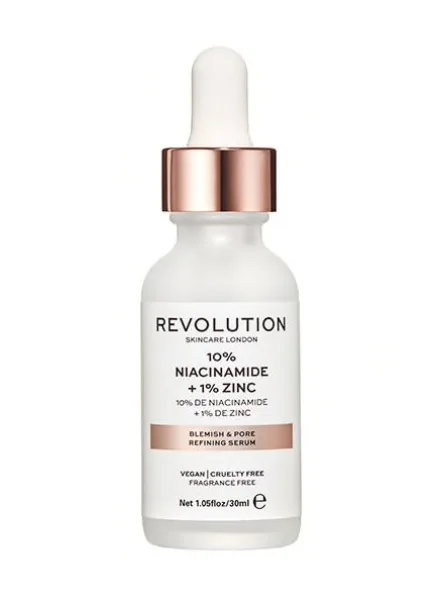
This serum is deliberately minimalist — water, humectants, niacinamide, zinc PCA, and preservatives, nothing else. That's a feature rather than a flaw at this price point: fewer ingredients means fewer variables, less chance of irritation, and the full 10% niacinamide concentration isn't diluted by competing actives. It's essentially the UK drugstore counterpoint to The Ordinary's Niacinamide 10% + Zinc 1%.
Revolution Skincare's Niacinamide 10% + Zinc 1% is a deliberately minimal, highly affordable niacinamide serum that sits squarely in The Ordinary's lane and does essentially the same job. It's fragrance-free, oil-free, fungal-acne safe, and compatible with virtually every active you can pair with it — an easy budget addition to almost any routine.
The case for it
What would change this: Guideline or regulatory standing for the active on this concern would move this from a promising bet to a recommendation.
Same rule for everyone. “Promising” is the verdict on 7,858 of 45,024 concern verdicts across the catalog; rule R9p decided 7,858 of them. Unchanged since September 5, 2026, engine 5.1.1.
Brand or formulator? Disclose a concentration or correct a fact →
The studies behind the evidence row
The case for it
What would change this: Guideline or regulatory standing for the active on this concern would move this from a promising bet to a recommendation.
Same rule for everyone. “Promising” is the verdict on 7,858 of 45,024 concern verdicts across the catalog; rule R9p decided 7,858 of them. Unchanged since September 5, 2026, engine 5.1.1.
Brand or formulator? Disclose a concentration or correct a fact →
The studies behind the evidence row
The case for it
What would change this: Guideline or regulatory standing for the active on this concern would move this from a promising bet to a recommendation.
Same rule for everyone. “Promising” is the verdict on 7,858 of 45,024 concern verdicts across the catalog; rule R9p decided 7,858 of them. Unchanged since September 5, 2026, engine 5.1.1.
Brand or formulator? Disclose a concentration or correct a fact →
The studies behind the evidence row
The case for it
Same rule for everyone. “Good choice” is the verdict on 9,564 of 45,024 concern verdicts across the catalog; rule R5 decided 9,072 of them. Unchanged since September 5, 2026, engine 5.1.1.
Brand or formulator? Disclose a concentration or correct a fact →
The studies behind the evidence row
The case for it
What would change this: A declared concentration would move this to a firmer reading of the dose.
Same rule for everyone. “Promising” is the verdict on 7,858 of 45,024 concern verdicts across the catalog; rule R9p decided 7,858 of them. Unchanged since September 5, 2026, engine 5.1.1.
Brand or formulator? Disclose a concentration or correct a fact →
The studies behind the evidence row
Also listed for Blackheads — the actives here (Propanediol, Niacinamide, Zinc, Glycerin) are in our research queue for that concern; there is no verdict until their evidence rows are written. That is a gap in our table, not a mark against the product.
A verdict is DermApproved’s assessment of how well a product’s ingredients fit a concern — never a claim about what the product treats. Evidence dots and collected reviews sit beside it and are never blended in. Rules 0.5.1 · evidence table ev-2026.09-r228 · how we decide
The Ordinary's Niacinamide 10% + Zinc 1% serum changed the budget skincare landscape when it launched in 2017. It was one of the first products to prove that a well-formulated active serum could sell at drugstore prices and still perform like a prestige product, and it became a global cult favorite almost overnight. Revolution Skincare launched this serum in 2018 as part of their broader mass-market active lineup, explicitly positioned at the same price point and with a nearly identical formulation philosophy. The product has stayed in their catalog ever since and remains one of their most widely recognized items, regularly showing up in UK drugstore skincare roundups as 'the niacinamide serum you buy when the Boots is out of The Ordinary.'
The formulation is almost radically simple. Ten ingredients total: water, propanediol, niacinamide, zinc PCA, glycerin, butylene glycol, xanthan gum as a thickener, sodium benzoate and potassium sorbate as preservatives, and disodium EDTA as a chelator. That's it. No fragrance, no botanical extracts, no secondary actives competing for space, no emollient support, no antioxidants. The 10% niacinamide sits in a clean humectant base with 1% zinc PCA as the only other active, and the whole serum is structured to deliver those two ingredients into the skin without any interference. At first glance this looks like a weakness — no supporting cast, nothing fancy — but at this price point and with this formulation philosophy, minimalism is a feature. Fewer ingredients means fewer potential irritants, a more predictable interaction profile with the rest of your routine, and the full 10% niacinamide concentration isn't diluted by competing actives trying to share the label real estate.
On application the serum pours out as a thin, slightly slippery water-gel that absorbs in under a minute to a matte finish. There's no tingling, no warming, no sensation of any kind — which is exactly what a well-formulated niacinamide serum should feel like. Niacinamide works slowly and cumulatively, so don't expect dramatic results in the first week. By day three to five, oily skin users often notice a mild reduction in midday shine as the zinc PCA normalizes sebum output. By week three to four, pore appearance starts to refine visibly — particularly across the t-zone — and active blemishes heal slightly faster than baseline. By week eight the cumulative effect is clearer, and by twelve to sixteen weeks post-inflammatory hyperpigmentation from old breakouts starts fading noticeably.
Where this serum genuinely shines is in compatibility. Niacinamide is one of the few active ingredients that pairs well with essentially everything else in a skincare routine — retinoids, AHAs, BHAs, vitamin C, peptides, benzoyl peroxide — and the bare-bones formulation here means there's nothing in the serum to create layering conflicts. You can apply it before or after acid toners, in the morning alongside vitamin C, at night before retinol. It layers without pilling under moisturizer and sunscreen, and the lack of fragrance makes it a safe pick for sensitive users who can't tolerate more heavily formulated products. It's the kind of serum that quietly slots into a routine and stays there for years because it never creates problems.
Its limitations are minor and expected. The minimal formulation means there's no supporting cast to soften the experience — no emollient lipid layer, no antioxidant complex, no peptide support, no texture interest. It's a functional serum, not a sensorial one. Dropper packaging is sometimes criticized for occasionally dispensing too much serum at once, which is a real but minor issue. The zinc PCA can very slightly separate or settle in the bottle over extended storage, and a gentle shake before use handles that fine. The 30ml size is small, but Revolution does sell a 60ml 'super-sized' version at some retailers for slightly better per-ml economics if you know you like it.
The value math is exceptional. At roughly $9 for 30ml this is one of the cheapest legitimate 10% niacinamide serums on the market. A bottle lasts 2-3 months with twice-daily use, so the monthly cost is $3-5 for what may be the most universally useful active serum in skincare. Compared to premium niacinamide options from brands like Paula's Choice or SkinCeuticals, which sit at $30-55 for similar concentrations, the savings are substantial, and the core ingredient delivery is comparable. For anyone building out an affordable routine, this is one of the easiest buys on the shelf — low risk, well-documented, and compatible with everything else you might already own. It's not going to be the star of your routine, but it will quietly do useful work in the background for as long as you keep using it.
The hero actives that drive this product's performance.
| Ingredient | Function | Evidence |
|---|---|---|
| Niacinamide 10% (10%) | The primary active at a high but well-tolerated concentration. In this specific formulation niacinamide is placed in a simple propanediol-glycerin base with zinc PCA as the only other active, which keeps the formula uncluttered and lets the niacinamide work without competing actives diluting its effect. | Emerging for Hyperpigmentation |
| Zinc PCA 1% (1%) | Zinc PCA is a zinc salt with antibacterial and sebum-normalizing properties — in this serum it pairs with niacinamide specifically to target oily, congested skin. The zinc's sebum-regulating effect complements niacinamide's pore-refining and blemish-calming action for a focused dual-active approach. | Limited for Acne |
| Propanediol | Sits second on the INCI as a humectant and penetration enhancer that helps the niacinamide deliver into the skin. It's a plant-derived alternative to butylene glycol and contributes a lightweight, non-sticky feel to the serum. | Not yet assessed |
| Glycerin | A humectant counterweight that pulls water into the upper skin and keeps this minimal formula from feeling drying despite the absence of an emollient or lipid support. | Plausible mechanism for Dullness |
Ingredient standings describe the active at treatment-level doses and vehicles; this product's own condition grades weigh its actual formula.
Aqua (Water/Eau), Propanediol, Niacinamide, Zinc PCA, Glycerin, Butylene Glycol, Xanthan Gum, Sodium Benzoate, Potassium Sorbate, Disodium EDTA.
serum
AM & PM
Apply 3-4 drops to clean skin morning and night after cleansing and any acid toners, before moisturizer. Layers well under everything.
Mild sebum reduction within 3-5 days. Visible pore refinement and reduced blemish frequency at 4-8 weeks. Full hyperpigmentation benefits at 12-16 weeks of consistent use.
Niacinamide is one of the most clinically well-studied actives in modern dermatology, with decades of published research supporting its multiple mechanisms of action. At 5-10% topical concentrations, niacinamide has been shown in peer-reviewed studies to reduce transepidermal water loss, normalize sebum production, decrease pore appearance, fade post-inflammatory hyperpigmentation, and improve barrier function. The 10% concentration used here sits at the upper edge of common cosmetic formulations — above which some users start reporting mild flushing reactions, which is why 10% tends to be the ceiling for most over-the-counter niacinamide serums. Zinc PCA is zinc salt-bound to pyrrolidone carboxylic acid, an amino acid derivative that is also a natural moisturizing factor in the skin. The zinc component has some evidence for antibacterial activity against Cutibacterium acnes and for sebum regulation, and the PCA side adds a small humectant benefit. The pairing of niacinamide with zinc is not dramatically synergistic — they don't amplify each other in any major way — but they are structurally complementary: niacinamide addresses pore appearance, tone, and barrier function, while zinc addresses sebum and mild antibacterial effects. The formulation here is essentially a clean delivery vehicle: water as the base, propanediol and glycerin as humectants that also aid niacinamide absorption, butylene glycol as a penetration enhancer, xanthan gum for mild thickening, and preservative system for shelf stability. There are no antioxidants, emollients, or secondary actives, which keeps the product uncluttered and predictable. The evidence base for the core ingredients is solid, and the minimal delivery system is appropriate for the concentration being delivered.
Dermatologists frequently recommend 10% niacinamide serums as foundational additions to most skincare routines because of the ingredient's strong safety profile and broad functional benefits. In the dermatology community, niacinamide is one of the few actives that can be used by essentially any skin type without significant risk of irritation, and it pairs well with virtually every other active ingredient. This serum's minimalist formulation makes it particularly well-suited to patients with sensitive skin or complex routines where a heavily formulated product might create conflicts. The zinc PCA addition is regarded as a reasonable supporting actor for oily and acne-prone skin, though not strong enough to replace dedicated acne treatments. In clinical practice, 10% niacinamide is often recommended as a twice-daily staple for pore refinement, post-inflammatory hyperpigmentation support, and barrier function improvement, with realistic expectations of 8-16 weeks to full visible results.
Apply 3-4 drops to clean skin morning and night after cleansing and any acid toners, before moisturizer and sunscreen. Can be used on the full face and neck. Layers without conflict before or after retinol, vitamin C, acid exfoliants, or any other serum. Gently shake the bottle if the zinc PCA appears to have settled during storage. Consistency is key — niacinamide's benefits build over 8-16 weeks of twice-daily use, so commit to the full timeline before judging results.
At around $9 for 30ml this is one of the best price-to-performance ratios in the entire niacinamide category. A bottle lasts 2-3 months with twice-daily use, working out to roughly $3-5 per month — essentially a rounding error in a skincare budget. Compared to premium niacinamide options at $30-55, the savings compound across years of consistent use. The super-sized 60ml version offers even better per-ml value for users who know they like it. For anyone building an affordable routine or supplementing a more expensive routine with a reliable niacinamide step, this is one of the easiest value picks in drugstore skincare.
Essentially any skin type looking for an affordable, reliable niacinamide serum — this is the most universally useful active in skincare and this is one of the most accessible places to buy it. It's particularly well-suited to oily, acne-prone, or congested skin, users building a budget-friendly starter routine, and anyone with sensitive skin who needs a clean, fragrance-free formulation.
Users looking for a more luxurious, sensorial serum experience with texture and supporting cast will want a more heavily formulated alternative. Very dry skin may need to pair this with additional hydrating layers since the formulation offers no emollient support. Anyone already using another 10% niacinamide serum doesn't need to switch — the performance differences at this concentration are minimal across brands.
Ready to try Revolution Skincare Niacinamide 10% + Zinc 1% Blemish & Pore Refining Serum?
Buy at Amazon ♥Thin, slightly slippery water-gel — spreads easily and absorbs within a minute.
Unscented.
Glass dropper bottle, 30ml. Also available in a 60ml 'super-sized' version from some retailers.
First use delivers a slightly slippery sensation as the serum absorbs. No stinging, no tingling, no visible change on day one. Over the first two weeks of consistent use, oily skin users usually notice sebum normalization and a slight reduction in midday shine. By week four to six, pore appearance starts to refine and any active blemishes heal slightly faster than baseline.
30ml lasts approximately 2-3 months applied morning and night. The 60ml size lasts about twice as long.
All Year
Revolution launched this serum in 2018 as one of the first products in its active skincare line, explicitly positioned against The Ordinary's hugely successful Niacinamide 10% + Zinc 1%. The formulation mirrors The Ordinary's approach but with subtle differences — Revolution uses zinc PCA where The Ordinary uses zinc PCA as well, but with a slightly different base. It has remained one of Revolution's best-selling products through the entire line's history.
Revolution Skincare is the skincare line from Revolution Beauty, a UK mass-market beauty group with a strong drugstore distribution footprint. Since the late 2010s the brand has offered ingredient-forward serums positioned explicitly against The Ordinary at similar price points.
Niacinamide and vitamin C can't be used together.
This is a persistent myth dating from old research on pure niacinamide and pure ascorbic acid converting to niacin and dehydroascorbic acid under heat. Modern formulations are stable, and many dermatologists routinely recommend using them in the same routine — either together or at different times of day. There's no safety or efficacy issue.
Zinc in this formula kills acne bacteria.
Zinc PCA has mild antibacterial and sebum-regulating effects, but it's not comparable to prescription antibiotics or benzoyl peroxide. Its role in this serum is supportive — it helps normalize oil production and complements the niacinamide's pore effects. If you have moderate to severe acne, this serum alone won't solve it.
The formulations are structurally very similar — both center 10% niacinamide and 1% zinc PCA in a simple humectant base. The Ordinary uses a slightly different pH and supporting excipients, but in practical daily use, the two products produce comparable results. Revolution is often slightly cheaper and more widely stocked in UK drugstores.
Yes — niacinamide pairs excellently with retinol. Many routines apply niacinamide in the morning and retinol at night, or layer niacinamide first followed by retinol at night. Niacinamide actually helps buffer some of the barrier stress that retinol can cause.
Niacinamide has moderate evidence for reducing post-inflammatory hyperpigmentation and melanin transfer, so it can contribute to fading dark spots over 12-16 weeks of consistent use. For more stubborn hyperpigmentation, pair it with azelaic acid, vitamin C, or tranexamic acid for faster results.
Yes. The old myth about niacinamide and vitamin C being incompatible has been thoroughly debunked — modern formulations are stable together, and many skincare routines include both. You can layer them, alternate them, or use them at different times of day depending on your preference.
Yes. Niacinamide and zinc PCA are both considered safe during pregnancy and breastfeeding. This serum's minimal formulation makes it one of the easier niacinamide picks for pregnant users.
Mild sebum reduction appears within 3-5 days for oily skin users. Visible pore refinement typically shows at 4-8 weeks, and hyperpigmentation benefits take 12-16 weeks of consistent twice-daily use to fully emerge.
Recurring themes our editors read across retailer reviews of this product — summaries in our words, not quotations, and not a substitute for your own patch test.
Affordable and effective
No fragrance or irritation
Noticeable pore refinement within a month
Lightweight layering under everything
Minimal formula has no supporting cast
Dropper packaging occasionally dispenses too much
Zinc PCA can slightly settle in the bottle over time
Verified answers from our questions library — the nuance a product page cannot carry.