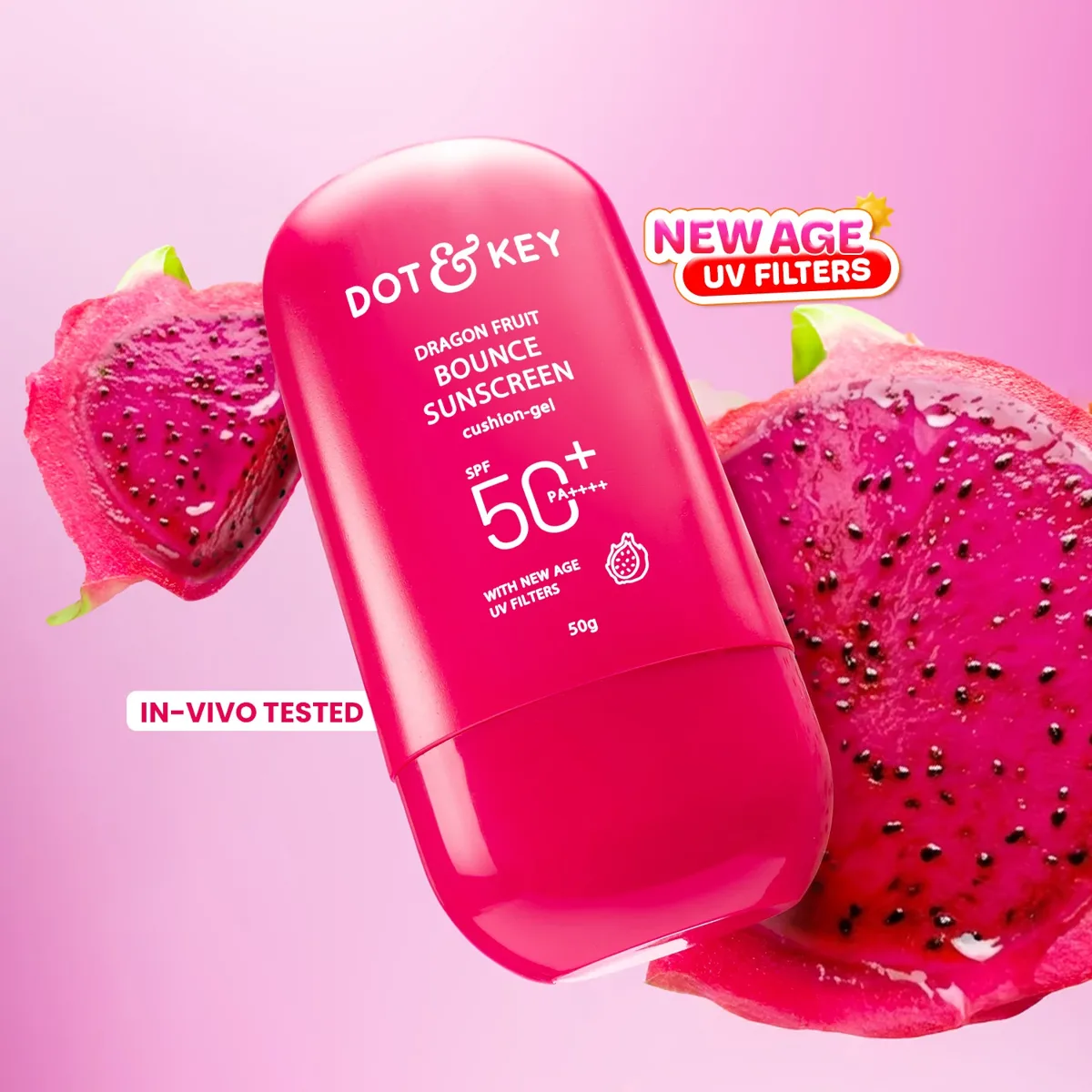
Combines European-approved Tinosorb S and Uvinul A Plus filters (not FDA-approved in the US) with US-standard avobenzone and octocrylene plus meaningful niacinamide plus K-beauty centella-aloe soothing cast plus dragon fruit positioning in characteristic 'bounce' jelly texture. European-tier SPF chemistry at emerging-brand pricing.
Roughly 850 cross-retailer reviews, weighted heavily toward Indian e-commerce, back this 2023 sunscreen, so the score blends real user volume with filter analysis. The European-tier Tinosorb S and Uvinul A Plus chemistry is well-documented, but long-term wear and real-world UVA stability across Western markets remain less established for this specific bounce formula.
Verdicts
How well it fits each concern
Verdict by concern tap a concern for the case
Full protectionfor Sun DamageIn your profileYou chose · Broad-spectrum SPF 50 with avobenzone, tinosorb s 4%, uvinul a plus 3%. inactive ingredients: aqua: the protection sun damage calls for.Moderate evidenceGentleNo reviews collected yet
The case for it
European-Tier Chemical SPF Filters is a first-line active — approved, monograph-listed or named in current guidelines — for this concern.
It is present at an effective concentration, declared or high in the ingredient list.
The formula carries none of the triggers this concern is sensitive to.
Same rule for everyone. “Full protection” is the verdict on 2,288 of 45,024 concern verdicts across the catalog; rule P1 decided 2,232 of them.
Unchanged since September 5, 2026, engine 5.1.1.
P1 — Photoprotection standing is regulatory (M020 / Annex VI filters; 21 CFR 201.327 attaches the early-skin-aging claim to tested broad-spectrum SPF 15+). SPF 30 is the AAD daily-use bar. · the full register
Carrying active
European-Tier Chemical SPF Filters
Standing
first line — a regulator recognises it for this use; trials support it · per 21 CFR § 352.10 Sunscreen active ingredients (US FDA — 21 CFR Part 352 (Sunscreen Drug Products for Over-the-Counter Human Use), via Cornell Legal Information Institute; part heading marked [STAYED INDEFINITELY], effective date stayed at 66 FR 67485), opened September 1, 2026
Form
adequate (declared 3%) — studied range up to 3%, from the OTC monograph or label; needs leave-on contact
Tolerability
gentle
Row checked
against its sources on September 1, 2026 (evidence table ev-2026.09-r228)
21 CFR § 352.10 Sunscreen active ingredients — US FDA — 21 CFR Part 352 (Sunscreen Drug Products for Over-the-Counter Human Use), via Cornell Legal Information Institute; part heading marked [STAYED INDEFINITELY], effective date stayed at 66 FR 67485, opened September 1, 2026
Full protectionfor AgingIn your profileYou chose · Broad-spectrum SPF 50 with avobenzone, tinosorb s 4%, uvinul a plus 3%. inactive ingredients: aqua: the protection aging calls for.Moderate evidenceGentleNo reviews collected yet
The case for it
Niacinamide has early or mechanistic evidence for this concern, not trial-backed standing.
It is plausibly present at a working level, though the concentration is not declared.
The formula carries none of the triggers this concern is sensitive to.
What would change this: A declared concentration would move this to a firmer reading of the dose.
Same rule for everyone. “Full protection” is the verdict on 2,288 of 45,024 concern verdicts across the catalog; rule P1 decided 2,232 of them.
Unchanged since September 5, 2026, engine 5.1.1.
P1 — Photoprotection standing is regulatory (M020 / Annex VI filters; 21 CFR 201.327 attaches the early-skin-aging claim to tested broad-spectrum SPF 15+). SPF 30 is the AAD daily-use bar. · the full register
Carrying active
Niacinamide
Standing
plausible — trials support it
Form
plausible — studied range 4–5%, from the trials on the row; needs leave-on contact; judge it after ~8 weeks
Tolerability
gentle
Row checked
against its sources on July 17, 2026 (evidence table ev-2026.09-r228)
Full protectionfor HyperpigmentationIn your profileYou chose · Broad-spectrum SPF 50 with avobenzone, tinosorb s 4%, uvinul a plus 3%. inactive ingredients: aqua: the protection hyperpigmentation calls for.Moderate evidenceGentleNo reviews collected yet
The case for it
Niacinamide has trial-supported standing for this concern.
It is plausibly present at a working level, though the concentration is not declared.
The formula carries none of the triggers this concern is sensitive to.
What would change this: A declared concentration would move this to a firmer reading of the dose.
Same rule for everyone. “Full protection” is the verdict on 2,288 of 45,024 concern verdicts across the catalog; rule P1 decided 2,232 of them.
Unchanged since September 5, 2026, engine 5.1.1.
P1 — Photoprotection standing is regulatory (M020 / Annex VI filters; 21 CFR 201.327 attaches the early-skin-aging claim to tested broad-spectrum SPF 15+). SPF 30 is the AAD daily-use bar. · the full register
Carrying active
Niacinamide
Standing
supported — trials support it
Form
plausible — studied range 2–5%, from the trials on the row; needs leave-on contact; judge it after ~8 weeks
Tolerability
gentle
Row checked
against its sources on July 17, 2026 (evidence table ev-2026.09-r228)
Does the jobDoes what a sunscreen is for: UVA coverage, kind to the skin wearing it. Not measured from the label: pleasant enough to actually use.
A verdict is DermApproved’s assessment of how well a product’s ingredients fit a concern — never a claim about what the product treats. Evidence dots and collected reviews sit beside it and are never blended in.
Rules 0.5.1 · evidence table ev-2026.09-r228 · how we decide
Assessment
Pros & Cons
Pros
✓ European-tier hybrid SPF filter framework (Tinosorb S + Uvinul A Plus + avobenzone + octocrylene)
✓ PA++++ UVA protection rating exceeds typical US broad-spectrum coverage
✓ Niacinamide at meaningful position 4 for barrier and tone support
✓ Very accessible 19-dollar pricing for European-tier SPF chemistry
✓ Fragrance-free formulation
Cons
✗ European filters NOT FDA-approved — limits US availability to import channels
✗ Dragon fruit positioning is brand marketing rather than mechanism
✗ Indian formulation may differ from international export versions
✗ Indian e-commerce brand with limited US retail presence
Review
Full Review
Spend any time in dermatology-leaning skincare circles and you'll eventually run into the great American sunscreen grievance: the FDA hasn't approved a genuinely new chemical UV filter since the 1990s, which leaves US formulators working with an older toolkit while the rest of the world has moved on. The practical fallout is real — older filters like avobenzone degrade under UV unless carefully stabilized, and US options for deep UVA1 coverage are thin. Europe, Asia, and Australia, meanwhile, greenlit newer filters years ago that offer broader UVA protection, better photostability, and gentler tolerance. Dot & Key's Dragon Fruit Bounce Sunscreen is interesting precisely because it's built on that newer-generation chemistry, and it arrives at a price that makes the sophistication almost surprising.
The filter framework is the headline, and it's a hybrid one. There's avobenzone at 3 percent (the standard US UVA workhorse) and octocrylene at 5 percent (which doubles as a photostabilizer for that avobenzone), and then the genuinely notable additions: Tinosorb S at 4 percent, a broad-spectrum filter covering both UVA and UVB with documented superior photostability, and Uvinul A Plus at 3 percent, a UVA1 specialist that fills exactly the gap US-only formulas struggle with. Together this delivers SPF 50+ with a PA++++ rating, the highest UVA mark in the Japanese-Korean-Indian system, indicating a UVA protection factor of 16 or higher. American sunscreens use the binary "broad spectrum" designation without that granularity, but a PA++++ rating reliably outpaces typical US broad-spectrum UVA performance. For a daily anti-photoaging sunscreen, that UVA depth is the part dermatology actually cares most about, since UVA penetrates deeper, drives the collagen breakdown behind wrinkles and laxity, and passes through window glass — meaning it's working on your skin even on overcast days and indoors near a window. A sunscreen that's strong on UVB but thin on UVA can post an impressive SPF number while quietly leaving you exposed to the wavelengths that age you most, which is exactly the gap these European filters close.
The supporting cast follows the K-beauty playbook intelligently. Niacinamide sits at position 4 in the INCI, suggesting a meaningful 3-5 percent, contributing tone evenness and barrier support alongside the SPF. Then there's the soothing complex — centella asiatica with isolated madecassoside (centella's most-studied triterpene) plus aloe polysaccharides, allantoin, and panthenol — which helps offset the reactivity that chemical filters can occasionally provoke. Dragon fruit (Hylocereus undatus) extract is the brand-positioning hero and the name on the bottle, but be clear-eyed about it: it offers modest antioxidant polyphenol content and a lot of brand identity, and it is emphatically not where the sun protection comes from. The signature "bounce" jelly texture, similarly, owes nothing to the fruit and everything to polyacrylate crosspolymer-6, the polymer that creates that springy, fast-absorbing Korean-style cushion feel.
In use, the bounce-jelly texture applies cleanly with that characteristic K-beauty give, absorbing to a satin finish without white cast or sticky residue. It's fragrance-free, oil-free, and rated fungal-acne-safe, and the lightweight feel genuinely suits oily and combination skin that finds cream sunscreens heavy and occlusive. It wears well under makeup, layering without pilling or that grey cast some chemical sunscreens leave under foundation. The one discipline it demands is the same as any sunscreen worth wearing: apply enough — roughly two finger-lengths for the face and neck — and reapply through a long day outdoors, because no filter framework, however sophisticated, protects at half the tested dose. Protection is immediate the moment it's on, and the cumulative payoff — the actual reason to wear it daily — is photoaging prevention that builds quietly over months and years.
The real limitations are regulatory and logistical rather than formulary. Those European filters are not FDA-approved for sale in the US, so this reaches American buyers through import channels — Amazon import sellers, direct-from-India retailers — rather than standard shelves, and the Indian-market formulation may differ from international export versions. Dot & Key itself is an emerging Indian e-commerce brand (launched 2018) with strong traction on Nykaa and Myntra but limited US retail presence and a shorter track record than legacy sun-care names. The dragon fruit positioning, as noted, is marketing rather than mechanism. And while the product is cruelty-free and vegan certified, that certification doesn't extend to the parent-company level. The review base is also still modest, so the assessment leans more on the filter chemistry than on years of accumulated user data.
On value, nineteen dollars for 50 grams works out to roughly thirty-eight cents per gram, which is genuinely strong for a European-tier filter framework — the SPF sophistication here outstrips what's typically available at US drugstore pricing, and you're paying emerging-brand rates for next-generation chemistry. That value, paired with the PA++++ UVA depth, is what carries the high score.
Where it lands: for normal, combination, and oily skin that's willing to source through import channels and wants modern UVA protection in a lightweight, fragrance-free, breakout-friendly format, this is a thoughtful and frankly impressive buy. For anyone who needs strict US-FDA-compliant products or wants the reassurance of a long-established brand on familiar shelves, the older-generation filter sunscreens already in the US market will be the more practical route — but they won't match this UVA coverage at this price.
Formula
Key Ingredients
The hero actives that drive this product's performance.
Hybrid chemical filter framework using European-approved Tinosorb S and Uvinul A Plus alongside US-standard avobenzone and octocrylene. The European filters provide superior photostability and broader UVA coverage than US-only filters. SPF 50+ with PA++++ UVA protection.
Regulator-approvedfor Sun Damage · emerging certainty
Brand-positioning hero ingredient and 'bounce' texture differentiator — dragon fruit extract provides modest antioxidant polyphenol content plus brand identity. The 'bounce' texture comes from the polyacrylate crosspolymer, not the dragon fruit itself.
The polymer that creates the characteristic 'bounce' jelly texture — Korean-style sunscreen format that absorbs quickly and feels lightweight versus traditional cream sunscreens.
Not yet assessed
Ingredient standings describe the active at treatment-level doses and
vehicles; this product's own condition grades weigh its actual formula.
Full INCI List
Active Ingredients (Hybrid): Avobenzone 3%, Octocrylene 5%, Tinosorb S 4%, Uvinul A Plus 3%. Inactive Ingredients: Aqua (Water), Glycerin, Propanediol, Niacinamide, Hylocereus Undatus (Dragon Fruit) Fruit Extract, Sodium Hyaluronate, Centella Asiatica Extract, Madecassoside, Aloe Barbadensis Leaf Juice, Allantoin, Panthenol, Tocopheryl Acetate, Carbomer, Dimethicone, Polyacrylate Crosspolymer-6, Disodium EDTA, Phenoxyethanol, Caprylyl Glycol
Apply as the final morning step, two finger-lengths over the face. The 'bounce' texture absorbs quickly. Reapply every 2 hours of sun exposure. Compatible with makeup layering.
Results Timeline
Immediate broad-spectrum UVA+UVB protection at PA++++ level; cumulative photoaging prevention with daily use.
Dot & Key Dragon Fruit Bounce Sunscreen SPF 50+ PA++++
Sample PM Routine
Cleansing
Toner
Treatment serum
Eye cream
Night cream
Evidence
Science & Expert Perspective
The Science
The European-tier SPF filter chemistry has substantial regulatory and peer-reviewed evidence. Tinosorb S (bis-ethylhexyloxyphenol methoxyphenyl triazine) provides broad-spectrum UVA and UVB protection with documented superior photostability compared to US-approved-only filter combinations. Uvinul A Plus (diethylamino hydroxybenzoyl hexyl benzoate) provides UVA1 specialist coverage that complements other filters. The combined hybrid framework with avobenzone and octocrylene delivers SPF 50+ broad-spectrum protection with PA++++ UVA rating. Published research has documented broader UVA coverage of newer-generation chemical filters compared to older US-approved alternatives. Niacinamide at meaningful concentration provides barrier function support and tone evenness through documented mechanisms. The centella triterpene supporting cast provides anti-inflammatory action. Dragon fruit (Hylocereus undatus) extract has limited but promising research on antioxidant polyphenol content.
References
Newer-generation chemical sunscreen filters — global regulatory landscape review — Photochemistry and Photobiology (2020)
Dermatologist Perspective
European-tier SPF filter frameworks are commonly cited by dermatologists as superior to US-only filter combinations for photostability and UVA coverage. The Dot & Key Dragon Fruit Bounce Sunscreen fits this clinical positioning at the emerging-brand accessibility tier. Patient selection: anyone seeking next-generation SPF chemistry available through import channels, K-beauty routine builders, patients prioritizing UVA protection (melasma, hyperpigmentation). The European filter availability is the limiting factor for US patients — choose US-FDA-approved alternatives for strictly-domestic sourcing.
Guidance
Usage & Recommendations
How to Use
Apply as the final morning step — two finger-lengths over the face. Reapply every 2 hours of direct sun exposure or after swimming, sweating, or towel-drying. The bounce-jelly texture absorbs quickly and suits makeup layering. Pair with vitamin C serum (AM) for antioxidant photo-protection complement.
Value Assessment
At 19 dollars for 50g, per-gram cost is 0.38 dollars — very accessible for European-tier filter framework. CeraVe AM SPF 30 at lower price covers US-FDA filters with ceramides. Bondi Sands Face SPF 50 at moderate price covers US-FDA SPF 50 framework. Beauty of Joseon Relief Sun at moderate price covers Korean SPF positioning. The Dot & Key offers genuinely strong value for the European-tier filter chemistry — the formulation sophistication exceeds US drugstore tier comparable products.
Strict US-FDA-compliant routines (European filters not FDA-approved). Strict US retail-only routine builders. Patients with chemical SPF filter sensitivities.
Ready to try Dot & Key Dragon Fruit Bounce Sunscreen SPF 50+ PA++++?
Dot & Key launched in 2018 as an Indian e-commerce skincare brand positioned as accessibly-priced K-beauty-inspired skincare for the Indian market. Has built rapid traction through Indian online retailers (Nykaa, Myntra). The Dragon Fruit Bounce Sunscreen launched in 2023 leveraging the Korean-style 'bounce' (jelly-textured) sunscreen format.
About Dot & Key Established Brand (5–20 years)
Dot & Key is an Indian skincare brand launched in 2018, positioned as accessibly-priced K-beauty-inspired skincare for the Indian market. Has built rapid traction in Indian e-commerce. The Dragon Fruit Bounce Sunscreen uses the Korean-style 'bounce' (jelly-textured) sunscreen format that has become popular in K-beauty SPF.
Brand founded: 2018 · Product launched: 2023
Myth vs. Reality
Common Myths
Myth
Indian and Asian-market SPF products are equivalent to US FDA-regulated sunscreens.
Reality
Different regulatory frameworks govern Indian, EU, Australian, and US sunscreens. The European-tier filters (Tinosorb S, Uvinul A Plus) in this product provide superior photostability and broader UVA coverage than US-approved-only filters, but these European filters are NOT FDA-approved for US sale. Available through international importers but not standard US retail.
FAQ
Frequently Asked Questions
Why are European SPF filters not available in US sunscreens?
Tinosorb S and Uvinul A Plus are approved in EU, India, Australia, and most other markets, but FDA has not approved newer-generation sunscreen filters for US sale. The Dot & Key Bounce Sunscreen with these filters is available through international importers but not standard US retail.
What does PA++++ mean?
PA is the UVA protection rating used in Japanese, Korean, and Indian sunscreens. PA++++ is the highest rating, indicating UVA protection factor (UVA-PF) of 16 or higher. US sunscreens use 'broad spectrum' designation without comparable rating granularity.
Is dragon fruit extract doing real work in this Dot & Key sunscreen?
Dragon fruit extract provides modest antioxidant polyphenol content but is primarily brand-positioning ingredient. The SPF chemistry (European-tier filters), niacinamide, and centella supporting cast do the verifiable formulation work.
Will this Dot & Key sunscreen leave a white cast?
No — chemical SPF filters do not produce the white cast that mineral filters can show. The bounce-jelly texture absorbs cleanly across skin tones.
Is this Dragon Fruit Bounce Sunscreen pregnancy-safe?
Yes — chemical SPF filters including European-tier Tinosorb S and Uvinul A Plus are considered safe during pregnancy at cosmetic concentrations.
Reviews
What Reviewers Tend to Say
Recurring themes our editors read across retailer reviews of this product — summaries in our words, not quotations, and not a substitute for your own patch test.
Common Praise
European-tier SPF filters (Tinosorb S + Uvinul A Plus) provide superior photostability
PA++++ UVA protection rating uncommon at this price tier
Bounce texture absorbs quickly
Niacinamide and soothing cast support sensitive routines
Vegan and cruelty-free certified
Very accessible 19-dollar pricing
Common Complaints
European filters not FDA-approved (limits US import availability)
Dragon fruit positioning is brand marketing more than mechanism
Indian-formulation may differ from international versions
Notable Endorsements
Dot & Key Indian K-beauty brand tractionEuropean-tier SPF filter inclusion
We have spent years praising Japanese filter chemistry while ignoring that the filter is the last line of a system built out of fabric, shade and timing — the part that needs no importing and does not depend on you remembering to reapply.
Nearly every trial that made this ingredient famous ran at 2–5%. The double-digit numbers on the shelf are answering a question the biology never asked.
It was invented to stop bleeding during surgery. In 2026 it's in dozens of brightening serums — and the evidence is better than most trend ingredients can claim.
Jul 6, 2026· 3 min
Questions people ask about Hyperpigmentation
Verified answers from our questions library — the nuance a product page cannot carry.
Products, answers, therapy guides, tools and articles in one search. Brand names,
slang and abbreviations all work — accutane finds isotretinoin, bacne finds truncal acne.