The Best Thing About Japanese Sun Protection Is Not the Sunscreen
We have spent years praising Japanese filter chemistry while ignoring that the filter is the last line of a system built out of fabric, shade and timing — the part that needs no importing and does not depend on you remembering to reapply.
Read the preview
From the DermApproved blog, in J-Beauty: we have praised Japanese sunscreen for years and missed the point entirely. Researchers counted people on Japanese streets — the most common sun-protective item wasn't a bottle. It was a parasol, on an ordinary Tuesday. And the reason fabric beats any filter comes down to arithmetic most people have never seen. For the full breakdown, visit dermapproved.com/blog.
What an observer counting people on a Japanese street actually sees
Skincare writing about Japan, including a good deal of ours, has concentrated on the filters — the modern ultraviolet-A absorbers, the elegant textures, the aesthetic gap between an Anessa milk and a Western beach lotion. All of that is true and none of it is the interesting part.
Researchers once stood on Japanese streets and counted. In a cross-sectional observational study of pedestrians, 53.0% of women were using at least one sun-protective item, against 30.2% of men. The single most common item was not a bottle. It was a parasol, carried by 33.0% of the women observed. Not at the beach. On the way to work, in a city, in the ordinary course of a Tuesday.
That is the thing worth exporting, and it is invisible in a product review because it is not a product. It is an environment: a stack of physical interventions — parasol, brimmed visor, arm covers, gloves, UV-cut outerwear, shaded routes, avoided hours — inside which sunscreen is the last and smallest layer, applied to the small fraction of skin the rest of the system leaves exposed.
Two more numbers from that literature complicate the picture in ways worth stating rather than smoothing over. The same pedestrian study found sunglasses use strikingly low — 8.5% of men, 6.5% of women — despite high measured ultraviolet indices, which is a real hole in an otherwise thorough system, given what ultraviolet does to the ocular surface and the eyelid skin. And a 2024 comparative study found sunscreen use in Japan running at 45.7% overall, but split brutally by sex: 70.1% of women against 18.74% of men. Japanese sun avoidance is not a national practice. It is largely a practice of Japanese women, and the men are roughly as exposed as men anywhere.
The arithmetic that makes fabric beat filters
The argument for prioritising the physical layer is not aesthetic or cultural. It is a dose calculation, and it is the single most under-communicated fact in sun protection.
An SPF number is generated in a laboratory at a defined application density of 2 milligrams per square centimetre. That figure is not a recommendation; it is the condition under which the number on the bottle is true. Studies measuring what people actually apply find a mean closer to 1 milligram per square centimetre — roughly half — and the relationship between thickness and protection is not proportional. One study of a high-performance sunscreen found the relationship followed a logarithmic curve and concluded that a double application should be recommended. Another, examining consecutive applications, reported that a first application delivered an effective protection factor of around 3.2 from a product labelled 50, rising to roughly 8.6 after a second pass.
The exact shape of that curve is genuinely contested — published work has variously described exponential, logarithmic and near-linear relationships, and anyone quoting a single conversion figure with confidence is overreaching. The direction, though, is not in dispute. Whatever number is printed on your sunscreen, the number on your face is materially smaller, and it degrades further with every hour, every wipe, every bead of sweat.
Now consider fabric. A garment's ultraviolet protection factor is a property of the material — its weave density, fibre type, colour, weight and stretch. It does not depend on whether you applied enough. It does not decline at hour three. It is not removed by a towel or a shirt collar or the back of your hand. There is no reapplication schedule to fail. The protection you get from a sleeve at the end of a long day is the protection you had when you put it on, and that consistency is worth more than any filter's laboratory advantage.
Our sunscreen amount calculator will show you what a genuinely correct facial dose looks like — most people find the quantity startling — and our sun safety tool converts the local ultraviolet index into how quickly unprotected skin accumulates damage. Use them together and the case for covering skin rather than coating it becomes obvious.
UPF is not SPF, and confusing them costs you
The two ratings look like siblings and describe different kinds of thing.
The ultraviolet protection factor of a textile expresses the ratio of erythemally effective ultraviolet reaching the skin without the fabric to the amount reaching it through the fabric. Australia and New Zealand established the first labelling standard of its kind in 1996, and the current classification scheme sorts garments into minimum protection at 15, good at 30, and excellent at 50 and above. Europe has its own standard for sun-protective clothing. To calibrate: a garment rated 40 blocks approximately 97.5% of erythemally effective ultraviolet radiation.
The crucial distinction is where the number lives. SPF is a property of an application — of a specific quantity of product spread on skin under test conditions you will not replicate. UPF is a property of an object. You can buy the object once and wear it for years.
The caveats are real and worth knowing, because the original standard was criticised for exactly them. Stretching a fabric opens its weave and drops its rating. Wetting many fabrics drops it further. Wear and laundering change it over time. And the largest limitation is the dullest: a garment protects precisely what it covers and nothing else, which is why the Japanese stack includes arm covers and gloves rather than stopping at a shirt. A rating of 50 on a T-shirt says nothing at all about your forearms.
The corollary is what makes the system coherent rather than fussy. Once fabric covers the trunk, arms and legs, the remaining exposed surface — face, ears, neck, hands — is small enough that applying sunscreen at a genuinely adequate density becomes realistic. The failure mode of sunscreen-only protection is that the surface area is too large for anyone to dose properly twice a day forever. Reduce the area and the compliance problem shrinks with it.
The randomised trial nobody cites
Photoprotection evidence is mostly observational, which is why the sceptical response to sun advice — that it rests on correlation — has more force than dermatology usually concedes. There is, however, a cluster-randomised controlled trial of clothing, and it is rarely mentioned.
The North Queensland Sun-Safe Clothing trial randomised 25 childcare centres in Townsville, Australia, covering 544 children, and followed them for up to four years. Children at intervention centres wore legionnaire hats rated between 30 and 50-plus, elbow-length cotton crew-neck T-shirts and knee-length shorts every day at childcare, plus sun-protective swimwear at home. Control centres carried on as normal.
The outcome measured was the development of new melanocytic naevi — moles — which accumulate in childhood as a function of ultraviolet dose and which predict later melanoma risk. At three and a half years, the intervention group had 24.3% fewer new moles overall. On the body sites the clothing actually covered — trunk, neck, upper arms, thighs — the reduction was 31.6%. The incidence rate ran at 0.46 moles per month against 0.68 in controls.
Two features make this more persuasive than the headline number. It was randomised, so the usual objection about sun-careful families differing systematically from others does not apply. And the effect was larger at covered sites than overall, which is an internal dose-response: the protection tracked the fabric rather than tracking the kind of family who enrols in a sun-safety study.
The honest limitation is that moles are a surrogate. The trial did not measure melanoma, could not have within its timeframe, and the link from naevus count to cancer is an association rather than a demonstrated causal chain. Anyone telling you this trial proves clothing prevents melanoma has overstated it. What it does show is that a fabric intervention measurably reduces a biological marker of accumulated ultraviolet damage in a randomised design — which is more than most sunscreen behaviour has ever been asked to demonstrate.
Where the habit actually came from
It would be comfortable to present this as a public health triumph, a society that absorbed the dermatological evidence and acted. That is not what happened, and skipping the real history would be the kind of tidy omission this site tries not to make.
The Japanese preference for pale skin substantially predates any understanding of ultraviolet radiation. It runs through classical aesthetics, through the proverb that white skin conceals seven flaws, through centuries of associating an untanned complexion with class position — indoor labour, leisure, distance from field work. The modern commercial category built on it, bihaku, translates literally as beautiful whiteness, and it is the direct descendant of that hierarchy rather than a coincidental rhyme with it. The 2024 comparative work quantifies the resulting attitude gap: 44.30% of Japanese respondents considered tanned skin attractive, against 81.1% of Europeans and 77.6% of North Americans.
So the photoprotection is a by-product. A society organised around avoiding tan will, incidentally, avoid a great deal of photoaging and cutaneous carcinogenesis, and the incidental benefit is genuine. But the machinery producing it is a colourist aesthetic with real costs — pressure on people whose skin is naturally deeper, a beauty standard that treats a tone as a defect, and a marketing category that has spent decades selling whiteness as improvement.
Both things are true and neither cancels the other. You can adopt the parasol without adopting the hierarchy that put it in someone's hand, and you should be clear-eyed that praising "Japanese sun culture" without naming its origin launders something worth naming. The behaviour is excellent. The reason is not the reason you should have.
What actually transfers
Assume you will not carry a parasol. Most Western readers will not, and there is no point building advice around a prop that will stay in the cupboard. What is left is still most of the benefit.
The highest-leverage change is a long-sleeved layer with a rated ultraviolet protection factor, worn as ordinary clothing rather than as sun equipment. Lightweight UPF shirts are now unremarkable in outdoor and athletic ranges, they cost once, and they eliminate the arms and torso from the problem permanently. That single swap removes more surface area from your exposure than any change to your sunscreen ever will.
Second, a hat with a genuine brim, and be sceptical of what you are sold — a 2025 review of hats available online in the United States found that many failed to meet sun-protective recommendations, mostly on brim width. A baseball cap protects a forehead and leaves the ears, cheeks and neck fully exposed, which is exactly where facial skin cancers cluster.
Third, treat driving as sun exposure. Windscreens laminate out most ultraviolet-A; side windows generally do not, which is why occupational drivers show asymmetric photoaging. The Japanese arm cover exists precisely for this and generalises perfectly to a Western commute.
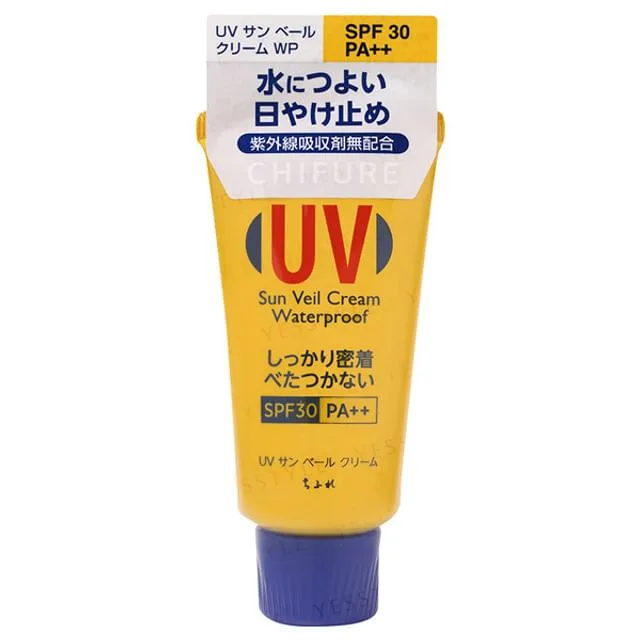
Then, and only then, sunscreen — applied properly to the small area the rest of the system left uncovered. This is where Japanese formulation genuinely earns its reputation, because a product you enjoy wearing is a product you apply at an adequate density. Biore UV Athlizm Skin Protect Milk is built for sweat and movement; Skin Aqua Serum UV is the light daily option that people actually finish the bottle of; Anessa Mineral UV Sunscreen Mild Gel covers the reactive-skin case with mineral filters; Biore UV Kids Pure Milk handles children, who are the population the clothing trial suggests matters most; and Chifure UV Sun Veil Cream WP shows the category running all the way down to drugstore pricing. Our Japanese sunscreen ranking goes through the filter systems properly. If mineral filters are the sticking point, our answer on white cast covers what causes it and what fixes it, and for anyone with a thinning or shaved scalp, how much sunscreen a bald scalp needs is the quantity question people get most wrong.
The argument underneath all of this is simple and slightly bad for business. Photoprotection is an environment problem that the industry has profitably reframed as a product problem. Japan's aisle is admired for its chemistry; its actual advantage is that the chemistry is the last thing in the chain rather than the only thing. The most valuable lesson available from a Japanese street is the one nobody can sell you.
Products mentioned
Independently reviewed and scored — the real products behind this piece.


- Ranked list Best Japanese Sunscreens The filter-system side of the story, in detail.
- Question Why do sunscreens leave a white cast, and what avoids it? The barrier that stops people using mineral filters properly.
- Question How much sunscreen does a bald scalp actually need? The quantity question people get most wrong on the least-covered site.
References
- Use of sun-protective items by Japanese pedestrians: a cross-sectional observational study — Archives of Dermatology, 2011
- Attitudes and behaviors regarding sun exposure in Japan compared to Europe and North America — The Journal of Dermatology, 2024
- Relationship between sun-protection factor and application thickness in high-performance sunscreen: double application of sunscreen is recommended — Clinical and Experimental Dermatology, 2012
- Sunscreen use optimized by two consecutive applications — PLoS One, 2018
- Sun-Protective Clothing Worn Regularly during Early Childhood Reduces the Number of New Melanocytic Nevi: The North Queensland Sun-Safe Clothing Cluster Randomized Controlled Trial — Cancers, 2023
- Availability of Hats Online in the United States that Meet Sun Protective Recommendations — The Journal of Clinical and Aesthetic Dermatology, 2025
- The European standard for sun-protective clothing: EN 13758 — Journal of the European Academy of Dermatology and Venereology, 2006
Every cited link is verified to resolve to the paper named. Where a source could not be independently confirmed, it is listed without a link rather than pointing you somewhere wrong.
Frequently asked
Is UPF clothing better than sunscreen?
For the skin it covers, generally yes — because the rating is a property of the fabric rather than of how carefully you applied something. It delivers the same attenuation all day with no reapplication, whereas measured sunscreen application typically falls to around half the density its SPF was tested at.
What does a UPF rating actually mean?
It expresses how much erythemally effective ultraviolet reaches skin through the fabric compared with bare skin. Standards classify 15 as minimum protection, 30 as good and 50 or above as excellent; a garment rated 40 blocks roughly 97.5% of erythemally effective ultraviolet.
Does a UPF garment lose protection when stretched or wet?
Often, yes. Stretching opens the weave and wetting many fabrics reduces their rating, both of which the original standard was criticised for not testing. Wear and laundering also change performance over time, so a rating describes a garment in good condition rather than forever.
Is there real evidence that sun-protective clothing works?
There is a cluster-randomised trial. Across 25 Australian childcare centres and 544 children, daily sun-protective clothing produced 24.3% fewer new moles at three and a half years, rising to 31.6% at covered body sites. Moles are a surrogate for ultraviolet damage rather than melanoma itself.
Why do Japanese women use parasols rather than more sunscreen?
Because the practice is older than sunscreen. It descends from a long-standing aesthetic preference for untanned skin, which comparative surveys still show clearly. The photoprotective benefit is real but incidental to the motivation, which is worth separating before importing the habit.
What is the single most useful change to copy?
A long-sleeved layer with a rated ultraviolet protection factor, worn as normal clothing. It permanently removes the arms and torso from the exposure problem, costs once, and shrinks the remaining area enough that dosing sunscreen properly on your face becomes realistic rather than aspirational.