Combines sophisticated four-filter chemistry (Octinoxate + DHHB + Uvinul T 150 + Tinosorb S) with silicone film-formers in a true mist format — uncommon at the drugstore price tier. The reapplication convenience over makeup addresses the daily compliance gap that defines real-world sunscreen effectiveness, with the filter sophistication exceeding what most Western mist sunscreens deliver.
An ambitious J-beauty drugstore mist sunscreen combining sophisticated four-filter chemistry (Octinoxate + DHHB + Uvinul T 150 + Tinosorb S) with silicone film-formers in a true mist format. The filter system is uncommon at this price tier and the reapplication convenience over makeup addresses the daily compliance gap that defines real-world sunscreen effectiveness. The alcohol-and-fragrance composition limits sensitive-skin suitability, but for the target demographic — users wanting Japanese-tier filter chemistry in a reapplication format — this is among the most thoughtful mist sunscreens currently available globally.
Full protectionfor Sun DamageIn your profileYou chose · Broad-spectrum SPF 50 with bemotrizinol (Tinosorb S): the protection sun damage calls for.Moderate evidenceStandard tolerabilityNo reviews collected yet
The case for it
Filter System is a first-line active — approved, monograph-listed or named in current guidelines — for this concern.
It is plausibly present at a working level, though the concentration is not declared.
The formula carries no trigger this concern is sensitive to, with the cautions noted.
What would change this: A declared concentration would move this to a firmer reading of the dose.
Same rule for everyone. “Full protection” is the verdict on 2,288 of 45,024 concern verdicts across the catalog; rule P1 decided 2,232 of them.
Unchanged since September 5, 2026, engine 5.1.1.
P1 — Photoprotection standing is regulatory (M020 / Annex VI filters; 21 CFR 201.327 attaches the early-skin-aging claim to tested broad-spectrum SPF 15+). SPF 30 is the AAD daily-use bar. · the full register
Carrying active
Filter System
Standing
first line — a regulator recognises it for this use; trials support it · per 21 CFR § 352.10 Sunscreen active ingredients (US FDA — 21 CFR Part 352 (Sunscreen Drug Products for Over-the-Counter Human Use), via Cornell Legal Information Institute; part heading marked [STAYED INDEFINITELY], effective date stayed at 66 FR 67485), opened September 1, 2026
Form
plausible — studied range up to 7.5%, from the OTC monograph or label; needs leave-on contact
Tolerability
standard
Row checked
against its sources on September 1, 2026 (evidence table ev-2026.09-r228)
21 CFR § 352.10 Sunscreen active ingredients — US FDA — 21 CFR Part 352 (Sunscreen Drug Products for Over-the-Counter Human Use), via Cornell Legal Information Institute; part heading marked [STAYED INDEFINITELY], effective date stayed at 66 FR 67485, opened September 1, 2026
Full protectionfor AgingIn your profileYou chose · Broad-spectrum SPF 50 with bemotrizinol (Tinosorb S): the protection aging calls for.Not yet assessedStandard tolerabilityNo reviews collected yet
The case for it
Ethanol Base has no evidence row yet for this concern — it is in the research queue.
The formula carries no trigger this concern is sensitive to, with the cautions noted.
What would change this: A researched evidence row for the lead active would replace this with a verdict.
Same rule for everyone. “Full protection” is the verdict on 2,288 of 45,024 concern verdicts across the catalog; rule P1 decided 2,232 of them.
Unchanged since September 5, 2026, engine 5.1.1.
P1 — Photoprotection standing is regulatory (M020 / Annex VI filters; 21 CFR 201.327 attaches the early-skin-aging claim to tested broad-spectrum SPF 15+). SPF 30 is the AAD daily-use bar. · the full register
Full protectionfor HyperpigmentationIn your profileYou chose · Broad-spectrum SPF 50 with bemotrizinol (Tinosorb S): the protection hyperpigmentation calls for.Not yet assessedStandard tolerabilityNo reviews collected yet
The case for it
Ethanol Base has no evidence row yet for this concern — it is in the research queue.
The formula carries no trigger this concern is sensitive to, with the cautions noted.
What would change this: A researched evidence row for the lead active would replace this with a verdict.
Same rule for everyone. “Full protection” is the verdict on 2,288 of 45,024 concern verdicts across the catalog; rule P1 decided 2,232 of them.
Unchanged since September 5, 2026, engine 5.1.1.
P1 — Photoprotection standing is regulatory (M020 / Annex VI filters; 21 CFR 201.327 attaches the early-skin-aging claim to tested broad-spectrum SPF 15+). SPF 30 is the AAD daily-use bar. · the full register
Does the jobDoes what a sunscreen is for: UVA coverage, holds up in sunlight. Not measured from the label: pleasant enough to actually use.
A verdict is DermApproved’s assessment of how well a product’s ingredients fit a concern — never a claim about what the product treats. Evidence dots and collected reviews sit beside it and are never blended in.
Rules 0.5.1 · evidence table ev-2026.09-r228 · how we decide
Assessment
Pros & Cons
Pros
✓ Four-filter chemistry (Octinoxate + DHHB + Uvinul T 150 + Tinosorb S) uncommon at drugstore price tier
✓ Tinosorb S and DHHB together address long-UVA range that Western mists typically leave under-protected
✓ Silicone film-formers prevent typical streaky mist finish and provide water resistance
✓ Mist format enables reapplication over makeup throughout the day
✓ Approximately 400 pump applications per bottle delivers excellent value
✓ Compatible with daily makeup-based routines without disrupting cosmetics
✓ Pregnancy-safe filter system across the four-filter combination
✗ Fragrance disqualifies it for fragrance-reactive routines
✗ Comedogenic filter and solvent content makes it not fungal-acne-safe
✗ Mist format presents inhalation risk requiring proper application technique
✗ Not ideal as primary morning sunscreen — better as reapplication product
✗ BHT preservative is a flag for clean-beauty-oriented routines
Review
Full Review
Sunscreen effectiveness in real-world use is largely a compliance problem. The morning application matters, but daily UV exposure typically continues for 10-12 hours, well beyond the 2-hour reapplication interval that sunscreen efficacy testing assumes. Most users don't reapply because the available formats — creams, lotions, sticks — are difficult to use over makeup throughout the day. The result is that real-world sun protection underperforms label claims significantly, particularly for users who spend extended time outdoors or work near windows where UV exposure accumulates through the day.
Mist sunscreens address this compliance gap. The format allows quick reapplication over makeup without disrupting cosmetics, supporting the cumulative photoprotection that morning-only application cannot deliver. Most Western mist sunscreens use older filter systems with limited UVA coverage and basic formulations that prioritize the mist format over filter sophistication. The Japanese J-beauty mist sunscreen category has historically delivered substantially better filter chemistry in mist format, reflecting the country's broader sun-care formulation regulatory framework that allows access to filter classes (DHHB, Tinosorb S, Mexoryl) restricted in the US.
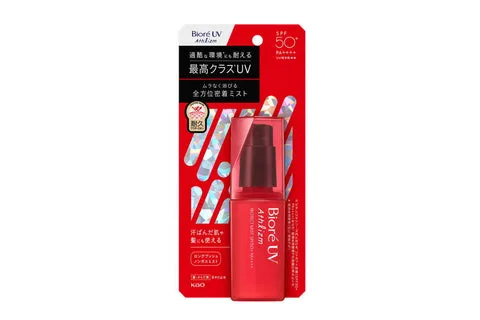
Biore UV Aqua Rich Smooth Mist SPF 50 is among the more sophisticated J-beauty drugstore mist sunscreens currently available. The filter system combines Ethylhexyl Methoxycinnamate (octinoxate) for UVB protection, Hexyl Diethylaminohydroxybenzoylbenzoate (Uvinul A Plus / DHHB) for long UVA coverage, Ethylhexyl Triazone (Uvinul T 150) for photostable UVB protection, and Bis-Ethylhexyloxyphenol Methoxyphenyl Triazine (Tinosorb S) for broad-spectrum photostable coverage. The four-filter combination delivers comprehensive UV protection — DHHB and Tinosorb S together address the long-UVA range that most Western sunscreens leave under-protected.
The formulation chemistry around the filters is engineered for the mist format specifically. Ethanol as the first ingredient provides the volatile vehicle that creates the true mist particle distribution. The silicone film-formers (Polysilicone-15, Polysilicone-9, Trimethylsiloxysilicate) deposit a water-resistant protective layer that holds the filter system in place after the alcohol evaporates. Dimethicone provides slip and spread. Isononyl Isononanoate and Alkyl Benzoate (C12-15) serve as solvent and texture aids for the filter system. Dibutyl Ethylhexanoyl Glutamide is the amino-acid-derived gelling agent contributing to the 'Smooth' positioning in the product name. Squalane provides minimal barrier-supporting work alongside the more dominant filter chemistry.
The sensory experience matches the format. True fine mist that dispenses as a spray and settles on skin within 5-10 minutes. Initial cool refreshing feel from the alcohol evaporation. The post-evaporation skin feel is comfortable and matte without obvious stickiness or shine, with the silicone film-formers preventing the streaky finish that basic mist sunscreens produce. The fragrance is detectable on application and fades within minutes.
The water resistance is meaningful for active use. The silicone film-forming system survives moderate sweat and humidity, which is what users want from a mist sunscreen used during outdoor activity. Heavy water exposure (swimming) requires reapplication after toweling off, but the resistance to ambient moisture and sweat is reliably good.
The positioning relative to other Biore UV Aqua Rich products matters for routine planning. The Watery Essence (the line's flagship cream-format product) is the appropriate choice for primary morning sunscreen — the format delivers more consistent coverage than mists. The Smooth Mist is positioned specifically for reapplication during the day, ideally after the morning Watery Essence application. The Aqua Protect Mist from the same line emphasizes water resistance for swimming and outdoor activity specifically. For comprehensive sun protection routines, two products from the line covering primary and reapplication needs is the brand's recommended approach.
Its caveats are clear. The ethanol-first formulation creates significant sensitivity concerns — for fragrance-reactive or genuinely reactive skin, the alcohol can sting on application. The fragrance adds additional irritation potential. The comedogenic content (Ethylhexyl Methoxycinnamate, Isononyl Isononanoate) makes the product not fungal-acne-safe. The mist format presents some inhalation risk requiring proper application technique. The format isn't ideal for very dry skin where the alcohol evaporation can compound dryness.
The value math works clearly. At roughly $22 USD via J-beauty retailers for 60g, the product provides approximately 400 pump applications — substantial reapplication capacity for 8-12 weeks of daily use. Comparison against Western alternatives: Coola Mineral Body Sunscreen Mist at $26 for 5oz delivers fewer applications with mineral-only filter chemistry. Supergoop Glow Mist at $34 for 3.4oz delivers fewer applications with antioxidant focus rather than filter sophistication. The Biore at $22 with sophisticated four-filter chemistry at this volume represents excellent value for the J-beauty drugstore tier.
The demographic this product serves is normal-to-combination or oily skin (dry skin tolerable with caution) wanting Japanese-tier filter chemistry in a reapplication format suitable for daily over-makeup use. Users committed to comprehensive sun protection through daily reapplication routines. Users wanting to upgrade their reapplication step from basic Western mist alternatives to more sophisticated filter chemistry. Users in environments with extended daily UV exposure (outdoor workers, athletes, drivers).
For reapplication sunscreen specifically, this is among the most thoughtfully formulated drugstore-tier J-beauty options globally. The filter chemistry sophistication, the silicone film-former integration, the substantial volume per dollar, and the over-makeup compatibility all support the daily reapplication routine that defines real-world sun protection. The compliance gap that morning-only application creates is what this product is designed to close.
Where this lands: the answer to 'I want a sophisticated Japanese filter-chemistry mist sunscreen for reapplication over makeup throughout the day, and I'm willing to navigate the alcohol-and-fragrance composition.' Not the answer to 'I want a primary morning sunscreen' (use the Biore Watery Essence cream-format instead) or 'I want a sensitive-skin-appropriate mist' (fragrance-free alternatives serve better). For users in the target demographic, the formulation chemistry holds up, the filter sophistication is genuinely uncommon, and the value math is exceptional.
Formula
Key Ingredients
The hero actives that drive this product's performance.
Sophisticated four-filter chemical sunscreen system uncommon in Western sunscreens — Ethylhexyl Methoxycinnamate (octinoxate) for UVB, Hexyl Diethylaminohydroxybenzoylbenzoate (Uvinul A Plus / DHHB) for long UVA, Ethylhexyl Triazone (Uvinul T 150) for stable UVB, and Bis-Ethylhexyloxyphenol Methoxyphenyl Triazine (Tinosorb S) for broad-spectrum photostable coverage. The combination delivers comprehensive UV protection in a chemical-only formula appropriate for mist application.
Regulator-approvedfor Sun Damage · emerging certainty
First on the INCI — the alcohol base is what makes this product a true mist sunscreen rather than a cream or lotion. Ethanol evaporates quickly leaving the filter system on skin in a thin film, enabling the reapplication-friendly format that mist sunscreens are designed for. The high alcohol content is essential to the format, not a sensory choice.
Silicone film-formers that deposit a water-resistant protective layer on skin alongside the UV filters. The combination is what makes this mist water-resistant and provides the comfortable post-application skin feel rather than the typical alcoholic dry-down of basic mist sunscreens.
Amino acid-derived gelling agent that contributes to the formula's structure and skin feel, providing a subtle smoothing effect characteristic of the 'Smooth' positioning in the product name.
Skin-mimetic lipid late on the INCI providing minimal but meaningful barrier-supporting work. In an alcohol-heavy mist sunscreen the small squalane addition mitigates the typical drying potential of the mist format.
Not yet assessed
Ingredient standings describe the active at treatment-level doses and
vehicles; this product's own condition grades weigh its actual formula.
Use as a reapplication sunscreen over makeup or as the primary sunscreen step on simpler routines. Hold the bottle 4-6 inches from the face, close eyes, mist evenly, then optionally pat or smooth in with clean fingers. Reapply every 2 hours during sun exposure. Avoid spraying directly toward eyes or mouth — the chemical filters can sting ocular tissue.
Results Timeline
Sun protection is immediate once the mist film sets, about 5-10 minutes after application. The mist format's primary value is reapplication convenience over the day, supporting the cumulative photoprotection that no morning-application alone can sustain through full-day sun exposure.
The formulation case for this mist sunscreen rests on sophisticated multi-filter chemistry adapted to the mist format. The four-filter combination provides broad-spectrum UV protection with substantial photostability — Ethylhexyl Methoxycinnamate (octinoxate) primarily for UVB protection, Hexyl Diethylaminohydroxybenzoylbenzoate (Uvinul A Plus / DHHB) for long UVA coverage particularly at the 350-380 nm range, Ethylhexyl Triazone (Uvinul T 150) for photostable UVB protection, and Bis-Ethylhexyloxyphenol Methoxyphenyl Triazine (Tinosorb S) for broad-spectrum photostable coverage. Research support for each filter is substantial — DHHB and Tinosorb S are particularly distinguished by their photostability and their coverage of the long-UVA range that contributes most to pigmentation and photoaging.
The combination delivers comprehensive UV protection across the 290-400 nm UV range. Studies on multi-filter combinations including these specific actives have demonstrated effective photoprotection with substantially better long-UVA coverage than US-formulated sunscreens that lack access to DHHB and Tinosorb S due to FDA monograph restrictions.
The silicone film-forming system (Polysilicone-15, Polysilicone-9, Trimethylsiloxysilicate) deposits a water-resistant protective layer that holds the filter system in place after the alcohol vehicle evaporates. Research on silicone film-formers in sunscreen formulations has demonstrated meaningful water resistance benefits and improved filter substantivity on skin.
Dibutyl Ethylhexanoyl Glutamide is an amino-acid-derived gelling agent with documented use in cosmetic formulations for texture modification and skin feel. The inclusion contributes to the 'Smooth' positioning in the product name through subtle surface-smoothing effects.
Squalane at the end of the INCI provides minimal but meaningful barrier-supporting work, mitigating the typical drying potential of alcohol-heavy mist sunscreen formulations.
The overall formulation design represents a thoughtful adaptation of sophisticated J-beauty filter chemistry to the mist format — combining filter sophistication with the format-specific requirements of vehicle volatility, silicone film-forming, and reapplication compatibility. The active loading is appropriate for the mist format's typical use as reapplication rather than primary sunscreen.
References
UV-A photoprotection: clinical effects of broad-spectrum sunscreens — Journal of the American Academy of Dermatology (2002)
Photostability of sunscreen agents — International Journal of Cosmetic Science (2008)
Importance of sunscreen reapplication — Journal of the American Academy of Dermatology (2007)
Dermatologist Perspective
Within J-beauty dermatological practice, mist-format sunscreens like the Biore UV Aqua Rich Smooth Mist are commonly recommended for patients wanting reapplication-friendly products that complement their primary morning sunscreen. The four-filter chemistry is widely viewed as meaningful filter sophistication for the drugstore price tier. Clinicians typically position mist sunscreens as supplements to cream or lotion sunscreens rather than as primary morning protection, since mist application delivers less consistent coverage than creams. The ethanol and fragrance content lead to redirects for fragrance-reactive, alcohol-sensitive, or rosacea-prone patients toward fragrance-free alternatives in the broader J-beauty category. For comprehensive sun protection routines, the recommended approach combines this Smooth Mist for reapplication with the matching Watery Essence cream-format as primary morning sunscreen.
Guidance
Usage & Recommendations
How to Use
Shake the bottle briefly before use. Hold 4-6 inches from face, close eyes, and mist evenly across face and neck. Allow 30 seconds for the alcohol vehicle to evaporate, then optionally pat or smooth in with clean fingers to ensure even distribution. Avoid spraying directly toward eyes or mouth. Use as reapplication every 2 hours during sun exposure, after toweling off from swimming, or after substantial sweating. Best used as a complement to a primary morning sunscreen rather than as standalone protection. Apply outdoors or in well-ventilated spaces to minimize inhalation. Can be reapplied over makeup without disrupting cosmetics when applied with proper technique.
Value Assessment
$22 USD via J-beauty retailers for 60g delivers approximately 400 pump applications — exceptional value for the J-beauty drugstore tier with this filter sophistication. Comparison against alternatives: Coola Mineral Body Sunscreen Mist at $26 for 5oz delivers fewer applications with mineral filter chemistry. Supergoop Glow Mist at $34 for 3.4oz delivers fewer applications with antioxidant focus rather than filter sophistication. EltaMD UV Aero at $36 for 7oz delivers chemical filters but lacks DHHB and Tinosorb S. The Biore at $22 with sophisticated four-filter chemistry at substantial volume represents the strongest value calculation in the reapplication mist sunscreen category. For users wanting Japanese filter chemistry at drugstore pricing, the math works clearly.
Who Should Buy
Normal-to-combination or oily skin (dry skin tolerable with caution) wanting Japanese-tier filter chemistry in a reapplication format suitable for daily over-makeup use. Users committed to comprehensive sun protection through daily reapplication routines. Users wanting to upgrade their reapplication step from basic Western mist alternatives. Users in environments with extended daily UV exposure (outdoor workers, athletes, drivers) where 2-hour reapplication matters for real-world protection.
Who Should Skip
Fragrance-reactive or alcohol-sensitive routines should pass entirely. Fungal-acne-prone users should skip due to comedogenic content. Users wanting primary morning sunscreen should choose the Biore UV Aqua Rich Watery Essence cream-format instead. Users with respiratory sensitivities should consider non-mist alternatives. Clean-beauty-oriented routines may want to avoid the BHT preservative. Users in dry climates where alcohol evaporation compounds dryness should choose cream-format alternatives.
Ready to try Bioré UV Aqua Rich Smooth Mist SPF 50?
True mist that dispenses as a fine spray, settles on skin within 5-10 minutes leaving a thin film. The silicone film-formers prevent the typical streaky finish of basic mist sunscreens.
Scent
Light Biore-typical fragrance with citrus and floral notes — present and detectable on application, dissipating within minutes.
Packaging
60g pump-spray bottle in blue-and-white Biore Aqua Rich branding. The pump dispenses approximately 400 sprays over the product's life, providing substantial reapplication capacity.
Finish
lightweightsatinmatte
What to Expect on First Use
First application feels cool and refreshing from the alcohol evaporation. The mist disperses evenly with proper application technique (4-6 inches from face, eyes closed). The skin feel within minutes is comfortable and matte without obvious stickiness or shine.
How Long It Lasts
Approximately 8-12 weeks with daily reapplication every 2 hours during sun exposure — the substantial pump capacity supports sustained use through the product's life.
Biore launched the UV Aqua Rich franchise in the early 2010s as Kao Corporation's J-beauty drugstore sun-care line, with the Watery Essence becoming one of the most popular Japanese sunscreens globally. The Smooth Mist variant extended the line into the reapplication-format category, addressing the consumer trend toward sunscreen reapplication products usable over makeup throughout the day rather than relying on single morning applications.
About Bioré Legacy Brand (20+ years)
Biore is Kao Corporation's J-beauty drugstore brand with the UV Aqua Rich franchise being one of the most popular Japanese drugstore sunscreens globally; the Smooth Mist variant extends the line into the reapplication-format sunscreen category.
Brand founded: 1980 · Product launched: 2022
Myth vs. Reality
Common Myths
Myth
Mist sunscreens are too unreliable for real protection — they don't apply evenly.
Reality
Mist sunscreens require proper application technique but can deliver reliable protection when used correctly. The trick is generous application (more than feels intuitive), proper distance (4-6 inches), and optional patting in with clean fingers to ensure even coverage. The format is best suited for reapplication over makeup rather than as primary morning sunscreen, where a cream or lotion delivers more consistent coverage.
Myth
All chemical mist sunscreens are basically the same — they all have ethanol.
Reality
The filter chemistry varies enormously. Most Western mist sunscreens use older filter systems with limited UVA coverage. This Biore mist uses DHHB (Uvinul A Plus) and Tinosorb S — filters uncommon outside Japanese and European sunscreens — alongside the standard octinoxate and Uvinul T 150. The filter sophistication is a real differentiator at the drugstore price tier.
FAQ
Frequently Asked Questions
How is Biore UV Aqua Rich Smooth Mist different from the Aqua Protect Mist?
Both are mist-format Biore UV Aqua Rich sunscreens with similar filter systems. The Smooth Mist variant emphasizes a smoother post-application skin feel through additional silicone film-formers and the amino-acid-derived smoothing agent dibutyl ethylhexanoyl glutamide. The Aqua Protect Mist focuses on water resistance for swimming and outdoor active use. Choice depends on intended use — Smooth for daily over-makeup reapplication, Aqua Protect for outdoor activity.
Should you use Biore UV Aqua Rich Smooth Mist as your primary morning sunscreen?
Not ideal. Mist sunscreens deliver less consistent coverage than creams or lotions in the morning application — the format is best suited for reapplication over makeup or as a second-layer protection. For primary morning sunscreen, the Biore UV Aqua Rich Watery Essence (cream-format with similar filter chemistry) is the better choice from the same brand. Use the mist for the 2-hour reapplication routine during the day.
Can sensitive skin use Biore UV Aqua Rich Smooth Mist?
Use with caution. The ethanol-first formulation creates significant sensitivity concerns — for fragrance-reactive or genuinely reactive skin, the alcohol can sting on application. The fragrance adds additional irritation potential. For sensitive routines wanting Japanese filter chemistry, the fragrance-free Biore UV Aqua Rich Watery Essence variants or Anessa alternatives serve better.
Will Biore UV Aqua Rich Smooth Mist disrupt makeup when reapplied?
Generally no with proper technique. Hold the bottle 4-6 inches from the face, close eyes, mist evenly. The fine mist particles settle without obvious disruption. For best results, allow about 30 seconds for the alcohol to evaporate, then optionally pat gently with clean fingers to ensure even distribution. The silicone film-formers help the mist play well with foundation and other makeup.
Is Biore UV Aqua Rich Smooth Mist pregnancy-safe?
The filter system is generally considered acceptable during pregnancy — octinoxate, DHHB, Uvinul T 150, and Tinosorb S all have established safety profiles. The ethanol content is at controlled topical concentration. Consult your dermatologist for personalized guidance; some pregnancy-conservative routines prefer mineral-only sunscreens, in which case alternatives serve.
How do you avoid inhaling the mist when reapplying?
Hold breath briefly during the mist application, close eyes, and don't spray directly toward the mouth. Apply outdoors or in well-ventilated spaces to minimize accumulation. The fine particle mist does present some inhalation risk that doesn't apply to cream or lotion sunscreens — users with respiratory sensitivities should consider alternative formats.
Reviews
What Reviewers Tend to Say
Recurring themes our editors read across retailer reviews of this product — summaries in our words, not quotations, and not a substitute for your own patch test.
Common Praise
Users consistently note effective reapplication convenience over makeup without disrupting cosmetics
Sophisticated filter system uncommon in Western mist sunscreens
Lightweight feel that doesn't create visible white cast on most skin tones
Water-resistant film survives moderate sweat and humidity
Common Complaints
High alcohol content can sting on sensitive or freshly cleansed skin
Strong fragrance scent some users find overpowering
Mist format risks inhalation if used improperly
Not appropriate as primary morning sunscreen — better as reapplication
Notable Endorsements
Featured in Asian beauty editor recommendations for reapplication-format sunscreensBrand widely cited in J-beauty enthusiast communities for accessible Japanese filter chemistry
The supplier specification for standard witch hazel water caps the tannin content — the fraction all the research is about — at a level indistinguishable from none. The tightness you feel is the solvent.
The blocker isn't chemistry — it's a classification. In the US a sunscreen is a drug, and that single word explains the empty shelf, the relabelled bottles, and what finally changed in June 2026.
IPL is a filtered flashlamp, a true vascular laser is one wavelength aimed at haemoglobin, and the choice between them turns on a distinction almost no consult makes: whether your redness is vessels or a state.
We have spent years praising Japanese filter chemistry while ignoring that the filter is the last line of a system built out of fabric, shade and timing — the part that needs no importing and does not depend on you remembering to reapply.
Aug 28, 2026· 10 min
Questions people ask about Hyperpigmentation
Verified answers from our questions library — the nuance a product page cannot carry.
Products, answers, therapy guides, tools and articles in one search. Brand names,
slang and abbreviations all work — accutane finds isotretinoin, bacne finds truncal acne.