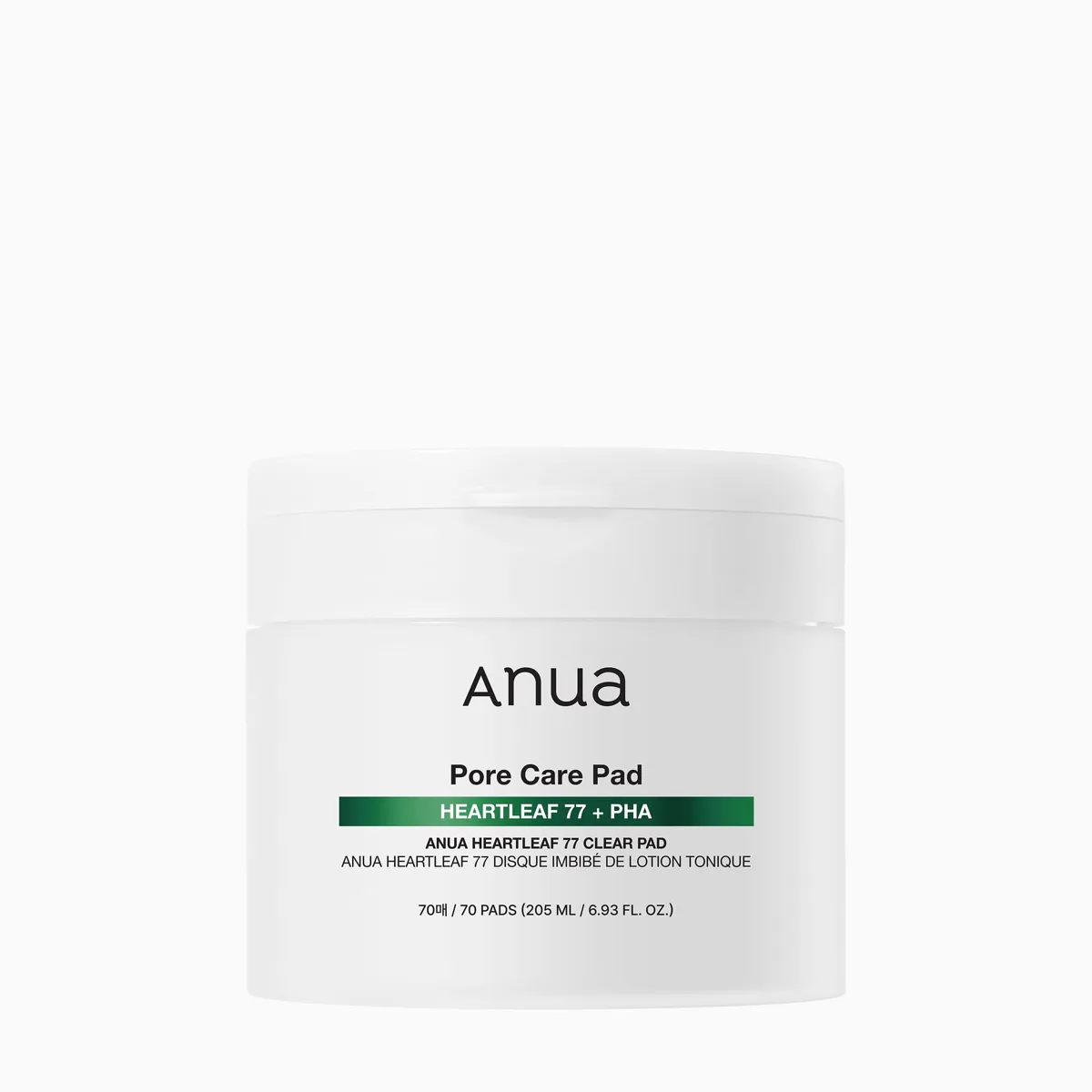
Most exfoliating toner pads use a water base with a token plant extract for marketing. Anua replaces the entire water phase with 77% heartleaf extract, which means the PHA exfoliant arrives wrapped in actual anti-inflammatory flavonoids rather than chasing them. The dual-textured pad design — embossed for sloughing, smooth for pressing essence in — also makes this one of the few pad products that genuinely earns its dual-purpose claim.
A genuinely well-formulated K-beauty exfoliating pad that earns its viral reputation. The PHA-plus-heartleaf combination delivers visible texture improvement without the stinging burn most acid pads cause, and the dual-textured pad design makes daily use practical. One of the few hyped Korean SKUs where the cult following actually tracks the formulation quality.
Good choicefor SensitivityIn your profileYou chose · No fragrance, drying alcohol, declarable allergens or sensitising preservatives in this pad — the profile sensitive skin looks for.Not yet assessedGentleNo reviews collected yet
The case for it
Centella Asiatica Complex has been researched for this concern and the evidence does not support it.
It is plausibly present at a working level, though the concentration is not declared.
The formula carries none of the triggers this concern is sensitive to.
What would change this: A declared concentration would move this to a firmer reading of the dose.
Same rule for everyone. “Good choice” is the verdict on 1,938 of 45,024 concern verdicts across the catalog; rule F2 decided 1,938 of them.
Unchanged since September 5, 2026, engine 5.1.1.
Also listed for Acne, Blackheads, Large Pores, Rough Texture, Dullness and Excess Oiliness — the actives here (Houttuynia Cordata (Heartleaf) are in our research queue for those concerns; there is no verdict until their evidence rows are written. That is a gap in our table, not a mark against the product.
A verdict is DermApproved’s assessment of how well a product’s ingredients fit a concern — never a claim about what the product treats. Evidence dots and collected reviews sit beside it and are never blended in.
Rules 0.5.1 · evidence table ev-2026.09-r228 · how we decide
Assessment
Pros & Cons
Pros
✓ PHA exfoliation gentle enough for daily use on sensitive skin
✓ 77% heartleaf base genuinely soothes rather than acting as marketing window-dressing
✓ Dual-textured pads earn their two-sided design with real mechanical-plus-chemical action
✓ Visibly clearer texture and smaller-looking pores within 2 weeks for most users
✓ Centella complex uses all four titrated actives, not just generic cica
✓ Excellent per-use price relative to prestige toner pad alternatives
✗ Screw-on lid isn't fully airtight; top pad can dry out in humid bathrooms
✗ Mild purging possible in first 1-2 weeks for acne-prone users
✗ Not strong enough exfoliation for users used to glycolic peels
✗ Embossed side can feel slightly abrasive on freshly compromised skin
Review
Full Review
When Anua's Heartleaf 77% Soothing Toner went viral on TikTok in 2023, the toner pad version of the same formula had been quietly sitting on Korean shelves for almost two years, doing the unglamorous work of converting curious shoppers into repeat buyers one pore at a time. By the time the Western beauty internet caught up, the pad had become the format that long-time Anua devotees actually preferred — same heartleaf-soaked essence, but with a PHA exfoliant and a dual-textured wipe that turned a single skincare step into something genuinely multi-functional. It is one of those rare cases where the hype caught up to a product that had already earned the loyalty of the people paying attention.
The formula starts with 77% Houttuynia cordata extract — heartleaf, in plain English — used as the base of the pad solution instead of water. This is not a marketing flourish. The flavonoids in heartleaf, particularly quercitrin and afzelin, have a growing body of evidence for calming the kind of low-grade redness that lives next to active acne and sebum overactivity. Anua's choice to replace the water phase entirely means the rest of the formula sits in a botanical solvent that is doing its own anti-inflammatory work in the background, rather than being suspended in plain water with a marketing-friendly extract bolted on.
On top of that base, the formulation adds gluconolactone, a polyhydroxy acid that exfoliates the surface of the skin and inside the pore lining without the molecular slip that lets AHAs and BHAs penetrate more deeply. PHAs have a reputation in some quarters for being too gentle to do anything, which misses the point — they exfoliate more gradually, which is exactly why they can be used daily on sensitive skin without the cumulative dryness and irritation that builds up with glycolic or salicylic acid. The result is a pad that genuinely smooths texture over a couple of weeks rather than after a single dramatic use.
The pads themselves are dual-textured, with an embossed diamond pattern on one side and a smooth weave on the other. The intended ritual is wipe with the embossed side to slough off surface debris, then flip to the smooth side to press the essence into the skin. After several weeks of use, this two-sided choreography is more than a gimmick — the embossed side does measurable mechanical exfoliation, and the smooth side actually does feel like it pushes a layer of hydration into the skin rather than just dragging it across the surface.
A centella asiatica complex sits underneath, but Anua does this part right too: they include all four titrated saponins — madecassoside, asiaticoside, asiatic acid, and madecassic acid — rather than just a generic cica extract. This is the version of centella with actual clinical data behind it for barrier repair and post-inflammatory soothing, which is the version this product needs given that the PHA is briefly disrupting the stratum corneum. Add purslane for its omega-3 and beta-carotene profile, betaine for humectancy, and a handful of supporting botanicals (Ulmus davidiana, Pueraria lobata, evening primrose flower), and you end up with a formula that does its acid work on a deeply cushioned bed of soothing ingredients.
In the bottle, the pads are saturated without being soggy. The essence has a watery, slightly slippery feel and a light herbal scent that is unmistakably plant-derived rather than fragrance-added. The first wipe with the embossed side feels cool, with a mild PHA tingle that fades within seconds. By day three of daily use, most people notice that their skin feels different to the touch — smoother, less granular, with the small congestion bumps along the chin and jawline starting to flatten. The brand claims a 49.8% reduction in pore appearance at two weeks; the actual experience tends to match the spirit of that claim, if not the precise number.
Where the product falls short is mostly logistical. 70 pads finishes faster than most people expect if you use it twice a day across face and neck — call it five weeks with once-daily use, or two and a half weeks with twice-daily. The lid is a screw-on tub rather than a true airtight seal, so the top pad in the stack can dry out a bit if the bathroom runs hot and humid. And while the formula is genuinely gentle for a PHA, it is not infinitely gentle — users with actively compromised barriers or freshly post-procedure skin should let the inflammation calm down before reintroducing daily acid exfoliation, regardless of how mild the acid is.
The price-to-quality math also works out well. At twenty-two dollars for 70 saturated pads, the per-use cost lands well under prestige toner pads from Drunk Elephant, Tatcha, or Sunday Riley, and the formulation arguably outperforms them for the specific job of gentle daily exfoliation on reactive skin. There is no reformulated-for-the-U.S. version that quietly removes the active ingredients to clear regulatory hurdles, which is a real risk with K-beauty exports and a real strength here.
For anyone who has spent the last few years cycling between salicylic acid pads that sting, glycolic acid pads that leave skin tight, and heartleaf toners that soothe but never quite resolve the texture issue underneath, this pad does the work in one step. It is not a miracle. It will not flatten cystic acne or erase scars. But for the unglamorous problem of small, persistent congestion on combination or sensitive skin, it earns its cult status and its viral moment the old-fashioned way: by being good at exactly what it claims to do.
Formula
Key Ingredients
The hero actives that drive this product's performance.
The reason this product exists — heartleaf replaces the water phase that most toner pads rely on, soaking each pad in a botanical infusion rich in quercitrin and afzelin flavonoids that calm post-acne redness and dampen sebaceous overactivity. Working alongside the gluconolactone exfoliant in this formula, it provides the anti-inflammatory cushion that keeps PHA exfoliation from triggering reactive flushing on sensitive skin.
A polyhydroxy acid with a larger molecular size than AHAs, so it exfoliates the surface layer of dead skin and inside the pore lining without penetrating deeply enough to provoke the sting most acids cause. In this pad format, it pairs with the embossed pad texture for mechanical-plus-chemical sloughing while the surrounding heartleaf and centella extracts buffer any irritation.
Anua includes all four titrated centella actives rather than just generic cica extract, which means this pad delivers the specific saponins clinically studied for accelerating barrier repair and reducing TEWL after disruption. Particularly relevant here because the gluconolactone and embossed texture briefly disrupt the stratum corneum — centella's role is to start rebuilding it before you apply the next step.
Adds omega-3 fatty acids and beta-carotene to the pad solution, contributing antioxidant defense and mild moisturization to offset any tightness from exfoliation. It is a K-beauty staple for reactive skin and complements heartleaf's flavonoid profile so the pad ends up calming rather than stripping.
A trimethylglycine humectant pulled from sugar beet that helps each pad deliver a thin layer of hydration after wiping. In a low-pH PHA pad like this one, betaine offsets the slight surface dehydration that exfoliation creates, so the skin feels conditioned rather than papery after use.
Not yet assessed
Ingredient standings describe the active at treatment-level doses and
vehicles; this product's own condition grades weigh its actual formula.
Use after cleansing on dry skin. Wipe with the embossed side first to gently exfoliate, then flip and pat with the smooth side to push the essence in. Wait 30 seconds before applying serums; can be followed by hydrating layers like hyaluronic acid or snail mucin.
Results Timeline
Skin feels smoother and pores look cleaner from the first use. Most users see visibly clearer texture and fewer closed comedones within 2 weeks. Brand's clinical claims of 49.8% smaller pore appearance at 2 weeks align with typical PHA timelines. Full benefits to tone and clarity at 4-8 weeks of consistent use.
The defining feature of this pad is the unusual choice to use Houttuynia cordata extract as the solvent base in place of water. A 2017 study in the Journal of Ethnopharmacology characterized the flavonoid profile of heartleaf and documented its inhibitory effect on the NF-kB inflammatory pathway, which is the same pathway implicated in chronic facial redness and acne-adjacent inflammation. A separate review in the Korean Journal of Microbiology examined the antimicrobial activity of heartleaf against Cutibacterium acnes and found measurable inhibitory effects at concentrations within the range used in cosmetic formulations. This is not a definitive clinical case for heartleaf as an acne treatment, but it is enough evidence to justify why 77% of the formula does meaningful work rather than acting as filler.
The gluconolactone in the formula is more thoroughly studied. A landmark 2004 study in Dermatologic Surgery compared PHAs to AHAs in subjects with sensitive skin, including those with rosacea and atopic dermatitis, and found that gluconolactone produced exfoliation and photo-protection benefits without the irritation profile of glycolic acid. PHAs have a larger molecular size, which slows their penetration and reduces the burn associated with stronger acids — the trade-off being slower onset of dramatic results, which in this formulation is exactly the point.
The centella asiatica complex is supported by the most extensive evidence base in the formula. A 2014 review in the Journal of Drugs in Dermatology pulled together two decades of research on titrated centella extracts, documenting accelerated wound healing, increased collagen synthesis, and reduced post-inflammatory hyperpigmentation. Critically, the studies that show these effects use the four-saponin complex — madecassoside, asiaticoside, asiatic acid, madecassic acid — that Anua includes here, not generic centella leaf extract.
Where the formulation gets clever is in the interaction between these three ingredient classes. The gluconolactone briefly thins the surface barrier, the heartleaf solvent simultaneously dampens the inflammatory response to that thinning, and the centella complex begins active barrier repair before the pad has even fully absorbed. The product's two-week timeline for visible results is consistent with the rate of stratum corneum turnover and the typical onset of centella's barrier effects.
References
Anti-inflammatory effect of Houttuynia cordata: an active component of NF-kB inhibition — Journal of Ethnopharmacology (2017)
Cytoprotective effects of polyhydroxy acids on sensitive skin — Dermatologic Surgery (2004)
Centella asiatica in cosmeceuticals: a review — Journal of Drugs in Dermatology (2014)
Dermatologist Perspective
Dermatologists who work with sensitive and acne-prone skin frequently point patients toward PHA-based exfoliants as a starting point, and gluconolactone in particular shows up in clinical recommendations for rosacea-adjacent skin where stronger acids tend to trigger reactive flushing. Clinicians have noted in industry coverage that K-beauty pads delivering acid exfoliation in a botanical base tend to outperform stripped-down acid formulations for patients who report a history of irritation. The Anua pad specifically gets cited in K-beauty roundups as a reasonable over-the-counter option for patients between in-office treatments — particularly those on prescription tretinoin who need a gentle exfoliation alternative on off nights. Dermatologists also caution that 'gentle' is not the same as 'inert,' and that even PHA pads should be paused after in-office peels, microneedling, or laser sessions until the barrier has fully recovered.
Guidance
Usage & Recommendations
How to Use
Use on cleansed, dry skin in either AM or PM, or both. Take one pad from the tub and re-seal the lid quickly to keep remaining pads saturated. Start with the embossed side and gently wipe across the face in outward motions, avoiding the immediate eye area. Flip the pad and use the smooth side to pat the remaining essence into the skin. Wait about 30 seconds before applying the next product. Follow with a hydrating serum, moisturizer, and sunscreen in the AM. New users with sensitive skin should start every other day for the first week and ramp to daily as tolerated. Skip on nights when using retinol or other strong actives.
Value Assessment
At twenty-two dollars for 70 saturated pads, this product lands in the budget tier of K-beauty exfoliants while delivering formulation quality that rivals products at twice the price. The per-use cost works out to roughly thirty cents per pad — under half of what a prestige toner pad from a U.S. brand typically costs. There is no larger size available, which is a minor drawback for committed users, but the value math is unambiguous. Compared to single-acid pads at similar price points, the addition of 77% heartleaf and a titrated centella complex makes this one of the better-formulated daily exfoliants in its category. For someone evaluating whether the brand's viral moment translates into real value, the answer here is yes.
Who Should Buy
Anyone with combination, oily, or sensitive skin who has tried salicylic acid pads and found them too irritating, or glycolic pads and found them too drying. Especially well-suited to the closed-comedone problem on chin, jawline, and forehead. A strong daily-driver for K-beauty routines built around layering and gentle actives.
Who Should Skip
Skin types looking for fast, dramatic exfoliation should choose a stronger AHA or BHA product instead. Users with actively compromised barriers, freshly post-procedure skin, or severe eczema should pause until the skin has stabilized. Anyone who finds botanical scents unpleasant — the light herbal note from heartleaf is unavoidable.
Pads are saturated with a watery, slightly slippery essence. Embossed side has visible diamond-pattern bumps; smooth side is finely woven cotton.
Scent
Light, herbal — naturally derived from the heartleaf and centella extracts. No added fragrance.
Packaging
Round PET tub with screw-on lid. Pads stack flat inside. Lid seal isn't quite airtight — users with hot bathrooms sometimes find the top pad dries faster than the rest.
Finish
non-greasylightweightfast-absorbing
What to Expect on First Use
First use feels cool and slightly tingly from the PHA, but without the burn associated with stronger acids. By day 3, skin texture is noticeably smoother to the touch. A small minority of acne-prone users experience mild purging in the first 1-2 weeks as the PHA accelerates surface turnover; this typically resolves on its own.
How Long It Lasts
About 5 weeks with once-daily use, or 2.5 weeks applied morning and night on face only.
Anua launched Heartleaf 77 as a line in 2021, but it sat quietly on Korean shelves for nearly two years before the Soothing Toner went viral on TikTok in mid-2023. The brand fast-tracked the toner pad format soon after as a more convenient companion product, and it became one of the most-shipped K-beauty SKUs at U.S. retailers like iHerb and Amazon throughout 2024.
About Anua Established Brand (5–20 years)
Anua launched in 2018 in South Korea with the explicit goal of bringing pharmacy-grade botanical formulations to the K-beauty market. The brand reached global recognition in 2023 when the Heartleaf 77% Soothing Toner went viral on TikTok, and its formulations are now regularly cited by Korean dermatologists for sensitive and acne-prone skin.
Brand founded: 2019 · Product launched: 2021
Myth vs. Reality
Common Myths
Myth
PHA pads are 'too gentle' to actually do anything.
Reality
Gluconolactone has a larger molecule than glycolic acid, but it still exfoliates the stratum corneum — it just does so more gradually, which is precisely why it can be used daily on sensitive skin without the cumulative irritation that builds up with stronger AHAs.
Myth
Heartleaf extract is just K-beauty marketing fluff.
Reality
Houttuynia cordata has been used in East Asian traditional medicine for centuries and has emerging clinical evidence for anti-inflammatory and antimicrobial activity. The 77% concentration in this product is high enough that the extract is the actual vehicle, not a token afterthought.
FAQ
Frequently Asked Questions
Can I use the Anua Heartleaf 77 Toner Pad every day?
Yes — the PHA exfoliant (gluconolactone) in this pad is gentle enough that most skin types tolerate daily use, and the 77% heartleaf base actively buffers any irritation. Sensitive or barrier-compromised users should start with every other day and increase to daily as tolerated.
What's the difference between the Heartleaf 77 Toner and the Toner Pad?
The Soothing Toner is a leave-on liquid with no exfoliating acid — pure soothing. The Toner Pad in this product adds gluconolactone (PHA) and a dual-textured wipe format, so it does the soothing AND mild exfoliation in one step. If you have very reactive skin and no need for exfoliation, the toner is gentler; if you want texture improvement, choose the pads.
Can I use Anua Heartleaf 77 Toner Pad with retinol?
Yes, but not in the same routine. Alternate nights — retinol one night, the toner pad the next — to avoid stacking exfoliation. On retinol nights, skip the pad to let the heartleaf base do its calming work without piling on acids.
Does this product cause purging?
A small subset of acne-prone users experience mild surface purging in the first 1-2 weeks as the PHA accelerates cell turnover and brings sub-surface comedones to the surface faster. This typically resolves on its own; if breakouts persist past 4 weeks, the product may not be a fit.
Is the Anua Heartleaf 77 Toner Pad safe during pregnancy?
Yes — gluconolactone is generally considered pregnancy-safe (it's a PHA, not a salicylate or retinoid), and the rest of the formula is botanically driven without any flagged actives. Check with your OB if you have specific concerns.
Will this help with closed comedones (small bumps under the skin)?
This is one of the products closed-comedone sufferers report success with most consistently. The combination of mild surface exfoliation from PHA and pore-targeting heartleaf flavonoids gradually clears the stubborn micro-bumps that resist stronger AHA/BHA treatments in sensitive skin.
How is this different from CosRx One Step Original Clear Pads?
CosRx pads use a betaine salicylate (gentle BHA) base and target oilier, more acne-prone skin. Anua's PHA-plus-heartleaf approach skews softer and is better suited to sensitive or combination skin that needs gentle exfoliation without the salicylate sting.
Reviews
What Reviewers Tend to Say
Recurring themes our editors read across retailer reviews of this product — summaries in our words, not quotations, and not a substitute for your own patch test.
Common Praise
Noticeable smoother texture within a week
Doesn't sting like glycolic or salicylic pads
Dual-textured pad design feels effective without aggressive scrubbing
Pores look visibly cleaner
Travel-friendly and convenient
Common Complaints
70 pads finishes quickly with twice-daily use
Outer pads can dry out if lid isn't sealed properly
Polyhydroxy acids get filed under 'beginner exfoliant,' as if gentle meant weak. The truth is stranger: their bulk is exactly why they work for the skin everything else sets on fire.
The whole case for salicylic acid rests on one unglamorous fact of chemistry: it dissolves in oil. Understand that, and you know exactly when it beats a glycolic acid — and when it's overkill.
The K-beauty buzzword slaps a green leaf on half the shelf — but centella is one of the rare botanicals with genuine wound-healing data. The trick is knowing which molecule is doing the job.
The smallest AHA gets deepest and shows results soonest — which is precisely why routines built around it overshoot, and why the people who do best with it use it least.
Jul 30, 2026· 7 min
Questions people ask about Acne
Verified answers from our questions library — the nuance a product page cannot carry.
Products, answers, therapy guides, tools and articles in one search. Brand names,
slang and abbreviations all work — accutane finds isotretinoin, bacne finds truncal acne.