



Melasma Doesn't Want to Be Cured — It Wants to Be Managed
The pigment problem that humbles dermatologists rewards patience and punishes aggression, and the 2026 approach finally leans into that reality.
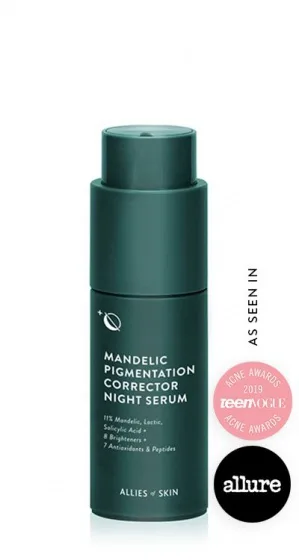
Most prestige exfoliating serums center on glycolic or lactic acid. This one builds around mandelic acid specifically because of its safer profile on melanin-rich skin, then layers in tranexamic acid, azelaic acid, niacinamide, and bakuchiol to attack pigmentation through five different pathways simultaneously. That kind of mechanism diversity is rare even at this price point.
One of the most thoughtfully formulated pigmentation serums on the market. Mandelic acid leads, but the real story is the supporting cast — tranexamic acid, azelaic acid, niacinamide, and bakuchiol attacking hyperpigmentation through five different pathways. Specifically formulated to be safe on melanin-rich skin and it shows.
The case for it
Cautions: a photosensitising active — use sun protection.
What would change this: A declared concentration would move this to a firmer reading of the dose.
Same rule for everyone. “Good choice” is the verdict on 9,564 of 45,024 concern verdicts across the catalog; rule R5 decided 9,072 of them. Unchanged since September 5, 2026, engine 5.1.1.
Brand or formulator? Disclose a concentration or correct a fact →
The studies behind the evidence row
The case for it
Cautions: a photosensitising active — use sun protection.
What would change this: A declared concentration would move this to a firmer reading of the dose.
Same rule for everyone. “Good choice” is the verdict on 9,564 of 45,024 concern verdicts across the catalog; rule R5 decided 9,072 of them. Unchanged since September 5, 2026, engine 5.1.1.
Brand or formulator? Disclose a concentration or correct a fact →
The studies behind the evidence row
The case for it
Cautions: a photosensitising active — use sun protection.
What would change this: A declared concentration would move this to a firmer reading of the dose.
Same rule for everyone. “Promising” is the verdict on 7,858 of 45,024 concern verdicts across the catalog; rule R9p decided 7,858 of them. Unchanged since September 5, 2026, engine 5.1.1.
Brand or formulator? Disclose a concentration or correct a fact →
The studies behind the evidence row
The case for it
Cautions: a photosensitising active — use sun protection.
What would change this: A declared concentration would move this to a firmer reading of the dose.
Same rule for everyone. “Promising” is the verdict on 7,858 of 45,024 concern verdicts across the catalog; rule R9p decided 7,858 of them. Unchanged since September 5, 2026, engine 5.1.1.
Brand or formulator? Disclose a concentration or correct a fact →
The studies behind the evidence row
The case for it
Cautions: a photosensitising active — use sun protection.
What would change this: A declared concentration would move this to a firmer reading of the dose.
Same rule for everyone. “Not for this” is the verdict on 488 of 45,024 concern verdicts across the catalog; rule R10 decided 488 of them. Unchanged since September 5, 2026, engine 5.1.1.
Brand or formulator? Disclose a concentration or correct a fact →
The studies behind the evidence row
Also listed for Dullness — the actives here (Mandelic Acid, Niacinamide, Azelaic Acid, Tranexamic Acid) are in our research queue for that concern; there is no verdict until their evidence rows are written. That is a gap in our table, not a mark against the product.
A verdict is DermApproved’s assessment of how well a product’s ingredients fit a concern — never a claim about what the product treats. Evidence dots and collected reviews sit beside it and are never blended in. Rules 0.5.1 · evidence table ev-2026.09-r228 · how we decide
If you have melanin-rich skin and you've ever tried to treat hyperpigmentation with a glycolic acid serum, you probably know the heartbreak. You start using it, you get a little brighter for a couple of weeks, and then the dark spots come back darker than before, because the inflammation triggered by aggressive exfoliation set off a fresh round of post-inflammatory hyperpigmentation. It's the cosmetic equivalent of pouring water on a grease fire. For decades the industry treated this as a footnote — the assumption being that anyone who wanted to fade dark spots could just use the same exfoliants everyone else uses, and if their skin reacted differently, that was their problem to solve. Allies of Skin's Mandelic Pigmentation Corrector is one of the cleaner attempts to actually solve the problem instead, and it deserves credit for that alone.
The choice of mandelic acid as the lead AHA is the first signal that the formulators knew what they were doing. Mandelic is a larger molecule than glycolic — nearly twice the size — so it crosses the stratum corneum more slowly and exfoliates more gently. That slower action is precisely what melanin-rich skin needs from an acid: enough turnover to clear surface pigment, not so much inflammation that it seeds a fresh wave underneath. Mandelic also carries its own published data on melasma and post-inflammatory pigmentation, including work showing it can perform comparably to glycolic with markedly better tolerance. Which quietly overturns the most persistent belief in this entire category — that stronger acids fade spots faster. On darker skin, stronger acids frequently create more pigment than they remove, and the gentler molecule wins on a timescale that actually matters.
What lifts this from a good mandelic serum to a genuinely impressive multi-mechanism treatment is everything behind it. Tranexamic acid is one of the most interesting topical brighteners of the past decade, working upstream by blocking the plasminogen pathway that drives melanin overproduction, with clinical data in both topical and oral form for melasma. Azelaic acid contributes anti-inflammatory tyrosinase inhibition and an extensive evidence base of its own. Niacinamide handles the melanosome-transfer step, interrupting the handoff of pigment from melanocytes to surrounding cells, while reinforcing the barrier so the exfoliation doesn't compound on itself. Bakuchiol adds retinol-like signaling without retinoid irritation — the one plant ingredient here that earns its place rather than decorating the label. A stable vitamin C derivative, acetyl glucosamine, licorice root, and glutathione extend the brightening axis further still. Centella, bisabolol, allantoin, and panthenol keep the whole stack tolerable, three peptides and two ferments quietly support repair, and sodium PCA and trehalose stop the acids from leaving the surface parched. The result attacks pigmentation through five distinct pathways at once. Most prestige brightening serums manage two.
The texture is unobtrusive — a clear, lightweight serum that absorbs in seconds and leaves no tackiness. A mild tingle shows up in the first few applications, especially on skin unaccustomed to acids, and fades within a week of nightly use. The pH sits around 3.8, squarely in the active range, and the opaque airless pump protects a formula whose vitamin C and ferments would otherwise degrade in daylight. It layers cleanly under any moisturizer, it's fungal-acne safe, and it plays well with a morning vitamin C on the other half of the routine. The pairing rules are the obvious ones: no retinoid on the same night, no benzoyl peroxide, no scrubs, and sunscreen the next day without exception. None of that is unique to this serum — it's the price of admission for any AHA — but the SPF part is not optional advice, it's the difference between the product working and the product wasting your money.
Results follow the standard hyperpigmentation timeline, which is to say slower than anyone wants to hear. Texture improves first, with a subtle overall glow inside a week or two. Post-acne marks begin softening around week four to six. Stubborn melasma and sun damage need eight to twelve weeks of consistent nightly use, and they need it alongside disciplined daily sunscreen. Congestion that was already sitting under the surface may briefly become visible in the first fortnight as the acid works through dead cell layers — that isn't purging in the retinoid sense, it's just the queue moving. Across roughly fourteen hundred reviews the praise is remarkably specific: post-acne marks fading, none of the backfire that stronger acids caused, no retinoid-style peeling. The complaints are equally specific, and they're the ones you'd predict — the price, the pregnancy exclusion, and that first-week tingle.
At around $99 for 30ml this is unambiguously a prestige serum, but the price is more defensible than most, because the active list is genuinely hard to replicate. You aren't paying for mandelic acid; you're paying for mandelic plus tranexamic plus azelaic plus niacinamide plus bakuchiol in one bottle, a combination that would otherwise take two or three separate purchases to assemble — and would then require you to sequence them without irritating yourself. A bottle runs two to three months nightly, longer if alternated with other treatments, though the six-month PAO means it shouldn't be rationed indefinitely.
The reasons not to buy it are narrow and clear. Pregnancy rules it out — neither the tranexamic acid nor the bakuchiol is well studied in that context. Eczema-prone skin should stay away, and rosacea or a compromised barrier warrants caution. And it costs what it costs. But for the right person — stubborn hyperpigmentation, especially in melanin-rich skin, and a history of being burned by stronger acids — this is among the strongest non-prescription pigmentation treatments available without an appointment. It's also a quiet rebuttal to the idea that fading post-acne marks requires a prescription at all: tranexamic acid, niacinamide, azelaic acid, and a well-chosen AHA have real published evidence behind them, and this bottle happens to contain all four.
The hero actives that drive this product's performance.
| Ingredient | Function | Evidence |
|---|---|---|
| Mandelic Acid | A larger-molecule alpha hydroxy acid that exfoliates more slowly and gently than glycolic, making it the ideal AHA for melanin-rich and hyperpigmentation-prone skin. In this serum it sits as the lead exfoliant precisely because it brightens without provoking the post-inflammatory pigmentation that stronger AHAs can trigger. | Not yet assessed |
| Tranexamic Acid | One of the most evidence-supported topical pigmentation modulators, blocking the plasminogen pathway that drives melanin overproduction. In this formula it works directly with mandelic acid and niacinamide as a three-pronged attack on hyperpigmentation rather than relying on exfoliation alone. | Clinically supported for Melasma · well-established certainty |
| Azelaic Acid | Provides additional tyrosinase inhibition and anti-inflammatory action that works particularly well alongside the mandelic acid and tranexamic acid in this formula. Its anti-redness behavior also helps offset the mild flushing that AHAs can sometimes provoke. | Named in treatment guidelines for Hyperpigmentation · emerging certainty |
| Niacinamide | Inhibits melanosome transfer from melanocytes to keratinocytes and supports the barrier so the AHA exfoliation is better tolerated. In this formula it functions as the connective tissue between the exfoliant and the pigmentation modulators. | Emerging for Hyperpigmentation |
| Bakuchiol | A plant-derived ingredient with retinol-like signaling activity that complements the brightening complex without retinoid irritation. In this serum it adds a 'PM repair' angle that doesn't conflict with the AHAs the way an actual retinoid would. | Not yet assessed |
Ingredient standings describe the active at treatment-level doses and vehicles; this product's own condition grades weigh its actual formula.
Water (Aqua), Mandelic Acid, Lactic Acid, Propanediol, Glycerin, Niacinamide, Azelaic Acid, Tranexamic Acid, 3-O-Ethyl Ascorbic Acid, Acetyl Glucosamine, Bakuchiol, Glycyrrhiza Glabra (Licorice) Root Extract, Centella Asiatica Extract, Bisabolol, Allantoin, Panthenol, Sodium Hyaluronate, Tetrapeptide-30, Acetyl Tetrapeptide-2, Palmitoyl Tripeptide-1, Camellia Sinensis (Green Tea) Leaf Extract, Tocopherol, Ubiquinone, Glutathione, Lactobacillus Ferment, Bifida Ferment Lysate, Sodium PCA, Trehalose, Xanthan Gum, Sodium Hydroxide, Phenoxyethanol, Ethylhexylglycerin
treatment
PM
Apply to clean dry skin in the evening before moisturizer. Do not pair with retinoids on the same night. Always follow with SPF the next morning — AHAs increase photosensitivity.
Smoother texture and slight brightening within 1-2 weeks. Visible reduction in post-inflammatory marks at 4-8 weeks. Stubborn melasma and sun-damage spots typically take 8-12 weeks of consistent use plus disciplined SPF.
Mandelic acid (an aromatic alpha hydroxy acid derived from bitter almonds) has been studied specifically for hyperpigmentation in melanin-rich skin, with published trials showing it is comparable in efficacy to glycolic acid while producing less inflammation and post-inflammatory pigmentation. Its larger molecular size (approximately 152 daltons versus glycolic's 76) is the structural reason for the gentler penetration profile. Tranexamic acid has emerged in the past decade as one of the most evidence-supported topical brighteners, with clinical work demonstrating it can interrupt the plasminogen-keratinocyte signaling that drives melasma. Azelaic acid is well-established in dermatology literature as both a tyrosinase inhibitor and an anti-inflammatory, and is FDA-approved at prescription strength for rosacea and acne — over-the-counter concentrations are commonly used for adjunctive pigmentation support. Niacinamide has multiple controlled studies showing it reduces melanosome transfer from melanocytes to keratinocytes and improves the appearance of hyperpigmentation at concentrations between 2 and 5 percent. Bakuchiol has a smaller but growing body of evidence as a retinol-like signaling ingredient with better tolerance, though comparative data is still maturing. The novelty here is the integration: combining five complementary mechanisms in a single tolerable formula is more difficult than pairing any two of them.
Dermatologists frequently recommend mandelic acid for patients with melanin-rich skin who have struggled with glycolic-induced post-inflammatory hyperpigmentation. From a clinical standpoint, combination approaches — pairing a gentle exfoliant with a tyrosinase inhibitor and an anti-inflammatory — tend to outperform single-mechanism treatments for stubborn pigmentation. Tranexamic acid is increasingly mentioned in clinical conversation as an adjunct for melasma, and azelaic acid has long been a derm staple for both pigmentation and acne. The combination of these ingredients in one serum is consistent with current clinical thinking, though dermatologists usually emphasize that any pigmentation treatment is only as effective as the daily SPF that supports it. Patients are typically advised that visible results take several weeks and that consistency, not intensity, is the most important factor.
Apply 3-4 drops to clean, dry skin in the evening before moisturizer. Avoid the immediate eye area. Start with three nights per week if your skin is new to AHAs, then increase to nightly as tolerated. Always pair with broad-spectrum SPF 30 or higher in the morning — AHAs increase photosensitivity, and pigmentation treatments are wasted without sun protection. Do not use on the same night as a retinoid, benzoyl peroxide, or strong physical exfoliant.
At roughly $99 for 30ml, this serum sits in the prestige bracket but is more defensible than many of its peers because the active stack is genuinely difficult to replicate by combining individual products. Building an equivalent routine separately would require a mandelic acid serum, a tranexamic acid serum or essence, an azelaic acid product, and a niacinamide product — almost certainly more expensive in aggregate, with significant layering pilling risk. There is no larger value size, so per-ml cost is fixed. For users with serious hyperpigmentation concerns, the consolidated multi-mechanism approach justifies the price. For mild brightening goals, simpler and cheaper serums exist.
Anyone with stubborn hyperpigmentation, post-inflammatory marks from acne, or early melasma — particularly users with melanin-rich skin who have been burned by stronger AHAs. Also a strong fit for people who want a multi-mechanism brightening treatment without needing a dermatologist visit for prescription options.
Pregnant or breastfeeding users — tranexamic acid and bakuchiol lack sufficient pregnancy safety data. Anyone with very compromised barriers, active eczema, or rosacea flares should also wait. Budget-focused users will find more affordable single-ingredient options, though none with this formulation density.
Ready to try Allies of Skin Mandelic Pigmentation Corrector Night Serum?
Buy at Amazon ♥Lightweight clear serum that absorbs quickly with a faint silky finish
Faint, neutral
Opaque airless pump bottle
Mild tingle on the first few applications is normal and typically fades. No purging in the retinoid sense, but pre-existing congestion may surface as the AHA works through dead cell layers in the first 1-2 weeks.
Approximately 2-3 months with nightly use, longer if alternated with other PM treatments
All Year
The Mandelic Pigmentation Corrector launched in 2020 in response to growing demand for hyperpigmentation treatments designed for darker skin tones, where stronger AHAs and harsh peels can trigger post-inflammatory hyperpigmentation. Allies of Skin built the formula around mandelic acid precisely because of its larger molecular size and gentler exfoliation profile.
Allies of Skin was founded in 2016 by Nicolas Travis in Singapore and is recognized for high-density multi-active formulas. The Mandelic Pigmentation Corrector launched in 2020 and is one of the few prestige night serums built around mandelic acid as the headline AHA.
Stronger acids fade dark spots faster.
On melanin-rich skin, stronger AHAs often trigger more post-inflammatory pigmentation than they fade. Mandelic acid's slower, gentler action is frequently the better long-term strategy for hyperpigmentation.
You need a prescription to fade post-acne marks.
Topical tranexamic acid, niacinamide, azelaic acid, and gentle AHAs have substantial published evidence for fading PIH without prescription strength.
Mandelic acid has a larger molecular size, so it penetrates more slowly and exfoliates more gently. That makes it significantly better tolerated on melanin-rich skin and less likely to trigger post-inflammatory hyperpigmentation than glycolic acid.
Yes, the formula is designed for nightly PM use. Some users prefer to alternate with hydrating-only nights for the first two weeks while their skin acclimates to the AHA.
Yes, and it is specifically formulated with darker skin tones in mind. Mandelic acid's gentler profile combined with tranexamic acid and niacinamide is one of the safer non-prescription approaches to hyperpigmentation in deeper skin.
Not on the same night. Alternate them — retinol one evening, this serum the next — to avoid stacking actives that could overwhelm the barrier.
No. While mandelic acid alone is often considered low-risk, this formula contains tranexamic acid and bakuchiol, which lack sufficient pregnancy safety data. Look for a fragrance-free azelaic acid serum instead during pregnancy.
Smoother texture and a slight glow appear within 1-2 weeks. Visible fading of post-inflammatory marks typically begins around 4-8 weeks. Stubborn melasma or sun-damage spots usually take 8-12 weeks plus disciplined daily SPF.
Recurring themes our editors read across retailer reviews of this product — summaries in our words, not quotations, and not a substitute for your own patch test.
Visible fading of post-acne marks
Gentler than glycolic exfoliants
Works on melanin-rich skin without backfire
No retinoid-like irritation
Premium price for 30ml
Cannot use during pregnancy
Mild tingle on first applications
Verified answers from our questions library — the nuance a product page cannot carry.