Melasma Doesn't Want to Be Cured — It Wants to Be Managed
The pigment problem that humbles dermatologists rewards patience and punishes aggression, and the 2026 approach finally leans into that reality.
Read the preview
From the DermApproved blog, in Skin Concerns: melasma — the pigment problem that humbles dermatologists. Here's the uncomfortable truth. It doesn't want to be cured. Treat it too hard and it fights back, darker than before — and there's one nuclear-option treatment people beg for that can wreck their skin for good. Even stranger: that flawless-SPF sunscreen you trust might be quietly undoing everything, because it's letting in a whole kind of light most people don't even know is the real enemy. So no, this isn't a story about a miracle serum. It's about restraint — the gentle, layered stack that actually holds, the one foundation step nobody wants to hear is non-negotiable, and why slow and boring beats dramatic and fast every single time. There's also a hormone twist that explains why it keeps ambushing the same people. If your dark patches keep coming back no matter what you throw at them, this is the piece — at dermapproved.com/blog.
Why this pigment problem outlasts your patience
Most dark spots are shallow. A post-acne mark or a freckle sits in the epidermis, the top layer, where a good brightening routine can reach it and clear it in a season. Melasma cheats. In many people the excess pigment reaches down into the dermis — the deeper layer topical actives struggle to penetrate — and the melanocytes producing it are chronically over-caffeinated rather than merely bruised. You are not fading a stain; you are trying to quiet a gland-like factory that keeps restarting.
Three forces keep that factory running. Hormones are the first: melasma flares in pregnancy (hence the old name, "the mask of pregnancy") and with combined oral contraceptives, because estrogen and progesterone appear to sensitize melanocytes. Genetics load the gun — it clusters in families and in medium-to-deep skin tones. And light pulls the trigger daily. That combination is why melasma is the pigment condition that humbles specialists: you can do everything right for months, get a beautiful result, take one sunny vacation without rigorous protection, and watch it march back. The framing that actually helps is to stop chasing a cure and start managing a chronic, relapsing condition — like eczema for pigment.
The part everyone gets wrong: it's not just UV
Here is the single most important and most-ignored fact about melasma. It is driven not only by ultraviolet light but by visible light — the part of the spectrum you can actually see, which pours through windows on a cloudy day and is emitted, weakly, by screens. A standard "clear" chemical or mineral sunscreen can post a flawless SPF number and still let visible light straight through, because SPF only measures UVB. For melasma, that is the loophole that quietly undoes your treatment.
The fix is pigment you can see on your skin: iron oxides, the tinting agents in tinted mineral sunscreens, which physically absorb visible light. A 2022 review in Photodermatology, Photoimmunology & Photomedicine laid out the case for tailored photoprotection, and randomized trials have since shown tinted, iron-oxide sunscreens outperform the identical untinted formula at preventing melasma relapse. This is why a tone-adding sun step like Klairs TXA Supple Tone Up Sun Essence — which pairs a modern UVA filter with tranexamic acid and a light tint — is more useful here than an invisible SPF, and why our sunscreen finder filters specifically for tinted options. If your melasma routine has one non-negotiable, it is not a serum. It is a tinted, visible-light-blocking sunscreen, reapplied, every single day, indoors and out.
The topical stack that actually holds up
With the foundation in place, the treatment layer is a small set of ingredients with real evidence — used gently, because gentleness is the strategy. Tranexamic acid is the standout of the last decade. It interrupts the signaling between skin cells and melanocytes and, unusually, also calms the tiny blood vessels that feed melasma's vascular component. A 2023 meta-analysis in the Indian Dermatology Online Journal pooled oral, topical, and intradermal tranexamic acid and found meaningful improvement across routes, with oral use carrying the strongest data (and a prescriber's oversight, given clotting considerations). Topically, it is low-risk and a sensible daily anchor — a budget option like Good Molecules Discoloration Correcting Serum delivers tranexamic acid and niacinamide without drama.
Azelaic acid earns its place by being anti-inflammatory as well as pigment-suppressing, so it rarely provokes the irritation that makes melasma worse; an option like Naturium Azelaic Acid Derivative Complex 10% is gentle enough for nightly use. Cysteamine, a tyrosinase inhibitor derived from an antioxidant your own cells make, is the newer contender: a 2024 meta-analysis in the Journal of Clinical Medicine found its depigmenting effect comparable to hydroquinone-based regimens — impressive, though its notorious sulfur smell and finicky application keep it a second-line pick. A well-built multi-ingredient serum like SkinCeuticals Discoloration Defense combines tranexamic acid, kojic acid, and niacinamide for people who want one bottle doing several jobs, and a retinoid or gentle acid a few nights a week supports turnover. Before you stack all of this at once, run the actives through our conflict checker — piling on is exactly how melasma routines tip into irritation.
Why the nuclear options can make it worse
It is tempting to think a stubborn problem needs a strong tool, and this is precisely where melasma punishes people. Aggressive resurfacing lasers, high-energy IPL, and deep chemical peels can absolutely lighten melasma in the short term — and then trigger a rebound that is darker and more diffuse than the original, sometimes permanently. The mechanism is straightforward: melasma's melanocytes are hyper-reactive, and heat or heavy trauma is a signal to make more pigment, not less. Post-inflammatory hyperpigmentation stacked on top of melasma is a genuinely hard place to climb out of, especially in deeper skin tones where the risk is highest.
This does not mean procedures are off the table — low-fluence "laser toning," gentle microneedling, and superficial peels have a role in experienced hands, always as a cautious add-on to a topical-and-photoprotection base, never as a shortcut that replaces it. The through-line of the modern approach is restraint: the more reactive the condition, the softer the touch. Anyone selling you a dramatic one-session fix for melasma is either misinformed or hasn't seen the rebound six months later. Slow, boring, and consistent is not a compromise here — it is the treatment.
Setting expectations you can actually live with
The honest promise of a good melasma routine is control and gradual lightening, held in place by daily maintenance — not a finish line where you stop. Improvement is measured in months. The first visible change from a tranexamic-and-azelaic base often shows around eight to twelve weeks, with continued fading over half a year, and the result only lasts as long as the sun protection holds. Vacations, pregnancy, and skipping the tinted SPF are the classic relapse triggers, and they are worth planning around rather than being surprised by.
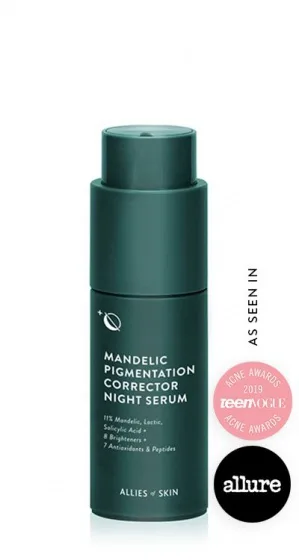
If you want the premium end of the topical spectrum, a layered treatment like Allies of Skin Mandelic Pigmentation Corrector Night Serum folds mandelic acid, tranexamic acid, and azelaic into one bottle — genuinely thoughtful formulation, though at its price you are paying for the convenience of the blend more than for any single hero ingredient you couldn't assemble more cheaply. That is the reasonable trade if simplicity keeps you consistent, and consistency is the whole game. Use our ingredient decoder to check whether a "brightening" product actually contains an evidence-backed pigment lever or just a hopeful botanical, and build the smallest routine you will genuinely keep up for a year. Melasma rewards the person who shows up daily and forgets the one chasing a dramatic month.
Products mentioned
Independently reviewed and scored — the real products behind this piece.


References
- Efficacy of Oral, Topical, and Intradermal Tranexamic Acid in Patients with Melasma — A Meta-Analysis — Indian Dermatology Online Journal, 2023
- Clinical Efficacy of Cysteamine Application for Melasma: A Meta-Analysis — Journal of Clinical Medicine, 2024
- Melasma: The need for tailored photoprotection to improve clinical outcomes — Photodermatology, Photoimmunology & Photomedicine, 2022
Every cited link is verified to resolve to the paper named. Where a source could not be independently confirmed, it is listed without a link rather than pointing you somewhere wrong.
Frequently asked
Why does my melasma come back even after it fades?
Melasma is a chronic, relapsing condition driven by hormones and light, so fading it is only half the job. It returns when sun and visible-light exposure re-stimulate the melanocytes, which is why daily tinted sunscreen is maintenance, not a one-time step.
Does regular sunscreen protect against melasma?
Only partly. Standard SPF measures UVB and does not block visible light, which is a major melasma driver. You need a tinted, iron-oxide sunscreen — the mineral pigment physically absorbs visible light in a way that clear formulas cannot.
Is tranexamic acid better taken orally or applied topically for melasma?
Oral tranexamic acid has the strongest data but requires a prescriber because of clotting considerations. Topical tranexamic acid is lower-risk and a sensible daily anchor. Many people use topical at home and reserve oral for supervised, resistant cases.
Can lasers cure melasma quickly?
No, and aggressive lasers can make it worse. Melasma's melanocytes are hyper-reactive, so heat and trauma can trigger rebound pigmentation darker than the original. Gentle, low-energy procedures may help as a cautious add-on, never as a standalone shortcut.
How long before I see melasma improve with treatment?
Expect the first visible change around eight to twelve weeks with a tranexamic-and-azelaic routine, and continued fading over about six months. The result holds only as long as strict daily photoprotection continues.