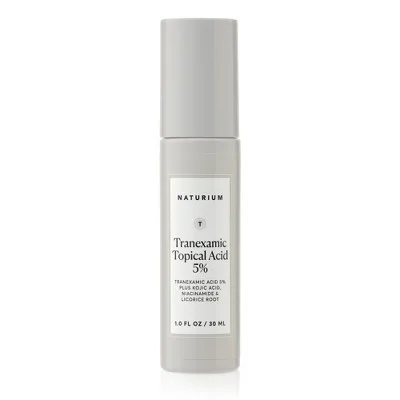
Most brightening serums rely on a single active ingredient. This formula combines four distinct anti-pigmentation mechanisms — tranexamic acid (plasmin inhibition), kojic acid (tyrosinase inhibition), niacinamide (melanosome transfer inhibition), and licorice root (glabridin-mediated brightening) — into one serum at $20. This multi-target approach mirrors what dermatologists do when combining prescription brightening agents.
Naturium's Tranexamic Topical Acid 5% is a remarkably well-constructed brightening serum that tackles hyperpigmentation from four different biochemical angles for just $20. It mirrors the multi-active approach that dermatologists use in prescription protocols — at a fraction of the cost. Patience is required, but the science behind this formula is sound and the results are real.
Backing here includes roughly 300 reviews over about five years plus a brand-commissioned eight-week study. Tranexamic acid is well-researched for hyperpigmentation, but long-term outcome data for this specific four-active OTC serum is still building, so the grade blends the multi-pathway formulation analysis with moderate, still-maturing real-world results.
Verdicts
How well it fits each concern
Verdict by concern tap a concern for the case
Good choicefor HyperpigmentationIn your profileYou chose · Niacinamide is a trial-supported active for hyperpigmentation; this serum carries it, though the concentration is not declared.Moderate evidenceGentleNo reviews collected yet
The case for it
Niacinamide has trial-supported standing for this concern.
It is plausibly present at a working level, though the concentration is not declared.
The formula carries none of the triggers this concern is sensitive to.
What would change this: A declared concentration would move this to a firmer reading of the dose.
Same rule for everyone. “Good choice” is the verdict on 9,564 of 45,024 concern verdicts across the catalog; rule R5 decided 9,072 of them.
Unchanged since September 5, 2026, engine 5.1.1.
Good choicefor MelasmaIn your profileYou chose · Tranexamic Acid is a trial-supported active for melasma; this serum carries it at 5%.Strong evidenceGentleNo reviews collected yet
The case for it
Tranexamic Acid has trial-supported standing for this concern.
It is present at an effective concentration, declared or high in the ingredient list.
The formula carries none of the triggers this concern is sensitive to.
Same rule for everyone. “Good choice” is the verdict on 9,564 of 45,024 concern verdicts across the catalog; rule R5 decided 9,072 of them.
Unchanged since September 5, 2026, engine 5.1.1.
Unprovenfor Dark SpotsIn your profileYou chose · Kojic Acid has early or mechanistic evidence for dark spots — a reasonable bet, not a recommendation; the other actives here are not yet assessed for it.Limited evidenceGentleNo reviews collected yet
The case for it
Kojic Acid has early or mechanistic evidence for this concern, not trial-backed standing.
It is plausibly present at a working level, though the concentration is not declared.
The formula carries none of the triggers this concern is sensitive to.
What would change this: A declared concentration would move this to a firmer reading of the dose.
Same rule for everyone. “Unproven” is the verdict on 1,111 of 45,024 concern verdicts across the catalog; rule R9 decided 1,111 of them.
Unchanged since September 5, 2026, engine 5.1.1.
R9 — Plausible-tier actives alone do not earn a recommendation, and 'not for this' would overstate the case against them. 'Unproven' with the evidence dots lets the reader judge the bet (added 0.2.0 after the first shadow run put a 10% niacinamide serum at 'not for this' for hyperpigmentation). 0.5.0: the closing clause reads the other heroes — "nothing else here addresses it" only when every other active has a researched 'none' row; "not yet assessed" when that is the truth. Rows whose dots read moderate or better now reach R9p first. · the full register
Carrying active
Kojic Acid
Standing
plausible — trials support it
Form
plausible — studied range 1–4%, from the OTC monograph or label; needs leave-on contact; judge it after ~12 weeks
Tolerability
gentle
Row checked
against its sources on July 17, 2026 (evidence table ev-2026.09-r228)
Promisingfor Sun DamageIn your profileYou chose · Niacinamide has trial-level evidence for sun damage but no guideline or regulatory standing yet — promising, short of a recommendation; the other actives here are not yet assessed for it.Moderate evidenceGentleNo reviews collected yet
The case for it
Niacinamide has trial-level evidence for this concern but no guideline or regulatory standing yet.
It is plausibly present at a working level, though the concentration is not declared.
The formula carries none of the triggers this concern is sensitive to.
What would change this: A declared concentration would move this to a firmer reading of the dose.
Same rule for everyone. “Promising” is the verdict on 7,858 of 45,024 concern verdicts across the catalog; rule R9p decided 7,858 of them.
Unchanged since September 5, 2026, engine 5.1.1.
R9p — 0.5.0: 'Unproven' beside three filled dots read as one question answered twice with opposite words (7,018 rows). The chip measures standing, the dots measure trial volume; where the row carries at least one RCT or a tier-2 source (moderate dots) and the active is present at a working level, the honest word is Promising. Unproven is reserved for plausible-standing rows with limited or weak evidence, or an under-dosed form. Same rank as Unproven — a bet either way; the dots order them. · the full register
Carrying active
Niacinamide
Standing
plausible — trials support it
Form
plausible — studied range 5–10%, from the OTC monograph or label; needs leave-on contact; judge it after ~8 weeks
Tolerability
gentle
Row checked
against its sources on July 17, 2026 (evidence table ev-2026.09-r228)
Promisingfor AcneIn your profileYou chose · Niacinamide has trial-level evidence for acne but no guideline or regulatory standing yet — promising, short of a recommendation; the other actives here are not yet assessed for it.Moderate evidenceGentleNo reviews collected yet
The case for it
Niacinamide has trial-level evidence for this concern but no guideline or regulatory standing yet.
It is plausibly present at a working level, though the concentration is not declared.
The formula carries none of the triggers this concern is sensitive to.
What would change this: A declared concentration would move this to a firmer reading of the dose.
Same rule for everyone. “Promising” is the verdict on 7,858 of 45,024 concern verdicts across the catalog; rule R9p decided 7,858 of them.
Unchanged since September 5, 2026, engine 5.1.1.
R9p — 0.5.0: 'Unproven' beside three filled dots read as one question answered twice with opposite words (7,018 rows). The chip measures standing, the dots measure trial volume; where the row carries at least one RCT or a tier-2 source (moderate dots) and the active is present at a working level, the honest word is Promising. Unproven is reserved for plausible-standing rows with limited or weak evidence, or an under-dosed form. Same rank as Unproven — a bet either way; the dots order them. · the full register
Carrying active
Niacinamide
Standing
plausible — trials support it
Form
plausible — studied range 4–5%, from the OTC monograph or label; needs leave-on contact; judge it after ~8 weeks
Tolerability
gentle
Row checked
against its sources on July 17, 2026 (evidence table ev-2026.09-r228)
Also listed for Dullness — the actives here (Tranexamic Acid, Kojic Acid, Niacinamide, Panthenol (Vitamin B5) are in our research queue for that concern; there is no verdict until their evidence rows are written. That is a gap in our table, not a mark against the product.
Where our review and the verdict differ. The review below was written on the formulation and the published trials; the verdicts above apply the stricter standing test in our methodology — an active earns a recommendation only with guideline or regulatory standing for the concern. Where the two disagree, the verdict is DermApproved’s position.
A verdict is DermApproved’s assessment of how well a product’s ingredients fit a concern — never a claim about what the product treats. Evidence dots and collected reviews sit beside it and are never blended in.
Rules 0.5.1 · evidence table ev-2026.09-r228 · how we decide
Assessment
Pros & Cons
Pros
✓ Four distinct brightening mechanisms in one formula — mirrors dermatologist-prescribed protocols
✓ 5% tranexamic acid at the high end of effective OTC concentrations
✓ Exceptionally affordable at $20 with a jumbo size available for extended treatment
✓ Lightweight serum texture absorbs instantly and layers invisibly under other products
✓ Fragrance-free and silicone-free — minimal unnecessary additives
✓ Clinically tested with demonstrated 8-week dark spot improvement
✓ Gentle enough for daily twice-daily use on most skin types
Cons
✗ Results require 8-12 weeks of patience — not for those seeking immediate gratification
✗ Standard 1 oz size is insufficient for a full 8-week treatment course at twice-daily use
✗ Kojic acid may cause contact sensitivity in very reactive skin types
✗ Less effective for deep dermal melasma than oral tranexamic acid or prescription treatments
✗ Limited independent long-term clinical data on this specific OTC formulation
Review
Full Review
The story of tranexamic acid in skincare begins in a place you would never expect — the surgical suite. Developed in the 1960s by Japanese researchers as an antifibrinolytic agent to control excessive bleeding, tranexamic acid spent decades as a purely medical intervention. Then, in the early 2000s, dermatologists in Asia began noticing something peculiar: patients taking oral tranexamic acid for bleeding disorders were reporting that their melasma was fading. It was a side effect so consistent that it could not be ignored, and it launched an entirely new chapter in pigmentation science.
Naturium's Tranexamic Topical Acid 5% takes that clinical heritage and packages it into a $20 serum that would have been unthinkable at this price point five years ago. What makes this product genuinely interesting is not just the tranexamic acid — it is the strategic layering of four distinct brightening mechanisms in one formula. This isn't a single-active serum with some hydrating filler. This is a calculated multi-pathway attack on hyperpigmentation.
Let us walk through the architecture. Tranexamic acid at 5% works by inhibiting plasminogen activator, which in turn reduces the production of plasmin — a molecule that triggers melanocyte activity when skin is inflamed or UV-exposed. It addresses pigmentation at the signaling level, upstream of melanin production itself. Kojic acid then picks up the next step, directly inhibiting tyrosinase — the enzyme that catalyzes melanin synthesis. Niacinamide enters at the transport phase, blocking the transfer of melanosomes (melanin packages) from melanocytes to the keratinocytes that form the visible skin surface. And licorice root extract, via its active compound glabridin, provides yet another tyrosinase-inhibiting pathway with bonus anti-inflammatory effects.
Four ingredients, four mechanisms, one goal. This is the kind of combinatorial approach that dermatologists assemble when prescribing custom compounded brightening formulas — they know that attacking pigmentation from multiple angles produces better results than any single ingredient alone. That Naturium has assembled this cocktail in a $20 OTC serum is, from a formulation standpoint, genuinely impressive.
The texture is everything a treatment serum should be: lightweight, fast-absorbing, and completely invisible once applied. The water-gel consistency spreads easily, and there is no stickiness, greasiness, or film left behind. It layers seamlessly under moisturizer and sunscreen, which is critical because you absolutely must wear SPF while using any brightening treatment. Without sun protection, you are trying to bail water out of a boat while the ocean pours in.
The experience is remarkably uneventful — and that is a compliment. No tingling, no burning, no visible reaction for most users. Tranexamic acid is inherently gentle, and the formula's panthenol and licorice root provide soothing backup. Kojic acid can occasionally cause contact sensitivity in very reactive skin types, but at the supporting concentration used here, most users tolerate it without issue.
Patience is the price of admission. This isn't an overnight miracle product. Tranexamic acid works gradually, and the clinical study Naturium commissioned showed significant improvement at the 8-week mark. In practice, most users begin noticing their dark spots looking slightly lighter at 3-4 weeks, with progressive improvement through weeks 8-12. For melasma specifically, the timeline may stretch to 12-16 weeks. This is normal and expected — melanin turnover takes time, and any product promising faster results for established pigmentation is likely overpromising.
The value proposition here is almost unfairly strong. Prescription tranexamic acid treatments, whether oral or compounded topical, typically cost $50-150 or more per month. Competing brightening serums from clinical or luxury brands with similar multi-active approaches run $45-90. Naturium delivers a more comprehensive active lineup than most of those options at less than half the price. The jumbo 2 oz size, available at a per-ounce discount, makes the math even better for those who commit to the full treatment course.
There are limitations to acknowledge. The 1 oz standard bottle feels small for a product designed for consistent twice-daily use over 8-12 weeks — the jumbo size is the smarter buy. The product targets pigmentation specifically, so if you are looking for broad anti-aging, exfoliation, or texture refinement beyond what pigment correction provides, you will need additional products in your routine. And while the evidence for topical tranexamic acid is strong and growing, it is not as robust as the evidence for oral tranexamic acid — topical penetration remains a limiting factor that higher-concentration prescriptions address more aggressively.
Naturium may still be proving itself as a brand, but this formulation needs no such grace period. The science behind every active in this bottle is independently validated by decades of dermatological research. The combination is rational, the concentrations are meaningful, and the price respects the consumer's intelligence. For anyone fighting dark spots, post-inflammatory hyperpigmentation, or the early signs of melasma, this serum deserves a place in the conversation — not because of the brand on the label, but because of the chemistry inside the bottle.
Formula
Key Ingredients
The hero actives that drive this product's performance.
A synthetic amino acid derivative that disrupts the melanin production cascade by blocking the interaction between keratinocytes and melanocytes. At 5% in this formula, it works through a different mechanism than the kojic acid and niacinamide alongside it, creating a three-pronged approach to stubborn hyperpigmentation and melasma.
A potent tyrosinase inhibitor derived from fungal fermentation that directly blocks melanin synthesis at the enzymatic level. In this formula, it provides immediate pigment suppression while the tranexamic acid addresses the upstream signaling pathways — a complementary dual attack on dark spots.
Named in treatment guidelinesfor Melasma · limited certainty
Adds a third brightening mechanism by inhibiting melanosome transfer from melanocytes to keratinocytes. In this three-active formula, it ensures that even melanin that gets produced has reduced pathways to reach the skin surface, while simultaneously strengthening the barrier.
Contains glabridin, which inhibits tyrosinase activity and provides anti-inflammatory benefits. In this formula, it adds a fourth brightening pathway while calming any irritation from the kojic acid — a smart soothing-and-brightening dual role.
Vitamin B5 derivative that provides hydration and barrier support in this active-heavy formula, ensuring the skin stays calm and moisturized while four brightening agents work simultaneously.
Not yet assessed
Ingredient standings describe the active at treatment-level doses and
vehicles; this product's own condition grades weigh its actual formula.
Apply after cleansing and toning, before heavier serums and moisturizer. Use morning and evening for best results. Layers well under moisturizer and sunscreen. If using with vitamin C, apply vitamin C first, let absorb, then layer this serum. Always pair with SPF 30+ in the morning.
Results Timeline
Gradual brightening begins within 2-3 weeks. Clinically proven to show visible improvement in dark spots at 8 weeks. Maximum results for melasma and stubborn hyperpigmentation may require 12-16 weeks of consistent twice-daily use. Maintenance use is recommended to prevent recurrence.
Pairs Well With
SPFvitamin C serumhyaluronic acidceramide moisturizer
Tranexamic acid's anti-pigmentation mechanism is distinct from traditional brightening agents. As a plasmin inhibitor, it blocks the conversion of plasminogen to plasmin in the skin — a process that stimulates melanocyte activity through prostaglandin and arachidonic acid pathways. A randomized controlled trial published in the Journal of the American Academy of Dermatology (Kim et al., 2016) demonstrated that topical 5% tranexamic acid significantly reduced melasma severity index scores compared to placebo over 12 weeks.
The combination with kojic acid creates a dual-mechanism approach: while tranexamic acid works upstream at the signaling level, kojic acid directly chelates copper at the tyrosinase active site, preventing the enzyme from catalyzing the conversion of tyrosine to melanin. One trial published in the Journal of Cosmetic Dermatology has shown kojic acid's efficacy as a depigmenting agent, particularly when combined with other brightening actives.
Niacinamide's role in this formula is supported by the landmark Hakozaki et al. study (British Journal of Dermatology, 2002) demonstrating that 5% niacinamide significantly reduces melanosome transfer and visible hyperpigmentation. The mechanism is distinct from both tranexamic acid and kojic acid — rather than suppressing melanin production, niacinamide prevents its delivery to visible skin layers.
Licorice root extract (Glycyrrhiza glabra) contains glabridin, which has been shown to inhibit tyrosinase activity in melanocyte cultures at concentrations as low as 0.1 μg/mL. A study in the Journal of Agricultural and Food Chemistry demonstrated glabridin's potency as a depigmenting agent with simultaneous anti-inflammatory properties via cyclooxygenase inhibition — making it both a brightening active and an irritation buffer in this formula.
Most dermatologists increasingly recognize topical tranexamic acid as a valuable addition to melasma and hyperpigmentation protocols. Dermatologists note that the multi-active approach in this formula — combining tranexamic acid with kojic acid, niacinamide, and licorice root — aligns with evidence-based combination therapy that targets melanogenesis at multiple points in the cascade. This strategy is considered more effective than single-agent therapy, particularly for stubborn pigmentation. Dermatologists emphasize that topical tranexamic acid is well-tolerated across skin types and does not carry the photosensitivity risks associated with hydroquinone, making it a strong option for maintenance therapy after initial brightening results are achieved.
Guidance
Usage & Recommendations
How to Use
Apply 3-5 drops to clean, dry skin morning and evening after cleansing. Spread evenly across the face, concentrating on areas of hyperpigmentation or dark spots. Allow to absorb for 1-2 minutes before layering with moisturizer. In the morning, always follow with SPF 30+ — sun protection is essential for any brightening treatment to work. Can be layered under or over vitamin C serum. For best results, maintain consistent twice-daily application for a minimum of 8-12 weeks.
Value Assessment
At $20 for 1 oz (or better per-ounce value in the jumbo size), this is one of the most cost-effective multi-active brightening serums available. Prescription compounded brightening formulas containing tranexamic acid typically cost $75-150 per month. Competing OTC serums with fewer brightening actives — like SkinCeuticals Discoloration Defense at $110 — charge five times more. The per-ounce cost is so low that the recommendation is straightforward: buy the jumbo size, commit to 12 weeks, and pair it with diligent SPF use.
Who Should Buy
Ideal for anyone dealing with post-inflammatory hyperpigmentation, sun-induced dark spots, early melasma, or overall skin tone unevenness who wants a multi-active approach at a budget-friendly price. Particularly well-suited for those who have found hydroquinone too irritating or who want a long-term maintenance brightening product.
Who Should Skip
It is not your product if you need aggressive treatment for deep dermal melasma — prescription-strength options (oral tranexamic acid, hydroquinone, or combination peels) will be more effective. Also not ideal if you are unwilling to commit to 8+ weeks of consistent use, as results are genuinely gradual.
Lightweight, slightly viscous serum with a water-gel consistency. Absorbs quickly and completely without residue or stickiness. Sits well under moisturizer and sunscreen.
Scent
No added fragrance. Virtually no detectable scent.
Packaging
Frosted glass bottle with dropper dispenser. A jumbo 2 oz size is also available at a per-ounce discount.
Finish
lightweightnon-greasyfast-absorbing
What to Expect on First Use
On first application, the serum absorbs almost instantly with no tingling, stinging, or visible reaction for most users. Some sensitive skin types may notice very mild warmth from the kojic acid, which subsides quickly. No purging or adjustment period is typical. Results are gradual — do not expect visible changes in the first week. The product is undetectable once absorbed.
How Long It Lasts
1.5-2 months applied morning and evening full-face application (standard size); 3-4 months with jumbo size
Tranexamic acid's skincare origin story is genuinely fascinating — it was originally developed as a blood-clotting medication, and its pigment-reducing properties were discovered accidentally when patients noticed their melasma improving as a side effect. The ingredient went from operating rooms to dermatology clinics in Asia before making its way into OTC skincare. Naturium's version brought this clinical-grade ingredient to the mass market at a fraction of the typical cost.
About Naturium Established Brand (5–20 years)
Naturium was co-founded in 2020 by beauty journalist and influencer Susan Yara alongside brand accelerator The Center. The brand was acquired by e.l.f. Beauty in 2023 for $355 million. While its formulations use well-studied ingredients at effective concentrations, Naturium's track record is still relatively short and independent clinical validation of its specific products is limited.
Brand founded: 2019 · Product launched: 2020
Myth vs. Reality
Common Myths
Myth
Tranexamic acid is only effective when taken orally or injected.
Reality
While oral tranexamic acid has the strongest clinical evidence for melasma, topical application at 2-5% has been shown in multiple studies to significantly reduce hyperpigmentation. This 5% concentration falls at the high end of what OTC products typically deliver and is supported by clinical research for topical efficacy.
Myth
You should not use multiple brightening ingredients at once — they will cancel each other out.
Reality
The opposite is true for well-chosen combinations. The four brightening actives in this formula work through completely different biochemical pathways, making them complementary rather than redundant. This multi-target approach is actually what many dermatologists recommend for stubborn hyperpigmentation.
FAQ
Frequently Asked Questions
Is Naturium Tranexamic Acid effective for melasma?
Tranexamic acid has strong clinical evidence for improving melasma, and this 5% topical concentration is within the effective range studied in research. The addition of kojic acid, niacinamide, and licorice root creates a multi-pathway approach that mirrors dermatologist-prescribed regimens. However, deep or hormonal melasma may require prescription-strength treatments or combination therapy with this product.
Can I use Naturium Tranexamic Acid with vitamin C?
Yes — tranexamic acid and vitamin C work through different brightening mechanisms and are complementary. Apply your vitamin C serum first, allow it to absorb for 1-2 minutes, then layer this tranexamic acid serum on top. Both should be followed by SPF 30+ in the morning for maximum protection against future pigmentation.
How long does it take to see results from Naturium Tranexamic Acid?
Based on Naturium's clinical study, visible improvement in dark spots was demonstrated at 8 weeks of consistent use. Most users begin noticing subtle brightening at 3-4 weeks, with progressive improvement through weeks 8-12. Stubborn melasma or deep sun damage may take 12-16 weeks. Maintenance use is recommended to prevent recurrence.
Is Naturium Tranexamic Acid safe for sensitive skin?
Tranexamic acid itself is very well-tolerated and rarely causes irritation. However, this formula also contains kojic acid, which can occasionally cause contact sensitivity in reactive skin types. Start with once-daily application and monitor for any redness or irritation. The panthenol and licorice root in the formula help buffer potential sensitivity.
What is the difference between the regular and jumbo size?
The jumbo size contains 2 oz (twice the standard 1 oz) at a 10% savings per ounce. If you plan to use this product consistently for the 8-12 weeks needed to see full results, the jumbo size offers better value and eliminates the need to reorder mid-treatment.
Reviews
What Reviewers Tend to Say
Recurring themes our editors read across retailer reviews of this product — summaries in our words, not quotations, and not a substitute for your own patch test.
It was invented to stop bleeding during surgery. In 2026 it's in dozens of brightening serums — and the evidence is better than most trend ingredients can claim.
In the largest maintenance trial of its kind, 78.8% of patients cleared in eight weeks and only 53% were still clear six months later — and the thing that predicted relapse was not how well they cleared.
Every brown mark gets lumped together as a 'dark spot,' but the four common types have different causes and answer to different treatments. Misidentifying yours is the most likely reason your serum 'isn't working.'
Apr 15, 2026· 5 min
Questions people ask about Hyperpigmentation
Verified answers from our questions library — the nuance a product page cannot carry.
Products, answers, therapy guides, tools and articles in one search. Brand names,
slang and abbreviations all work — accutane finds isotretinoin, bacne finds truncal acne.